Category Archives: Creativity

Writing the Senses: Smell

nose by bex

Nose (self portrait) watercolour and pencil

I spoke before about what I call Embodied Writing.  I don’t think you have writing that is truly immediate and visceral without grounding it in the physical.  Using your senses is one way to do this.

I looked up the sense of smell, and was blinded by a great deal of science on the olifactory system.  A couple of little morsels I did manage to glean included:

  • Women have a stronger sense of smell than men, and their sense of smell is most powerful during ovulation.
  • The senses of smell and taste are related, and both depend on responding to volatile chemicals in the atmosphere.  Which is presumably why I sometimes feel like I can ‘taste’ a smell.
  • In the human brain, the temporal lobes, which deal with cognition and memory, and the olifactory bulbs, which handle the perception of smell, are very closely linked.  Scientists have speculated that this is what gave Homo Sapiens the evolutionary advantage over their rivals.  It also means that smell and memory are closely linked, which is why certain smells can take you back to breath-takingly vivid memories of the past.
  • You sense of smell starts deteriorating in your teens, but that said, some pensioners have a better sense of smell than the average twenty-something.  Like taste, though, smell is likely to be something you will lose as you get older.

Smell helps us identify the ripe and healthy food from the rotten.  It helps us select a mate, and stay safe from dangers such as fires and wild animals.  Smells connect us with our past, with positive and negative memories.

Nurses in front line dressing stations in the First World War reported vivid memories of the odors of rotting flesh amongst the casualties; and we all remember that quote from the film ‘Apocalypse Now’ about ‘the smell of napalm in the morning’.

For many of us, the scents of cinnamon and nutmeg instantly transport us to Christmas, and the smell of a favoured sun tan lotion can have us basking on a tropical beach even if we are actually sitting in a park in Barking.  Watching cookery programmes is often so frustrating for this reason too – why doesn’t someone invent ‘Smellivision’?  And if you have ever walked into a supermarket and found yourself drawn to the Bakery, even though you only came in for loo roll, don’t be fooled.  Marketing specialists know how seductive that delicious scent is, so they pump the scent of baking bread through the air conditioning system to coax your brain into feeling hungry – and thus buying more.

Smells are hugely evocative, from the smell of poster paint on our first day at school to the aroma of wet earth after a summer storm, and that is why they are so important in writing.

Writing Exercises:

  • Take out your writing notebook and note down some of your favourite smells.  What are the scents that are the most evocative for you?  Make a list, then choose one and write down the memory that is associated with it, or why you chose it.  Take the time to write in as much detail as you can.  Think up as many adjectives, as many ways of describing the smell as you can.
  • Over the next few days and weeks, make a point of thinking more about your sense of smell, and the smells around you.  If you are like me, and not a perfume wearer, or someone particularly aware of smells, you may have to work at this.  Try to keep it in mind.  Every day, try to pick a particular smell and write about it in your notebook, describing it as much detail as you can, and making connections with its context, or what memories it evokes for you.
  • Take yourself on a ‘Smell Safari’.  Visit a florist’s and smell the flowers.  Hang out at the bakers or in a shop that sells spices.  Health Food shops and New Age shops often have interesting scents.  Walk around the park, or in the country, smelling nice things and the nasty ones. (Don’t get too close to the nasty ones, though, for health reasons!)  Don’t forget to take your notebook and make copious notes.  Don’t limit yourself to nice perfume stores, though they can be interesting in themselves.  There are millions of smells out there to sample, and very few of them are manufactured.
  • Write a few character sketches of people you know, describing them solely by their smells.  What about the characters in the stories you are writing at the moment – what would they smell like?  What smells would they like, and why?
  • Find out more about your sense of smell and how it works.  Maybe you can work out the science better than I have.  Then, test it out.  What smells excite you, what smells depress you?  Do some smells make you fearful?  How do you react emotionally to individual scents?
  • Read Patrick Sűskind’s splendiferous masterpiece, ‘Perfume:  The Story of a Murderer’.  A whole book written about the sense of smell?  Yes, it’s incredible.  You won’t believe your eyes.  Or possibly your nose.
  • Imagine a familiar smell.  Now take out your notebook and write about a context or scene in which that familiar, comforting scent becomes sinister, even terrifying.  Now try it the other way around.

Once you have built up this memory bank of information about smell, think about how you can incorporate it into your writing.  How can you use it to describe your characters, what telling details of scent will be enough to show your reader a person’s nature?

Happy Sniffing,

EF
Journal Friday: Derek Jarman’s Sketchbooks

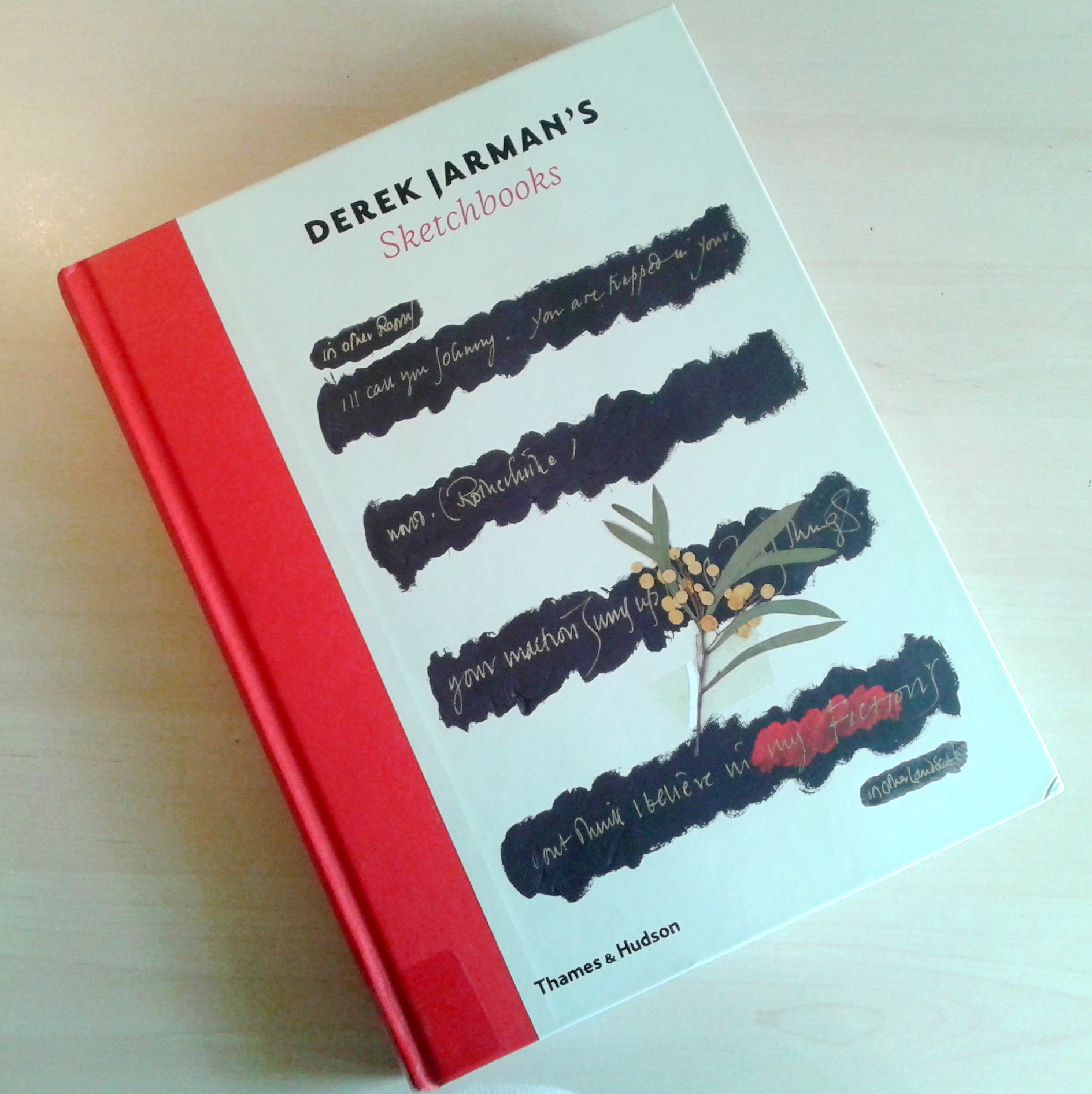
jarman diariesIt’s been a very busy week, and I’ve been diving into all kinds of exciting new and inspirational activities, including the UEA Literary Festival.  I’ve also been submerged in the magical world of Derek Jarman’s Sketchbooks, edited by Stephen Farthing and Ed Webb-Ingall, and I want to share the inspiration I’ve found in them with you.

derek_jarmanIn case you have never heard of Derek Jarman, he was a fabulously talented artist, film-maker, designer, writer, gardener and Gay Rights activist whose career was tragically cut short by AIDS in 1994, aged 52.  He directed music videos for the Pet Shop Boys and designed the sets for Ken Russell’s landmark 1971 film, ‘The Devils’.  At his home in Dungeness, he created one of the most haunting modern gardens in Britain, one that I am deeply in love with.

I first became aware of Jarman when I saw his film, Caravaggio (1986), starring Nigel Terry, Sean Bean, and Tilda Swinton in her first film role.  Later, in 1991, I wept my way through his heart-breaking ‘Edward II’, an adaptation of Marlowe’s play that spoke of Jarman’s outrage at homophobia in Thatcherite Britain.  These are not easy and accessible films.  They are, however, fabulous to look at, and very moving.

When I came across this edition of the sketchbooks in the library the other day, quite by chance, I had no idea that Jarman was a committed visual diarist.  The sketchbooks themselves are large – family photo album sized – and each cover is decorated in black and gold, making a slightly varied but pleasing continuity.  Inside them, Jarman uses ephemera, calligraphy, drawing and painting, poetry, pages of film scripts, actors’ head shots from casting sessions, clippings from newspapers, reviews, photographs of friends and colleagues, bits of feathers and pressed flowers to document his life and each of his projects.  The sketchbooks contain his thoughts on everything from his garden (there is a carefully drawn planting plan), to his illness, to sex, history and death.

Jarman made a series of paintings, the ‘GBH’ series, of black on gold abstracts, inspired by Goya’s Black paintings, and a film called ‘Imagining October’, which arose from finding Sergei Eisenstein’s own copy of ‘Ten Days that Shook the World’, the famous book on the Russian Revolition, and on which Eisenstein had based his ground-breaking film, ‘Battleship Potemkin’.  Jarman had been shocked to discover how much of the book had been redacted with blacked-out text by the Communist authorities.  Both of these concepts are reflected in the sketchbooks, where you can see Jarman working on the idea of black bars with gold writing, seen on the cover of the volume.  Jarman’s anger at the political situation for Gays in the UK shines through these blackened pages.

One of the things that particularly strikes me is the simplicity of the layouts he uses.  Even when he is writing pages of text, making notes or journalling, there is a sense of space.  Nothing is cramped.  He spreads out, not denying himself room to work, enjoying the clarity of white space around his words and images.  This is something I will definitely take away. My diaries always feel cramped.  I always feel that every inch of space must be used, because materials are scarce.  This denial of room to grow is cramping my creativity, something I need to break out of.

I want to draw inspiration from the sheer range of activities Jarman undertook, too.  For him, there is no line in his sketchbooks between diary, writer’s notebook, sketchbook, planner or scrapbook, anymore than there were boundaries between the creative areas he worked in.  Although he was primarily a film-maker, he was so many other things as well.  Jarman teaches me that I don’t just have to stick to writing.  I can follow where ever my Muse leads me.

There are no limits to what we can create, only the ones we impose on ourselves.

Things to try:

  • See if you can get hold of a copy of Jarman’s sketchbooks.  It isn’t cheap – £28 – so maybe you can order it from your library.  You may not like his style of modernist art, but you can appreciate how he puts every aspect of his life into these visual journals to make a record of his thinking.
  • Use your own sketchbook or diary as a kind of studio to record everything you do and think about a particular project.
  • Collect clips, postcards, photos, anything relevant to stick in – Jarman even stuck a ten pound note into his!
  • Luxuriate in space.  Allow each of your drawings, paragraphs, or collaged pieces to bask in a frame of white space, so that they can shine out, and be seen for what they are.  Don’t fall into my scarcity trap – there will always be more paper.
  • Decorate the covers of your sketchbooks or journals in a similar way, as Jarman did, each one slightly different, but using the same colours or materials.  Maybe you could do ‘series’ of notebooks, with matching covers, for different projects.  Don’t be precious about them, however.  Jarman once stuck a heavy bronze seal on the front of one of his books, but it was too heavy to carry and got in the way, so he ended up prizing it off.  The scarred gold cover is even more interesting as a result.

Happy journalling,

EF

Journal Friday: The Emotional Swingometer

go away bagThe Creative Life is a carnival ride.  Don’t let anyone tell you otherwise.

Right now I am on the rollercoaster.

Thank goodness for my diary.  If it were not for that little Moleskine notebook, I would be a complete basketcase.  Actually, I’m probably still a complete basketcase, but I feel better about it, because I write it all down.

The days when I am completely sure I have squeezed every last drop of juice out of Johnlock.

They days when I can’t stop writing Johnlock.

The days when I have so many ideas for stories that I don’t know what to do with them all.

The days when my imagination is a barren wasteland.

The days when one comment has convinced me that my work is utter crap and I owe it to the world to never write again.

The days when a stroppy comment has filled me with so much anger and resentment and martyrdom that I am going to passive-aggressively hold the entire fandom to ransom by never publishing another Johnlock story again because frankly those bitches are all so ungrateful.  (as if they’d even notice.)

The days when that novel I am writing is the greatest thing ever written.

The days when that novel is so bad I am ashamed to even walk into the same room as my laptop.

The days when reviews flood in, and I am Queen of the World and Goddess of All Writing and my ego is the size of Jupiter.

The days when the reviews flood in, and they just aren’t praising me enough, they’ll never say enough good things about me because I am so bloody wonderful, which of course means that secretly I know without doubt that I am an absolute fraud and completely useless.

The days when the reviews flood in, and I am cowering under my desk in shame that anybody could think that story I wrote is readable.

The days when I am satisfied because I have written something that I think is good.  Good in the way that tapping on solid mahogany with your knuckles is good.  Something that is out of my own real, original voice.  Something that I am satisfied with.

The days when the fandom bores me to tears, or irritates the hell out of me, and so does my writing.

The days when I know my writing is completely stagnant, and I need to progress onto the next stage but I don’t know where to start.

And the days when I just sit down and write.

Before, or after I have written some fiction, I take a little time to reflect.  Sometimes I write in my journal to get my juices flowing, the way Morning Pages are supposed to.  Sometimes I write afterwards, to reflect on where I am going, on my emotional equilibrium (or lack of it).

Usually, when I have published a story, I watch the comments coming in, and try to write through my responses, the paranoid ones and the egotistical ones, the happy, the grateful and the furious.

My journal helps me keep my writing experience in perspective.  There isn’t a lot of perspective about our own creativity, lets face it.  We are all reared to be perfectionists, to rule ourselves out in the basis of not being Picasso, or to believe ourselves to be Dickens without needing to do the hard work.  It is so hard to be objective.

My journal helps me remember that the only life I am saving when I write is my own.  In the great scheme of things, this is not battlefield surgery.  Or, if it is, it is on my emotions alone.  That is why objectivity is important.

I need to remember that my writing is not about what other people think.  It’s about me.  At its very core, it is about healing my own wounds. 

Even if I never publish another word, I will still keep writing, partly because it’s a compulsion, and partly because it mends my soul.

That is why keeping a journal is crucial for every creative person, whether you are amateur or professional.  It reminds you of the WHY.

How do you use your journal in your creative process?

Happy journaling,

EF

Embodied Creativity

In my last post, I talked a little about telling details, those tiny things that communicate so much.  Noticing them requires opening the mind.  But there is another rung on the ladder with this:  Opening to the body.

I call this embodied writing.  By this I mean the kind of writing that includes the visceral details of what it is like to inhabit a physical body.  Physical sensation, not just ideas and emotions.

Our bodies are not just the ‘transport’ we inhabit, as dear Sherlock likes to put it.  They interact with the environment in order to gain information about it for survival purposes.  They do this through the medium of the Senses.

  • Touch
  • Taste
  • Sight
  • Smell
  • Hearing

Our eyes, noses, ears, tongues and skins gather data and feed it back to the brain, which sifts it and uses it to build up a picture of the outside world.  This means that our experience of life is formed as much by our body’s external contact as it is by our thoughts and ideas.  As writers particularly, we spend so much time locked inside our heads, submerged in ideas for stories, that we forget we have bodies.  Our bodies get neglected, or worse – sometimes writers abuse their bodies because they actually get in the way of the work by demanding annoying things like food and sleep.  We forget that our bodies are the foundation of our art.

By using the sensations they give us, we can enrich our work exponentially, making it more immediate, tapping into common experience and tissue memory.

Over the next few weeks, I am going to talk about ‘Writing with the Senses’ in an effort to get you and me out of our heads and into our bodies with our writing.  We will be working our way through each of the senses, being mindful of the feedback they give us, using them to ground us in our corporeal selves, and bringing the gorgeous experiences they give us into our creative lives.  I’m doing this myself, because I really need to be present inside my body right now, instead of having my brain flying about sixteen feet from it, attached only by the barest thread of consciousness.  And I thought you might be interested in joining me!

So, in the meantime, do this:

Take a few minutes today, tomorrow, daily if you can.  Just stop.  Take a deep breath and let it out.  Bring your mind inside your body.  What sensations can you feel?  Do you have a pain in your toe, or an itchy insect bite?  Did you eat spinach for tea that left that annoying coating on your teeth?  Is your belt too tight?  There doesn’t have to be any great revelation.  Just notice.

Taking a moment at regular times during the day in order to be present inside your body is an invaluable exercise in grounding yourself and being mindful.  And it is a great prelude to thinking about the Senses.

Happy Creating,

EF

Inspiration Monday: Telling Details

sussex church

The Zen of Details

At the moment, I am fascinated by ‘telling details’.

At our writers’ group last week, my friend read out the first pages of her novel, a description of a little girl watching her mother as she used a sewing machine to make a new dress for her little girl.  It took me right back to my childhood, watching my own mother labour over the sewing machine.

It was the little details that transported me.  The jar of spare buttons which the little girl was allowed to play with.  The thunk of the presser foot being let down onto the fabric.  The smell of sewing machine oil and new cloth, unwashed, still fusty from the haberdashery.

I have re-ignited my enthusiasm for my writer’s notebook with these details.  Using the little components of life.  Scribbling them down when I notice them.

The way the local cockerel sounds like he has a sore throat when he crows.

My husband saying ‘Marriage is about sharing’ when he farts.

The dust that builds up in the corners of the treads on the stairs, and how gritty it is.

Puffs of pollen falling off the sunflowers I have rescued from the storm-lashed garden, falling like yellow flour on the tabletop under the vase, powdering a biro that had been abandoned there.

These are the little glimpses of our everyday life that we mostly ignore, but when someone draws our attention to them in prose or art, they enrich our perception, throng our minds with memories, ground us in the present in a way nothing else can.

At the moment I am working on a series of short fanfics that are grounded in these details.  I am trying to use a single detail to spark each story.  Each story then contributes to a wider portrait of a relationship.  This means collecting details. So here I am with my notebook, going back to the very beginning of my writing career, ‘back to basics’ if you like, collecting scraps for here and there and jotting them down.  I feel like a mosaicist building up a mural made of broken pots.

And it is delicious.

 Creative Exercise:  Lists

Unearth your notebook, if you haven’t been using it much recently.  If you are an artist, grab your sketchbook.  Now open your mind.  Start noticing things.  It takes practise to be sufficiently present in life to recognise the tiny details that contribute to the big picture of shared experience, but once you start, you will find them coming thick and fast.

  • Walk around the house and look at the piles of stuff that have built up.  Write down where they are.  Make a list of what is in them.
  • When you visit the bathroom at a friend’s house, look at their lotions and potions.  Make a list to jot down later.  What do the bottles and jars tell you about their life and health?  If you draw, make a sketch of them, or if it’s easier, draw the contents of your own medicine cabinet.
  • Standing in the queue for the checkout, look in other people’s baskets.  What are they buying?  Another list.  What does this say about them?  Can you make a still life that communicates what they are eating, who they are eating it with, and why?

Open your eyes wide.  Your mind is constantly sifting sensory input, picking out things that may or may not be important.  Usually, you toss most of your perceptions aside.  Instead, write down as many as you can.  Use them later in your work.

Happy Creating,

EF

Journal Friday: Wardrobe Planning

More dashBecause I’m ill, I am not able to work, and that means everything I do has to be on a budget – energy-wise and money-wise.  As a result, planning is my friend.  If I have thought about something beforehand, it makes everything so much quicker, easier, and less worrying.  That includes clothes.

I was looking at this fantastic dressing room today, and was shocked that anyone could have that many clothes.  If I did, I’d never get dressed at all because I wouldn’t have the energy to decide what to wear.  I have a small wardrobe, partly on purpose, because cutting down options means less to worry about, but also because of money.  I just can’t afford to spend lots.

Mostly I buy my clothes from my catalogue, on a monthly payment basis, and annually, with my birthday money.  Relatives are kind enough to donate to my clothing fund every year, and I plan very carefully what I am going to spend it on.  I make sure all my big purchases colour co-ordinate, and concentrate on one core colour and two accent colours.

Currently navy is my core, and bright red and bright (lime) green are my accents.  At the moment, though, I am feeling a pull towards charcoal grey, and since I bought a dark grey sweater in the sales a few years ago, I’ve been thinking I might go in that direction a little.  Plus it seems to bring out the colour of my eyes.  (It’s really hard to work out what colours I can wear these days, as I am growing out my coloured hair and letting the grey come through.  I didn’t think this measure, taken because I just can’t be fussed with home dyeing anymore, would make such a big difference to my complexion, but it does.)

grey croppedAnyway, the way my brain is, I can’t keep all this information in my head anymore, so I have started using my journal to plan my outfits.

I have an ulterior motive here too.  I haven’t been able to get past the creative block I have with my art, and I find that if I just do a scribble in my journal, it doesn’t have to perfect.  It is just a gesture drawing with a few colours to note down information in a graphic form, and it cons Nigel into thinking what I am doing is actually not painting at all!  Clever, eh?

black hat litUsing my journal in this way is a helpful planning tool.  It helps me to work out what extras I need in addition to what I already have, and to budget for them.  It also allows me to think through how I really want to look for a particular occasion, such as a wedding.  I am also finding it is changing the way I feel about my clothes.  I’m finally at the age when I can get away with wearing very classic styles, and you can see from my sketches that there is a distinctly ‘50s vibe going on.  I’ve always been in love with Dior’s 1947 New Look, and it looks like that is where I am going.  I’m intend to grow old elegantly as well as disgracefully!

How could you use your journal to plan your life or your look?

Happy journaling,

EF

Smorgesbord

sleep sketchI usually try to post on a Monday, Wednesday and Friday, but this week’s Wednesday post got missed because I was ill.  I’m still ill, but my brain is slightly clearer today and I am giving myself to thinking time.

Thinking about future posts for this blog.  Thinking about writing and notebooking.  Thinking about art.  Thinking about clearing space in my life for more creativity.  Its a luxury I have to lie in bed and consider which direction I am going in creatively, and I recognise that.  Few people get that option.  I may be feeling terrible, but I’m enormously grateful I can use this time to be present with my work.

I thought I’d share a few things I have been mulling over with you.

Here are the thoughts of Elmore Leonard on writing, an enormous inspiration.

Here is Stephen King, saying illuminating things about both ‘The Shining’ and about the attitude of critics, something I really needed to hear this week.

Talking about critics, Jack Vettriano has been savaged by the art establishment over the years, but now he’s having a retrospective at the Kelvingrove.  Oh, the irony!  (And lets just remind ourselves that this man is self-taught, which may be why critics hate him so much.)

If you are interested in art, check out this site.  I love its brightness and enthusiasm.

I want to do this course next.

And to end, a little light reading.  I’m pursuing a new project of short stories and vignettes which explore life inside an established relationship through fanfiction.  The series is called ‘Geography of a Shared Life’.  You can read my latest piece here at A03, and here at FF.net.

Happy creating,

EF

Do you have a Creative Vision?

This man has a vision (click on the link below and watch the film clip):

Portraits of St Davids residents

He knows what his project is.  He knows what he is after.  He is going for it.  The breadth of his vision, as well as the beauty of it, and of his work, is dazzling.

I’ve been thinking a lot about Vision over recent days.  Wondering what I am really after, what I am trying to achieve.  I can’t just be driven by fear anymore.

My fear is that I will die without getting all these pictures out of my head and into the world so that other people can enjoy them as much as I do.  I find the inside of my imagination highly entertaining, and I want to share it.  Does that sound vain?  I don’t know.  All I know is that I feel compelled to transmit the pictures in my head.

I watched the film, ‘The Reader’ the other night, based on the magnificent book by Bernhard Schlink.  It was wonderful.  It stirred up so many complicated and conflicting feelings inside me.  It is a true tragedy in the Greek style, a man forced to face the truth about the love of his life, and her part in unspeakable acts.  So much love.  So much horror.  This story is designed to spur debate about the morality of our actions, about good and evil, about the excuses people give, about love and literature and illiteracy and shame.  You could call it a romance, but thats only a tiny part of the story.  Schlink’s genius is to use romance as the vehicle to consider more difficult moral problems.

After the film had ended, I was getting ready for bed, cleaning my teeth and staring into the mirror, as I mulled over the storm of feelings going on under my ribs.  And I realised something.

This is exactly what I want my readers to feel when they finish reading one of my stories.

Complicated emotions.  The vast, unquenchable yearning of love.  The conflict of being caught in morally complex situations.  The struggle for answers.  And that iresistable siren call of need that drives us towards one another, even when we understand that pain can be the only result.

Is this too big a vision for someone of my talents?  I’m not saying I want to be Dickens, after all.  I guess I am aiming higher than that, in a way.  These issues seem to me to be at the core of our existence as emotional beings.  We struggle with them, just as we struggle with the philosopical questions of why we are here, and whether there is a God.  This is what I want to examine with my writing.

So its more than just getting the pictures out of my head and onto the page.  It is observing the emotions that make us love, too.  Call me a hopeless romantic, but that is what I am interested in, and I think I always have been.  I just never really thought consciously about it before.

I know what I’m trying to achieve now.  The thought has given me purpose.  All I have to do is go out and do it.

Do you have a vision for your creative work?  Maybe its worth thinking about.

Happy Creating,

EF

The Wild Donkeys: A Strategy for Choosing a Creative Project

donkey

‘So, how’s the writing going?’

This from a man who is one of the Blessed Few.  A writer whose work was picked up by an agent straight from the much garlanded MA in Creative Writing at the Unversity of East Anglia.  Alumni include Ian McEwan, Rose Tremain, Hanif Kureshi, Tracey Chevalier and, well, you get the picture.  He is in glittering company.

He is also a really lovely man and a dear friend who takes a genuine interest in my work, so I rein in the envy monster and give him the polite and honest answer.

‘Fine.  Well, actually, I’m a bit stuck.’

‘Creative block?’

‘No, too many ideas.  I don’t know where to start.’

‘You should be writing a novel, you know.  I read some of your Sherlock stuff the other day.  It’s really good.’

‘Thank you.  I’ve written seven novels so far.  Writing a novel isn’t the hard part.  Its choosing which one to write that’s difficult.’

‘Well, just pick one and start.’

I love men.  Everything seems so easy to them.  And they are so good at handing out really practical advice.  (You’ll also notice that I don’t ask him how his novel is going.  That’s because I know.  I recognise that pained look.  I’ve seen it in the mirror too many times.)

OK, I know its good advice.  The right advice.

As Leonie Dawson puts it, I need to choose a wild donkey and ride the shit out of it till its done.

Every writer has a place where they habitually get stuck.  A psychological Marianas Trench on the road to getting their work into the readers’ hands, one that they tumble into every time.  For some it is grinding the words out, which for them is like sweating blood.  For others, it is coming up with the idea in the first place.  Some worry when they get to the middle because that’s always where they get bogged down, and some will spend ten years writing the first page.  We all have our Achilles’ heel.

For me, its choosing which idea to stick with.

So I have decided to take September off.  Not from writing; quite the opposite, in fact.  No, I’m taking the month off from worrying which novel to concentrate on.  I’m in a physically stuck place right now, and I need to concentrate on my health, on getting my body moving again after a summer of boom and bust energy.  I’m looking to create a smooth, even flow in my life, in my health, and my art.  I have faith that if I can manage to attain a relative level of consistency in my body, the answer will come to me.  Yes, maybe that sounds mad, but its just how my creative process works.

And in the meantime, I’m refreshing my theory knowledge, reading, working on my notebooking, and bashing out some major fanfiction.  I’m easily distracted, and having short stories and novellas on the go is a great way to handle that.  But sooner or later, I want to create something major.  Something big.  Something that shows both me and you, dear Reader, what I can really do.

Happy creating,

EF

On Process: Too Many Ideas, Too Little Time

Usually creative people complain about creative block.  I don’t.  For the most part, I have the opposite problem.  Too many ideas.  Not enough time to execute them.  I have this constant fear that I shall die suddenly without sharing all the pictures in my head.  That would be a great incentive to work if it weren’t for the fact that my poor health is a huge brake on my capacity to work.

And then there is the fact that I have the mind of a butterfly.

The Buddhist masters often refer to the concept of ‘Monkey Mind’.  This is what your mind does when you try to meditate, and your thoughts bounce around like gibbons, and feel impossible to control.

Welcome to my world.

Actually, that is not entirely true.  I can be deeply committed to one idea for a short period of time.  The most I can normally manage is about three months.  Then I bounce off to find another sparkly thing.  Most of the time, I come back.  Occasionally, I manage to actually finish something.  Occasionally it gets shelved for good, or the idea gets incorporated into something new, because its too good to waste.

I’ve been socialising a lot this summer, and people have repeatedly asked me the same questions:

‘How’s the writing going?  What are you working on at the moment?’

Below is the honest answer (i.e. the one I don’t give nice people at parties because its too complicated to explain, especially if they’ve never met me before.)

The things I am currently working on:

  • A series of short stories about John and Sherlock in a stable relationship
  • Finishing a work about Sherlock’s pursuit of public sexual humiliation because of his guilt about his faked suicide.
  • A novella about a Viking Princess
  • My novel about Victorian sexuality, currently titled ‘The Butler Did It’ (Please could somebody suggest a better title, I’m getting desperate!)
  • My journaling ebook

Other ideas I have churning about in my head include:

  •  A possible novella about a young man getting over the death of his male lover in a road accident
  • A short story based on a line from a deliciously naughty Johnlock fanfic I read the other day, The Red Box by Cleo2012
  • The third Evenlode novel (vampire gangsters ahoy!)
  • A Loki fanfic set after the end of Thor 1

(And this is before I have even begun to tell you about the paintings I want to make…)

I was explaining this smorgasbord to a friend, and she said ‘How on earth do you handle all that?’

The answer is, ‘I have no idea.’

I suppose I have a good memory, but the older I get, the more I am going to need to employ my writing notebooks to record all this.  The truth is that ideas are far easier to come by for me than the wherewithal to execute them.  And there just isn’t enough time in my day to get all this done, and execute my duties as wife, friend, aunt, guidemother, part-time carer to elderly, sick in-laws etc etc. and still protect my health.

Triage is necessary.

I just have to grab one sparkly thing and run with it for as long as I can.  I have to choose the most important thing to me at the time.

Most creative people complain about creative block, but the other side of the coin is equally disabling, and I know for a fact I am not the only one who experiences this problem.  Choosing which is the best idea to work on.

If you have any ideas on how best to deal with idea overspill, please let me know in the Replies section.  I’d love to know what you do.

Happy Creating,

EF