Category Archives: Inspiration

Inspiration Monday: Observing Roles

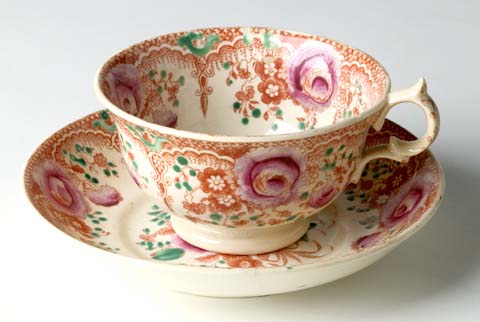
Captain Cook's teacup

Captain Cook’s Teacup

A few days staying with my mother require me to be paraded around the village, being shown off to friends.

I am taken to her oldest friends first:  Husband was close to my father, Wife is my mother’s best friend, and something of a surrogate mother to me.  They are Scottish, loving, hospitable.

My mother sits primly on the sofa while the tea set is laid out, her little legs crossed at the ankles, not quite touching the floor.  We are having the best china, and a freshly baked Victoria Sandwich cake, set on a glass cake stand and dusted with icing sugar.  This is a proper English afternoon tea.

I notice how polite my mother is being.  The way she holds the fork as she eats her cake so delicately.  The way she plucks at her napkin.  The way she stirs her tea with her teaspoon, holding the end like a pen, making the prescribed figure of eight with the bowl, just so.  I notice the way she nods, agrees, doesn’t initiate conversation.  I realise she is being a Good Girl.  Just as her own mother taught her, back before the War, she is behaving politely in order to be accepted.

Our hosts are playing roles too.  She is the Hospitable Hostess, asking kind questions, offering more cake.  Her husband is sitting enthroned in his armchair, interjecting occasionally with amusing quips or information, partly the Wise Sage, and partly the Jester – he always played the Jester to my father’s Straight Man when I was a child.

Then their middle daughter arrives, a beautiful woman a little older than I am, with a grown-up family and a business of her own.  As soon as she walks into the house, though, she adopts the role of Mischievous Daughter, stealing a donut from the kitchen, helping herself to a cup of tea (without a saucer), lounging in an armchair and making us all laugh.

I glance at my mother.  She is laughing politely.  Still being the Good Girl.

And me?  Well, I am the Entertainment.  Which is another way of saying that I am being the Good Girl too.  Pleasing my mother by being polite and charming her friends.  Being a credit to her.  Displaying the manners she taught me.  Sitting up straight, holding my teacup correctly, watching my language, and wishing profoundly that I could play the Mischievous Daughter too, which would be a lot more fun, and more like who I really am.

We all play social roles, in company, with family, with friends, with strangers, colleagues or acquaintances.  Our roles change according to those we are with, and to circumstance.  Sometimes we even change roles within a single situation.  This is not necessarily being inauthentic, or even manipulative.  It is the way human beings function socially together, as all animals who live in groups do.  It began as a means of survival, but today has become a complicated social pas de deux.

And why am I talking about it?  Well, because if we play roles, what about the characters we write?  You may know who your protagonist is, you may have written his back story in detail, and know how he might respond in a given situation, but have you thought about the roles he might play?  Does he play roles to fit in, or does he reject them?  Or does he continually play different roles to get what he wants, to manipulate others?  And if he does the latter, how are you, the writer, going to keep track of who he is underneath those roles?

Writing Exercise

Begin to observe social encounters going on around you as dispassionately as you can.  Can you see what social roles are being played?  Who is being submissive, funny, polite, in order to win friends?  Who is refusing the engage with the social dance?  Who is asserting their dominance as Alpha Male or Female?  Who is the real person under the role?  What are their motivations for choosing the role they do?

Remember to observe without judgement.  This is not about values.  This is about behaviour.

Spend some time writing down the roles you observe, and reflecting on them, in your writers notebook.  Think especially about what lies underneath the role, what event might cause a person to adopt one role rather than another.

Write a scene about some characters you are currently working with.  What roles could be played here?  What non-verbal behaviour communicates that role – or betrays what is going on underneath?  See if you can write your characters functioning at two levels, the role they play, and the real person behind the role.  Explore this difficulty where you can to make your characters more three dimensional.

Meanwhile, I am going back to contemplating the idea that my mother, my dominant, matriarchal mother, could actually play the Good Girl, because its not an idea I have ever entertained before, and its going to take a while to get my head around it!

Happy Writing,

EF

For Creativity, Press The ‘OFF’ Button Now

This morning, my part of the UK was hit by the worst Atlantic storm in some years.  Trees came down, houses flooded, power cables snapped, cars were crushed, trains and planes came to a standstill, and double decker buses were lifted off their wheels.  It was not nice.  Its over now, blazing across the county in under three hours, leaving a trail of destruction in its wake.

Which got me thinking, you will not be surprised to hear.

Husband and I spent most of yesterday glued to various forms of news media, trying to gauge the progress and destructive force of Storm St Jude, working out which hatches to batten down, what damage might ensue, and whether, in Husband’s case, it was sensible to cancel his 9am lecture this morning. (He did, and I think it was the right decision).  The upshot of all this digital frenzy was that I didn’t get anything much done.  Which was an annoying waste of a whole day.  And made me think about something I had read a few days earlier:

I came across the work of Linda Stone, and in particular, her term ‘Continuous Partial Attention’, which is when we multitask cognitive functions such as talking with a friend at coffee whilst checking our email on our android under the table, surfing the internet when we are on the phone, and all those other digital things we do these days that we never used to.  Linda Stone says:

“Continuous Partial Attention involves an artificial sense of constant crisis, of living in a 24/7, always-on world.  It contributes to feeling stressed, overwhelmed, overstimulated and unfulfilled; It compromises our ability to reflect, to make decisions and to think creatively.”

Lindastone.net/qa/continuous-partial-attention quoted in Sharon Salzberg, The Power of Meditation: A 28-Day Programme for Real Happiness, Hay House 2011.

It compromises our ability … to think creatively.

Just think about that for a minute.  I did.

I thought about how long I spend on Facebook every day, how many hours I lose cruising Tumblr and reading fanfics, checking my phone, watching BBC News 24.  These are what Jennifer Louden calls Time Monsters, habits you fall into that eat up the spare time you have and leave you feeling rushed and stressed out because you aren’t left with enough time to do the things you really want or need to do.  I have been known to lose whole weeks to my Time Monsters.  Yesterday, thanks to Storm St Jude, I lost an entire day.

I’m 46!  I don’t want to waste any more time!

Increasingly, I am finding that it is a luxury to switch off my phone and not look at my laptop.  I don’t want it to feel like a luxury to disconnect.  I want it to be the constructive core of my working life as a writer.  I don’t want to have to employ some kind of app to shut me out of the internet in order to finish a story, just because I can’t resist looking at yet another iteration of the same picture of Benedict Cumberbatch.

I want the sense of calm that comes with not knowing what is happening in the outside world.  The same calm I felt lying in bed this morning, listening to the wind riffling the roof tiles, blissfully ignorant of what speed it was going or when the next pulse of the storm was going to hit, courtesy of the Met Office website.

The question is, can I do this?  I caught myself the other day thinking that I couldn’t write down a snatch of dialogue I had going around my head because I didn’t have my laptop open.  As if a pen and paper weren’t good enough.

To be creative, in whatever art form you choose, from cookery and sewing singing, tango, writing or painting, you need time and space.  You need to reflect.  Being connected doesn’t give you that space.

For our own creative self-care, we need to make time to switch off.

I don’t want the stress of Continuous Partial Attention to wreck my creativity through anxiety, perceived comparison or peer pressure, or just from lack of time to create.  I want to make space.  Space to think more, reflect more, make more.

You can too.

Creativity Exercises

1. How do you use your time?  What are your chief Time Monsters?  What are the digital munchers in your life?

2. Once you have identified your Time Monsters, you can decide whether you want to continue feeding them, or jettison them to make room to do the things that really make you happy, instead of just keeping boredom and despair at bay.  Its nice to keep a few on standby, for days when you really are frazzled and just need to stare at the telly and not think, but that shouldn’t have to be every night.  If it is, maybe you need a major rethink.

3.  Consciously switch off.  Turn off the telly, your phone, your lappy.  Sit in an armchair and read a book, bake a cake, go for a walk, paint or garden or see friends.  Do something that involves experiencing the world directly, not digitally.   Use your time to think and create.

4.  Do one thing at a time.  Don’t surf on your phone when you are out with your pals, that’s rude.  Don’t have the telly on when you are painting (a bit of inspiring music might help, but nothing you have to think about.)  When you have a conversation with your mum on the phone, concentrate on her, don’t keep one eye on the news.  If something is worth doing, its worth giving your whole attention to.

I’m not advocating digital purdah, believe me.  The digital world has its place, but it is down to us to keep it in it.  I’m just saying we need to use our time more mindfully.  Which is what, from now on, I am going to try and do.

Happy Creating,

EF

Preparing for a Writing Retreat

I’m so excited.  I’m going on a writing retreat!

This weekend, my writers group is convening at a nearby conference centre for a weekend of writing and eating and talking about writing and eating some more, and maybe a little bit of dozing or walking, and then some more writing.

We normally do this once a year, but this year, we enjoyed ourselves so much we thought we’d do it again at the end of the year.  So here I am, thinking about a weekend spent solely with my friends and the Work.

Over years of doing this, I’ve found I need to do a few things to prepare myself so that I get the most out of the time:

Plan:

I usually like to sit down with my writers notebook or my journal, and think about two things:

  • where I am, and
  • where I want to be.

This year I am thinking about the goals or intentions I have set myself for this website, for my publications, and for moving my writing on to the next level.  Its one of the few truly extended, uninterrupted periods I get to just write, so I like to choose a project that I can get my teeth into, but also one that really needs to be tackled.   Something pressing.

This year, I am toying with the idea of doing NaNoWriMo, because I want to crank out a novel as fast as possible.  So I have decided to lay the groundwork on this new idea, and throw myself into it, immerse myself in it as much as I can.  In previous years, I have redrafted novels or short stories, polished specific sections of a novel, worked specifically on character, or redrawn a dodgey plot.

My goal this year is especially fuelled with the knowledge that I need to be writing something original, something other than fanfiction.  Nothing wrong with fanfiction.  Its given me marvellous confidence in my work, and I love writing it.  I just think I need push myself, to do something new.

Manage expectations: 

I’m not going to finish an entire novel in a weekend.  I may even get no further than writing 500 words.  And I am okay with that.

When I first started going on retreats, I had HUGE expectations of myself and what I could achieve.  I thought I could crank out 20,000 words in two days, a third of a novel.  I thought I could create publisher-ready prose.  The truth is that even on retreat, there is only a limited amount of time, and making really good prose takes time.  A lot of time.  I have only learnt this with experience.

There have been several retreats where I have slept badly on the first night, or felt ill, and as a result have really been unable to do anything much at all apart from eat, sleep, talk with my fellow writers, and be.  Sometimes that is what a retreat is for.  I have gained from those experiences.  These days I am ready to allow my retreat to be whatever it needs to be, and to trust that whatever happens is part of the process.

So I make plans, but I don’t get too attached to them.

Be present:

Being aware of my physical wellbeing is very important on retreat, and not simply because I suffer from chronic illness.  I need to be present in my body, so I do yoga and meditate, go for walks, stand in the shower and feel the water on my skin, and take naps.  (One friend uses the annual retreat to undulge in long, hot, scented baths because she doesn’t have a tub at home!)  This might all seem time away from writing, but it is crucial.  Self care is part of retreating.  Doing these things allows me time to think about the writing, to form scenes and sentences in my head.  But it also allows me to come to the laptop refreshed afterwards.  So it is an investment in my writing, as well as my body.

Packing: 

As a result, packing right is really important.  I always make sure I take warm, snuggly clothes, my yoga mat and yoga clothes, a hot water bottle, walking boots and, on occasion, even a teddy bear for cuddling purposes.  And because I have weird dietary issues, I make sure I take an extra supply of good, healthy foods and my favourite herbal teas too.  The centre staff are really great in catering for my diet, but there are those in-between-meals moments, when what you really need to fuel the Muse is your own favourite brand of chocolate!

Be absent: 

I get very anxious when I am away from home.  I need to be grounded in my safe environment in order for my imagination to work properly.  It helps that we have been going on retreat to the same place for years, and also that it really isn’t very far from my own home, so I feel like I am on home turf.  Other people find their imagination is stimulated by unfamiliar territory.  Mine just shuts down so that my emotional system can cope with the panic attacks.

To counter this, I take music and listen to it doggedly in order to transport me to safe psychic territory.  I put on my headphones, close my eyes and fly away.  And then I can write.

It is a major diffence to how I normally write, which is in silence.  So part of my preparation ritual is to gather music around me.  I make playlists for different characters, delve into iTunes and my CD collection,  choose music that evokes particular memories or landscapes for me, or none at all.

Allow it: 

Going on retreat is supposed to be calming, an activity to feed your soul.  Its supposed to be downtime from your usual life.  As a result it is easy to get really wound up about how good it is going to be, and then find yourself disappointed.  To feel like you just aren’t calm enough, or getting enough done, or maybe even that you are wasting time that should be spent looking after the kids, doing the washing or writing that sales report.  This harks back to managing expectations.  But it also has a deeper meaning.

you are allowed to have time to yourself

You aren’t being selfish.  Leave all your SHOULDS and OUGHTS at home.  You deserve to have this time spent solely with yourself, doing something you love.  I continue to struggle with this.  I tend to make retreat a time which is about productivity rather than identity – about being myself and giving myself what I need.  When you accept retreat as a gift to yourself, managing expectations becomes easier.  And that precious dimension of writing that no one seems to talk about – moodling – becomes possible.  Have a weekend’s moodle.  Because you are worth it.

I heartily recommend going on a retreat if you can manage it.  Maybe for a day, or even overnight.  Maybe just for an afternoon.  If you are looking for ideas and guidance, I also recommend Judy Reeves’ wonderful ‘A Writers Retreat Kit:  A Guide for Creative Exploration and Personal Expression’, which I ordered recently from Amazon in preparation for this weekend.

Now I had better get back to my packing!

Happy writing (and moodling)

EF

Writing the Senses: Smell

nose by bex

Nose (self portrait) watercolour and pencil

I spoke before about what I call Embodied Writing.  I don’t think you have writing that is truly immediate and visceral without grounding it in the physical.  Using your senses is one way to do this.

I looked up the sense of smell, and was blinded by a great deal of science on the olifactory system.  A couple of little morsels I did manage to glean included:

  • Women have a stronger sense of smell than men, and their sense of smell is most powerful during ovulation.
  • The senses of smell and taste are related, and both depend on responding to volatile chemicals in the atmosphere.  Which is presumably why I sometimes feel like I can ‘taste’ a smell.
  • In the human brain, the temporal lobes, which deal with cognition and memory, and the olifactory bulbs, which handle the perception of smell, are very closely linked.  Scientists have speculated that this is what gave Homo Sapiens the evolutionary advantage over their rivals.  It also means that smell and memory are closely linked, which is why certain smells can take you back to breath-takingly vivid memories of the past.
  • You sense of smell starts deteriorating in your teens, but that said, some pensioners have a better sense of smell than the average twenty-something.  Like taste, though, smell is likely to be something you will lose as you get older.

Smell helps us identify the ripe and healthy food from the rotten.  It helps us select a mate, and stay safe from dangers such as fires and wild animals.  Smells connect us with our past, with positive and negative memories.

Nurses in front line dressing stations in the First World War reported vivid memories of the odors of rotting flesh amongst the casualties; and we all remember that quote from the film ‘Apocalypse Now’ about ‘the smell of napalm in the morning’.

For many of us, the scents of cinnamon and nutmeg instantly transport us to Christmas, and the smell of a favoured sun tan lotion can have us basking on a tropical beach even if we are actually sitting in a park in Barking.  Watching cookery programmes is often so frustrating for this reason too – why doesn’t someone invent ‘Smellivision’?  And if you have ever walked into a supermarket and found yourself drawn to the Bakery, even though you only came in for loo roll, don’t be fooled.  Marketing specialists know how seductive that delicious scent is, so they pump the scent of baking bread through the air conditioning system to coax your brain into feeling hungry – and thus buying more.

Smells are hugely evocative, from the smell of poster paint on our first day at school to the aroma of wet earth after a summer storm, and that is why they are so important in writing.

Writing Exercises:

  • Take out your writing notebook and note down some of your favourite smells.  What are the scents that are the most evocative for you?  Make a list, then choose one and write down the memory that is associated with it, or why you chose it.  Take the time to write in as much detail as you can.  Think up as many adjectives, as many ways of describing the smell as you can.
  • Over the next few days and weeks, make a point of thinking more about your sense of smell, and the smells around you.  If you are like me, and not a perfume wearer, or someone particularly aware of smells, you may have to work at this.  Try to keep it in mind.  Every day, try to pick a particular smell and write about it in your notebook, describing it as much detail as you can, and making connections with its context, or what memories it evokes for you.
  • Take yourself on a ‘Smell Safari’.  Visit a florist’s and smell the flowers.  Hang out at the bakers or in a shop that sells spices.  Health Food shops and New Age shops often have interesting scents.  Walk around the park, or in the country, smelling nice things and the nasty ones. (Don’t get too close to the nasty ones, though, for health reasons!)  Don’t forget to take your notebook and make copious notes.  Don’t limit yourself to nice perfume stores, though they can be interesting in themselves.  There are millions of smells out there to sample, and very few of them are manufactured.
  • Write a few character sketches of people you know, describing them solely by their smells.  What about the characters in the stories you are writing at the moment – what would they smell like?  What smells would they like, and why?
  • Find out more about your sense of smell and how it works.  Maybe you can work out the science better than I have.  Then, test it out.  What smells excite you, what smells depress you?  Do some smells make you fearful?  How do you react emotionally to individual scents?
  • Read Patrick Sűskind’s splendiferous masterpiece, ‘Perfume:  The Story of a Murderer’.  A whole book written about the sense of smell?  Yes, it’s incredible.  You won’t believe your eyes.  Or possibly your nose.
  • Imagine a familiar smell.  Now take out your notebook and write about a context or scene in which that familiar, comforting scent becomes sinister, even terrifying.  Now try it the other way around.

Once you have built up this memory bank of information about smell, think about how you can incorporate it into your writing.  How can you use it to describe your characters, what telling details of scent will be enough to show your reader a person’s nature?

Happy Sniffing,

EF

Journal Friday: Derek Jarman’s Sketchbooks

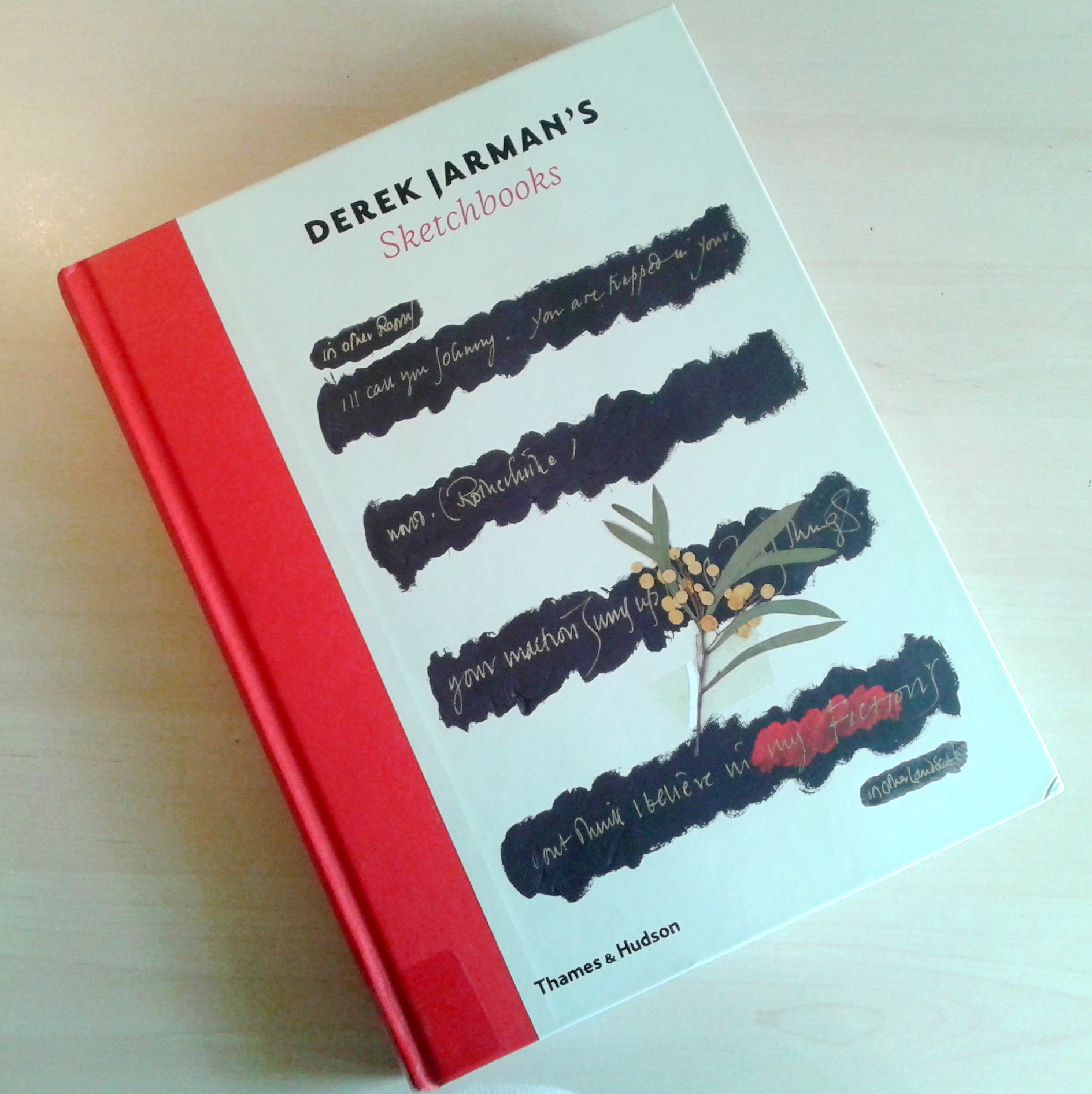
jarman diariesIt’s been a very busy week, and I’ve been diving into all kinds of exciting new and inspirational activities, including the UEA Literary Festival.  I’ve also been submerged in the magical world of Derek Jarman’s Sketchbooks, edited by Stephen Farthing and Ed Webb-Ingall, and I want to share the inspiration I’ve found in them with you.

derek_jarmanIn case you have never heard of Derek Jarman, he was a fabulously talented artist, film-maker, designer, writer, gardener and Gay Rights activist whose career was tragically cut short by AIDS in 1994, aged 52.  He directed music videos for the Pet Shop Boys and designed the sets for Ken Russell’s landmark 1971 film, ‘The Devils’.  At his home in Dungeness, he created one of the most haunting modern gardens in Britain, one that I am deeply in love with.

I first became aware of Jarman when I saw his film, Caravaggio (1986), starring Nigel Terry, Sean Bean, and Tilda Swinton in her first film role.  Later, in 1991, I wept my way through his heart-breaking ‘Edward II’, an adaptation of Marlowe’s play that spoke of Jarman’s outrage at homophobia in Thatcherite Britain.  These are not easy and accessible films.  They are, however, fabulous to look at, and very moving.

When I came across this edition of the sketchbooks in the library the other day, quite by chance, I had no idea that Jarman was a committed visual diarist.  The sketchbooks themselves are large – family photo album sized – and each cover is decorated in black and gold, making a slightly varied but pleasing continuity.  Inside them, Jarman uses ephemera, calligraphy, drawing and painting, poetry, pages of film scripts, actors’ head shots from casting sessions, clippings from newspapers, reviews, photographs of friends and colleagues, bits of feathers and pressed flowers to document his life and each of his projects.  The sketchbooks contain his thoughts on everything from his garden (there is a carefully drawn planting plan), to his illness, to sex, history and death.

Jarman made a series of paintings, the ‘GBH’ series, of black on gold abstracts, inspired by Goya’s Black paintings, and a film called ‘Imagining October’, which arose from finding Sergei Eisenstein’s own copy of ‘Ten Days that Shook the World’, the famous book on the Russian Revolition, and on which Eisenstein had based his ground-breaking film, ‘Battleship Potemkin’.  Jarman had been shocked to discover how much of the book had been redacted with blacked-out text by the Communist authorities.  Both of these concepts are reflected in the sketchbooks, where you can see Jarman working on the idea of black bars with gold writing, seen on the cover of the volume.  Jarman’s anger at the political situation for Gays in the UK shines through these blackened pages.

One of the things that particularly strikes me is the simplicity of the layouts he uses.  Even when he is writing pages of text, making notes or journalling, there is a sense of space.  Nothing is cramped.  He spreads out, not denying himself room to work, enjoying the clarity of white space around his words and images.  This is something I will definitely take away. My diaries always feel cramped.  I always feel that every inch of space must be used, because materials are scarce.  This denial of room to grow is cramping my creativity, something I need to break out of.

I want to draw inspiration from the sheer range of activities Jarman undertook, too.  For him, there is no line in his sketchbooks between diary, writer’s notebook, sketchbook, planner or scrapbook, anymore than there were boundaries between the creative areas he worked in.  Although he was primarily a film-maker, he was so many other things as well.  Jarman teaches me that I don’t just have to stick to writing.  I can follow where ever my Muse leads me.

There are no limits to what we can create, only the ones we impose on ourselves.

Things to try:

  • See if you can get hold of a copy of Jarman’s sketchbooks.  It isn’t cheap – £28 – so maybe you can order it from your library.  You may not like his style of modernist art, but you can appreciate how he puts every aspect of his life into these visual journals to make a record of his thinking.
  • Use your own sketchbook or diary as a kind of studio to record everything you do and think about a particular project.
  • Collect clips, postcards, photos, anything relevant to stick in – Jarman even stuck a ten pound note into his!
  • Luxuriate in space.  Allow each of your drawings, paragraphs, or collaged pieces to bask in a frame of white space, so that they can shine out, and be seen for what they are.  Don’t fall into my scarcity trap – there will always be more paper.
  • Decorate the covers of your sketchbooks or journals in a similar way, as Jarman did, each one slightly different, but using the same colours or materials.  Maybe you could do ‘series’ of notebooks, with matching covers, for different projects.  Don’t be precious about them, however.  Jarman once stuck a heavy bronze seal on the front of one of his books, but it was too heavy to carry and got in the way, so he ended up prizing it off.  The scarred gold cover is even more interesting as a result.

Happy journalling,

EF

Inspiration Monday: Telling Details

sussex church

The Zen of Details

At the moment, I am fascinated by ‘telling details’.

At our writers’ group last week, my friend read out the first pages of her novel, a description of a little girl watching her mother as she used a sewing machine to make a new dress for her little girl.  It took me right back to my childhood, watching my own mother labour over the sewing machine.

It was the little details that transported me.  The jar of spare buttons which the little girl was allowed to play with.  The thunk of the presser foot being let down onto the fabric.  The smell of sewing machine oil and new cloth, unwashed, still fusty from the haberdashery.

I have re-ignited my enthusiasm for my writer’s notebook with these details.  Using the little components of life.  Scribbling them down when I notice them.

The way the local cockerel sounds like he has a sore throat when he crows.

My husband saying ‘Marriage is about sharing’ when he farts.

The dust that builds up in the corners of the treads on the stairs, and how gritty it is.

Puffs of pollen falling off the sunflowers I have rescued from the storm-lashed garden, falling like yellow flour on the tabletop under the vase, powdering a biro that had been abandoned there.

These are the little glimpses of our everyday life that we mostly ignore, but when someone draws our attention to them in prose or art, they enrich our perception, throng our minds with memories, ground us in the present in a way nothing else can.

At the moment I am working on a series of short fanfics that are grounded in these details.  I am trying to use a single detail to spark each story.  Each story then contributes to a wider portrait of a relationship.  This means collecting details. So here I am with my notebook, going back to the very beginning of my writing career, ‘back to basics’ if you like, collecting scraps for here and there and jotting them down.  I feel like a mosaicist building up a mural made of broken pots.

And it is delicious.

 Creative Exercise:  Lists

Unearth your notebook, if you haven’t been using it much recently.  If you are an artist, grab your sketchbook.  Now open your mind.  Start noticing things.  It takes practise to be sufficiently present in life to recognise the tiny details that contribute to the big picture of shared experience, but once you start, you will find them coming thick and fast.

  • Walk around the house and look at the piles of stuff that have built up.  Write down where they are.  Make a list of what is in them.
  • When you visit the bathroom at a friend’s house, look at their lotions and potions.  Make a list to jot down later.  What do the bottles and jars tell you about their life and health?  If you draw, make a sketch of them, or if it’s easier, draw the contents of your own medicine cabinet.
  • Standing in the queue for the checkout, look in other people’s baskets.  What are they buying?  Another list.  What does this say about them?  Can you make a still life that communicates what they are eating, who they are eating it with, and why?

Open your eyes wide.  Your mind is constantly sifting sensory input, picking out things that may or may not be important.  Usually, you toss most of your perceptions aside.  Instead, write down as many as you can.  Use them later in your work.

Happy Creating,

EF

Smorgesbord

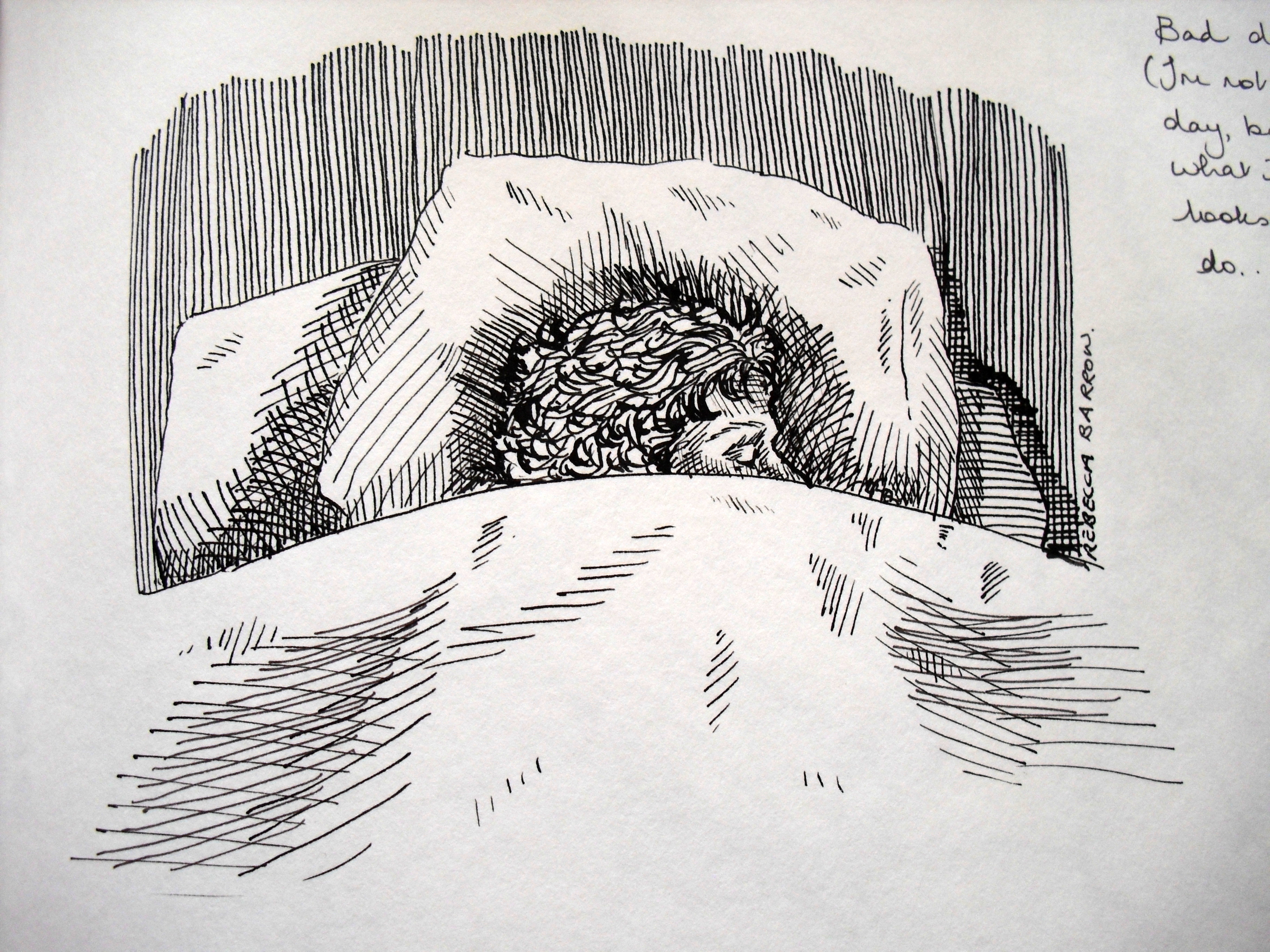
sleep sketchI usually try to post on a Monday, Wednesday and Friday, but this week’s Wednesday post got missed because I was ill.  I’m still ill, but my brain is slightly clearer today and I am giving myself to thinking time.

Thinking about future posts for this blog.  Thinking about writing and notebooking.  Thinking about art.  Thinking about clearing space in my life for more creativity.  Its a luxury I have to lie in bed and consider which direction I am going in creatively, and I recognise that.  Few people get that option.  I may be feeling terrible, but I’m enormously grateful I can use this time to be present with my work.

I thought I’d share a few things I have been mulling over with you.

Here are the thoughts of Elmore Leonard on writing, an enormous inspiration.

Here is Stephen King, saying illuminating things about both ‘The Shining’ and about the attitude of critics, something I really needed to hear this week.

Talking about critics, Jack Vettriano has been savaged by the art establishment over the years, but now he’s having a retrospective at the Kelvingrove.  Oh, the irony!  (And lets just remind ourselves that this man is self-taught, which may be why critics hate him so much.)

If you are interested in art, check out this site.  I love its brightness and enthusiasm.

I want to do this course next.

And to end, a little light reading.  I’m pursuing a new project of short stories and vignettes which explore life inside an established relationship through fanfiction.  The series is called ‘Geography of a Shared Life’.  You can read my latest piece here at A03, and here at FF.net.

Happy creating,

EF

Do you have a Creative Vision?

This man has a vision (click on the link below and watch the film clip):

Portraits of St Davids residents

He knows what his project is.  He knows what he is after.  He is going for it.  The breadth of his vision, as well as the beauty of it, and of his work, is dazzling.

I’ve been thinking a lot about Vision over recent days.  Wondering what I am really after, what I am trying to achieve.  I can’t just be driven by fear anymore.

My fear is that I will die without getting all these pictures out of my head and into the world so that other people can enjoy them as much as I do.  I find the inside of my imagination highly entertaining, and I want to share it.  Does that sound vain?  I don’t know.  All I know is that I feel compelled to transmit the pictures in my head.

I watched the film, ‘The Reader’ the other night, based on the magnificent book by Bernhard Schlink.  It was wonderful.  It stirred up so many complicated and conflicting feelings inside me.  It is a true tragedy in the Greek style, a man forced to face the truth about the love of his life, and her part in unspeakable acts.  So much love.  So much horror.  This story is designed to spur debate about the morality of our actions, about good and evil, about the excuses people give, about love and literature and illiteracy and shame.  You could call it a romance, but thats only a tiny part of the story.  Schlink’s genius is to use romance as the vehicle to consider more difficult moral problems.

After the film had ended, I was getting ready for bed, cleaning my teeth and staring into the mirror, as I mulled over the storm of feelings going on under my ribs.  And I realised something.

This is exactly what I want my readers to feel when they finish reading one of my stories.

Complicated emotions.  The vast, unquenchable yearning of love.  The conflict of being caught in morally complex situations.  The struggle for answers.  And that iresistable siren call of need that drives us towards one another, even when we understand that pain can be the only result.

Is this too big a vision for someone of my talents?  I’m not saying I want to be Dickens, after all.  I guess I am aiming higher than that, in a way.  These issues seem to me to be at the core of our existence as emotional beings.  We struggle with them, just as we struggle with the philosopical questions of why we are here, and whether there is a God.  This is what I want to examine with my writing.

So its more than just getting the pictures out of my head and onto the page.  It is observing the emotions that make us love, too.  Call me a hopeless romantic, but that is what I am interested in, and I think I always have been.  I just never really thought consciously about it before.

I know what I’m trying to achieve now.  The thought has given me purpose.  All I have to do is go out and do it.

Do you have a vision for your creative work?  Maybe its worth thinking about.

Happy Creating,

EF

Tips on Writing a Eulogy (Because you never know when you might need to.)

cropped rosesToday’s post is something of a reactive one.

A friend emailed.  He told me that another friend had died suddenly, unexpectedly.  He was in his forties.  My friend has been asked to give the eulogy at his funeral.

‘What do I do?  Where do I start?  You’re the writer, you tell me.’

As it happens, I have written a eulogy myself.  I wanted to give a speech at my step-father’s funeral.  I wanted to talk about how much he meant to me.  In the end, because of family circumstances, this became impossible, so instead I read his favourite poem and luckily, that summed up a lot of what I wanted to say about him anyway.  I still have the speech I wrote, tucked away somewhere.

You never know when you might be called upon to give such a speech.  Unexpected deaths happen all the time, and even if the death is expected, it’s still a tough call when you are asked by the chief mourner to stand up and ‘say a few words’.  That makes it sound so easy, doesn’t it, that phrase?  Like you can just burble out the right thing off the top of your head.  No one does that.  You have to plan.  Here’s a handle on where to start:

  • Think of a list of adjectives that best describe the deceased as you knew them.  Don’t go overboard trying to make a huge list.  Four or five will do.
  • Now think of memories of them which illustrate that quality.  Maybe your adjective is ‘kind’, and the memory might be an occasion when they sat up with you all night after a bad breakup, not really saying anything much, just listening to your sorrow and comforting you with their presence and understanding.  Maybe ‘talented’ is the word, and the memory is of going to hear the premiere of their latest musical composition at a local concert hall.  Perhaps ‘inept’ is the word, and your memory is of them falling into the river whilst trying to row a boat and impress everyone on the bank!
  • Don’t choose too many words and memories.  People at a funeral can’t sit through too much.  Try three, and see if that gives you an overall picture of what meant most to you about the person.
  • Think carefully about the situation.  If someone has died young, or without fulfilling their potential, the audience might appreciate hearing of some lesson the deceased taught you that may serve as evidence of a legacy.
  • People don’t like to hear ill of the dead.  Don’t tell the mourners about the horrendously blue best man’s speech he gave at your wedding, or how she borrowed your best dress and left lipstick stains all over the hem.  They don’t want to hear the small things any more than they want to hear that the deceased was a child-murderer or cheated on their spouse.  We deify the dead, and only get angry at their shortcomings much later in the grieving process.
  • If you are angry at the deceased, reflect on your anger carefully before you give your speech.  If you don’t, your words might come across as bitter.
  • Read your speech out aloud and practise it.  Show it to sympathetic friends who you trust to say ‘you can’t say that!’, or ‘That’s perfect!’
  • Don’t ramble on.  Keep your speech short and to the point.
  • Be fond, and include a gently amusing anecdote if you can.  This diffuses tension and helps mourners think of the happier times.
  • Expect to have a rollercoaster of feelings on the day.  You may have trouble speaking at all without weeping.  Or you may experience a sense of enormous calm descend on you, and give an Oscar-worthy performance.  Or more likely, a bit of both.  Either way, don’t judge yourself.
  • Always try to end on a positive note, emphasising some way in which the deceased enriched the world with their presence, however brief.

That’s a few ideas off the top of my head.  I hope that this is not something you are facing right now. If you are, please be assured you have my deepest sympathies.  If you have written a eulogy yourself and have some tips, do please share them in the comments section.

This post was written with fondest love to Mad Mark the Maniac,

EF

Inspiration Monday: Support your local library

the forum-norwichI am tempted to break into my own, rather wobbly version of Petula Clarke’s ‘Downtown’ here, but slight amendments the eponymous destination.

“When you’re alone

And life is making you lonely

You can always go:

To the Library!”

Okay, it doesn’t work, but you get the idea.  The Library is your friend.  It’s your soulmate.  It’s a world of excitement and adventure cocooned within four walls.  And it’s currently free (at least at the moment it is in the UK– but David Cameron, I’m watching you!)

I have always felt a strange sense of peace amongst books.  Not for me the sudden flash of panic as the realisation dawns that there are never going to be enough hours in one’s life to read everything one wants to.  Books en masse produce in me a kind of nirvana, a bliss, a calm.  It doesn’t matter how bad things are, a library is one of the two places I can go to know peace.  (The other is the beach, in case you were wondering, but that’s another story.)  This is no coincidence.

Jeanette Winterson, in her emotionally complex autobiography, credits working her way (alphabetically – how pragmatic) through her local library with saving her life from a traumatic and abusive childhood.  Books give us the power to escape, to transcend, to find knowledge and wisdom, happiness and peace.

And more than that – Terry Pratchett notes the strange distortion that occurs when books are gathered together.  He calls it L-space, a phenomenon in which the power of knowledge bends the time space continuum so that all places and times are accessible from the magnificent Library of the Unseen University (although travelling in L-space can be dangerous!). This is really just a charming metaphor for what Winterson reports.  Libraries open up unexplored and unimagined realms for us without our ever having to leave their environs.  Although, if you have ever visited Kim’s Bookshop in Arundel, Sussex, you might agree with Pratchett that L-space does indeed exist!

Libraries have changed greatly since the days when my Dad used to take me down to our village library every Friday night with my fist full of little cardboard pockets to exchange with the kindly librarian for books that enchanted and fascinated me all week long.  Now I frequent the UK’s most popular library, the Millennium Library at the Forum, Norwich, which is housed in a breath-taking vision of modern architecture, and has the highest borrowing numbers in the country.  No wonder.  Its great.

My favourite treat is to go to the library without a time limit, and just browse, as if I were in a sweet shop.  I can wander about, dipping into sections, picking out jewels here and there like a magpie.  I can have whatever I want to try, and I don’t have to worry about how much its going to cost me.  Often I find books I have been hanging my nose over on Amazon or favourite blogs, wondering whether I should buy them – with the library I can try them out, and see if they are worth the investment.

I always make sure I browse the ‘Just Returned’ trolleys too.  This is a great way to come across books that you would never have tried otherwise, because they are shelved in sections you would not normally think to visit.  These eclectic shelves are a great way to expand your reading by picking up whatever appeals to you.

Appeal is crucial.  Sometimes I go in with the challenge to choose books on the basis of their covers alone!  This is a fun thing to do with fiction particularly, because you end up not only with a bunch of stuff you would never have found otherwise, but also you get to sample the publishers’ strategies on book design, which is a useful thing to know about if you are a writer or illustrator.

If I find a book that proves especially useful for research purposes, I always make sure I record its Class Number as well as the author and title details in my writers notebook, so that I can find them easily again.

One of my most profound library revelations of recent years is the idea that if I choose a book that it turns out I don’t like, I don’t have to keep it the full three weeks.  Yes, I can take it back the very next day, if I like.  Nobody will judge me.  Its like test driving a car.  If it doesn’t prove useful, its not the end of the world.  I used to have such an investment in choosing the right books to borrow.  But there are so many books to delight in.  Why worry?  Just try a few on for size.  Its not as if you have to pay for them.

Libraries are an enormous resource.  As are librarians.  Many of them are highly trained, and they really love it when a borrower asks them a question which is something more interesting than ‘why won’t my card work in the machine?’  They love to ferret out unusual and rare tomes, and rifle through the vagaries of the inter-library loan system.  They are usually only too happy to help you with your research questions.  There is so much knowledge and expertise on offer, and most of time we don’t even know it is there.

This week, give yourself the best treat ever.  Go and gorge yourself at the library!

Happy browsing,

EF