Category Archives: Journal Friday

Journal Friday: The Life Organiser

life org pages 2I’ve been enjoying Jennifer Louden’s The Life Organiser for a while now, and I wanted to share it with you.  It is a weekly practise that may offer those who struggle with daily journaling an easier way into self-expression.

Now I have to confess, I’ve got a bit of a thing about the whole Organising scene.  It is definitely a displacement activity for me.  I would much rather go out and drool over new Filofaxes than actually do the work to sort out my office.  I love stationery.  I love notebooks.  I love books about how to organise your life.  I love the websites too.  Call me a GTD addict.  It cons me into thinking I’m actually getting something done.  I am sure many of you can relate to that!

Lately, though, I have been wrestling with something of a mid-life crisis, and that, together with the complexities of actually writing on a regular basis for this website, as focussed my attention on the real core of the whole productivity mindset:

 Intention

Life Coaches and self-development gurus go on about formulating your life goals, having a vision, a mission statement, working towards SMART goals, and all that stuff.  Achievement, in other words.  All of which is great of you actually know where you are going, and what you want.

But what if, like me, you are about to fall off the edge of 45, and still don’t have a clue what you want to do when you grow up?

Deciding what direction you want to push your life in is a huge project.  It can feel overwhelming.  Jennifer Louden’s approach is more subtle and manageable.  Building on her work with The Women’s Comfort Book, and other invaluable tomes, she has written a workbook that gives the reader a chance to get in touch with their essential self, cut down empty busyness and focus on what is really important.  On a week-by-week and day-by-day basis, she encourages you to think about what is going on in your life, here and now, and what you need to help you flourish.  It feels quiet, comforting and manageable.  And it offers you a chance to choose direction and improve the quality of your life in a gentle, incremental way.  So how does it work?

 The Life Organiser Book

The book itself is a delightfully satisfying object to handle, even before you get inside.  It begins with some explanatory chapters, and then sets to work.  Each week of the year has a two page spread, offering journal prompts and questions to contemplate and answer, inspiring quotes and the chance to list things you have to do, would like to do, and can reasonably let go of (the latter is my favourite, because it is the most thought-provoking for me.)  It is all laid out so that you can use the actual book to write in if you like, but there are inspiring examples at the front of how other women have made their own notebooks and digital documents into Life Organisers too.

My Life Organiser Kit

My Life Organiser kit comes in this cute little bag...

My Life Organiser kit comes in this cute little bag…

I was given a little bag which is just the right size to keep my organiser kit in, and my day-to-day dates diary and journal fit in there nicely too.

 I like to use lots of bright colours when I am answering the questions, so I include coloured felt-tipped pens, both fine and brush point, so that I can do that.  I have settled on a colour scheme that I like, with particular colours for certain subjects, and that helps me if I want to check back through the pages of my notebook.

... and here is what's in it!… and here is what’s in it!

The notebook itself is one I bought from WH Smith because I liked the cover.  It has wide-spaced lines and lies open easily, which is great if I want to do a two-page spread for a mind map or such like.

Doing My Organising

I try to do my Organiser on Sundays or Mondays, so I can set a clear intention for myself for the week.

I like to write in my journal or do morning pages before I start on my organiser because it clears my mind, and helps me to focus on my needs rather than my complaints.  I like to check my date diary or calendar before I start too, so I know what appointments I’ve got coming up, and how my time and energy will have to be distributed for the ensuing week.

When I have done that, I put in the date, and then write a section I call:

Where I am right now

This is a way of grounding myself, working out where I am emotionally and physically, and what issues are coming up for me at present.  It isn’t in the Louden version, but I find it useful to do.

Once I know where I am, I start on the actual questions for the week.  I always write out the questions in, in full, in a bright pen.  (This year I am using pink, last year it was orange.) I answer in a kind of stream-of-consciousness.  Sometimes a list comes out, sometimes a paragraph, sometimes a complete rant!  It doesn’t matter what, it is all instructive.  It tells me what is important to me at the moment, what I need to encourage and nourish myself, what I need to take notice of.  From these realisations come the lists of what I could do, must do, and need to let go of.

I have found it is important not to make long lists of things to get done or to force myself to release things.  Once you become prescriptive, these things become OUGHTS, and just make yet more burdens to add to those we have already.  I keep my list of things I could do for the week to a minimum so I don’t pressure myself.  Sometimes it is just a couple of things I could think about.

The lists can then be transferred over into my day to day diary and calendar if appropriate.  I can make appointments to do the self-care things I have identified, and book rest time in, which I need because of my health.  I put my ‘Let Go Of:’ list in the margin of my diary too, so that when I refer to it every day, I reminded of what is important to me.

Life Org pagesI think the Life Organiser is a more mindful way of keeping true to my intentions and needs than the endless To Do lists most productivity tools offer.  It forms a kind of accounting process that lies on top of my journaling, a means of orienting myself in a more concrete way.  Because I do it on a weekly basis, (although sometimes I miss, in which case, I don’t worry about it)  it doesn’t feel so much like a chore, and I look forward to it.  It keeps me in touch with myself and has helped me formulate my dreams and visions into doable agendas in a gentle way that seems far less scary than other methods.

I recommend it.  Get yourself a copy, and have a bash.  You might find it bridges the gap between journaling and Filofaxes that you need!

(You can find out mroe about the amazing Jennifer Louden here.)

Happy journaling

EF

Journal Friday: Outflow – Making Lemonade

LemonsPart of being a writer is the dance of self-acceptance.

I have to deal with a chronic illness, which has radically altered my life for the last fifteen years, and shows no sign of waning.  This means I have to manage the delicate balance between self-care and doing too much.  When I overdo it, I end up exacerbating my symptoms and have to face extended periods of bed rest and being confined to the house.  Anf brain fog.

So sometimes I can’t write.  And its not that I don’t want to, its just that I literally can’t.

As I have said before, however, that doesn’t mean I’m not writing.  In my head, at least.

Sometimes life deals us lemons, and the lemonade is hard to make.  But even when I feel like I am buried under tonnes of lemons, the dream is still there.  The memory of how fantastic it feels when I am able to write, when the flow is happening and I am submerged in a scene.

This is where my diary comes in.  At times when I can process language, when I can hold my pen, I write in my journal.  It may only be a few lines, a sentence or two, but it is self-expression, getting the feelings out onto the page, and it feels fantastic.

At times when things are tough, my journal is my life raft.

At the moment, as I struggle with another period of sickness, I am working with this book.  When I have finished squeezing every drop of goodness from it, I will tell you how I got on, a little review of sorts.  In the meantime, I offer you this quote, from the marvellous SARK, patron saint of creative women, quoted by the author, Jackee Holder:

“I love journal keeping because it has helped me to discover and uncover myself, to encourage my own bravery, sort out difficulties with other people, to invent new ways of being.”

SARK, Juicy Pens, Thirsty Paper, 2008.

Happy Journalling,

EF

Journal Friday: How to write yourself out of a hole

Lighthouse at Dusk, Islay, Scotland

Lighthouse at Dusk, Islay, Scotland

(DISCLAIMER:  I am not a qualified counsellor, psychiatrist or doctor.  I am just describing what works for me.  If you are suffering with depression I urge you strongly to reach out and get help.  You do not need to suffer.)

I have suffered from bouts of depression since I was a child.  Depression is not having a bad day, or feeling blue, though both of those are unpleasant.  Depression is a soul-crushing, heart-lacerating misery that debilitates and destroys everything in its path.  Do not deny it or under-estimate it.

That said, over the years I have found ways to help myself, and believe me, helping yourself, feeling you have a little control over something that feels like it is controlling you, is a real relief.  Journaling is one of those ways.

So what to do if you find yourself at the bottom of the depression mine shaft?  Or even if you are just having a bit of a black dog kind of day?

How to:

Get out your journal.

Write down how you are feeling RIGHT NOW, in this moment.  As my counsellor often says, you can’t get to Edinburgh if you don’t know where you are now. (Think about trying to plan a journey that way – impossible!)

Be specific.

Stop and take the time to feel what is going on inside your body.  Do you have particular sensations associated with this low mood?  If so, where are they?  Write them down. They may be indicative of trapped emotions.

How are you feeling emotionally?  Write that down too – a list of adjectives if that is all you can face doing.

Does an image that describes how you feel come to mind?  Describe that.  For example, for me a real, deep depression feels as if my ribs have been ripped open, and my heart repeatedly slashed.  I feel it bleeding inside my chest.  Yes, it is a horrible image, but that is exactly how I feel, and describing it, in as much detail as possible, can be a huge relief.

Do not judge your feelings as you record them.  Do not judge yourself as selfish or unfeeling because you resent the fact that your husband is not doing much to help with your crying baby, or that you are angry because your boss does not recognise how hard you are working..  Have a good rant, safe in the knowledge that you don’t have to protect anyone’s feelings.  You are not being a martyr or a victim at this point.  You are just recognising how you feel.  Do not feel bad about what you write.  Admitting these feelings exist to yourself is the first step to healing, and no one else is going to see what you write.

If you don’t feel anything, write that too.  An absence is just as important.  Describe the void in as much detail as you can.  You may even find, as you progress, that you begin to pick up on little gimmers in the abyss, feelings you didn’t know were there.  Write those too.

As you write, you may find other feelings coming up from underneath the ones you are describing.  Get those down.  I often find that underneath my depression is anger, and underneath the anger lies a need not being met.  When I identify what it is I want that I am not getting, I am right in touch with the small child inside that feels unloved, whose needs went unmet.  Do not judge the need.  Simply recognise it.  Is there a way you can get what you need now, in a healthy way?  Now you know what it is, you can ask for it.

Whatever else you do, try to write daily, and get whatever miserable feelings you are having onto the page.  Once you have let them out, keep writing.  You may find more positive stuff coming through behind, and perhaps even ideas of things to do to help, comfort and console yourself.

Above all, be gentle with yourself. 

Show yourself the same compassion you would to a friend in need. (We often don’t do this, conditioned as we are to berate ourselves for the smallest failing.)

What next?

This is a process of continuing orientation and expression.  If you were on a cross-country walk, you would stop regularly to check your map and compass, to be sure where you were, to work out which was the next direction to take.

In the same way, depression is a long journey.  You need to be taking your own emotional temperature, checking your compass, as regularly as possible.  So make time to write often.

In my last spell of depression, I worked in my journal like this three or four times a day, for several days, then continued on a daily basis long after.  That probably sounds like quite a lot of effort.  On the other hand, you might take a pill three or four times a day if told by the doctor that it would make you feel better.  And this will make you feel better.

Why?  Because it gets the toxic feelings out of your body and mind, and puts them somewhere else – onto the page.

NOTE:  Do not reread what you write when you are still ill, or at all.  That would be ruminating on your feelings, and will encourage you to judge, feel guilty or ashamed.  Just get it down.  You are looking for TRUTH, not BEING GOOD.

You may find it helpful to write on loose sheets of paper, rather than in your journal proper.  This way, you could opt to burn the pages, ritually releasing the feelings, and freeing yourself.

Whether you are in the midst of a long bout of clinical depression, or just having a low spell, I encourage you to try this way of journaling.  I hope that it will help you to release your pain and move back into the sunshine.

With love,

EF

Journal Friday: Art in your Journal, or Why I had to lock Nigel in the Garden Shed this Morning.

Diary Page mental energy groundedThe title for this post, “Using images in your journal”, has been in my editorial diary for weeks, swimming around, getting crossed out and rescheduled.  I knew I had to write about it, because Art Journaling is a huge movement, and one everyone can enjoy.

So why couldn’t I bring  myself to write about them?

In a word, Nigel.

Nigel, if you haven’t already come across him on this blog, is the name I have given to my inner critic.  At least its the one only one thats printable!  He is the psycho-demon-fuckwit-critic-from-Hell that sits inside my head, barking orders at me, making sure I keep being a Good Girl so that people will love me.

Yeah.  Right.

In the case of my art, I can identify exactly when my drawing became unacceptable.  Nigel began with the voice of my ‘A’ level art teacher, Bob Taylor.  I had always been a passionate artist, and while I always knew I wanted to be a writer, I felt that earning a living might enable me to use my art skills.  So I took Graphics at ‘A’ level, intending to apply to Art College.  When I told Bob Taylor this, he said the following:

You’re a good draughtsman but you don’t have originality.

Yeah, right.

Looking back on it as a much wiser adult, I can see what he was saying.  My art at that time was very constrained.  I was too busy producing what I thought other people wanted, and not following what I wanted to do, or breaking out and breaking rules.  My art was, frankly, pretty boring.  But being a Good Girl makes for boring.  Regardless of that, its a pretty cruel thing to say to a 17-year-old who has always dreamt of a sunny studio in St ives.  I suppose he was trying to save me many years of misery and disappointment. I just was not ready for Art School.  Or perhaps he had picked up on the vicious Nigel voice inside my head that kept me in check.  Whatever the reason, I quickly lost my passion, and ultimately abandoned my art.

Now I am pretty blocked.  Nigel says I shouldn’t draw unless I can make something perfect and professional, something of the kind I admire in other artists.  Only the best is good enough for me and you, he says.  And if you can’t make it perfect, why do it at all?

This morning, I locked Nigel in the garden shed with a ball gag in his mouth, and got out my diaries.  Because, you see I do draw.  Sometimes.  Where no one can see.  Where no one can judge.  And because a picture, as I learnt so long in Graphics class, can say so much more than words in describing a feeling.  I draw how I am feeling.  Sometimes.  If I am feeling daring, or desperate enough.  In my diary, it doesn’t have to be perfect.  It just has to be got out on paper.

Here are a few of my drawings.  Nigel is very unhappy about my publishing them here, and he wishes me to point out that they are not up to my usual artistic standard.  I would like to point out that you don’t have to be able to draw, let alone draw like Rembrandt, if no one but you will ever see the images!

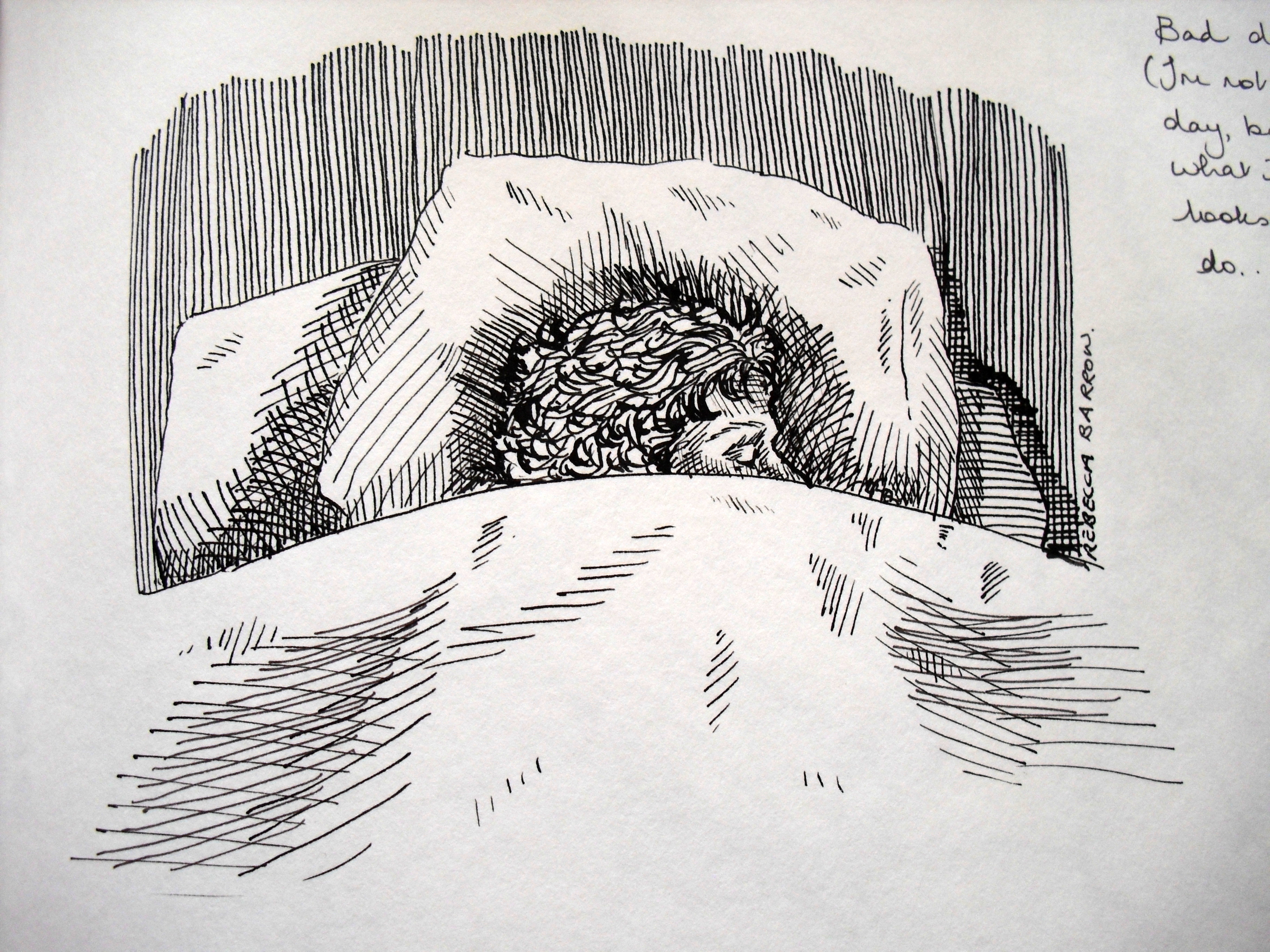
sleep sketchThis one is about my illness and the days I spend unable to get out of bed, which are frequent.

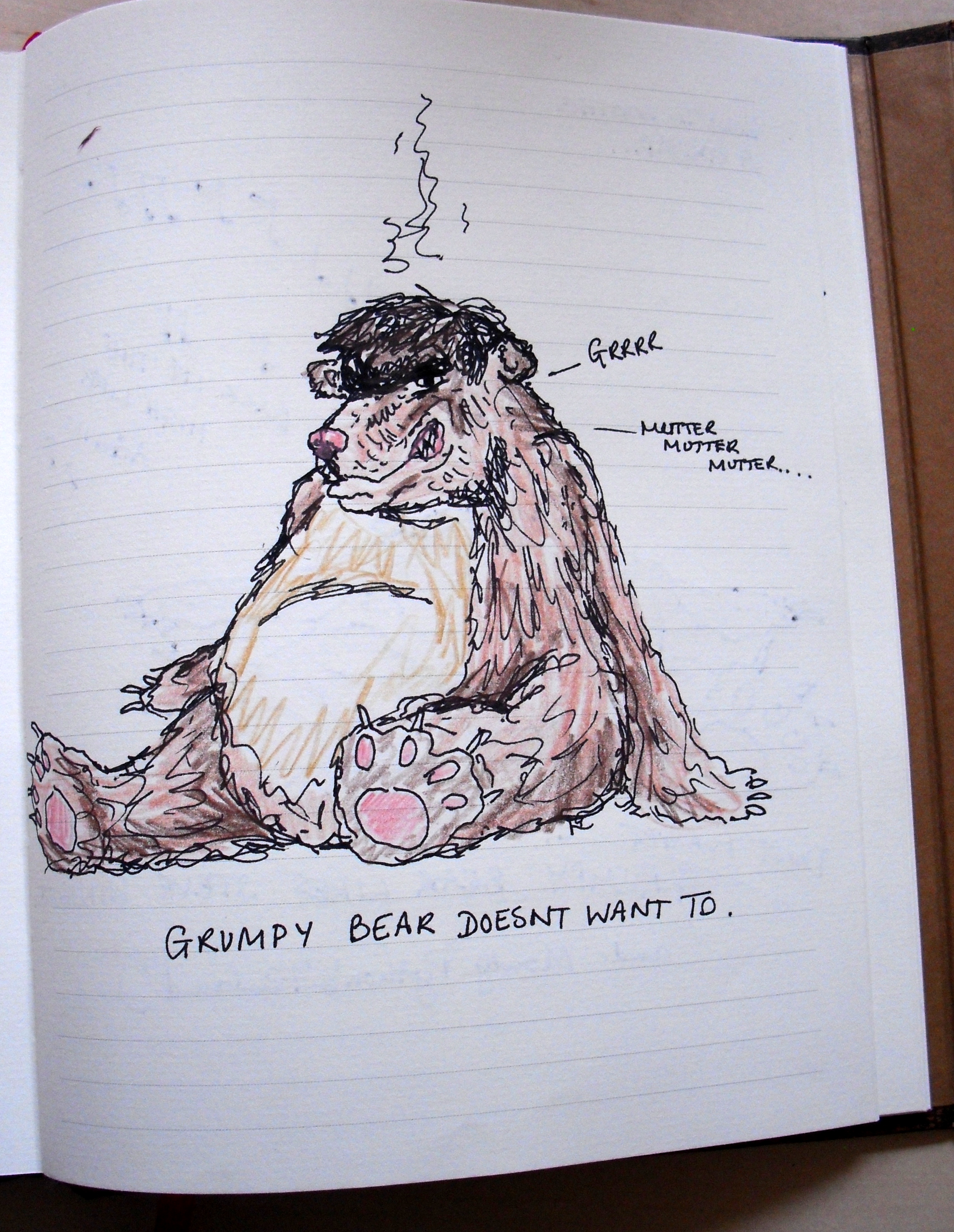
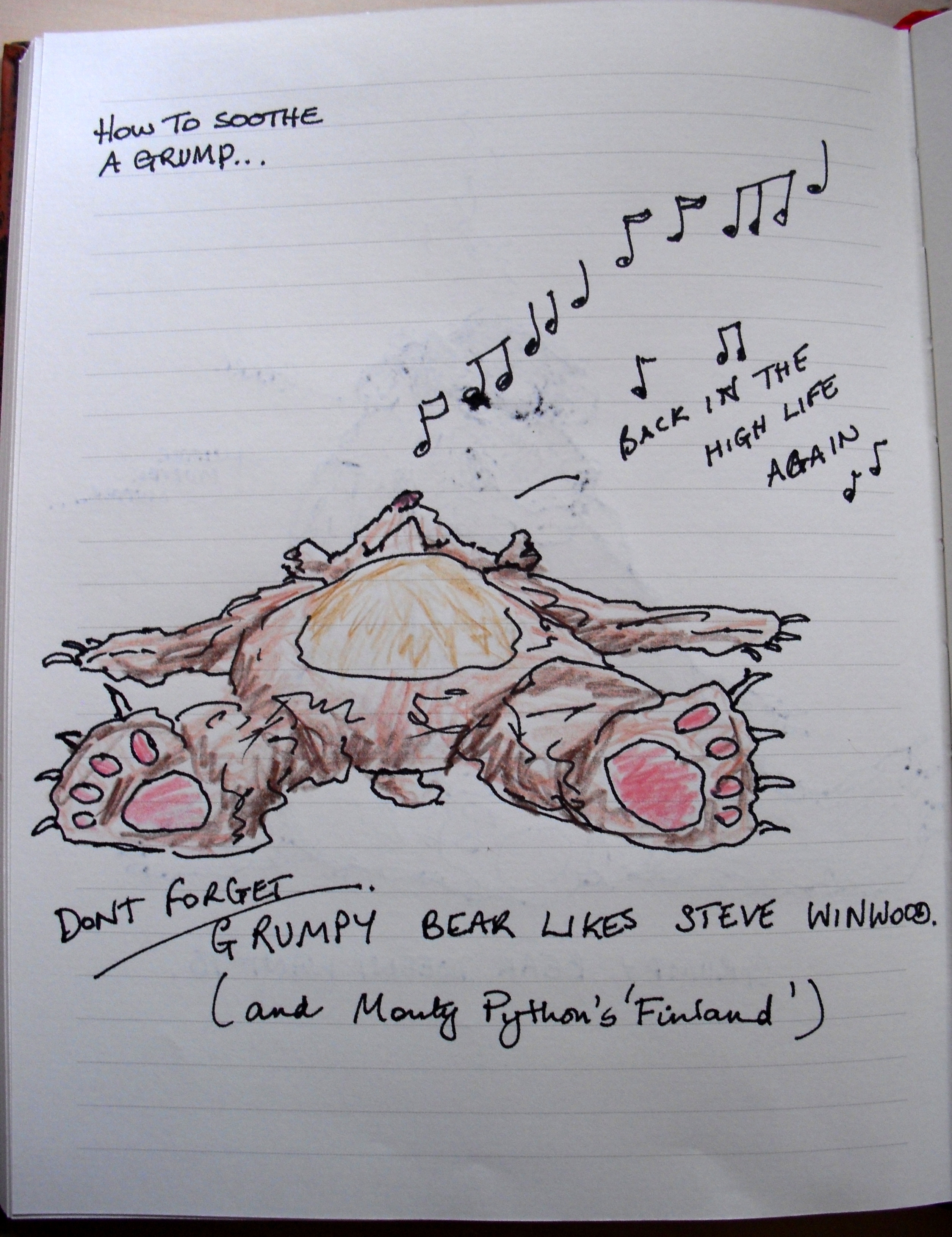
grumpy bear 1 grumpy bear 2

This is a feeling I had one day that I wanted to personify, in the hope of recording how to get rid of it.

hound sketchThis was the product of a night of insomnia.  Once I had drawn this rabid dog, something I felt compelled to do in a literally physical way, the feelings I was struggling with literally dissolved, and I went back to bed and slept for seven hours straight.

The point I want to make is not whether I can draw or not, but that you can use images to express your feelings in your journal without fear of judgement from others.  If you can’t draw, or can’t bring yourself to draw, paste in images cut from magazines, or postcards.  Collage is a great art form you can try without fear of criticism.  There are lots of ways to express what is pent up inside that are nothing to do with words.

Don’t let Nigel limit you.

Journal Exercise:

I am going to talk more about this, as I feel like I have opened up a rich seam, now that I have got over my block about it.  But in the meantime, you get to do some more shopping!  Go and buy yourself some nice coloured pens or pencils.  Sharpie ones are good and bright, but I like Staedtler Triplus fineliners and Berol Colour Brushes.

Reread my previous post about colour, and play with your pens or pencils inside your journal. Makes some marks.  Doodle.  If you fancy drawing, do, but don’t be critical of what you produce.  This is not about getting a grade A.  Just have a play.

What colours and shapes express particular feelings for you?  How do you feel when you use a particular colour?  What do certain shapes mean?

During the week, keep your eyes peeled when browsing newspapers and magazines, or even junk mail.  Pick out images that speak to you.  Pull them or snip them out and stash them in a box for future use, or stick them into the pages of your journal and write about how they speak to you.

Happy Journalling,

EF

Journal Friday: The Gratitude Journal

If you trawl self help and wellbeing blogs like I do, you’ll probably have come across the idea of the Gratitude Journal before.  Lots of people swear by them.  You might think they are a bit of a cheesy idea, writing down what you are grateful for in your life every day.  I mean, isn’t it self-evident?

Maybe not.

Think about all the time you spend moaning and complaining about what is wrong with your life.  Our consumer culture programmes us to always want something else, something more than what we already have.  There might be a reason why all those slum dwellers you see in doumentaries look so happy.  Its not because they are glad to be living in squallor and poverty, that’s for sure.  Maybe it’s because they have so little that they value what they do have.

Let me tell you a story about one of the most inspiring people I have ever known:

My Great Auntie Kitty.

She was in her late 80s and early 90s when I knew her.  I was a small child – I think I was probably about 8 or 10 when she died.  I didn’t know her well because she lived in a town four hours drive from our home, so we were only able to visit her rarely, but she made a big impression.

Auntie Kitty was born disabled as a result of problems with her hips and legs, though I don’t remember specifically what.  Suffice it to say that she had never been able to walk properly and had worn calipers all her life.  By the time I knew her, she was severely crippled with arthritis, in appalling pain, and mostly blind from macular degeneration.  She was also quite deaf.  But she had a brain as sharp as a knife, and wit to match, loved to debate politics, ethics and religion, and kept up to the minute with all the news through her radio.  She also loved talking books, which she listened to continually as well.  She was funny, entertaining, and never let you get away with anything, especially self pity or fuzzy thinking.

Like many younger daughters, she had devoted her life to caring for others in her family, nursing her own parents and siblings through old age and into death.  She was the last of her generation to survive.  She had never married.  She had battled her way through a hard life through sheer force of will.

I remember her telling me this:

Every night, when she lay in the dark after the carer had come to put her to bed, she would think of three things in her life to be grateful for.  Sometimes she was in horrific pain, and thinking of anything to be thankful for was very difficult.  But she told me that no matter what, she could always find something.

Every night for the last thirty years, I have done the same.  Three things.  Just three.  Usually there are plenty more.  I could fill pages!  Some nights, if I’ve had a row with my husband or I’m in a lot of pain, as I sometimes am, I can struggle a bit. It can be pretty rudimentary on those occasions:

1.  I have a roof over my head.

2.  I have a bed to support me.

3.  There is ibuprofen in the cupboard.

Most of the time, there is plenty to be grateful for:

1.  I have a wonderful husband who loves me.

2.  I live in a beautiful place that most people would give a limb to inhabit.

3.  I have lots of friends who care for me very much.

4.  I get to write!!  (And so on)

I do this every night, come what may, partly in remembrance of Auntie Kitty, in celebration of her huge personality and bravery, and partly for myself.  Because it helps.

Being grateful shifts us into awareness, not only of what is real in our lives, but what is important.  Having that latest pair of shoes or the new Clarisonic really is not important compared with the people who we love and who love us.  Unlike the slum dwellers of the Developing World, most of us know we have a safe place to sleep tonight, and food in our bellies.  We have other, First World problems, I suppose, but there is still such a lot to be thankful for.  It is so easy to forget how fortunate we are.  Let’s not.

(I was going to take a picture of my Gratitude Journal to show you, but somehow it felt wrong.  An invasion.  Privacy, remember?  I find my reaction about that interesting itself, and I propose to explore it more in my own journal later, because I wasn’t expecting to feel that way.  Its interesting when you find boundaries you didn’t know were there, don’t you think?)

Journal Exercise:

Okay, you get to go out and indulge in the stationery shop again this week!  Go and choose yourself a nice little notebook, one with small pages.  I use this one.

Every night before you go to bed, get your notebook out and write at least three things that you are grateful for today.  Use a separate page every day, and date each.  Sometimes you will fill the page, and wish you had another.  Maybe you will go on a fill another, that’s up to you.  Some days you will be grumpy and resentful, and won’t feel like doing anything other than having a pity party for yourself.  Regardless, remember: write three things.  Just three.  It will help.

At the end of the first month, go back through your notebook and reflect on the things you have written down.  What are your lists showing about what important to you?  Write about this in your journal, if you like.  How has a daily gratitude practise changed the way you feel about your life?

Happy Journalling,

EF

Journal Friday: More about Privacy

sussex church

Herstmonceaux Church, East Sussex

I’ve been thinking a lot about boundaries lately, and about the freedom they afford us to be ourselves.  We talk a lot about the boundaries we set for ourselves in the external world – saying no to doing too much, closing the door for some quiet time, backing off from an over-needy friend who is monopolising us.  What we rarely seem to do is think about the internal boundaries we set up, or fail to set up.

I think one of the things women, especially, do is to set up one set of boundaries for themselves, and one for everyone else, and not in a good way.

Let me give you an example:  my mother is a nice lady.  People like her.  She is charming and good company.  But she speaks to herself in ways she would never dream of using to others.  ‘You stupid bloody woman,’ I hear her saying to herself when she gets frustrated that she can’t remember things anymore now she’s in her 80s, ‘You idiot, can’t you do anything right?’  My mother does not have a boundary about treating herself in acceptable, compassionate and loving ways. I suppose I must have learnt the same trick from her, because sometimes, I catch myself doing it too.

It is hard enough to put your foot down when you need to set external boundaries.  It is even harder to do it when those oh-so-flexible standards are inside your own head. We need to destroy those self-sabotaging habits as much as we can.  This is what my husband calls:

‘Locating and Killing Your Inner Nigel.’

(You’ve heard about my ‘Nigel’ voice before!)  Sometimes Nigel is just your inner critic, telling you the story you just wrote, the sculpture you just made, is crap.  Sometimes he is a complete Hitler, out to annihilate you with core beliefs you didn’t even know you had!

Keeping a journal is a great way to kick the crap out of Nigel.

To do this, you have to feel free within your journal’s pages to say and do whatever you want.  Rubbish spelling?  Fine.  No punctuation?  Great.  Scribbly handwriting, not being neat? Perfect.  And those scrappy drawings?  Absolutely compulsory, if you feel the need.  The rule is this:

No Judgement.

Tell Nigel to go copulate with himself.  You say and do what you want.  Only then wil your journal come into its own, only then can it be your complete friend, your safe place, without self-censorship.

I wrote in a previous post about who you write your journal for, and although I still stand by that piece, it has been bothering me.  Because you see, if you always have an eye on posterity, on what people who come after you will with think of you, then you will never be honest.  And you must be honest, otherwise why bother?  Without honesty, you are wasting your time.  Who cares if you are being petulant, smug, dull or sulky inside your journal’s pages?  No one is perfect all the time.

Your diary must be, first and foremost, always for you alone, whatever else it is.

Journal Exercise:

When you write this week, do not judge yourself. Do not think about what anybody who reads your journal in years to come will think of you.  Pay no attention to Nigel the Neat Nazi, who wants everything in pukka little rows, with perfect handwriting and impeccable grammar, spelling and punctuation.  Scribble.  Make a mess.  Be what ever you are inside.  Set yourself this new internal boundary.

When it comes to my diary, I will be completely myself, whoever that is at this moment.

Happy Journalling,

EF

Journal Friday: Motivations

Grandmas 80th

Family memories: Who are you leaving a legacy for? (That isn’t me, incidentally, its my own Grandma, and my nephew and two nieces, all grown up now.)

I became a Great Auntie for the third time yesterday.  Actually, saying that makes me sound old, and I’m not, really I’m not.  I became an aunt for the first time when I was 14, and since then my siblings have surrounded me with a reasonably sized and very rewarding family.  A big family event like this, or even just a friend having a baby, always raises a question for me, since I don’t have children of my own.

When I am gone, who will remember I was here?

I think that is one of the reasons I have stuck so dilligently to the diary-keeping habit.  The need to leave a mark,  To leave something of myself for posterity.  My diary is a record of my brain as much as anything, its change and development;  the ideas and interests I have had; the things I believe in; the problems i have struggled with and the solutions I have found.  And yes, it records my loves and losses too.

Every time I write, there is a part of me, something in the back of my mind, that is aware that one day, some beloved relative will find these notebooks and start to read them.  I don’t censor myself because of that.  Far from it, because I want them to know, fifty years down the line, who I really was, and what my daily struggles and joys actually were.

Some women keep a diary throughout their pregnancies, talking to their unborn child through the pages.  Others record their terminal illnesses so as to leave a message for their children to remember them by in later years.

Writing a diary can also be a more direct conversation with another person.  Anne Frank wrote her famous diary to her imaginary friend Kitty, perhaps so that she would not feel so alone in her wretched circumstances.  I doubt she ever thought she was leaving a legacy that would inspire people all over the world for decades to come.  For Frank, Kitty was a friend and confidante, a person to whom she could confide things she would never be able to say to anyone else.

For the most part, people write diaries and journals for and to themselves.  They may have little thought of recording ‘interesting times’, unless they are self-seeking politicians such as Alan Clark.  They write because they need to, because it helps them work things out, or simply because they enjoy it.

None of these reasons is wrong.  There are no wrong reasons.  You might think it self-important to want to leave a mark on the world, but it doesn’t make it a reprehensible motivation.   We all have our motivations for doing what may seem an apparently narcissistic activity, at least on the surface.

What are yours?

Journal Exercise:

Take out your journal and spend a few pages musing on why you write it, and whether you write to or for someone.  Journals are not meant to be read by anyone except their writer, at least not without permission, but sometimes we write with someone specific in mind.  Do you write for someone else, to someone else, or just to yourself?  Do you mean to use your writing as a prompt for other forms of creativity, painting for instance?  Or do you want to record a difficult stage in your life so that you can learn from it?  Do you want to write things down so you will remember them in years to come, or do you want to leave a record for posterity and your great-grandchildren?

If you have something to say to a specific person that you cannot say to their face, write them a letter in your diary, letting it all out.  You never have to send it, but it can help to say those things in some private, safe way.  That is what your diary is for.

If you are interested in historical diaries, you might look at The Great Diary Project for inspiration.  Other people’s published diaries can be an endless source of inspiration, and I will be writing about notable ones in future posts.  In the meantime, why not pop out to your local library or bookshop and see what you can pick up.

Happy journalling!

Journal Friday: Check In and Kick Start

So how are you doing?  Have you been writing your Morning Pages?  Did you buy yourself a journal and scribble your thoughts?

I started my Artist’s Way ‘Redux’ on Monday, and so far I have only missed one day on the Morning Pages (MPs).  I’m feeling pretty proud of myself.  I keep my MP notebook by my bed, along with my fountain pen, and write when I wake up.  It seems to be clearing the sleepy fluff out of my head, and helping me to work out what I want to do for the day.  What’s important.  (Need to be careful not to get ink on my nice white sheets, though!)

How about you?

Did you have a go with the journal exercise last week, as Puggle did?  Did you find out more about your life, and where you are?  Maybe even where you want to be?

Why not share with us how you are doing by leaving a message in the replies/comments?

Sometimes, its hard to think of what to write, or how to start.  I have to admit, there are times when I sit down with my journal or MPs and stare into space and think ‘what now?’  My MPs especially are punctuated by the sentence:  ‘I don’t know what to write next, my mind has gone blank.’

If you are suffering from this, and need a little kick start to get you going, here are some ideas that might just prime your pump.

Kick-Start Exercise # 1:  What Happened today?

Yes, I know that sounds boring and traditional, but maybe its not if you go about it the right way.  What was the most important thing that happened to you today, the event or feeling that sticks out in your mind above all others as important?

It might be the moment the doctor told you that your child didn’t have meningitis.  (Or did, in which case I am sorry.)   It might be that your boss complimented you on your work for the first time ever.  It might just be a moment when you were sitting at the traffic lights and looked up, and the clouds making were breathtakingly beautiful shapes, and it felt good to be alive.   Maybe nothing happened, and that in itself is a relief, an achievement or a significant red flag for you.

We go through our lives in a state of dazed distraction most of the time.  We barely notice the things that are important, let alone the things that are not, no matter how beautiful or poignant they may be.  Take a moment to stop and record what was most important today, the lasting memory of the waking hours you have just experienced that you want to take forward with you into the future.

Kick Start Exercise #2:  Have a Rant

If you are still stuck, how about writing about somethiing that makes you angry.  Everybody has something.  If you don’t, maybe you want to consider that in and of itself – are you repressing feelings, and if so, why?  Maybe your rant has to do with the neighbour allowing their dog to bark at all hours of the night, or potholes in the road that the council doesn’t fix.   What would you say to them if you could?  Maybe you want to yell at the government for some policy you don’t like, or you hate that your washing machine seems to eat socks and you can never find a complete pair.  Perhaps there are things you need to shout at your parents, partner or children, but don’t feel able to.  Your diary or journal is a safe place for all this.  Let it out.

Good luck with your journalling and MPs this week, and please share how you are getting on with us here.

Journal Friday: Morning Pages

The Artists Way 2

If you read creative blogs of any kind, you are bound to come across Julia Cameron’s ‘The Artist’s Way’ eventually.  It’s cover bills it as ‘A Course in Discovering and Recovering your Creative Self’, and yes, it does exactly what it says on the tin.  I first completed the whole 12 week course in 2004, and now I am about to embark on a refresher.  I’ve pulled my much loved, somewhat dog-eared copy off the shelf and on Monday 6th May 2013 I shall launch into the unknown once more.

Cameron proposes two tools for this course, Morning Pages and Artist Dates.  No doubt we will talk about Artist Dates at some point soon, but today, let us think about morning pages, because they are enormously beneficial, whether you are a creative or not.

“What are morning pages?  Put simply, the morning pages are three pages of longhand writing, strictly stream-of-consciousness…”

Julia Cameron, ‘The Artist’s Way‘ Pan Boo 1995  pp9-10

Basically, what we are talking about here is three pages of brain dump.  You write them by hand because it enables your subconscious to express itself.  You don’t judge them, you don’t ty to be neat, you don’t reread them.  Cameron suggests doing them on loose sheets of A4/letter size paper, but I prefer to keep them in a notebook, the same kind I use for my writing notebook.

You can whine, complain, rave, drool, scream, laugh, giggle, rant, enthuse, or just repeat ‘I don’t know what to write, I don’t know what to write’ over and over again until something presents itself to be set down. Three pages.  Inane babble or heartfelt planning.  As scribbly as you like. (I realised after I had taken the photo above that this particular example of my pages is considerably neater than my usual.  Believe me, most of it is a real mess!)

Whatever comes out.  Three pages every day, no matter what.  Three pages to ground yourself in the very core of your psyche, to drain out the poison and find the shimmering gold doubloons resting on the sea bed beneath.

I have kept morning pages on and off for 9 years.  I have never reread any of them.  But when I do them, I find myself making sense of the world and my feelings, finding a way to my dreams and interests, naming new ideas and enthusiasms, letting out the bile that is getting in the way of health and healing.

I profoundly believe in the healing power of these pages in draining the poison and pain from life.  I have recommended it to several friends and acquaintences who were struggling with clinical depression.  They have found them enormously beneficial, as do I.  I now recommend them to you, not because I think you need help, but because they will help you find yourself, because they will help you become more of who you really are under all the OUGHTS and SHOULDS.

Journal Exercise:

Set your alarm half an hour earlier this week.  Get yourself a decent large notebook and a pen you like to write with (I do mine with a lovely old Parker fountain pen).  Write your three pages every day.  Do not judge yourself.  Do not censor yourself.  Get the dross and the sparkles alike down on paper.

If you would like to join me on the Artists Way, you are more than welcome.  I shall be writing more about my progress on this blog, and I would love to hear from you in the comments if you are game.

Journal Friday: The Rules

2013 diary

There is something about keeping a diary that makes us think there has to be rules. It may be something to do with those little lockable five year diaries girls were bought by well-meaning aunts in the 1970s.

If we aren’t careful, diaries become about OUGHTS – you know, how you OUGHT to do things – and I gave up doing OUGHTS about 10 years ago.  I don’t live in SHOULDland anymore.

The truth is that there are as many ways of keeping a diary as there are diarists.  But over the last 38 years I have found that the following guidelines are useful, for me and for friends I have helped with diary writing.

Guideline # 1:  Absolute Privacy is Non-Negotiable.

A journal/diary is a place you need to be able to be yourself.  Otherwise it is no good to you.  Where else can you say all the things you really need to express, but daren’t because someone might get upset or hurt.  Where else can you confide your deepest desires, wildest fantasies, greatest irritations, and the things you plan to do to Brad Pitt if you every get your hands on him?

I suppose this is what the lockable diary was about, all those years ago – I never had one, but I had a friend who did, and I envied her’s so much.  Funny – she never wrote in it.  I wonder why?  Maybe for her, it was an OUGHT.  Or maybe, she was worried that the lock was an invitation for her brother to break in and read her most intimate thoughts.

However you ensure privacy is up to you.  Maybe you need to get the agreement of those with whom you live.  My husband and I have shared a home for the last 16 years, and he has never once looked at my diary.  He knows it is my private place.  (I respect his privacy in turn.)

You may have to physcally hide your journal from prying eyes, which seems a shame to me, but then I don’t live with annoying siblings anymore.  You may need to keep it in a locked drawer at work, or hide it under a loose floorboard (I hope you don’t), but whatever you do, you need to be satisifed that whatever you say is safe and for you alone.  Otherwise you will not say what is in your heart, and that is not only defeating the object, but denying the healing power of the diary.

If your partner is upset and worried about your keeping a diary, comfort them that it is not a threat to your relationship with them.  Reassure them that it is a place for you to express yourself, to have a freedom that will in turn invigorate your relationship with them.

Guideline # 2:  Date Every Entry

Duh!  Yeah, this seems obvious, but sometimes people forget.  You need some kind of way to navigate this mountain of paper you are going to create.  Chronology is the way human beings connect things within their own lives, so it makes sense to use that.

Guideline # 3:  Write when you have something to say

Don’t allow yourself to fall for the tyranny of writing every day.  Sometimes you will write every day.  This is especially useful to do when experiencing difficult and demanding times, when you are trying to work out how you feel, or where you want your life to go next.  But do not force it.  Write only when you have something you wish to record, understand or work out.  And don’t beat yourself up if you look back and find a gap of months at a time.  Those were the times when you were too busy living to write, and thats okay too.

Guideline # 4:  It doesn’t have to be perfect

This is especially true if you have the nasty habit like I do, of perfectionism.  After all, whats the point in doing something unless you can do it perfect first time?

Reject perfectionism.  Make a mess.  Scribble.  Write scruffily.  Make blots.  Have fun.  Use different colours.  Play.

If you are doing art journals, beware of perfectionism in the images you create.  Its just for you.  You aren’t going to show this to anybody, so it doesn’t have to be Leonardo first time.

Aways tell Nigel (your perfectionist’s voice, remember him?) to bugger off, and just enjoy yourself.  Have fun.  It really doesn’t have to be perfect.

Journal Exercise – Where am I right now?

I hope that following last week’s post, you have been out and bought yourself a lovely notebook to write in.  Maybe you are already scribbling down your thoughts.  But perhaps you feel a bit stuck.  Sometimes it is a bit hard to get started.  Here is what I do:

Write down the sentence:  This is where I am right now.

Now, write whatever comes to mind after that.  You might want to describe the room you are sitting in, the town you may be visiting, the lover, friends or colleagues you are with.  Or you might want to talk about where you are in your life, the joys and frustrations you are experiencing, the hopes and fears lurking in the back of your mind.  Write whatever comes out, and don’t censor it.  No judging, no Nigels, remember?  Just do a brain dump.

Then, when you have finished saying where you are right now, maybe you can go on from there, and write about whatever else pops into your head.  Or maybe you can stop.  And use the same prompt tomorrow.

Whenever you feel you need to write, but don’t know where to start, this prompt is a great one.  It grounds you in your life and your feelings.  It often tells you things you didn’t know about yourself right now.  It illuminates, as well as getting the wheels rolling.

Happy journalling!