Category Archives: Writing

Journal Friday: Smorgesbord

Diary Pile 2I’m feeling a bit rough at the moment, so I’ve been spending a lot of time surfing the internet.  Its a good thing to do when my brain is mushy like this.  I have trouble parsing long  blocks of text, so little blog posts and internet sites are just the thing to keep my mind occupied and spark new ideas.

So I thought I’d share some of my journalling current faves with you:

I just bought this book.  Its written for teenagers, but its a brilliant introduction, and I am really enjoying dipping into it.

Loving this artjournal site.  So much eyecandy!

I love Bronwen’s Artful Life blog, and I really fancy trying her method of creating an art journal from a vintage book.

Have you come across creativebug.com yet?

I recently came across the idea of the Bullet journal, which was new to me.   Its a kind of cross between a to do list, a project planner and a journal.  Might be a great solution if you are pushed for time and looking for a way of combining recording your life with planning it!

On a similar theme, you might be interested in the whole idea of sketchnoting.  Check out the website of the Sketchnote Army, a pretty breath-taking archive of how to record information graphically.  You could combine Sketchnotes and Bullet journals, and you don’t have to be able to draw…

Lorraine Bell’s planner is delicious!

My Pinterest pinboard on organisers is continually growing.

If you love Moleskines, their myMoleskine site will bend your mind!

I love Plannerisms!

Well, that should keep you going for a while!  Hope you have a happy and creative weekend,

EF


Which Notebook?

My old writers notebook

My old writers notebook

I’ve been trying to find the best way to keep a writing notebook for the last year. And by ‘right’, I don’t mean correct, I mean the system that works best for me.

I always used to keep all my notes in an A4 ringbound PukkaPad notebook, the hardback kind. I loved it. There was plenty of room on the big pages, and PukkaPad’s paper is beautifully smooth and takes ink perfectly. Their products are especially good for Morning Pages, because you can write quickly and smoothly on them.

This was fine as far as it went, but the book was too big to carry around with me easily, which meant that I tended only used it at my desk. And that meant I wasn’t noting down all the ideas I had, just the few I had when I was thinking about it. Which meant I was always trying to remember what I had thought about. And that meant, of course, that 75% of the ideas I had went AWOL. What a waste.

(I did have a baby moleskine at one point. It just felt like clutter in my handbag and I rarely used it.)

Last September, I decided I was going to get serious about my writing practise, and that meant reflecting on my notebooking habits. This was not a flattering experience.

I restarted with a cheap hardback A5 notebook, because it had to be sturdy to withstand being knocked about in my handbag. I just bought the cheapest I could find because I figured it was an experiment, and it didn’t have to be perfect. Plus, if it was too nice, I wouldn’t use it.

(That’s a trap I’ve fallen into before. Its easy to feel intimidated by a fancy notebook to the point where you can’t bring yourself to write in it, because you feel anything you do write has to be perfect. It’s a creative disaster.)

So decorated the cover so it looked like a more expensive one I was coveting at the time, and away I went.

It was really hard at first, making sure I scribbled down the thoughts I had when I had them, not trying to save them up. I added quotes I came across, stories I heard on the bus or on the radio, and took notes in book talks I went to. And I quickly filled up my scrappy little book.

And once it was full, I forgot about it.

So when I got the bug again, deciding to renew my commitment to my work, I made the mistake of going off to gorge myself on the goodies at Staples. Gods, I love Staples!


The ARC discbound notebook system from Staples.  The one on the left is a cover I made myself.

The ARC discbound notebook system from Staples. The one on the left is a cover I made myself.

And there I fell in love with the ARC discbound system. I came home with a beautiful leatherbound A5 notebook. And it is gorgeous. You have no idea. And because its discbound, I decided I would combine my notebooking with a blog planner. I printed out pages and punched then and fitted them in and moved them about. And my lovely ARC planner became so big and heavy that I couldn’t get it in my handbag. Which rather defeated the object. And the thing with the lovely leather binding is that you can’t just throw the book in the back of the drawer to await later pillaging for ideas. You feel duty-bound to keep using it. So you have to take the contents out, and then what do you do with them?

So the ARC notebook, no matter how delectable, was a notebooking disaster.

But I learnt from my failure. I now knew I needed the following:

  • An A5 notebook to fit in my handbag.
  • A pen loop would be useful.
  • Nothing too fancy, or I won’t write in it.
  • Nice paper is an incentive.
  • A sturdy binding to withstand handbag battery

So back to Staples I went.

And this time I came home with the A5 version of the Oxford notebook. It has a stiff plastic cover and is spiral bound, which means I can fold it flat over easily. Its got lovely paper. I can tuck a biro into the spiral binding and it acts as a pen loop. It is satisfyingly thick but the smallish size means I can fill it quickly, which pleases me and makes me feel like I’m making progress.

And I am using it. Every day. Filling it with thoughts and ideas and potential stories and snippets and all kinds of goodies that I know I can rummage through in future. I’m even using it to write bits of stories and dialogue for my fanfics, and bits of diary-like reflection on the writing process for my novel.

People, its working!

It goes with me everywhere, my little friend. And it is still evolving. I could probably write another post along the same lines as this one in six months’ time, and I’ll probably tell you something completely different. I think the notebooking requirements you have change with you as you go on in the craft. But for me, this is where I am now, and I think I have finally found a way to record my brain on paper in a meaningful and useful way.

I encourage you to explore using a writers notebook if you write, but to do it, too if you pursue any other kind of creative art. A sketchbook for an artist fulfils the same function. It allows you to explore your creative interior, push the boundaries of your ideas. Its useful to keep a little notebook in your pocket or bag just to scribble down random ideas and thoughts you have, regardless of what art you do.

Be gentle with yourself as you find out what works best for you. From little cardboard-bound exercise books to luxurious Paperblanks, there will be something that fits your life. Think about your lifestyle and what your requirements are. I recommend that you start cheap so you feel like you can make mistakes. There is no wrong or right. Its just what works best for you. You just have to find it.

If you want a beginners guide to keeping a writers notebook, click here.

I’ll no doubt have lots more to say on the subject in coming posts.

Happy creating, EF

Journal Friday: Solitude

Shadow Selfie

Shadow Selfie

I’ve been making huge leaps this week, but one of the results has been a deep gloom opening up inside me.  The exact opposite of the feeling of exhilaration I SHOULD been feeling when I make massive learning gains with my creativity.

(Did you notice the Bingo! word there – give yourself a pat on the back if you picked out the poisonous SHOULD in that sentence!)

Instead of bouncing around like Tigger on a coke spree, I feel like a sodden blanket.

Why?

Because writing is a solitary art.  And human beings are social animals.

Now don’t get me wrong, I’m the first to admit that I need to be on my own a lot.  I like my own company.  But there are also limits.  If I get left on my own for long periods, I get mournful, bad-tempered, sick of myself, sick of everybody else.  I start feeling like I want to stab myself in the forearms with a compass point.  This is obviously not a good place to be.

Husband has been out pretty much every night this week, playing sports and meeting up with business colleagues.  He has commitments that sometimes pan out like this, and I’m fine with that.  But occasionally it means I get a week like this one.   I’ve been on my own from eight in the morning till eleven at night for four days on the trot.  Thats enough time on my own for me to go slightly round the twist, to over-react to everything, and end up in a grumpy hole.  From whence no writing, or anything positive, emerges.

I’ve spent a lot of time struggling to get out of my grumpy hole.  “I ought to be able to get over this, I SHOULD have worked out strategies by now to combat this,”  I told myself.  (There are two Bingo! words in that sentence, can you spot them?.

But then I thought maybe the thing to do was to allow myself to feel the feeling of misery, and then perhaps it would leave.  In other words, not to fight against it, but to be with it, and see where it took me.  Because lets face it, after 44 years of living with depression, I can safely say that a) the odd blue day is a doddle compared with the major depressions I’ve experienced, and b)  I know I get this when I’ve been on my own too much, so maybe I can work out what its trying to tell me.

It turns out that its trying to tell me that I need to get out more.

I get exhausted.  That is part of my ongoing health problems, and I need to take account of that, but I also need to accept that one of the basic needs I have is for a change of scene, and seeing people.  It doesn’t necessarily have to be conscious socialising.  It can be just getting out into town, seeing other human beings in the street in their infinite variety.  Maybe two days a week would be good maintenance treatment for me.  To get out, to see the world, interract with it.  And rest at home the remainer of the time.

(I should probably point out that I live in the middle of nowhere, literally, and I can go days without seeing anybody, which can be very isolating.  We are two miles from the nearest village, not a distance I can walk, so it is not like I can just pop out to the corner shop for a natter and some social contact.  Given that we can only afford one car, and that Husband’s access to work has to take priority, getting about has to be carefully planned.)

I need to take this awareness of my own needs forward.  I’m enjoying my writing so much, but I need to take care of myself too.  And that means going in to work maybe a day or two a week with Husband, settling down at the library or the cafe, and writing there instead of at home.  So that I see people.  So that I have the stimualtion I need.

Journal Exercise:

You may not have the same ‘shut-in’ issues that I have, but I invite you today to examine the ordinary activities and lifestyle factors that help you to be creative in a regular way.  Do you need to drink more water, take regular walks, get a new chair because the one you have gives you back ache, and makes you reticient to sit in it to draw or write?  Does eating dairy give you sinus headaches so that you feel all fuzzy, and you can’t think straight?  Do you need a holiday, a long bath, a place to work where next door’s dog isn’t barking?  Maybe your partner could look after the baby an hour a week so you can have time on your own, or perhaps you need to get up an hour earlier so you can be peaceful with yourself before the rest of the family rises.

Spend some time exploring in your journal the basic things you need to operate at your best: good food, 8 glasses of water a day, cuddles, exercise, Whatever your core requirements are.

Now write about the little things that you could do for yourself that would help you to function above just the basic level of proficiency that you explored above.  Think about the times when you have been really crackling creatively.  What made those times special?  Are there factors you could replicate, to recapture that sense of being in the flow?  What really makes your motor run?  It could be listening to rock music while you work, hanging out at the cafe, carrot cake, more cuddles, or anything else.

A note of caution:  The whole myth about artists having to be self-destructive is exactly that –  a myth.  Try copying F Scott Fitzgerald or Jack Kerouac, and drinking to promote creativity, and I can guarantee what you will end up with is not increased creativity.  You will just end up being dead.

All the actions you take should be self-caring and self-nurturing.

I hope that you can uncover some new ways to nurture your creative flow, or maybe just work out how you sabotage yourself with having too much of one thing, and not enough of another, as I do.  Writing is a solitary act, but you don’t have to be on your own to do it, as I have been reminded this week.

Take care of yourselves, and happy creating,

EF

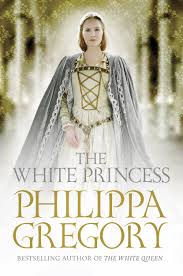
The White Princess Problem

the white princessI’m undergoing quite a lot of shifts in my creative work these days, and as a result, I’ve been reflecting on my reading habits.

Bit not good, as Sherlock would say.

I read woefully little fiction. My bad.

If you want to be writer, you need to read. And read lots. And I do read lots. Its just that most of what I read could be loosely classed as ‘self help’ and history. Let me explain:

A little while back, everyone was raving about Philippa Gregory’s Cousins War novels, which tells the stories of the women involved in the Wars of the Roses, during the late Medieval period. I’d read Gregory’s ‘The Other Boleyn Girl’ when it first came out, because I’d read something similar by Jean Plaidy as a girl, and liked it well enough. I tried the first book in the series, The White Queen, but couldn’t get on with it. So, on the basis (again) that I had read something similar by Jean Plaidy, I decided when The White Princess came out, with its plot about Elizabeth of York, mother of Henry VIII and wife of Henry VII, that it was for me. I bought the book and settled down for a good read.

What a miserable book.

I have clawed my way wretchedly through it. I’ve only got a few chapters left, but every time I pick it up, I am seized with a bout of miserable gloom and depression that can go on for days. I just can’t stand it. I’m determined to finish the beastly thing, just on the basis that I refuse to let it beat me, but dammit if it isn’t the most spirit-crushing book I have ever read. And I’ve read ‘Middlemarch’! Now everyone is telling me that I must read Hilary Mantel’s ‘Wolf Hall’, and I just know that’s going to have the same effect on me.

Is it any wonder that I return repeatedly to Terry Pratchett’s Discworld books?

I want a book to entertain me, and leave me panting for more. I want to be riveted by every turn of the page. Its not that I don’t want conflict. I love conflict. Conflict is what makes a plot irresistible. Without it, fiction is just a mushy mess.

But why does every book that gains acclaim have to be so bloody depressing?

Is it so much to ask for something to be a bit witty? Is it so hard to make a book hopeful in some way?

Maybe it is that I read mostly first thing in the morning, to help me wake up and while I wait for the day’s medication to kick in, and last thing at night before I sleep. What you read first thing can set the tone for your day, which is why I try to choose something uplifting. And late at night, you want to read something that will help you sleep, not leave you lying awake worrying about death and betrayal and being hung, drawn and quartered.

I have a heap of novels that friends have lent me. They seem to be mostly about the Second World War and the Holocaust, which doesn’t bode well. I tried reading Kate Mosse’s ‘Labyrinth’, but it felt too cheesy, and worryingly like Dan Brown’s ‘Da Vinci Code’, which is the only book I’ve ever actually physically thrown at the wall in disgust because it was so badly written. (How that man has the gall to teach creative writing beats me!) I love historical fiction, but I want to read good work that is recently published. And I’m fine reading contemporary set books. Why is it so hard to find something that isn’t going to make me want to slash my wrists?

Maybe I’ll just see if I can get the latest Alice Hoffman from the library. I used to read her. She was good. But if you have any recommendations that fit the ‘positive’ bill, please leave a comment below. I’d love to hear about your favourites.

In desperation,

EF

UPDATE: went to the library and found Andrew Miller’s ‘Pure’. First few chapters are beautifully written, even if it’s a dark story. I’ll let you know if I’m inclined to slash my wrists at any point.

How Scrivener Kicked My Butt into Enlightenment

People have been raving about Scrivener to me for ages, and I’ve been saying yeah, yeah, eventually. And then wrestling with Word for my novels, and spreadsheets for my research data. Given that I am hopeless at spreadsheets, you can just imagine how time-consuming that can be. Anyway, recently, my fanfic pal Chasingriver demonstrated to me conclusively that this was a programme I couldn’t live without.

You know, I hate it when she’s right.

It was the corkboard function that really sold me. Mainly because I’d spent the previous week working out how I could attach all the little index cards (each indicating a scene) which I had accumulated for my current project to my study wall without damaging the plaster with blu-tak. Once I’d downloaded Scrivener, it was a case of YAY! No more blu-tak! No more holes in the paintwork!

With Scrivener, you can put all your little index cards on the screen, and move them about to change the order as you like, just as you would with the real thing. The good part, though, is that while you can’t carry your entire study wall along to the library with you when you want to work there, you can with Scrivener.

(Did I mention that I’m not getting paid to say this about Scrivener, just in case you were wondering?)

Anyway, yesterday I sat down in front of the offending, doomed wall, and started to copy out those little index cards into my Project folder. Away I went. I was having a lovely time. Type type, tap tap.

You’ve already guessed there is going to a BUT here, haven’t you?

Once I’d put in all my index-card scenes, I could see the plot I’d teased out as a whole. Or should I say HOLE. Because it was full of them. Holier than Righteous, as we used to say about my brother’s vests.

Now, of course this is a good thing. It is better to find out your plot is lacier than a wedding dress before you get down to churning out 80,000 words, rather than after. Of course it is.

Cue typical writers confidence wobble.

I crashed and burned.

Help! What have I got myself into? I thought I had a novel with a mostly sorted plot, and now I find there is mountains more work to do than I thought. Oh, oh, I am hopeless, my work is superficial, crap, lacking in psychological depth, etc. etc. You know the routine, because I’ll bet you’ve done it yourself at 3am enough times.

Don’t worry, I’ve got a grip on myself now. But it was a bit scary there for a while.

What the marvels of Scrivener have done is to make me see how I can get to grips with my project in a way I never have before. I have always been a ‘flying by the seat of my pants’ sort of writer, with plots that evolved organically as I went along. I’ve written to find the plots, rather than establishing them first. Much the same goes for character. I’ve done a bit of character work before on my novels, but most of the time, I’ve just sat down and written the damn thing, and kept writing till it felt done.

Which is why I could never get a handle on my books as whole, holistic entities, and why I always have such horrible trouble editing them.

You can’t break a stream-of-consciousness-written novel down into individual component parts in order to see if it makes logical sense, or to cut and paste bits around. Its too interwoven.

Cue HUGE AHA! moment.

Back in the dim and distant past, when I was studying systems analysis and design, I was taught that the way you design a system is to break it down into its individual constituent parts, each part serving a specific function and with a specified input, actors, outcome or output. But I never thought that you could view a novel this way, even though I was taught to look at every scene in my books, and ask what function it was there for, and whether it served that purpose. If it doesn’t, you have to cut it, say the gurus, with systems design and with novel editing.   Kill your darlings, they say, but I never could because I couldn’t see the whole, and I couldn’t see the individual functions.

What I think I am trying to say is that in two days, using Scrivener has revolutionised the way I conceptualise a writing project. It is scary, but it is also enormously liberating. I get it now, I really do. After years of struggling over how to plan, I now see it.

Thank you, Scrivener. (And Chasingriver, of course.)

Of course, I can also now see that I have a vast amount of work to do. But the nice thing about that is that I can also see how to break it down into little, manageable component tasks. Eating the elephant, as they say. I’ll let you know how I am getting on.

In the meantime, take a look at Scrivener, if you haven’t already.

Happy Creating,

EF

Finding the Right Place to Write

Roald Dahl in his writing hut.  From the CBBC website.

Roald Dahl in his writing hut. From the CBBC website.

As regular readers will know, me and my study have a kinda love-hate relationship. In recent months, I’ve been trying to do it up a bit, make it a nice place for me to work, somewhere that reflects who I am and what I want. Somewhere I want to inhabit. Because I really do think that it is important to have ‘A Room of One’s Own’.

The problem is that it doesn’t seem to work for me in practise.

I do most of my writing sitting in my comfy armchair in the living room, with my laptop in my lap (strangely enough!), or writing in notebooks resting on a brilliant drawingboard that I bought from The Art Trading Company. And seriously peeps, this drawingboard is brilliant, and I’m going to get another one for my bedroom so I can be comfortable when I write in bed, because I also write there a lot, especially in my journal.

Now, it has lately occurred to me that this habit was set in stone when I was just a little kid. When I was small, I had a tiny bedroom only just big enough for a not-quite-full-size single bed, and certainly not large enough to include something as luxurious as a table. As I got older, and siblings moved out, I moved into their (larger) bedrooms, but there was never really enough room for a table or desk.

Aha! But I had my trusty piece of board!

Yes, I said ‘board’. It was a thin bit of old chip board, about A3 size, and I used it for hours, sitting on my bed, for drawing and writing, as a working surface for sewing and painting and plasticine and homework, as a play area, and for all kinds of other activities. That board was a miracle. I could have it on my lap when I was snuggled up amidst the sheets, and it kept the ink from getting on the cotton as well as giving me a firm surface to work on. I loved it, and I was never without it until I left home. After that, I think my mother threw it away. But who knows, it might still be in her house, under the spare bed, along with my ‘A’ level art portfolio!

The other day, I was thinking about my lovely old piece of board as I sat in my armchair with my lovely new drawingboard on my lap, and I remembered seeing photographs of Roald Dahl’s writing hut, where he sat in an old armchair with a board on his lap, and wrote the great classic of my childhood, Charlie and the Chocolate Factory. (My husband actually knew the Dahl family and played in that hut at one time, the lucky hound!)

Nicole Kidson as Virginia Woolf inthe film 'The Hours'.

Nicole Kidson as Virginia Woolf inthe film ‘The Hours’.

Then I remembered a scene from the film, ‘The Hours’, in which my heroine, Virginia Woolf, played by Nicole Kidman, sits in an armchair by the window at Hogarth House, with a baize-covered board on her lap, and scratches out the first few lines of ‘Mrs Dalloway’ with her new pen nib. Woolf was actually more inclined to write at a high table, standing up, but the image is potent for me.

It is very nice to have a desk and a study, and sometimes, that is exactly what I need. But I am also fortunate in that I spend a great deal of time having the run of the house to myself, which means that I can write pretty much anywhere I have a suitable work surface, enough light, and where I can get comfortable. I’m not ungrateful to finally have the luxury of my own study, believe me, but having it as made me realise that really, it wasn’t necessary. I was always saying I couldn’t be a proper writer until I had a study of my own, but that just wasn’t true. I have written far more words in my armchair or my bed.

The lesson I have come upon, and the one I wish to communicate to you, Dear Reader, is that actually, once you find the place that suits you, you can write anywhere. You don’t need a study. And if you have one, as I am lucky enough to, you may not end up using it. Don’t beat yourself up about not doing so. Take Woolf’s exhortation to find ‘A Room of One’s Own’ as a wider license to find space of your own. The local Costa Coffee may be your perfect place to write. Or, as for my husband, the comfy chair by the roaring fire of your favourite pub may be just the place. Or you may indeed have your own study and revel in it. The important thing is to get comfortable and have a firm surface to write or type on, so that you are not distracted. It doesn’t matter if its in a caravan or a lorry cab, so long as your imagination can take flight. Because once it flies away to your story world, it doesn’t matter where you are.

Happy Creating,

EF

Inspiration Monday: Whats Inspiring Me Right Now

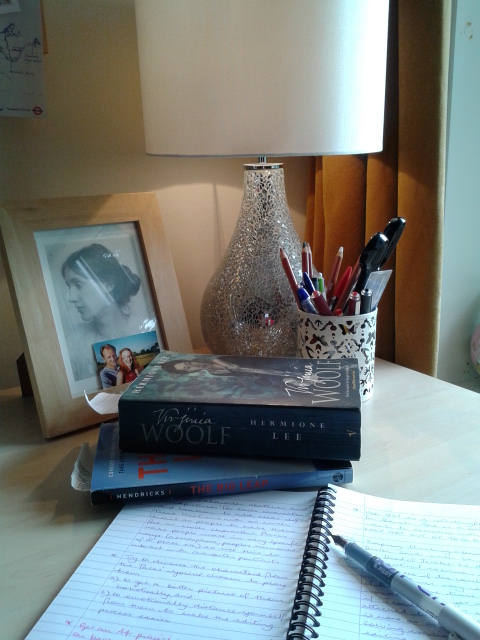
VW desktopFor today’s post, I thought I would bring you a little window into my creative mind.  Here are some of the things that are really getting my brain going at the moment.

This post from Kate Courageous really is causing a revolution inside my skull.  Imagine – learning to accept Nigel instead of kicking him?

Not practising enough?  Susan Piver has some interesting things to say about beating yourself up that are relevant whether you are talking about your meditation or your creative practise.

Found this lovely old post by Holly Becker on Decor8 about visual journals.  I really like this one about creating a lookbook too.

The New York Times on why handwriting matters.  Don’t say I didn’t tell you so.

The Handmade Home geniuses have their new 2015 planner out!  And yes, I am a total planner geek.  See also the fact that I have just discovered how Pinterest can feed my addiction!

I love Brainpickings.

I love iHanna’s blog, but I especially like this post – ‘Glue book where I collect happiness.’  Isn’t that a brilliant idea?  Collecting happiness between the pages of a journal.  Count me in.

This book.  I’ve lost count of how many times I have read this biography of Virginia Woolf, but right now, every time I pick it up, I am filled with a new rush of ideas, inspiration, and fixes for my novel.

I’m loving this book as well.

Well, that should keep us all going for a while.  Hope you have an inspired and creative week,

EF


Books about Writing


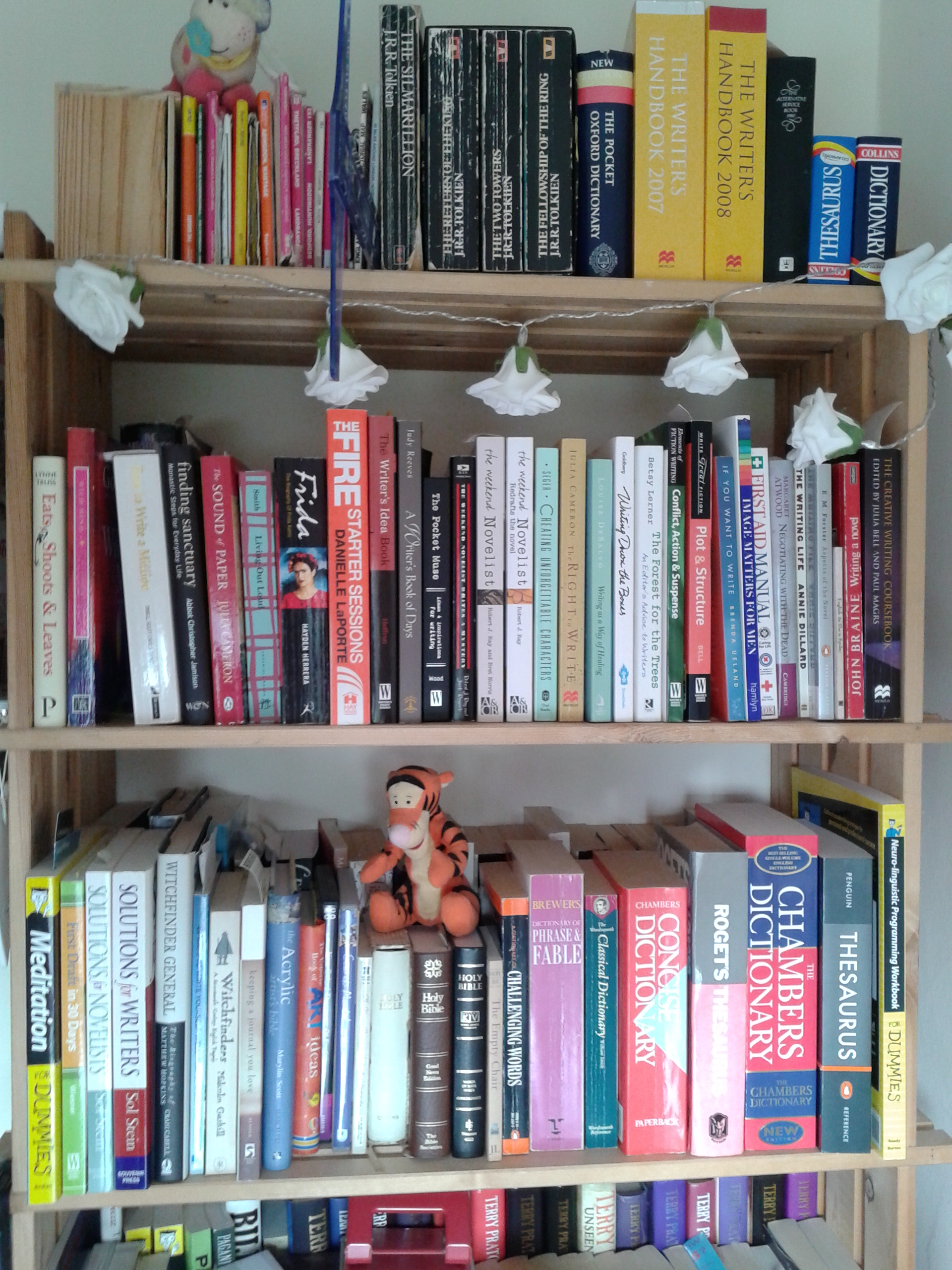
Bookshelf

My shelves of books about writing.

I’ve made a big decision.

No, not that one.

I’ve decided not to buy any more books about how to write for two months.

Now you may not think that’s such a hard task, but I am the sort of person who likes to buy a book about a subject in lieu of actually doing it. I’m a big one for research. If I’m going to take up some activity, say, crochet for instance, then I am the one who will chug down to the library and take out all known books on crochet, in order to find out everything I need to know about the subject. For two days I read avidly and become an armchair expert, without even touching a ball of wool. And then I lose interest and the books gather dust on the coffee table until they have to be taken back to the library before I get fined, no crochet having ever been done.

I’m the same with books about writing.

Once every three or four months, or so, I resolve ‘to take my work more seriously’. This usually involves going in to work with my husband, who is a University lecturer, and settling down in the campus library to tap away on laptop undisturbed. (Never mind the fact that I really struggle to visualise and write in that library, but there you are!)

To get to the library, I have to walk past a bookshop.

(If you love books, you just know where this is going to end, don’t you?)

Add to this the fact that this University runs one of the first, and still best, courses in Creative Writing in the world, whose alumni include the likes of Dame Hilary Mantel, Kazuo Ishiguro and Ian McEwan. You can imagine how good the bookshop’s section of writing is.

Let me tell you, it is hell to walk past.

This is the reason why the bookshelf beside my desk is so crammed with ‘How to Write’ books. I buy a book every time I decide to ‘get serious’, because of course, buying a book is a prerequisite of ‘getting serious’. I’ll read a few chapters. And then I get bored/move on/get ill/realise its shortcomings/decide I want to take up crochet instead etc. So now I have a bookshelf full of books about writing and how to write, many of which are very, very good, dozens of which come highly recommended by friends and in other books about writing, and almost none of which I have ever read cover to cover.

Just call me a butterfly.

Today is another of those ‘I’m going to get serious’ days. Today I am not going to buy a book.

This is partly because I am completely broke, and saving up for a new pair of spectacles because the ones I have got are close to useless and I’m fed up of having to take my glasses off in order to read.

But mostly because its because I need not to read about writing and how to write, but to actually DO it.

You can’t be a writer unless you actually write. And when you write, you learn far more about writing than you ever could from a book.

Books about writing are great. Don’t get me wrong. I’ve got a lot out of them. But there comes a time when you have to leave them alone and learn by doing.

I’ll let you know whether I stick to my guns or not, though I have to say I don’t think my groaning bookcase can survive even one more purchase!

Happy Creating,

EF

Choosing the Next Thing

go away bagI came back from Scotland with a marked desire to embark on a big project.  I suppose this isn’t something new, but is a desire I have been nurturing for a while.  It represents the need to get away from writing what are essentially someone else’s characters, and write my own.

I need something to get my teeth into, a full length novel to help me get my confidence in my ability to actually write something BIG back.  Its been a long time since I finished anything substantial in terms of original work, and I need this.

I was reading this article by justine Musk, in which she talks about some writing advice she was given by a teacher:

“Will writing this book change your life?” the teacher asked me. “If the answer is no, then that’s not your real baby.”

If we write our own psychodramas, if we write our way to self=knowledge, then I need something that reflects the place where I am in my life at the moment.  A novel that parallels my own journey.

I sat down with my notebook and wrote about the four projects I could choose from:  two Victorian novels, one Evenlode book, and one fantasy story.  Then I picked one of the Victorian novels and tried to write a little bit in the voice of the protagonist, mainly because I am struggling with making her a three-dimensional character, which is what has stymied progress so far.  And suddenly, everything made sense.

This novel is about being who you truly, authentically are.

And that is exactly where I am in life.  I am trying to own and be who I really am.

So in order to make the protagonist realistic, all I have to do is write her as me.  My voice, my problem, my reactions and interests.  Its not the way you are supposed to write a character, but it is a way into creating her in a believable way.  This way I can explore her voice and see the story from her point of view.  This pretty much buggers up everything I’ve previously written for this project, because its all third person, and varies the voices through each of the three main characters.  But that approach didn’t gel, which is why it didn’t get any further.  Now maybe I can find a way in.

And then all I have to do is to stick with it until its done.

I have no idea whether this will work.  Maybe this time next year I will have completed another Evenlode novel instead.  You never know.  What I don’t want is to still have four unfinished works in the pipeline by then.  I need to finish something.  So I’m going to ride this wild donkey side saddle, and see where it takes me.

Wish me luck,

Happy Creating,

EF.


Journal Friday: Using Memories

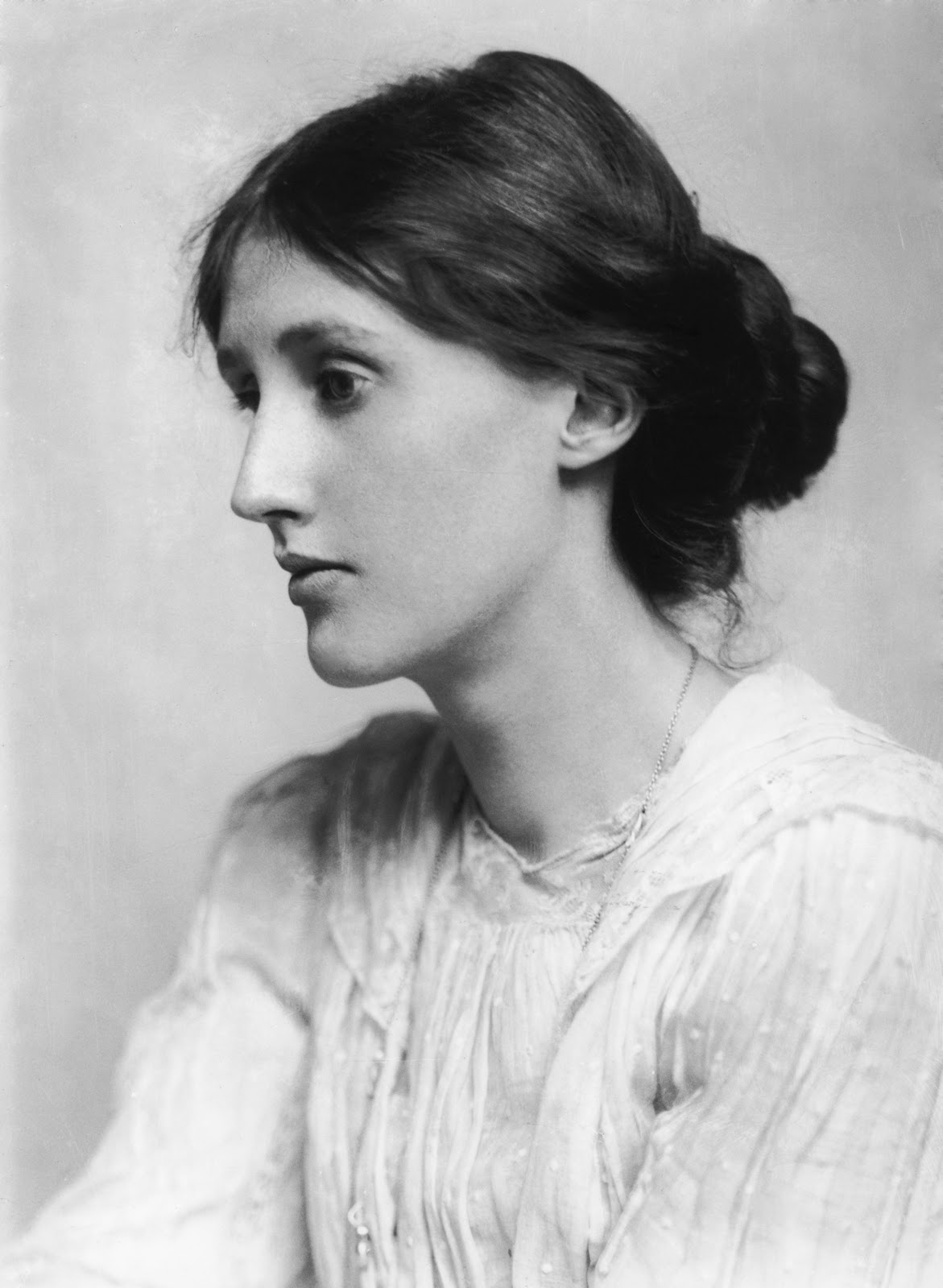
Virginia Woolf as a young woman.  I keep a copy of this portrait on my desk.

Virginia Woolf as a young woman. I keep a copy of this portrait on my desk.

I’ve been reflecting on using memories in my journal lately. This is not something I tend to do readily. I don’t like remembering, mainly because I have a lot of painful memories that I don’t like to revisit. Some people had happy childhoods that they like to relive. I didn’t. I’m always put off when writers encourage their students to draw on their childhoods for material:

“Start with your childhood, I tell them. Plug your nose and jump in, and write down all your memories as truthfully as you can. Flannery O’Connor said that anyone who survived childhood has enough material to write for the rest of his or her life. Maybe your childhood was grim and horrible, but grim and horrible is Okay if it is well done. Don’t worry about doing it well yet, though. Just start getting it down.”

Anne Lamott, Bird by Bird, p4.

That’s all very well, but what if you are not in a mental place where you can face your grim and horrible childhood? And yes, I know I am always ranting on about how creativity heals, but you need to be ready to make that leap, and I’m just not there yet.

What to do?

Well, I’ve been reading a brilliant biography of Virginia Woolf lately, (rereading actually) and its discussion of her reading methods prompted me to think about my own education. And remember.

Musing in my diary, I found memories I felt I could allow myself to revisit. I recalled how I set out to ‘spend three years reading’ – somewhat as Woolf intended to ‘read myself blue in the nose’ – when I embarked on my English and American Studies degree. I wanted the world of literature to open up to me. I wanted to bask in all its wondrous variety, from Spencer’s ‘Faerie Queen’, Alexander Pope’s satire, through the invention of the novel, to the Modernism of Woolf, Joyce and Eliot. I wanted to gulp down Byron and wallow in Shelly. I wanted to lose myself in Fitzgerald, Whitman, Hemingway, the Brontës and George Eliot. I wanted to read The Greats. In short, I wanted a ‘proper’ literary education.

What I got was an itinerary of a book per week for each course, three courses running over three eight week terms per year, for three years. And to about 70% of these books, a 50 minute seminar was allotted.

(Perhaps I was naive.  No, scratch that.  I was definitely naive!)

I remembered not the luxury of three years reading, when I looked back, nor even any real reflections on the books I actually read. It was on this course that I first read Woolf for example, her ground-breaking novel ‘The Waves’ in fact, but I don’t remember what I thought about it. I don’t remember if it moved me, or if I found it difficult. I remember no opinion of it from that time at all. I was too fixated on ploughing through every volume on the booklist, and how I could bluff my way through the seminar if I hadn’t managed to finish each.

I’m not a fast reader either. This scorching schedule of novel after novel, of play after poetry collection after essay collection, left me reeling. I could barely keep up, let alone reflect and absorb. Mainly my memories of this time comprise of the tyranny of the seminar programme, of grinding through every book, and hating the labour instead of loving the words and stories and imagery.

For me as a writer, this memory, or rather the understanding of an absence of memory, is an important one to explore. I was fortunate enough to have an education, but somehow, I kind of blinked and missed it. The lesson I drew as I wrote of my disappointment in my diary is that I will take the memory into the future with me, and use it to inform my future reading. I will never finish a book again without forming my own clear opinion of it – and writing it down. By finding my way back to a memory, I can change my reading practise in the future. And that change will inform my writing. Which is a good reason for reaching back to find this memory.

Using memories in your diary doesn’t have to be a process of self-flagellation. Or at least, not if you don’t want it to be.

You don’t have to write pages in your own blood. You can write down your happiest memories, or the most instructive ones, or you can choose not to use memories at all. Exploring the past can be a useful exercise. It can be a healing exercise, but tacking painful times should only be done when you are ready, and not before. Don’t force yourself.

Instead, write about memories as they occur to you, and explore why they have come up at that particular moment. Yes, record them as vividly as you can, if you can. Find instruction in them. And if the time is right, exorcise your ghosts. But not every entry has to be a process of emotional flaying.

Happy journaling,

EF