Tag Archives: journal

Why I don’t set Goals anymore

I love deadlines.  I love the whooshing sound they make as they fly by.

Douglas Adams

 Following on from my previous post about celebrating our creative achievements, I’d like to talk a bit about goals.

There is a lot of talk about setting goals and resolutions for the New Year around in the blogosphere at the moment.  I’m a sucker for all kinds of productivity systems, believe me.  I’ve got a cupboard full of Filofaxes, and I’ve read David Allen’s book ‘Getting Things Done’ more time than I can possibly count.  (I still don’t really understand it, though.  But that’s another story.)  Anything that requires a list, a planner, a diary, a system, I love it.

Except.

The thing about goals is that they are just another tyranny of the Scarcity culture, the trend in society that persuades us that we are not enough.

Meet your goals and you will be enough, they say.

Except.

What if they are not the right goals?  What if they are someone else’s goals that you are just pursuing because you feel you have to in order to please them?  What if life gets in the way and simply prevents you from completing them?

And.

Once you have achieved your goal, there is always, always another one.  One goal is never enough.  Because you are never enough.

What if you were enough?

What would you do if you couldn’t fail?

More importantly, what would you do if it didn’t matter if you failed?

The Catch-22 is this:  Our success-oriented culture tells us that we must have goals in order to be successful.  (For a very narrowly defined value of success, that is.)  If you don’t achieve your goals, you are a failure.  If you do achieve your goals, then you have to have more goals.  We are on a twenty-first century hamster wheel.

Let me illustrate:

Your goal is to write a novel.  How do you measure that goal?  Is it to write 50,000 words, as NaNoWriMo would have it?  Is it to complete a first draft?  Is it to get to a drafting stage where an agent accepts your work?  Is it to get it to the drafting stage where an editor is satisfied?  Or to publication?

And when you get there, what next?  Write another novel?  Does this one only count if it wins the Man Booker Prize?  Or if it tops the Amazon bestseller lists?  Or if you make your first million from it?

You see what I am getting at?  When do you say ‘when’?  When is it ‘enough’?  When does the goal, the To Do list, end?

Yes, goals motivate us.  They help us to get things done.  They help us build businesses and careers.  They help us expand our expertise, our creativity, our skills and range.  As creative people, goals help us to plot a course of where we want to go with our talents, what we want to explore.  And that is all good.

Except when it isn’t.

Intentions

The Douglas Adams quote at the top of this post says everything I feel about goals.  For me they are stressful, and because of my health, I need to eliminate all the stress from my life that I can.  That’s why I set intentions.

Intentions are gentler.  Intentions allow room to grow and explore.  They don’t stop me from achieving things.  They allow me to achieve far more, in fact, because they allow me space to find out more about my creativity than a narrow, specific goal might.  They also take account of the times when my health does not allow me to pursue timed objectives.  Intentions are better for my kind of creativity and my own personal challenges than goals.  And they take account of who I am as a whole being.  They allow me and my creativity to grow at a slower and more mindful pace.

If you are wondering what an intention might be, how about this illustration:  This year I decided on the Intention to make our home a calmer place filled with light and peaceful colours.  Now, I could make a whole To Do list based on this intention:

  • Paint bathroom white
  • Buy new living room rug
  • Sew new curtains and cushions
  • Declutter every room

And so on.  These might be classified as goals.  They might even be timed, with one goal set for every month of the year.

Instead, this Intention can evolve over the coming months.  Each of these items may indeed be included in the things I do to fulfil my Intention, but they are part of a wider, more fluid way of living that allows for evolution and expansion.  Intentions don’t stay still.  They move and change shape.  They allow me to go at my own pace, a pace that I can afford, both in terms of personal stress, time and finance.  If I decide an action doesn’t fit with my Intention, then I am at liberty not to do it.  And I know I am not going to wake up the morning after I have put up the new curtains and realise they are completely horrendous in the light at this time of year!

Perhaps the two things I like most about Intentions are that they are:

Not static

Slow.

Perhaps you might feel that Intentions are a luxury that you cannot afford in your time-pressured, stressful existence.  If you feel that way, I invite you to consider seriously how you are living.  If you are all rush-rush-rush, how are you ever going to have time to notice and experience your life as it passes?

Journal Exercise:

In the next few posts I am going to talk about the process of setting (particularly creative) intentions.  And it is a process, something that evolves and takes time.

In the meantime, take some time out with your journal to think about what goals mean for you.  Are you one of those people who always fails with their New Year resolutions?  Do you have goals, and if you do, do you achieve what you set out to do?  Do you consistently set them so high you can’t but fail to achieve them, or so low that you don’t value them because they take no effort to achieve?  How do you use goals to beat yourself up, to tell yourself that you are not good enough?  Where do you fail, fizzle out, fall off the waggon, and do you know why?

Alternatively, how do goals motivate you?  What have they helped you to achieve?  How do you feel when you complete a goal –are you proud of what you have done, excited about the next step, satisfied that you did what you set out to do, or disappointed because you don’t feel as if the result is quite what you expected or wanted?  Was it the right goal for you in the first place? (Indeed, whose goal was it?)

While doing this exercise, be kind to yourself.  Don’t judge.  Be gentle.  Treat yourself as if you were a dear friend whom you want to support to the utmost.  Be patient.  Don’t rush.  You are not seeking to punish yourself.  The goals have done that effectively enough already.  You are on the journey to find a new way of being.  A new way of sparking your creativity and enriching your life.

Happy Journaling,

EF
 

Reflecting on our Creative Achievements

2010-12-25 13.48.32

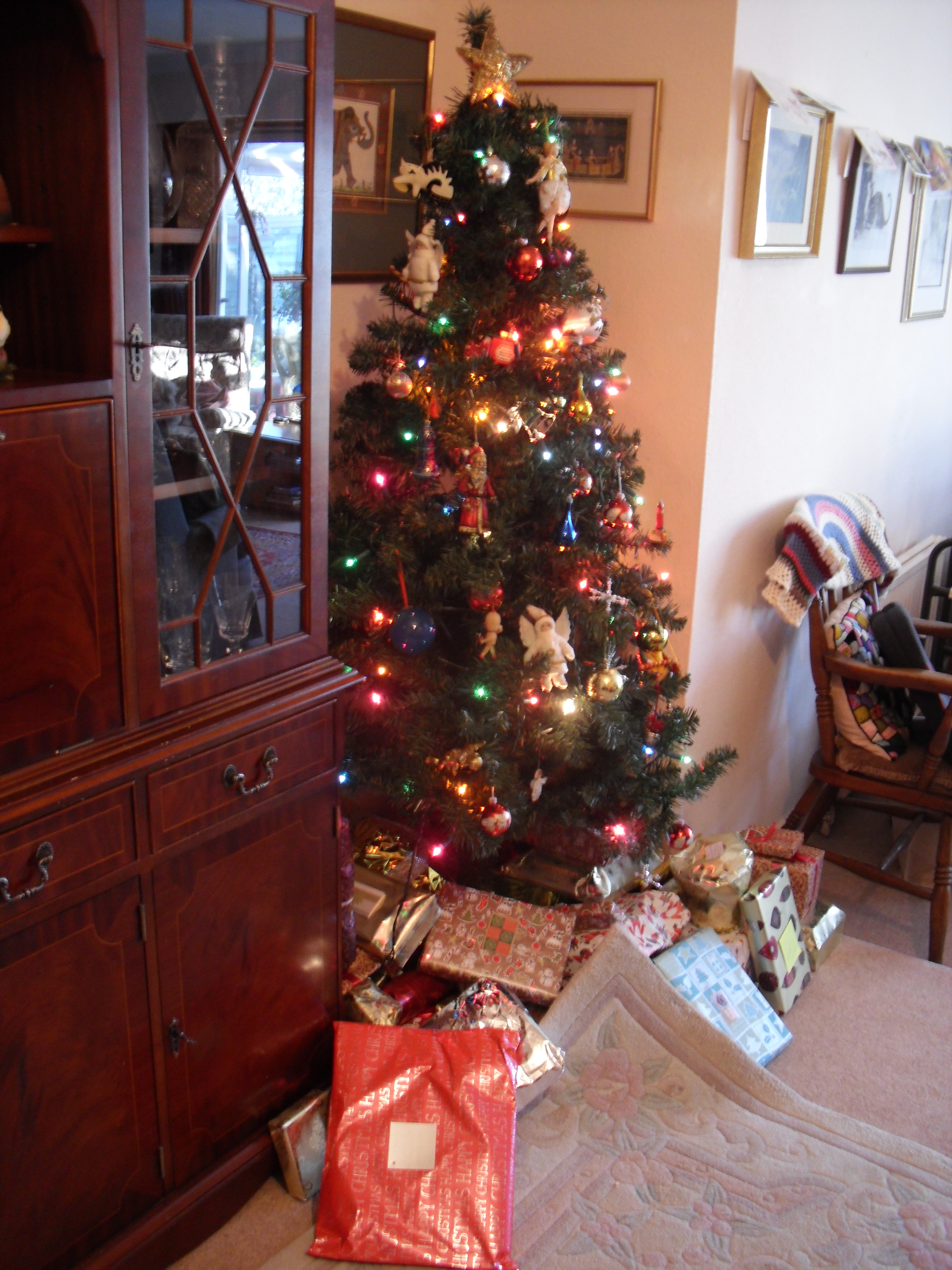
My mother-in-law’s mad Christmas tree. Apologies that the carpet is all ruckled up!

Christmas is coming.  We are all rushing around panicking about what to buy Great Auntie Flossie, trying to get trees up and mince pies made.  And once all the kerfuffle dies down, we’ll be trying to formulate New Year’s Resolutions while our heads are still spinning from the tinselly onslaught.

The blogs I follow are already jam-packed with ideas for resolutions and how to plan your goals for next year.

Aren’t we exhausted enough?

Let’s just take some time to stop and reflect.  To consider what we have achieved this year, before we start pushing ourselves about next.

I don’t think we take enough time to recognise and celebrate what we achieve. We are constantly encouraged to move on to the next thing, the next goal, always more, more, more!

Because we are never enough.

Yesterday I came across Dr Brene Brown’s book, ‘Daring Greatly’, in the library.  I have read and benefitted greatly from her earlier works, but I had avoided this one because for some reason I had got it into my head that it was about parenting, which isn’t exactly relevant to me.  I was wrong.  The first chapter, on Scarcity, had my head spinning!  I highly recommend you read it.

As writers, scarcity is a constant problem.  After all, in such a subjective realm, how can you measure enough?  I wrote recently about the problem of owning yourself as creative.  This is intimately linked to the problem of enough.  How can you know when you have done enough, produced enough, published enough?

I think one way to tackle this sense of dearth is to recognise and celebrate what we have done.

This year I have started this website, something I really didn’t think I had the guts to do.  This is my 86th post.  That’s a whole lot of words.  A big achievement?  You’d better believe it!  I have published over 40 fanfics too.  I have put myself out there.

This is not blowing my own trumpet.  This is stating the facts.

I am proud of what I have made this year.  It may not tally with the list of goals I made in January, but I’m okay with that – I’ll tell you why in the next post.  I’ve been telling myself I didn’t achieve a lot this year, but actually when I sit down and reflect on what I’ve done, I’ve moved mountains!

Journal Exercise:

Before you get too lost in the melee of Christmas, set aside some time to take stock.  Sit down with your journal, and a glass of wine if you like.  Perhaps light a candle, and put on some gentle music.

Think about what you have done this year.  Don’t look at your list of goals and resolutions.  Don’t think about all the things you planned to do, and didn’t.  Think about all the things that did get done, and the unexpected achievements too, things that came out of nowhere, the gifts the Universe has given you.

Count everything, from getting to see your favourite actor in a play, to passing that exam, from painting your biggest picture yet, to being in the village Christmas Panto.  Maybe you had a poetry collection or a novel published, exhibited your art, won a competition, or maybe you read out your first poem in public, or tried painting or drawing for the first time.  No matter how big all small, list everything.  Think about all the creative things you did, the cakes you made, the dances you went to, the pumpkin you carved, the costume you made for your kid’s school play.

Be proud of yourself, of where you are now.  Do it for yourself.  Savour it.

Because you are enough.

Happy Reflecting,

EF

Journal Friday (or rather, Thursday): Samhain

treepumpkinHappy Halloween everybody!

This week, and today in particular, journalling seems to be a particularly apposite subject, which is why you are getting a Thursday post instead of a Friday one!

In ancient tradition, the festival of Samhain, or Halloween as we now call it, was not simply a Feast of the Dead.  There is so much more to it than that.

Our ancestors celebrated the last harvest festival at this time, the final moment before the real onset of winter in Northern Europe.  The main crop  harvests had been gathered in.  Now was the time to choose which of the beasts on the farm was likely to survive the winter, and which were too old or too sick to waste valuable fodder on.  Food had to be laid in for the coming cold months, for the next crops might not be ready until June or July at the earliest.  So the animals that had outlived their usefulness had to be slaughtered and salted for meat, and the perishable parts eaten quickly.

It was not just the animals that faced mortality at this time.  For the majority of human history, we have faced high mortality rates in winter, and even now, you are more likely to die in January than August (click here.)

As the weather deteriorated, and darkness closed in, people were forced inside to do more meditative tasks.  Winter is necessarily a more interior time, and this means both literally and metaphorically.  There is even an energy change – plants retract as greenery dies off, while the roots go dormant in the cold soil, recharging in preparation for the growth spurt of Spring.  Some animals hiberate, and for good reason.  It is no coincidence that there are many myths associated with this process, most notably that of Persephone’s sojourn in the Underworld.

We live in a 24/7 world adorned with electric light and heating, but if you suffer from Seasonal Affective Disorder, you will understand how human biorhythms fluctuate over the seasons, despite our best efforts to pretend we are immune.  Most of us cannot afford to spend 6 months of the year in warmer climes, and if we could, it would not necessarily be good for us.  We need downtime too, just like the plants and animals from which we have evolved.

We need to withdraw into our interiors, our homes and our souls, to curl up beside a crackling fire under fluffy blankets, with hot drinks, to rest our bones.

The active, exterior period of the year is over.  Now we concentrate on the swift approach of Christmas, a time for family, and New Year, and time for assessing our lives and where we want to take them next.  Prior to the rush, it is good to set some time aside to contemplate our dark interiors, to work out what we really want, and perhaps, what we are most afraid of.  Some elements of our lives naturally die off, whilst others are hibernating, or are seeds lying in the ground awaiting the rush of Spring.

We usually choose New Year in January to make resolutions and start new habits, but for the Ancient Celts, Samhain was the new year, and they valued this time of contemplation and stillness.  The Scandanavian Viking cultures observed ‘Winter Finding’, also a period of contemplation.   Instead of letting your plans arise out of the post-Christmas exhaustion and a haze of overindulgence, October/November can offer more time and space to think.

Samhain Journal Exercises:

Make space to be alone.  Settle down in a warm room, light a candle, put on some soft music if you like, and have a glass of apple juice or red wine handy, along with your journal and favourite pen.  Rest and relax.  There is no pressure.  This is time for you.

Think over the past year.  What were your goals?  What were your successes?  Did you experiences failures or losses? Write about them – and what you have learnt from them.

Samhain is a time of natural wastage, of matter decomposing to feed future growth, a time of endings that feed beginnings.  What has died for you this year?  What relationships, habits, activities have fallen away?  Are there elements in your life that you would like to release?  Write about them.

If you have lost a loved one, take time to remember them in your journal, to write down your favourite memories.  If you had a difficult relationship with them, write about your ambivalent feelings.  People say it is wrong to speak ill of the dead, but it is far more damaging in my experience to deify them into saints that they were not.  Do not judge yourself as you write.  Lay your pain, your loss, your grief, on the page if you need to.

The apple is the fruit of Samhain.  Inside its tasty flesh are five seeds.  What seeds would you like to plant into the dark earth for the coming year?  Take time over this – it may take you the whole of ‘Winter Finding’, or the run-up to Christmas, to decide what new dreams you wish to plant.  Don’t rush it.  You are setting your intentions for coming months.  You may like to think about this post from Kelly Rae Roberts as inspiration.

Draw or collage pages to represent the past year, and what you hope for in the coming year.  Don’t worry about how good your pictures are – they are for your eyes only.  The point is to root images of your intention in your subconscious, which doesn’t care if you are Rembrandt or not!

Happy journalling,

EF

Journal Friday: Derek Jarman’s Sketchbooks

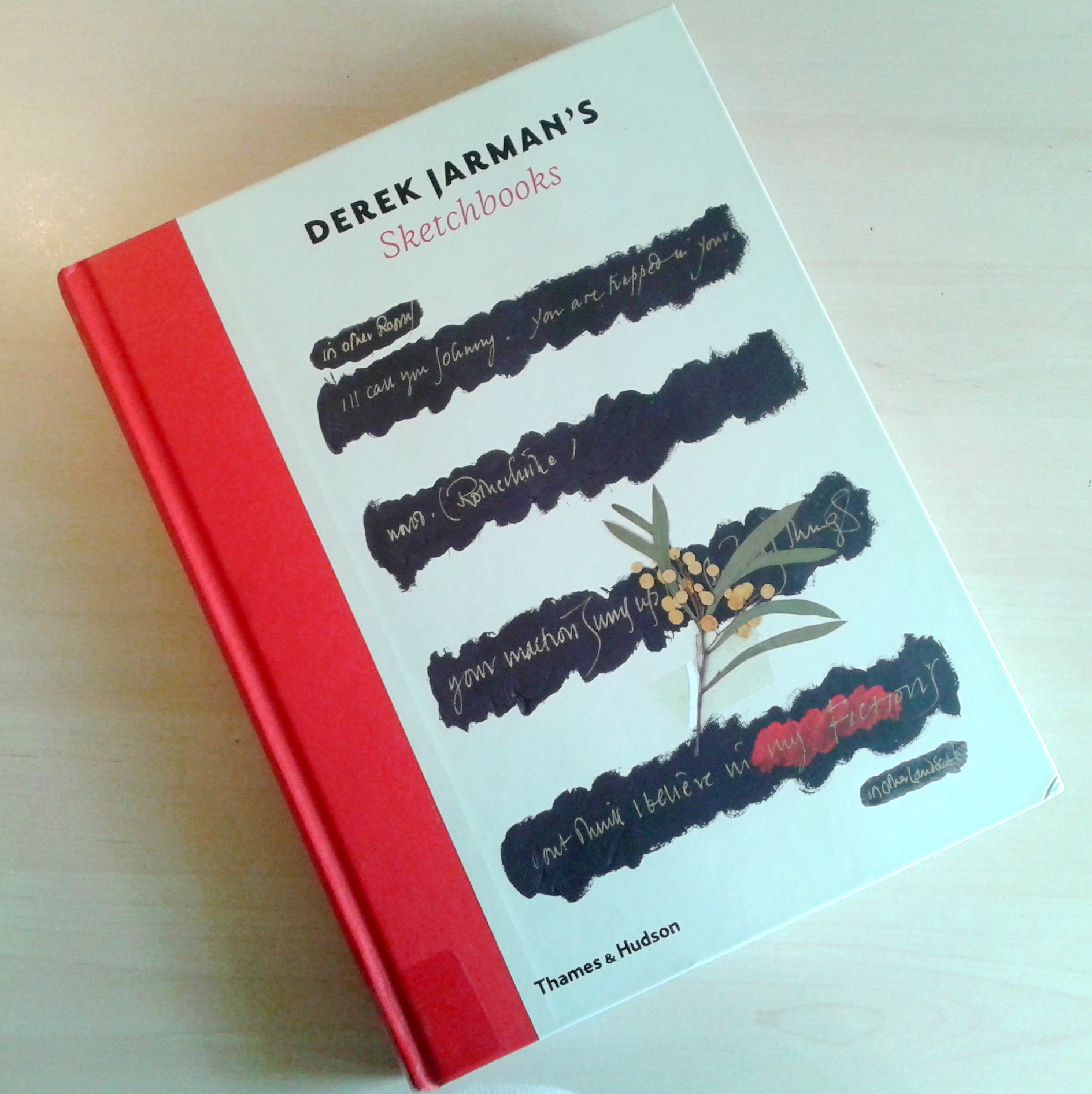
jarman diariesIt’s been a very busy week, and I’ve been diving into all kinds of exciting new and inspirational activities, including the UEA Literary Festival.  I’ve also been submerged in the magical world of Derek Jarman’s Sketchbooks, edited by Stephen Farthing and Ed Webb-Ingall, and I want to share the inspiration I’ve found in them with you.

derek_jarmanIn case you have never heard of Derek Jarman, he was a fabulously talented artist, film-maker, designer, writer, gardener and Gay Rights activist whose career was tragically cut short by AIDS in 1994, aged 52.  He directed music videos for the Pet Shop Boys and designed the sets for Ken Russell’s landmark 1971 film, ‘The Devils’.  At his home in Dungeness, he created one of the most haunting modern gardens in Britain, one that I am deeply in love with.

I first became aware of Jarman when I saw his film, Caravaggio (1986), starring Nigel Terry, Sean Bean, and Tilda Swinton in her first film role.  Later, in 1991, I wept my way through his heart-breaking ‘Edward II’, an adaptation of Marlowe’s play that spoke of Jarman’s outrage at homophobia in Thatcherite Britain.  These are not easy and accessible films.  They are, however, fabulous to look at, and very moving.

When I came across this edition of the sketchbooks in the library the other day, quite by chance, I had no idea that Jarman was a committed visual diarist.  The sketchbooks themselves are large – family photo album sized – and each cover is decorated in black and gold, making a slightly varied but pleasing continuity.  Inside them, Jarman uses ephemera, calligraphy, drawing and painting, poetry, pages of film scripts, actors’ head shots from casting sessions, clippings from newspapers, reviews, photographs of friends and colleagues, bits of feathers and pressed flowers to document his life and each of his projects.  The sketchbooks contain his thoughts on everything from his garden (there is a carefully drawn planting plan), to his illness, to sex, history and death.

Jarman made a series of paintings, the ‘GBH’ series, of black on gold abstracts, inspired by Goya’s Black paintings, and a film called ‘Imagining October’, which arose from finding Sergei Eisenstein’s own copy of ‘Ten Days that Shook the World’, the famous book on the Russian Revolition, and on which Eisenstein had based his ground-breaking film, ‘Battleship Potemkin’.  Jarman had been shocked to discover how much of the book had been redacted with blacked-out text by the Communist authorities.  Both of these concepts are reflected in the sketchbooks, where you can see Jarman working on the idea of black bars with gold writing, seen on the cover of the volume.  Jarman’s anger at the political situation for Gays in the UK shines through these blackened pages.

One of the things that particularly strikes me is the simplicity of the layouts he uses.  Even when he is writing pages of text, making notes or journalling, there is a sense of space.  Nothing is cramped.  He spreads out, not denying himself room to work, enjoying the clarity of white space around his words and images.  This is something I will definitely take away. My diaries always feel cramped.  I always feel that every inch of space must be used, because materials are scarce.  This denial of room to grow is cramping my creativity, something I need to break out of.

I want to draw inspiration from the sheer range of activities Jarman undertook, too.  For him, there is no line in his sketchbooks between diary, writer’s notebook, sketchbook, planner or scrapbook, anymore than there were boundaries between the creative areas he worked in.  Although he was primarily a film-maker, he was so many other things as well.  Jarman teaches me that I don’t just have to stick to writing.  I can follow where ever my Muse leads me.

There are no limits to what we can create, only the ones we impose on ourselves.

Things to try:

  • See if you can get hold of a copy of Jarman’s sketchbooks.  It isn’t cheap – £28 – so maybe you can order it from your library.  You may not like his style of modernist art, but you can appreciate how he puts every aspect of his life into these visual journals to make a record of his thinking.
  • Use your own sketchbook or diary as a kind of studio to record everything you do and think about a particular project.
  • Collect clips, postcards, photos, anything relevant to stick in – Jarman even stuck a ten pound note into his!
  • Luxuriate in space.  Allow each of your drawings, paragraphs, or collaged pieces to bask in a frame of white space, so that they can shine out, and be seen for what they are.  Don’t fall into my scarcity trap – there will always be more paper.
  • Decorate the covers of your sketchbooks or journals in a similar way, as Jarman did, each one slightly different, but using the same colours or materials.  Maybe you could do ‘series’ of notebooks, with matching covers, for different projects.  Don’t be precious about them, however.  Jarman once stuck a heavy bronze seal on the front of one of his books, but it was too heavy to carry and got in the way, so he ended up prizing it off.  The scarred gold cover is even more interesting as a result.

Happy journalling,

EF

Journal Friday: The Emotional Swingometer

go away bagThe Creative Life is a carnival ride.  Don’t let anyone tell you otherwise.

Right now I am on the rollercoaster.

Thank goodness for my diary.  If it were not for that little Moleskine notebook, I would be a complete basketcase.  Actually, I’m probably still a complete basketcase, but I feel better about it, because I write it all down.

The days when I am completely sure I have squeezed every last drop of juice out of Johnlock.

They days when I can’t stop writing Johnlock.

The days when I have so many ideas for stories that I don’t know what to do with them all.

The days when my imagination is a barren wasteland.

The days when one comment has convinced me that my work is utter crap and I owe it to the world to never write again.

The days when a stroppy comment has filled me with so much anger and resentment and martyrdom that I am going to passive-aggressively hold the entire fandom to ransom by never publishing another Johnlock story again because frankly those bitches are all so ungrateful.  (as if they’d even notice.)

The days when that novel I am writing is the greatest thing ever written.

The days when that novel is so bad I am ashamed to even walk into the same room as my laptop.

The days when reviews flood in, and I am Queen of the World and Goddess of All Writing and my ego is the size of Jupiter.

The days when the reviews flood in, and they just aren’t praising me enough, they’ll never say enough good things about me because I am so bloody wonderful, which of course means that secretly I know without doubt that I am an absolute fraud and completely useless.

The days when the reviews flood in, and I am cowering under my desk in shame that anybody could think that story I wrote is readable.

The days when I am satisfied because I have written something that I think is good.  Good in the way that tapping on solid mahogany with your knuckles is good.  Something that is out of my own real, original voice.  Something that I am satisfied with.

The days when the fandom bores me to tears, or irritates the hell out of me, and so does my writing.

The days when I know my writing is completely stagnant, and I need to progress onto the next stage but I don’t know where to start.

And the days when I just sit down and write.

Before, or after I have written some fiction, I take a little time to reflect.  Sometimes I write in my journal to get my juices flowing, the way Morning Pages are supposed to.  Sometimes I write afterwards, to reflect on where I am going, on my emotional equilibrium (or lack of it).

Usually, when I have published a story, I watch the comments coming in, and try to write through my responses, the paranoid ones and the egotistical ones, the happy, the grateful and the furious.

My journal helps me keep my writing experience in perspective.  There isn’t a lot of perspective about our own creativity, lets face it.  We are all reared to be perfectionists, to rule ourselves out in the basis of not being Picasso, or to believe ourselves to be Dickens without needing to do the hard work.  It is so hard to be objective.

My journal helps me remember that the only life I am saving when I write is my own.  In the great scheme of things, this is not battlefield surgery.  Or, if it is, it is on my emotions alone.  That is why objectivity is important.

I need to remember that my writing is not about what other people think.  It’s about me.  At its very core, it is about healing my own wounds. 

Even if I never publish another word, I will still keep writing, partly because it’s a compulsion, and partly because it mends my soul.

That is why keeping a journal is crucial for every creative person, whether you are amateur or professional.  It reminds you of the WHY.

How do you use your journal in your creative process?

Happy journaling,

EF

Journal Friday: Wardrobe Planning

More dashBecause I’m ill, I am not able to work, and that means everything I do has to be on a budget – energy-wise and money-wise.  As a result, planning is my friend.  If I have thought about something beforehand, it makes everything so much quicker, easier, and less worrying.  That includes clothes.

I was looking at this fantastic dressing room today, and was shocked that anyone could have that many clothes.  If I did, I’d never get dressed at all because I wouldn’t have the energy to decide what to wear.  I have a small wardrobe, partly on purpose, because cutting down options means less to worry about, but also because of money.  I just can’t afford to spend lots.

Mostly I buy my clothes from my catalogue, on a monthly payment basis, and annually, with my birthday money.  Relatives are kind enough to donate to my clothing fund every year, and I plan very carefully what I am going to spend it on.  I make sure all my big purchases colour co-ordinate, and concentrate on one core colour and two accent colours.

Currently navy is my core, and bright red and bright (lime) green are my accents.  At the moment, though, I am feeling a pull towards charcoal grey, and since I bought a dark grey sweater in the sales a few years ago, I’ve been thinking I might go in that direction a little.  Plus it seems to bring out the colour of my eyes.  (It’s really hard to work out what colours I can wear these days, as I am growing out my coloured hair and letting the grey come through.  I didn’t think this measure, taken because I just can’t be fussed with home dyeing anymore, would make such a big difference to my complexion, but it does.)

grey croppedAnyway, the way my brain is, I can’t keep all this information in my head anymore, so I have started using my journal to plan my outfits.

I have an ulterior motive here too.  I haven’t been able to get past the creative block I have with my art, and I find that if I just do a scribble in my journal, it doesn’t have to perfect.  It is just a gesture drawing with a few colours to note down information in a graphic form, and it cons Nigel into thinking what I am doing is actually not painting at all!  Clever, eh?

black hat litUsing my journal in this way is a helpful planning tool.  It helps me to work out what extras I need in addition to what I already have, and to budget for them.  It also allows me to think through how I really want to look for a particular occasion, such as a wedding.  I am also finding it is changing the way I feel about my clothes.  I’m finally at the age when I can get away with wearing very classic styles, and you can see from my sketches that there is a distinctly ‘50s vibe going on.  I’ve always been in love with Dior’s 1947 New Look, and it looks like that is where I am going.  I’m intend to grow old elegantly as well as disgracefully!

How could you use your journal to plan your life or your look?

Happy journaling,

EF

Journal Friday: The Structuring Absence

elephantWhen I did my English degree, way back in the late ‘80s, Literary Theory was all the rage.  I don’t know if they even study it now, but it was the thing then.  Literary theory is the place where literary criticism, philosophy and linguistics meet.  Throw in a good handful of politics, sexual politics and psychology and you have a seething mass of academic pretentiousness that no one with a reasonable sense of humour should be subjected to.  Literary Theory goes in fashions like everything else, and the Next Big Thing then was Postmodernism, which leant heavily on Poststructuralism and the work of theorists like Jacques Derrida and Roland Barthes. We read Thomas Pynchon and Paul Auster and pretended to know what they were on about.  We were encouraged to use words like signifier (word), signified (meaning), and problematize (make something difficult).  I find it deeply satisfying that Roland Barthes’s death resulted from being run over by a milk float.  It couldn’t be more pedestrian (sorry for the pun), or ironic, could it?

Now why am I ranting on about all this pretentious bollocks when I should be talking about journaling?  Well, let me explain the one phrase that poststructuralism gave me which I still cherish today:

The Structuring or Signifying Absence

This is actually another way of saying ‘The Elephant in the Room’.  It is the thing that is never spoken of, yet which underlies and give shape to everything that happens around it.  It is the empty space which is significant, which speaks of something profound.

It is ‘that which is left unsaid.’

Take a very simple example.  In Daphne du Maurier’s novel ‘Rebecca’, the character of Rebecca de Winter and her untimely death are the signifying absence.  Rebecca structures the whole novel, and the behaviour of all the characters revolves around her, even to the extent that we never learn the heroine’s name, because Rebecca is more important in everyone’s mind, including her own.  Rebecca is a tangible presence, even though she no longer exists.

Actually, this isn’t strictly a good example because its too overt.  Take the Wooster novels of P G Wodehouse.  Set in the 1920’s and ‘30’s England, they almost never mention the Great Depression or the First or Second World Wars, and yet the fact that as readers we know that the ridiculous events are going on against this backdrop makes them all the more ludicrous.  Wodehouse does lampoon the figure of fascist leader Oswald Moseley at one point, but basically, his choice is to exclude politics.

The point of the structuring absence is this:  that what the writer chooses to exclude is just, if not more, significant than what is left in.

How does this relate to writing a diary?

I am thinking right now of gaps.  I have been keeping a journal for nearly 40 years now (ouch!), but there are plenty of gaps.  And I am sure those gaps say as much about my life as the parts where I was writing.  They usually happened for two reasons:

  1. I was having a brilliant time and was too busy living life to bother writing everything, or anything, down.  My honeymoon is a great example of this.  I was determined I was going to record every detail of our tour across the south of England, but when it came to it, I was having too much fun!  So all I have is the photos we took.  And I think that is very significant.
  2. I was in a state of such terrible depression that I was incapable of writing.  This is far more common.  There are several gaps of months in my diary during my early 20s, when I was struggling with clinical depression so profound that it threatened my life, and it was impossible for me to write at that time.  So I didn’t.

What we don’t write about in our diaries is just as significant as what we do.  Every diary entry is an act of self-censorship, whether we know it or not.  By choosing what we write about, even if the choice is unconscious, we are in fact editing, fashioning a narrative of our lives structured by our choices and the responses we have to our life events.  Just as Wodehouse chose, out of what I believe was sheer political naiveté, not to write about politics (to his great cost as it turned out), we may choose not to write about our cancer, our son coming out as gay, our struggles with debt, even though these are massive issues which shape our lives in profound ways.  We may even choose at times simply not to write at all.

When I don’t write in my diary, I am always aware that something is going on for me.  I may be in denial about some issue that is obsessing me, or I am too sick to write, which is an issue in itself.  Either way, the gaps between dates in my journal are a red flag.

But they are not a reason for self-flagellation.

When I was a kid, I thought that you had to write a diary every single day.  A lot of people believe this, but very few manage it, and most give up because of this misconception.  Don’t beat yourself up when you have non-writing periods.  Accept these empty spaces as significant, as structuring absences, and consider what they might mean for you.  Above all:

Write when you need to write.

Journal Exercise:

At the moment a big gap is developing between today’s date, and the last one I wrote in my journal.  I know why this is.  I am ill.  Staring into space or lying on the sofa watching Harry Potter yet again is about as profound as I can manage right now, and I’m okay with that.  I will go back to it when I am ready, and because I don’t make a big deal about it, I won’t be creating any blocks, so the gap will be much smaller than it would have been otherwise.

Are you creating a journal gap, a structuring absence, consciously or not?  Take some time to contemplate why this might be happening for you – you don’t have to write about it in your journal, just allow it some kind and accepting thought.  It may because you are hung up on ‘doing it right’.  It may be because there is a HUGE elephant in your life that you are simply not ready to address yet.  It may just be because you are present in your life, too busy or, what a delight, having too much fun!

Whatever is going on for you with this, make peace with it.  Be accepting of yourself.  You might even want to write something in your journal to that effect:

‘I am not writing much here at the moment and I’m okay with that.  I’ll get to it when I need to.’

You may not want to write in the ‘why’.  Perhaps that is better left until you are ready to write again.

And if you are writing regularly, and getting lots out of it, make sure you relax into it and don’t make it an OUGHT.

Happy journaling,

EF

Journal Friday: Reflecting on Creative Blocks

paintbox

So, if you read my last post, you will know that I am increasingly drawn towards drawing and painting at the moment.  This is my current creative season and I want to honour it.  So today, no doubt, you will be expecting me to deluge you with jpegs of the beautiful pictures I have been creating.

Yeah, Right.

Nigel has been hard at work again.  I have produced the sum total of zero drawings in the last two days.  Yesterday I couldn’t even bring myself to go into the study to get out my sketchbook and paints.  The blank page suddenly seems terrifying.  I can’t even doodle.  How the hell have I lost the ability to doodle, for Gods’ sakes?

Bit not good.

This, my friends, is where the journal really comes into play.  I sat down with my trusty moleskine and pen, and thought about my childhood memories of drawing.

I used to draw all the time.  It was what I was known for, amongst family and friends.  I was never without a piece of paper and a pencil.  I made little books and illustrated them.  I wrote stories and illustrated them.  I wrote stories about my favourite TV programmes, like ‘Blakes 7’ (remember that one?  I had a terrible crush on Paul Darrow) and drew the characters all the time.  (If only I had known about fanfiction and fanart then!)  I was obsessed at one point with the Tudor monarchs, and copied their opulent portraits and clothes with fibre tipped colouring pens.  Then I got into the Ancient Egyptians, and copied their sideways style of representation.  I even copied the drawings of E.H Shepherd in the beautiful edition of Kenneth Graham’s ‘The Wind in the Willows’, which my father gave me – it was his favourite book.  And I painstakingly illustrated all my school work (except the Maths, of course, because that was too serious, which was probably why I was never any good at it.)  In other words, I spent hours absorbed in transferring images from my head onto the page.

What happened?  Senior school art classes.  Hours of drawing still lives of pots and pans. Teachers who made us draw boring subjects, and never gave us any information about technique.  I’ve learn everything I have ever learnt about art and how to use paint from copying, which my art teachers said was the worst possible sin.

(But I am getting ahead of myself, I’m supposed to be thinking about my childhood drawing.)

As a kid, art was my obsession, but it requires materials, and they were in short supply.  For paper, my dad bought home gash computer paper from work, the perforated kind that comes in a concertina, with holes along the edges, and with about the same handling quality as IZAL toilet paper.  I was occasionally bought coloured felt-tipped pens but in the 1970s they were rubbish, and the black ones were invariably dried out before they were even used.  At least 25% of the pens in the pack didn’t work within about two days of having them, and you had to conserve those that did with fiendish vigilance.  There were occasional gifts of watercolour pan boxes, but they were very low pigment, and anyway, painting in your bedroom is frowned upon by most mothers because it is messy.  And there wasn’t anywhere else to paint.  What I am trying to say is that I grew up yearning for those huge bottles of poster colour paint that stood on the trolley in school.  The thought of being able to just splash paint about willy-nilly was ridiculous.  My parents wanted to encourage my artistic side, but they didn’t have the disposable income or the mindset to invest in good raw materials for it.

The result is that the scarcity of my childhood has bloomed into a scarcity paranoia in adulthood.  As soon as I was earning, I went out and bought decent art materials, but then I couldn’t make myself use them.  I have drawers and boxes full of sketchbooks, pastels, inks and paint tubes that have never been opened because I still have the mindset that they have to be conserved.  I can’t waste a thing.  To the point where I can’t use a thing.

None of this would I know and understand, were it not for exploring it in my journal.  And in my journal have come the little glimmers of a solution, a plan to tackle my stuckness with baby steps so minute that I can fool Nigel into thinking I’m not even putting pen to paper at all!  Slowly and gently, I will con myself into the belief that making a tiny drawing is safe.  And then I will con myself into making a bigger one.  Until one day I will fulfil my dream of illustrating my own novels, and making huge abstract expressionist canvases like Rothko and Pollock.  But not yet.  To begin with, I will throw out everything I learnt in art class, scrunch up my eyes and begin again, as a child.  It will be hard, but I can do it.  I did it with the writing, after all…

Journal Exercise:

Are you also struggling with a creative block?  Is there something you used to do, and would like to do again, but are afraid to?  Perhaps you are just stuck and you can’t get out of your own way.  You probably don’t even know why.

Get out your journal and take a few deep breaths.  Close your eyes and let yourself fall backwards through time. Feel yourself become a child, doing that thing you loved do and don’t do anymore, whatever it is.  Immerse yourself in that memory.  How did it feel?  What was so satisfying, enticing, transcendently joyful or just effortless about it?  How did splashing paint on paper, sewing a doll’s dress or dancing to the radio help you express yourself?  Connect with the fun, the pleasure, the satisfaction.

Now write about it.  Take time to write out all you can remember about doing that creative activity, and take the memory from as early an age as possible.

Now take another deep breath and continue to write, this time about when you stopped pursuing that activity.  What happened?  What age where you?  Was there criticism from parents or responsible adults?  Or was it competition with other children who you regarded as being better at the skill than you?  Perhaps you reached puberty and decided that form of creativity was childish and no longer for you?  Or you felt you couldn’t go any further with it because you couldn’t make a living at it?  Whatever the reason, explore your memories of it.  Be as thorough as you can.

Give yourself some time to sit with these memories, to contemplate them.  Decide what aspects are still stopping you.  Are you, like me, fearful that your work won’t be ‘GOOD ENOUGH’ (thanks, Nigel), or still carrying that fear that there isn’t paper to waste?  Will doing this activity make you vulnerable in some way?  (If so, you don’t have to show it to anybody, just keep it for yourself.)

(If some major trauma is involved, it is wise to seek professional help.  A therapist is invaluable, and those who specialise in expressive arts or Gestalt might be just what you need.  Don’t suffer flashbacks alone as a result of this exercise.  Self care should always be the first rule of creative expression.)

Think about ways to ease yourself through these issues.  Maybe taking a beginners or taster course, where everyone will be fumbling about at the same starter level, could encourage you that what you make doesn’t have to be perfect.  Perhaps an online course that you can follow in private, and at your own pace (Alisa Burke has some brilliant art and sewing courses.)  Or you could buy some kids art materials and use them with your own kids (or borrow someone else’s for an afternoon).  Watch how kids are completely free of judgement when they make art.  They are just having fun.  You can, too.  (Actually, I think I may have to borrow some children and do this myself!)

Trust that what comes up in writing your journal is from deep within, an inner wisdom that will guide you back to your creative centre.  Above all, be gentle with yourself as your formulate your action plan, and give yourself as much time as you need.  You don’t have to become Picasso or Nijinsky overnight.

Happy Creating,

EF

Journal Friday: The Life Organiser

life org pages 2I’ve been enjoying Jennifer Louden’s The Life Organiser for a while now, and I wanted to share it with you.  It is a weekly practise that may offer those who struggle with daily journaling an easier way into self-expression.

Now I have to confess, I’ve got a bit of a thing about the whole Organising scene.  It is definitely a displacement activity for me.  I would much rather go out and drool over new Filofaxes than actually do the work to sort out my office.  I love stationery.  I love notebooks.  I love books about how to organise your life.  I love the websites too.  Call me a GTD addict.  It cons me into thinking I’m actually getting something done.  I am sure many of you can relate to that!

Lately, though, I have been wrestling with something of a mid-life crisis, and that, together with the complexities of actually writing on a regular basis for this website, as focussed my attention on the real core of the whole productivity mindset:

 Intention

Life Coaches and self-development gurus go on about formulating your life goals, having a vision, a mission statement, working towards SMART goals, and all that stuff.  Achievement, in other words.  All of which is great of you actually know where you are going, and what you want.

But what if, like me, you are about to fall off the edge of 45, and still don’t have a clue what you want to do when you grow up?

Deciding what direction you want to push your life in is a huge project.  It can feel overwhelming.  Jennifer Louden’s approach is more subtle and manageable.  Building on her work with The Women’s Comfort Book, and other invaluable tomes, she has written a workbook that gives the reader a chance to get in touch with their essential self, cut down empty busyness and focus on what is really important.  On a week-by-week and day-by-day basis, she encourages you to think about what is going on in your life, here and now, and what you need to help you flourish.  It feels quiet, comforting and manageable.  And it offers you a chance to choose direction and improve the quality of your life in a gentle, incremental way.  So how does it work?

 The Life Organiser Book

The book itself is a delightfully satisfying object to handle, even before you get inside.  It begins with some explanatory chapters, and then sets to work.  Each week of the year has a two page spread, offering journal prompts and questions to contemplate and answer, inspiring quotes and the chance to list things you have to do, would like to do, and can reasonably let go of (the latter is my favourite, because it is the most thought-provoking for me.)  It is all laid out so that you can use the actual book to write in if you like, but there are inspiring examples at the front of how other women have made their own notebooks and digital documents into Life Organisers too.

My Life Organiser Kit

My Life Organiser kit comes in this cute little bag...

My Life Organiser kit comes in this cute little bag…

I was given a little bag which is just the right size to keep my organiser kit in, and my day-to-day dates diary and journal fit in there nicely too.

 I like to use lots of bright colours when I am answering the questions, so I include coloured felt-tipped pens, both fine and brush point, so that I can do that.  I have settled on a colour scheme that I like, with particular colours for certain subjects, and that helps me if I want to check back through the pages of my notebook.

... and here is what's in it!… and here is what’s in it!

The notebook itself is one I bought from WH Smith because I liked the cover.  It has wide-spaced lines and lies open easily, which is great if I want to do a two-page spread for a mind map or such like.

Doing My Organising

I try to do my Organiser on Sundays or Mondays, so I can set a clear intention for myself for the week.

I like to write in my journal or do morning pages before I start on my organiser because it clears my mind, and helps me to focus on my needs rather than my complaints.  I like to check my date diary or calendar before I start too, so I know what appointments I’ve got coming up, and how my time and energy will have to be distributed for the ensuing week.

When I have done that, I put in the date, and then write a section I call:

Where I am right now

This is a way of grounding myself, working out where I am emotionally and physically, and what issues are coming up for me at present.  It isn’t in the Louden version, but I find it useful to do.

Once I know where I am, I start on the actual questions for the week.  I always write out the questions in, in full, in a bright pen.  (This year I am using pink, last year it was orange.) I answer in a kind of stream-of-consciousness.  Sometimes a list comes out, sometimes a paragraph, sometimes a complete rant!  It doesn’t matter what, it is all instructive.  It tells me what is important to me at the moment, what I need to encourage and nourish myself, what I need to take notice of.  From these realisations come the lists of what I could do, must do, and need to let go of.

I have found it is important not to make long lists of things to get done or to force myself to release things.  Once you become prescriptive, these things become OUGHTS, and just make yet more burdens to add to those we have already.  I keep my list of things I could do for the week to a minimum so I don’t pressure myself.  Sometimes it is just a couple of things I could think about.

The lists can then be transferred over into my day to day diary and calendar if appropriate.  I can make appointments to do the self-care things I have identified, and book rest time in, which I need because of my health.  I put my ‘Let Go Of:’ list in the margin of my diary too, so that when I refer to it every day, I reminded of what is important to me.

Life Org pagesI think the Life Organiser is a more mindful way of keeping true to my intentions and needs than the endless To Do lists most productivity tools offer.  It forms a kind of accounting process that lies on top of my journaling, a means of orienting myself in a more concrete way.  Because I do it on a weekly basis, (although sometimes I miss, in which case, I don’t worry about it)  it doesn’t feel so much like a chore, and I look forward to it.  It keeps me in touch with myself and has helped me formulate my dreams and visions into doable agendas in a gentle way that seems far less scary than other methods.

I recommend it.  Get yourself a copy, and have a bash.  You might find it bridges the gap between journaling and Filofaxes that you need!

(You can find out mroe about the amazing Jennifer Louden here.)

Happy journaling

EF

Journal Friday: How to write yourself out of a hole

Lighthouse at Dusk, Islay, Scotland

Lighthouse at Dusk, Islay, Scotland

(DISCLAIMER:  I am not a qualified counsellor, psychiatrist or doctor.  I am just describing what works for me.  If you are suffering with depression I urge you strongly to reach out and get help.  You do not need to suffer.)

I have suffered from bouts of depression since I was a child.  Depression is not having a bad day, or feeling blue, though both of those are unpleasant.  Depression is a soul-crushing, heart-lacerating misery that debilitates and destroys everything in its path.  Do not deny it or under-estimate it.

That said, over the years I have found ways to help myself, and believe me, helping yourself, feeling you have a little control over something that feels like it is controlling you, is a real relief.  Journaling is one of those ways.

So what to do if you find yourself at the bottom of the depression mine shaft?  Or even if you are just having a bit of a black dog kind of day?

How to:

Get out your journal.

Write down how you are feeling RIGHT NOW, in this moment.  As my counsellor often says, you can’t get to Edinburgh if you don’t know where you are now. (Think about trying to plan a journey that way – impossible!)

Be specific.

Stop and take the time to feel what is going on inside your body.  Do you have particular sensations associated with this low mood?  If so, where are they?  Write them down. They may be indicative of trapped emotions.

How are you feeling emotionally?  Write that down too – a list of adjectives if that is all you can face doing.

Does an image that describes how you feel come to mind?  Describe that.  For example, for me a real, deep depression feels as if my ribs have been ripped open, and my heart repeatedly slashed.  I feel it bleeding inside my chest.  Yes, it is a horrible image, but that is exactly how I feel, and describing it, in as much detail as possible, can be a huge relief.

Do not judge your feelings as you record them.  Do not judge yourself as selfish or unfeeling because you resent the fact that your husband is not doing much to help with your crying baby, or that you are angry because your boss does not recognise how hard you are working..  Have a good rant, safe in the knowledge that you don’t have to protect anyone’s feelings.  You are not being a martyr or a victim at this point.  You are just recognising how you feel.  Do not feel bad about what you write.  Admitting these feelings exist to yourself is the first step to healing, and no one else is going to see what you write.

If you don’t feel anything, write that too.  An absence is just as important.  Describe the void in as much detail as you can.  You may even find, as you progress, that you begin to pick up on little gimmers in the abyss, feelings you didn’t know were there.  Write those too.

As you write, you may find other feelings coming up from underneath the ones you are describing.  Get those down.  I often find that underneath my depression is anger, and underneath the anger lies a need not being met.  When I identify what it is I want that I am not getting, I am right in touch with the small child inside that feels unloved, whose needs went unmet.  Do not judge the need.  Simply recognise it.  Is there a way you can get what you need now, in a healthy way?  Now you know what it is, you can ask for it.

Whatever else you do, try to write daily, and get whatever miserable feelings you are having onto the page.  Once you have let them out, keep writing.  You may find more positive stuff coming through behind, and perhaps even ideas of things to do to help, comfort and console yourself.

Above all, be gentle with yourself. 

Show yourself the same compassion you would to a friend in need. (We often don’t do this, conditioned as we are to berate ourselves for the smallest failing.)

What next?

This is a process of continuing orientation and expression.  If you were on a cross-country walk, you would stop regularly to check your map and compass, to be sure where you were, to work out which was the next direction to take.

In the same way, depression is a long journey.  You need to be taking your own emotional temperature, checking your compass, as regularly as possible.  So make time to write often.

In my last spell of depression, I worked in my journal like this three or four times a day, for several days, then continued on a daily basis long after.  That probably sounds like quite a lot of effort.  On the other hand, you might take a pill three or four times a day if told by the doctor that it would make you feel better.  And this will make you feel better.

Why?  Because it gets the toxic feelings out of your body and mind, and puts them somewhere else – onto the page.

NOTE:  Do not reread what you write when you are still ill, or at all.  That would be ruminating on your feelings, and will encourage you to judge, feel guilty or ashamed.  Just get it down.  You are looking for TRUTH, not BEING GOOD.

You may find it helpful to write on loose sheets of paper, rather than in your journal proper.  This way, you could opt to burn the pages, ritually releasing the feelings, and freeing yourself.

Whether you are in the midst of a long bout of clinical depression, or just having a low spell, I encourage you to try this way of journaling.  I hope that it will help you to release your pain and move back into the sunshine.

With love,

EF