Category Archives: Creativity

Why I don’t set Goals anymore

I love deadlines.  I love the whooshing sound they make as they fly by.

Douglas Adams

 Following on from my previous post about celebrating our creative achievements, I’d like to talk a bit about goals.

There is a lot of talk about setting goals and resolutions for the New Year around in the blogosphere at the moment.  I’m a sucker for all kinds of productivity systems, believe me.  I’ve got a cupboard full of Filofaxes, and I’ve read David Allen’s book ‘Getting Things Done’ more time than I can possibly count.  (I still don’t really understand it, though.  But that’s another story.)  Anything that requires a list, a planner, a diary, a system, I love it.

Except.

The thing about goals is that they are just another tyranny of the Scarcity culture, the trend in society that persuades us that we are not enough.

Meet your goals and you will be enough, they say.

Except.

What if they are not the right goals?  What if they are someone else’s goals that you are just pursuing because you feel you have to in order to please them?  What if life gets in the way and simply prevents you from completing them?

And.

Once you have achieved your goal, there is always, always another one.  One goal is never enough.  Because you are never enough.

What if you were enough?

What would you do if you couldn’t fail?

More importantly, what would you do if it didn’t matter if you failed?

The Catch-22 is this:  Our success-oriented culture tells us that we must have goals in order to be successful.  (For a very narrowly defined value of success, that is.)  If you don’t achieve your goals, you are a failure.  If you do achieve your goals, then you have to have more goals.  We are on a twenty-first century hamster wheel.

Let me illustrate:

Your goal is to write a novel.  How do you measure that goal?  Is it to write 50,000 words, as NaNoWriMo would have it?  Is it to complete a first draft?  Is it to get to a drafting stage where an agent accepts your work?  Is it to get it to the drafting stage where an editor is satisfied?  Or to publication?

And when you get there, what next?  Write another novel?  Does this one only count if it wins the Man Booker Prize?  Or if it tops the Amazon bestseller lists?  Or if you make your first million from it?

You see what I am getting at?  When do you say ‘when’?  When is it ‘enough’?  When does the goal, the To Do list, end?

Yes, goals motivate us.  They help us to get things done.  They help us build businesses and careers.  They help us expand our expertise, our creativity, our skills and range.  As creative people, goals help us to plot a course of where we want to go with our talents, what we want to explore.  And that is all good.

Except when it isn’t.

Intentions

The Douglas Adams quote at the top of this post says everything I feel about goals.  For me they are stressful, and because of my health, I need to eliminate all the stress from my life that I can.  That’s why I set intentions.

Intentions are gentler.  Intentions allow room to grow and explore.  They don’t stop me from achieving things.  They allow me to achieve far more, in fact, because they allow me space to find out more about my creativity than a narrow, specific goal might.  They also take account of the times when my health does not allow me to pursue timed objectives.  Intentions are better for my kind of creativity and my own personal challenges than goals.  And they take account of who I am as a whole being.  They allow me and my creativity to grow at a slower and more mindful pace.

If you are wondering what an intention might be, how about this illustration:  This year I decided on the Intention to make our home a calmer place filled with light and peaceful colours.  Now, I could make a whole To Do list based on this intention:

  • Paint bathroom white
  • Buy new living room rug
  • Sew new curtains and cushions
  • Declutter every room

And so on.  These might be classified as goals.  They might even be timed, with one goal set for every month of the year.

Instead, this Intention can evolve over the coming months.  Each of these items may indeed be included in the things I do to fulfil my Intention, but they are part of a wider, more fluid way of living that allows for evolution and expansion.  Intentions don’t stay still.  They move and change shape.  They allow me to go at my own pace, a pace that I can afford, both in terms of personal stress, time and finance.  If I decide an action doesn’t fit with my Intention, then I am at liberty not to do it.  And I know I am not going to wake up the morning after I have put up the new curtains and realise they are completely horrendous in the light at this time of year!

Perhaps the two things I like most about Intentions are that they are:

Not static

Slow.

Perhaps you might feel that Intentions are a luxury that you cannot afford in your time-pressured, stressful existence.  If you feel that way, I invite you to consider seriously how you are living.  If you are all rush-rush-rush, how are you ever going to have time to notice and experience your life as it passes?

Journal Exercise:

In the next few posts I am going to talk about the process of setting (particularly creative) intentions.  And it is a process, something that evolves and takes time.

In the meantime, take some time out with your journal to think about what goals mean for you.  Are you one of those people who always fails with their New Year resolutions?  Do you have goals, and if you do, do you achieve what you set out to do?  Do you consistently set them so high you can’t but fail to achieve them, or so low that you don’t value them because they take no effort to achieve?  How do you use goals to beat yourself up, to tell yourself that you are not good enough?  Where do you fail, fizzle out, fall off the waggon, and do you know why?

Alternatively, how do goals motivate you?  What have they helped you to achieve?  How do you feel when you complete a goal –are you proud of what you have done, excited about the next step, satisfied that you did what you set out to do, or disappointed because you don’t feel as if the result is quite what you expected or wanted?  Was it the right goal for you in the first place? (Indeed, whose goal was it?)

While doing this exercise, be kind to yourself.  Don’t judge.  Be gentle.  Treat yourself as if you were a dear friend whom you want to support to the utmost.  Be patient.  Don’t rush.  You are not seeking to punish yourself.  The goals have done that effectively enough already.  You are on the journey to find a new way of being.  A new way of sparking your creativity and enriching your life.

Happy Journaling,

EF
 

Reflecting on our Creative Achievements

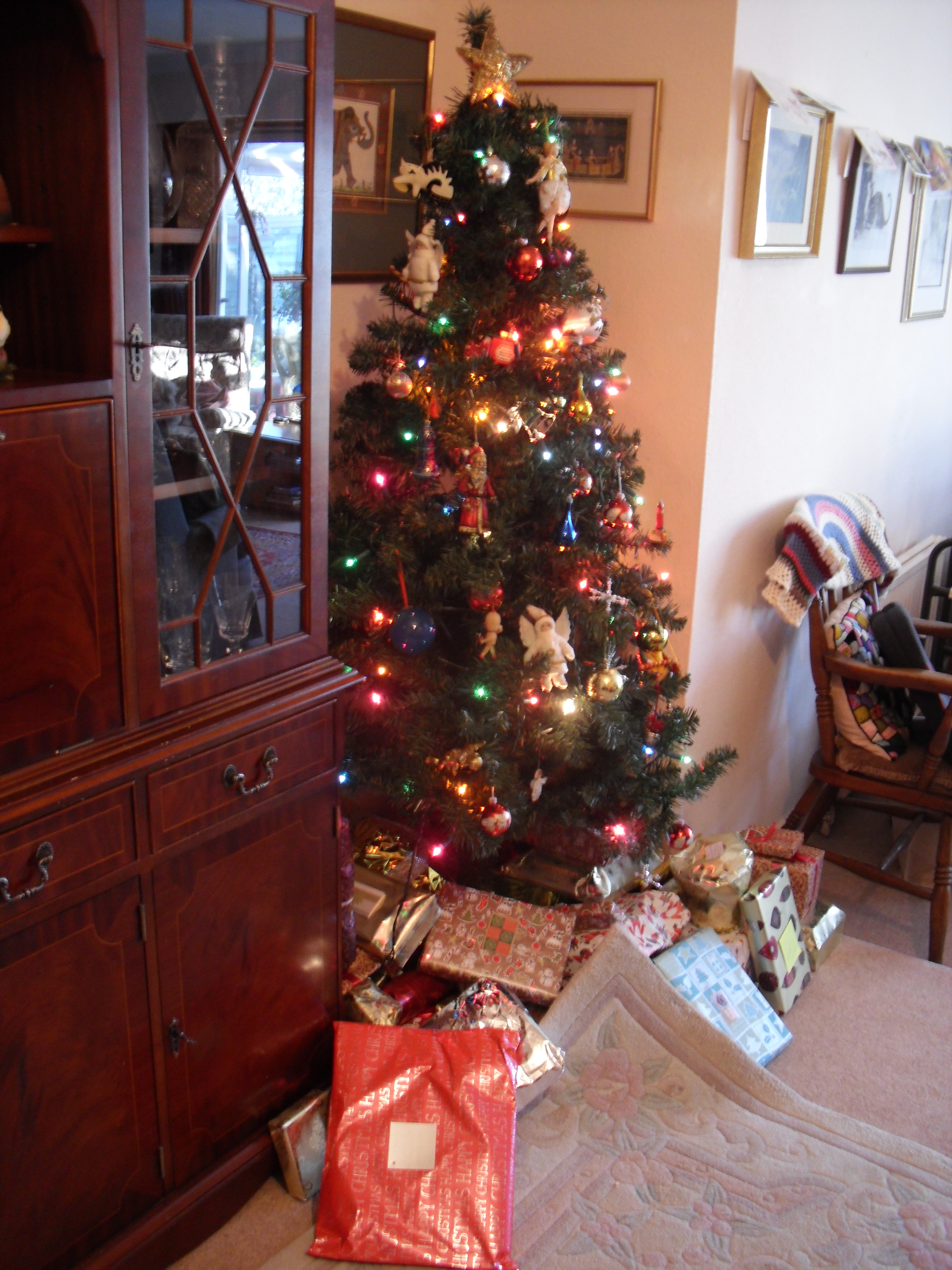
2010-12-25 13.48.32

My mother-in-law’s mad Christmas tree. Apologies that the carpet is all ruckled up!

Christmas is coming.  We are all rushing around panicking about what to buy Great Auntie Flossie, trying to get trees up and mince pies made.  And once all the kerfuffle dies down, we’ll be trying to formulate New Year’s Resolutions while our heads are still spinning from the tinselly onslaught.

The blogs I follow are already jam-packed with ideas for resolutions and how to plan your goals for next year.

Aren’t we exhausted enough?

Let’s just take some time to stop and reflect.  To consider what we have achieved this year, before we start pushing ourselves about next.

I don’t think we take enough time to recognise and celebrate what we achieve. We are constantly encouraged to move on to the next thing, the next goal, always more, more, more!

Because we are never enough.

Yesterday I came across Dr Brene Brown’s book, ‘Daring Greatly’, in the library.  I have read and benefitted greatly from her earlier works, but I had avoided this one because for some reason I had got it into my head that it was about parenting, which isn’t exactly relevant to me.  I was wrong.  The first chapter, on Scarcity, had my head spinning!  I highly recommend you read it.

As writers, scarcity is a constant problem.  After all, in such a subjective realm, how can you measure enough?  I wrote recently about the problem of owning yourself as creative.  This is intimately linked to the problem of enough.  How can you know when you have done enough, produced enough, published enough?

I think one way to tackle this sense of dearth is to recognise and celebrate what we have done.

This year I have started this website, something I really didn’t think I had the guts to do.  This is my 86th post.  That’s a whole lot of words.  A big achievement?  You’d better believe it!  I have published over 40 fanfics too.  I have put myself out there.

This is not blowing my own trumpet.  This is stating the facts.

I am proud of what I have made this year.  It may not tally with the list of goals I made in January, but I’m okay with that – I’ll tell you why in the next post.  I’ve been telling myself I didn’t achieve a lot this year, but actually when I sit down and reflect on what I’ve done, I’ve moved mountains!

Journal Exercise:

Before you get too lost in the melee of Christmas, set aside some time to take stock.  Sit down with your journal, and a glass of wine if you like.  Perhaps light a candle, and put on some gentle music.

Think about what you have done this year.  Don’t look at your list of goals and resolutions.  Don’t think about all the things you planned to do, and didn’t.  Think about all the things that did get done, and the unexpected achievements too, things that came out of nowhere, the gifts the Universe has given you.

Count everything, from getting to see your favourite actor in a play, to passing that exam, from painting your biggest picture yet, to being in the village Christmas Panto.  Maybe you had a poetry collection or a novel published, exhibited your art, won a competition, or maybe you read out your first poem in public, or tried painting or drawing for the first time.  No matter how big all small, list everything.  Think about all the creative things you did, the cakes you made, the dances you went to, the pumpkin you carved, the costume you made for your kid’s school play.

Be proud of yourself, of where you are now.  Do it for yourself.  Savour it.

Because you are enough.

Happy Reflecting,

EF

Its Never Too Late…

Whenever I see an article in the paper about some young person who has won an important first novel award, or got a massive advance on their first book, I have a mini meltdown.  Its not that I would take their achievement away from them.  Its just that I am now 46, and still struggling to finish a book that I am happy enough with to publish.

But how old is too old?

I could probably quote a dozen examples of authors who didn’t publish their first book until they were in their 60s or 70s.  There are always the exceptions.  I keep telling myself that its never too late to fulfil the dream of that first novel I wrote at the age of 16.  But you have to really understand the fact in your heart, as well as in  head.

Let me tell you a little story about fulfilling your dreams at any age.

The other day I went to my first Masked Ball.  I’m not a dancer by any stretch of the imagination, but we had been invited to go by friends who are.  It was an event run by the dancing school our friends attend, and as part of the entertainment, several of the school’s students danced exhibition dances.  To uproarious applause, there were paso dobles and waltzes and tangos.  (And there were lots of sparkles too, and I just love sparkles!)

Marvellous.

And then a tiny little old lady in a lacy top and a bow in her hair got up, and danced the foxtrot with her lady teacher.  And it was lovely.  She got the biggest round of applause of the night.

Then the evening’s compere told us about her.  How she had fulfilled a lifetime’s ambition recently by dancing in the British Ballroom Championships at the legendary Tower Ballroom in Blackpool.

Turns out, this lady, who reminded me a great deal of Mrs Pepperpot (if you remember her), was 86.

Eighty-six years old and still ballroom dancing.  Competitively.  Eighty-six years old and still pursuing her creativity.  Eight-six years old and still fulfilling her dreams.

How old is too old?

Ask me when I get to 87.

Happy Creating,

EF


The Perils of Getting Lost

There is no SatNav system for the artistic life.

Most of the time, we creative people complain about the problems of not being able to get into the Zone.  Not being able to find the door into the imagination.  Not being able to make our art.

Or we complain about not being able to get out of our own way.  We get hung up on the avoidance tactics and displacement activities we use so we don’t have to think about the empty page, the blank canvas.

Be honest, how many loads of washing have you done to avoid that novel you’ve been meaning to write?  How many drawers and cupboards have you cleaned out as an excuse to get away from your easel or your desk?

Seriously, its amazing how interesting cleaning can become when you need to be doing something else.

However, one of the perils of the artistic life that we rarely talk about, let alone complain about, is that of getting lost.

Lost in your imagination.

Lost in that place where the stories never end.

Lost where the romance and the passion and the adventure and the danger go on and on, and there is never, never washing to be done, unless it is in a picturesque stream with the sun sparkling on its surface, and requires both hero and heroine to divest themselves of their clothes in as romantic/modest/passionate (delete as appropriate) way as possible.

Suddenly you will wake up one morning and realise that you have been trapped on the island of the Lotus Eaters, so lost in the pleasures of your mind that you have forgotten to live.

Marriages founder this way.  Bankruptcies are forged, friendships lost, loved-ones go unmourned.  It happens all the time.

We lose ourselves constantly.  Often it is complusive shopping, gambling, drinking, eating or other drugs that claim us.  Addictions can be apparently harmless.  Surfing the internet seems harmless enough, until you realise you have lost days and weeks of your life doing it.  We lose ourselves in meaningless busyness, in rushing round fulfilling empty tasks, in competing with friends and neighbours, in acquiring the latest TV, sofa, car, clothes.  Modern life encourages us to find an addiction to dull the ennui.

Being present is hard.  Its even harder if you have an over-active imagination.  It is so much nicer to be lost in a story than facing the reality of life.  Doing the work of living.  Being real.  It is so easy to slip away and not come back.

Lately I have been away.  In the last couple of days, I’ve realised that life is tugging at the hem of my skirts, wanting me back, needing my attention.  I’m fighting it.  I don’t want to come back.  I want to stay in my fantasy world.

But life needs living.  We only get one go.  The art needs making, yes.  But our lives are our art too.

Don’t forget to live as well.

Happy Creative Living,

EF

PS – You might like to know that I have a new story out, The Retirement Party, a ‘Lewis’ romance, which you can read here at AO3 and here at FF.net.

Owning It

Have you been there too?  That cringe-making moment at a social event when you meet someone new and they ask you what you do.

For me it is a doubly difficult dilemma.

Do I give them one version of the truth:  I haven’t been able to do paid work since 2001 because of chronic health difficulties.  Which either makes me look like I am scrounging off the State, or like a whinging hypochondriac.  Either one pretty much means the end of the conversation.

Or do I say, Oh, I’m a writer and artist.  To which I get the next question:  where can I get your books?  So thats a whole ‘nother minefield.  Yes, I have written seven novels.  No, you cannot buy them in the shops. I publish on the internet.

(Oh, well you aren’t a proper writer, then, are you?  You’re just one of those middle class kept wives who plays at being a creative but is actually too mediocre at it to cut it in the real world.)

Admittedly, this last is probably supplied by Nigel, who is only too happy to make me feel like a loser and a waste of space, so that I will never take any risks or put my work out there.

These days, its even worse if I mention that I write fanfiction, because people have finally heard of it, and they always, always want to talk about 50 Shades of Grey.  Don’t mention that book in front of me.  Please.  (You wouldn’t like me when I’m angry.)

The other day I was at a social event and met someone new.  She was a fascinating person, and great fun.  I liked her a lot.  She asked me what I did.  I said, ‘I’m a writer and artist.’  Cue discussion about novels not yet published, how I am trying to make a go of this website, and why I am interested in creativity, which happened to be her field of research.

All fine.

I came home and felt like a total fraud.

Why is it so difficult to own our creativity?

I may not have had a novel published in conventional form, but then I’ve never really submitted one to a publisher.  I’ve written and published 42 works of fanfiction on the internet, some of which have novel-sized wordcounts.  I get around 100 readers per day of my fictions, and regularly get daily reader numbers over 500, figures that most conventionally published writers would give their eye-teeth for.  This website has over 300 followers.  What is it about these statistics that makes me not a writer?

What really makes me a writer is that I write.  Every day.  Being published does not make me a writer.  Public recognition does not make me a writer.  Having books on the shelves does not make me a writer, if I am not writing.

Being a writer is not something that other people tell you that you are.

Being a writer is what you do.  Day in. Day out.    I write because I need to write, not for the end result.  I write because it comes to me as naturally, and as necessarily, as breathing.

So why can I not own it?  Why do I not feel entitled to it?  Why am I embarassed to say it in front of someone new because Society says I do not tick the boxes required (ie publications, awards etc etc)?  Will I have to wait until I am as old and lauded as the late Nobel Prize laureate Doris Lessing before I can finally say I am a writer, and feel entitled to it?  (I really hope not.)  Do any writers ever feel entitled to the label?

Do you feel entitled to your creativity?  Do you make excuses that you are only a hobbyist painter or dancer, whether to yourself or others?  Do you feel you must keep your creative projects secret for fear that they will not be understood?  And is it really necessary to have public recognition for our art?

I’m not saying there are anwsers, or even right answers.  I think the answer is different for every one of us.  It is a complex tangle.  I simply think we have to address it in some way as artists in whatever medium, if only to find out what stifles or liberates our own voices.

And maybe this time next year, when I meet someone new at a party, I will feel entitled to say: ‘I am a writer’, and own it.

Happy Creating,

EF

Exploring Character: Handbags and Pockets

EV005075Let me tell you a story.

A long time ago, I bought my first car, a battered old Nissan Cherry.  I loved it, unreliable though it was.  In order to celebrate liberation from the tyranny of bus timetables, my friend and I decided to go on a day trip to Rockingham Castle, about an hour’s drive away.  It was an extremely hot summer’s day and, in the way of ancient cars everywhere, my new chariot broke down.  We sat on the grassy verge, waiting for steam to stop bellowing from under the bonnet, and sweltering in the heat.

My friend, who was a redhead, and thus especially vulnerable to sunburn, turned to me and sighed:  ‘What we really need is some suntan lotion.’

I pulled three bottles out of my handbag.  ‘Do you want Factor 8, 15 or 30?’

By now you will have guessed that I am the sort of person who likes to prepare for every eventuality.  I always have paracetamol in my handbag.  I can always be relied upon to be possessed of optical wipes for cleaning mucky spectacles, spare tissues, chocolate of course, and even echinacea lozenges just in case someone has a sore throat.  This is not because I have children – any mother will tell you that it is necessary to have a handbag full of bandaids, crayons and baby wipes.  It is because I am the sort of person that worries.

I know a man who always carries a length of string in his pocket.  He is a very practical person, and he tells me how useful a spare bit of string can be in unexpected situations.  This always seems a surprise to me, since he travels around the world, fixing nuclear power stations for a living.  Quite apart from the fact that I don’t want to imagine the kind of nuclear power station scenario in which a length of gardeners twine might save the day, I always feel he is the sort of person whom you could reasonably expect to be in possession of a sonic screwdriver.  For real.  The string therefore says a lot about his practical, if eccentric, character.

The things we carry with us say so much about who we are.  Ask a group of female friends to open their handbags and you will find the ones who carry about four different shades of lipstick, a packet of cuppa soup, or a spare bag to pick up dog poop.  Just look at the handbags, too.  There are those who insist on the vast sacks that are so fashionable these days, the ones who like bags with lots of pockets to organise things (and the ones with pocket bags who can never find anything inside the vast number of pockets), and the austerely practical ones who favour a tiny, cross-body pouch barely big enough to hold a purse, phone and keys.

Mens’ pocket contents are just as informative.  My husband’s pockets are always full of folded pieces of copier paper, on the outside of which he has made cryptic notes in his other-worldly, hieroglyphic handwriting.  He sheds them at the end of the day, leaving piles of folds on the dining room table.  I bought him a notebook once, but he rarely used it.  His paper folds reflect his scattered mode of thinking, and the fact that he is always thinking about something, even in the midst of something else.

Character could also undoubtedly be read in manbags, laptop bags, briefcases, breast pockets and poachers pockets in coats and suit jackets.  Each is a map to an individual’s mind, habits, and priorities as unique as its owner.

Writing Exercise:

This exercise is probably as old as the hills, and I have no idea who originally came up with it, but it always strikes gold for me when I am writing a new character.

Take out your notebook, and start a fresh page (of course).  Give yourself a few minutes to imagine the character you want to work with.  Picture them in your mind in as much detail as you can.  Clothes, smell, tone of voice and stance.  Now get them to empty out their pockets – or their handbag (or equivalent).

What items are so essential to them that they always have to carry them around?

Do they keep sentimental items on them, perhaps a pendant that belonged to an old lover, an outdated student ID card, a rosary or St Christopher.

My father always carried a crisply ironed gentlemens handkerchief of pure white cotton, fresh every day.  Is your character the kind that carries tissues, a handkerchief, or wipes their nose on their cuff?

This is a little like a writer’s version of Kim’s Game, except that each article you choose, from the broken crumbs of a forgotten polo mint to the famous sonic screwdriver, says something important about your character.  Why do they carry these things?  Is it for practical, spiritual or even superstitious reasons?  Are they carrying the past to motivate them in the present, or do they keep an array of useful bits close, just in case?

You could even expand this exercise to include car glove compartments and boots (trunks).

This exercise should give you a great start when you are working with a new character.  You will find out so many things about them that you never would have imagined possible.  Let them dance before your eyes, peeling off elements of themselves as if performing the Dance of the Seven Veils.  It’s so exciting when a new person reveals themselves to you.

And remember, once you know who they are, you will know how they behave.  And it is their behaviour that will make your plot.

Happy Writing,

EF

Writers: Know Your Limits! (or why I’m not doing NaNoWriMo again this year)

Husband and I often share a giggle over this Harry Enfield sketch when we talk about my limitations:

Yes, well, thank goodness its not so much like that anymore!

Women are especially bad at knowing their limits because we are brought up to be martyrs, to sacrifice our own well-being before that of others.  I’m no exception.  I’m useless at boundaries, and having ME has made me even worse for committing to something that I have no earthly hope of carrying through because of my  fluctuating energy and pain levels.  I continue to have expectations of myself that fall way beyond my capacities.

Anyway, a little while back I had this brainwave:  “I know,” I thought, with all the enthusiasm of a labrador puppy.  ‘I’ll do NaNoWriMo in November, and I’ll use the month to get the basis of my Viking novel done, and then I’ll have a book I can edit up and sell in the new year via Kindle.”

Great wheeze, No?

Hmm.  The thing is, November is always a really busy month for me.  Its the run-up to Christmas, which means getting the present shopping in early because I have to pace myself with all that trudging around the shops.  It usually involves an extended visit to elderly parents, taking a week out during which there is no spare time, and no internet access.  It is also the real onset of the bad weather, which always has a deleterious effect on my health. And if there is one thing I can always be sure of, its that I can never be sure when I am going to capable of getting out of bed in the morning!

I’d really like to do NaNoWriMo.    Its not that I am not capable of writing 1700 words a day.  I’m lucky in that, unlike many writers, I can crack through 3-5000 words a day when I’m well.  But writing 50,000 in under 3 weeks is probably beyond even me.

So with a sigh of realism, I have relinquished my claim on that November novel.  Another year will go by without me being a NaNoWriMo winner.

Instead, I have come up with another, more achievable goal, an ebook that I hope to bring you in the run-up to Christmas, so I hope that you’ll stay tuned to this blog to find out more about that.  I know you’ll love it!

In the meantime, here are a few ideas on how to judge whether you are over-reaching yourself on a creative project:

1. Be realistic about how much time it will take.  If you can, divide the task into measureable units, the way NaNoWriMo does with the word count.  How long does a unit take?  If you need three hours a day to write 1700 words or make a preparatory sketch, can you afford to carve out that time daily, or are you only likely to manage 3 hours once or twice a week?

2.  Schedule your units of time into your diary or planner and keep a date with yourself.  This might mean working other activities around them, bartering childcare with friends who are also mums, asking husband/partner or housemate to help out with basic chores.  But making an appointment with yourself to create, however much subtle manoevring it takes, will help you finish your project more easily in the long run.

3.  Expect the unexpected.  Be prepared for life to throw a spanner in the works (or, if you are like me, an entire socket set!).  Remember Murphy’s Law:  Anything that can go wrong, will go wrong.   So have a back-up plan.  Either that, or don’t get too wedded to a deadline, or you may find yourself disappointed, which could put you off for good.

If you are tackling NaNoWriMo this year, I wish you the best of luck!  If you have chosen to do something else, like me, then good luck with that too,  The point is to know how much, realistically, you can take on, and be at peace with that.

Happy Creating,

EF

For Creativity, Press The ‘OFF’ Button Now

This morning, my part of the UK was hit by the worst Atlantic storm in some years.  Trees came down, houses flooded, power cables snapped, cars were crushed, trains and planes came to a standstill, and double decker buses were lifted off their wheels.  It was not nice.  Its over now, blazing across the county in under three hours, leaving a trail of destruction in its wake.

Which got me thinking, you will not be surprised to hear.

Husband and I spent most of yesterday glued to various forms of news media, trying to gauge the progress and destructive force of Storm St Jude, working out which hatches to batten down, what damage might ensue, and whether, in Husband’s case, it was sensible to cancel his 9am lecture this morning. (He did, and I think it was the right decision).  The upshot of all this digital frenzy was that I didn’t get anything much done.  Which was an annoying waste of a whole day.  And made me think about something I had read a few days earlier:

I came across the work of Linda Stone, and in particular, her term ‘Continuous Partial Attention’, which is when we multitask cognitive functions such as talking with a friend at coffee whilst checking our email on our android under the table, surfing the internet when we are on the phone, and all those other digital things we do these days that we never used to.  Linda Stone says:

“Continuous Partial Attention involves an artificial sense of constant crisis, of living in a 24/7, always-on world.  It contributes to feeling stressed, overwhelmed, overstimulated and unfulfilled; It compromises our ability to reflect, to make decisions and to think creatively.”

Lindastone.net/qa/continuous-partial-attention quoted in Sharon Salzberg, The Power of Meditation: A 28-Day Programme for Real Happiness, Hay House 2011.

It compromises our ability … to think creatively.

Just think about that for a minute.  I did.

I thought about how long I spend on Facebook every day, how many hours I lose cruising Tumblr and reading fanfics, checking my phone, watching BBC News 24.  These are what Jennifer Louden calls Time Monsters, habits you fall into that eat up the spare time you have and leave you feeling rushed and stressed out because you aren’t left with enough time to do the things you really want or need to do.  I have been known to lose whole weeks to my Time Monsters.  Yesterday, thanks to Storm St Jude, I lost an entire day.

I’m 46!  I don’t want to waste any more time!

Increasingly, I am finding that it is a luxury to switch off my phone and not look at my laptop.  I don’t want it to feel like a luxury to disconnect.  I want it to be the constructive core of my working life as a writer.  I don’t want to have to employ some kind of app to shut me out of the internet in order to finish a story, just because I can’t resist looking at yet another iteration of the same picture of Benedict Cumberbatch.

I want the sense of calm that comes with not knowing what is happening in the outside world.  The same calm I felt lying in bed this morning, listening to the wind riffling the roof tiles, blissfully ignorant of what speed it was going or when the next pulse of the storm was going to hit, courtesy of the Met Office website.

The question is, can I do this?  I caught myself the other day thinking that I couldn’t write down a snatch of dialogue I had going around my head because I didn’t have my laptop open.  As if a pen and paper weren’t good enough.

To be creative, in whatever art form you choose, from cookery and sewing singing, tango, writing or painting, you need time and space.  You need to reflect.  Being connected doesn’t give you that space.

For our own creative self-care, we need to make time to switch off.

I don’t want the stress of Continuous Partial Attention to wreck my creativity through anxiety, perceived comparison or peer pressure, or just from lack of time to create.  I want to make space.  Space to think more, reflect more, make more.

You can too.

Creativity Exercises

1. How do you use your time?  What are your chief Time Monsters?  What are the digital munchers in your life?

2. Once you have identified your Time Monsters, you can decide whether you want to continue feeding them, or jettison them to make room to do the things that really make you happy, instead of just keeping boredom and despair at bay.  Its nice to keep a few on standby, for days when you really are frazzled and just need to stare at the telly and not think, but that shouldn’t have to be every night.  If it is, maybe you need a major rethink.

3.  Consciously switch off.  Turn off the telly, your phone, your lappy.  Sit in an armchair and read a book, bake a cake, go for a walk, paint or garden or see friends.  Do something that involves experiencing the world directly, not digitally.   Use your time to think and create.

4.  Do one thing at a time.  Don’t surf on your phone when you are out with your pals, that’s rude.  Don’t have the telly on when you are painting (a bit of inspiring music might help, but nothing you have to think about.)  When you have a conversation with your mum on the phone, concentrate on her, don’t keep one eye on the news.  If something is worth doing, its worth giving your whole attention to.

I’m not advocating digital purdah, believe me.  The digital world has its place, but it is down to us to keep it in it.  I’m just saying we need to use our time more mindfully.  Which is what, from now on, I am going to try and do.

Happy Creating,

EF

Retreat Debriefing

The house is cold and damp, and the fridge is empty.  Coming home from a retreat can feel a bit like being marooned on the shores of real life after a blissful dream.  It is wonderful to have your own space, and three two-course meals a day, plus a continual stream of tea and cake, laid on for you.  I feel as fat as a walrus.  Two and a half days with nothing to do except write, and talk about writing with your writing friends – it’s hard to beat.

As idyllic as it sounds, it can come as a bit of a shock to start with.  I woke up on Saturday morning and immediately plummeted into a panic attack of ‘Oh, Gods, I can’t do this!’  The day stretched out before me, packets of emptiness between appointments with the dining rooms.  Just me and my four walls, my pen, paper and laptop.  Suddenly writing was inescapable.  No more displacement activities.  There are only so many indulgent baths and long, breezy walks you can have before you can no longer avoid the inevitable contact of nib with paper.

By about 11.30am on Saturday morning, I had done every displacement activity available to me, and there was no choice but to get down to it.  I opened a fresh page of my notebook and off I went.

And it was wonderful.

I wrote and wrote and wrote.  I didn’t judge or edit myself.  I put down everything that came into my head, page after page of it.  Story after story fell onto the paper.  My two favourite pens ran out in the course of the weekend.  By afternoon tea at 3.30pm, I had 12 pages of A4 paper covered with my spindly scribble, and I had discovered things about my new hero that I had never dreamt of.  By supper time, I had two pages of polished script to read out at our evening meeting, where we gather to share our progress so far.  On Sunday morning, again about 11.30am, I started again, and by lunchtime had an idea of what research I would need to do, and a list of indigenous names for my characters, gleaned from the one book I had bought with me for research purposes.  By tea time I was exhausted but happy.  I had worked so much out.  I had a better idea of what needed doing next.  And I had learned to write lying down on my back (which became necessary because my back has really been playing up the last few days, and sitting up proved a nightmare).

I felt a bit dazed when I got home.  I stared at the telly for a couple of hours and then went to bed.  This morning, when I woke up, I felt slightly hung-over.   Just as you can eat and drink too much, it seems you can write too much too.

So I am having a bit of a day off.  I am just lolling about, digesting the weekend, getting my head around this week’s diary appointments, catching up on the laundry, and reading comforting books.

Tomorrow I will start again.  I will get back to my blank A4 pages and start downloading backstory with my biro, and my soul will soar.  In the meantime, I think a little time on the yoga mat may be what my back needs!

Happy creating,

EF

Preparing for a Writing Retreat

I’m so excited.  I’m going on a writing retreat!

This weekend, my writers group is convening at a nearby conference centre for a weekend of writing and eating and talking about writing and eating some more, and maybe a little bit of dozing or walking, and then some more writing.

We normally do this once a year, but this year, we enjoyed ourselves so much we thought we’d do it again at the end of the year.  So here I am, thinking about a weekend spent solely with my friends and the Work.

Over years of doing this, I’ve found I need to do a few things to prepare myself so that I get the most out of the time:

Plan:

I usually like to sit down with my writers notebook or my journal, and think about two things:

  • where I am, and
  • where I want to be.

This year I am thinking about the goals or intentions I have set myself for this website, for my publications, and for moving my writing on to the next level.  Its one of the few truly extended, uninterrupted periods I get to just write, so I like to choose a project that I can get my teeth into, but also one that really needs to be tackled.   Something pressing.

This year, I am toying with the idea of doing NaNoWriMo, because I want to crank out a novel as fast as possible.  So I have decided to lay the groundwork on this new idea, and throw myself into it, immerse myself in it as much as I can.  In previous years, I have redrafted novels or short stories, polished specific sections of a novel, worked specifically on character, or redrawn a dodgey plot.

My goal this year is especially fuelled with the knowledge that I need to be writing something original, something other than fanfiction.  Nothing wrong with fanfiction.  Its given me marvellous confidence in my work, and I love writing it.  I just think I need push myself, to do something new.

Manage expectations: 

I’m not going to finish an entire novel in a weekend.  I may even get no further than writing 500 words.  And I am okay with that.

When I first started going on retreats, I had HUGE expectations of myself and what I could achieve.  I thought I could crank out 20,000 words in two days, a third of a novel.  I thought I could create publisher-ready prose.  The truth is that even on retreat, there is only a limited amount of time, and making really good prose takes time.  A lot of time.  I have only learnt this with experience.

There have been several retreats where I have slept badly on the first night, or felt ill, and as a result have really been unable to do anything much at all apart from eat, sleep, talk with my fellow writers, and be.  Sometimes that is what a retreat is for.  I have gained from those experiences.  These days I am ready to allow my retreat to be whatever it needs to be, and to trust that whatever happens is part of the process.

So I make plans, but I don’t get too attached to them.

Be present:

Being aware of my physical wellbeing is very important on retreat, and not simply because I suffer from chronic illness.  I need to be present in my body, so I do yoga and meditate, go for walks, stand in the shower and feel the water on my skin, and take naps.  (One friend uses the annual retreat to undulge in long, hot, scented baths because she doesn’t have a tub at home!)  This might all seem time away from writing, but it is crucial.  Self care is part of retreating.  Doing these things allows me time to think about the writing, to form scenes and sentences in my head.  But it also allows me to come to the laptop refreshed afterwards.  So it is an investment in my writing, as well as my body.

Packing: 

As a result, packing right is really important.  I always make sure I take warm, snuggly clothes, my yoga mat and yoga clothes, a hot water bottle, walking boots and, on occasion, even a teddy bear for cuddling purposes.  And because I have weird dietary issues, I make sure I take an extra supply of good, healthy foods and my favourite herbal teas too.  The centre staff are really great in catering for my diet, but there are those in-between-meals moments, when what you really need to fuel the Muse is your own favourite brand of chocolate!

Be absent: 

I get very anxious when I am away from home.  I need to be grounded in my safe environment in order for my imagination to work properly.  It helps that we have been going on retreat to the same place for years, and also that it really isn’t very far from my own home, so I feel like I am on home turf.  Other people find their imagination is stimulated by unfamiliar territory.  Mine just shuts down so that my emotional system can cope with the panic attacks.

To counter this, I take music and listen to it doggedly in order to transport me to safe psychic territory.  I put on my headphones, close my eyes and fly away.  And then I can write.

It is a major diffence to how I normally write, which is in silence.  So part of my preparation ritual is to gather music around me.  I make playlists for different characters, delve into iTunes and my CD collection,  choose music that evokes particular memories or landscapes for me, or none at all.

Allow it: 

Going on retreat is supposed to be calming, an activity to feed your soul.  Its supposed to be downtime from your usual life.  As a result it is easy to get really wound up about how good it is going to be, and then find yourself disappointed.  To feel like you just aren’t calm enough, or getting enough done, or maybe even that you are wasting time that should be spent looking after the kids, doing the washing or writing that sales report.  This harks back to managing expectations.  But it also has a deeper meaning.

you are allowed to have time to yourself

You aren’t being selfish.  Leave all your SHOULDS and OUGHTS at home.  You deserve to have this time spent solely with yourself, doing something you love.  I continue to struggle with this.  I tend to make retreat a time which is about productivity rather than identity – about being myself and giving myself what I need.  When you accept retreat as a gift to yourself, managing expectations becomes easier.  And that precious dimension of writing that no one seems to talk about – moodling – becomes possible.  Have a weekend’s moodle.  Because you are worth it.

I heartily recommend going on a retreat if you can manage it.  Maybe for a day, or even overnight.  Maybe just for an afternoon.  If you are looking for ideas and guidance, I also recommend Judy Reeves’ wonderful ‘A Writers Retreat Kit:  A Guide for Creative Exploration and Personal Expression’, which I ordered recently from Amazon in preparation for this weekend.

Now I had better get back to my packing!

Happy writing (and moodling)

EF