Category Archives: Learning the Craft

Exploring Character: Handbags and Pockets

EV005075Let me tell you a story.

A long time ago, I bought my first car, a battered old Nissan Cherry.  I loved it, unreliable though it was.  In order to celebrate liberation from the tyranny of bus timetables, my friend and I decided to go on a day trip to Rockingham Castle, about an hour’s drive away.  It was an extremely hot summer’s day and, in the way of ancient cars everywhere, my new chariot broke down.  We sat on the grassy verge, waiting for steam to stop bellowing from under the bonnet, and sweltering in the heat.

My friend, who was a redhead, and thus especially vulnerable to sunburn, turned to me and sighed:  ‘What we really need is some suntan lotion.’

I pulled three bottles out of my handbag.  ‘Do you want Factor 8, 15 or 30?’

By now you will have guessed that I am the sort of person who likes to prepare for every eventuality.  I always have paracetamol in my handbag.  I can always be relied upon to be possessed of optical wipes for cleaning mucky spectacles, spare tissues, chocolate of course, and even echinacea lozenges just in case someone has a sore throat.  This is not because I have children – any mother will tell you that it is necessary to have a handbag full of bandaids, crayons and baby wipes.  It is because I am the sort of person that worries.

I know a man who always carries a length of string in his pocket.  He is a very practical person, and he tells me how useful a spare bit of string can be in unexpected situations.  This always seems a surprise to me, since he travels around the world, fixing nuclear power stations for a living.  Quite apart from the fact that I don’t want to imagine the kind of nuclear power station scenario in which a length of gardeners twine might save the day, I always feel he is the sort of person whom you could reasonably expect to be in possession of a sonic screwdriver.  For real.  The string therefore says a lot about his practical, if eccentric, character.

The things we carry with us say so much about who we are.  Ask a group of female friends to open their handbags and you will find the ones who carry about four different shades of lipstick, a packet of cuppa soup, or a spare bag to pick up dog poop.  Just look at the handbags, too.  There are those who insist on the vast sacks that are so fashionable these days, the ones who like bags with lots of pockets to organise things (and the ones with pocket bags who can never find anything inside the vast number of pockets), and the austerely practical ones who favour a tiny, cross-body pouch barely big enough to hold a purse, phone and keys.

Mens’ pocket contents are just as informative.  My husband’s pockets are always full of folded pieces of copier paper, on the outside of which he has made cryptic notes in his other-worldly, hieroglyphic handwriting.  He sheds them at the end of the day, leaving piles of folds on the dining room table.  I bought him a notebook once, but he rarely used it.  His paper folds reflect his scattered mode of thinking, and the fact that he is always thinking about something, even in the midst of something else.

Character could also undoubtedly be read in manbags, laptop bags, briefcases, breast pockets and poachers pockets in coats and suit jackets.  Each is a map to an individual’s mind, habits, and priorities as unique as its owner.

Writing Exercise:

This exercise is probably as old as the hills, and I have no idea who originally came up with it, but it always strikes gold for me when I am writing a new character.

Take out your notebook, and start a fresh page (of course).  Give yourself a few minutes to imagine the character you want to work with.  Picture them in your mind in as much detail as you can.  Clothes, smell, tone of voice and stance.  Now get them to empty out their pockets – or their handbag (or equivalent).

What items are so essential to them that they always have to carry them around?

Do they keep sentimental items on them, perhaps a pendant that belonged to an old lover, an outdated student ID card, a rosary or St Christopher.

My father always carried a crisply ironed gentlemens handkerchief of pure white cotton, fresh every day.  Is your character the kind that carries tissues, a handkerchief, or wipes their nose on their cuff?

This is a little like a writer’s version of Kim’s Game, except that each article you choose, from the broken crumbs of a forgotten polo mint to the famous sonic screwdriver, says something important about your character.  Why do they carry these things?  Is it for practical, spiritual or even superstitious reasons?  Are they carrying the past to motivate them in the present, or do they keep an array of useful bits close, just in case?

You could even expand this exercise to include car glove compartments and boots (trunks).

This exercise should give you a great start when you are working with a new character.  You will find out so many things about them that you never would have imagined possible.  Let them dance before your eyes, peeling off elements of themselves as if performing the Dance of the Seven Veils.  It’s so exciting when a new person reveals themselves to you.

And remember, once you know who they are, you will know how they behave.  And it is their behaviour that will make your plot.

Happy Writing,

EF

Embodied Creativity

In my last post, I talked a little about telling details, those tiny things that communicate so much.  Noticing them requires opening the mind.  But there is another rung on the ladder with this:  Opening to the body.

I call this embodied writing.  By this I mean the kind of writing that includes the visceral details of what it is like to inhabit a physical body.  Physical sensation, not just ideas and emotions.

Our bodies are not just the ‘transport’ we inhabit, as dear Sherlock likes to put it.  They interact with the environment in order to gain information about it for survival purposes.  They do this through the medium of the Senses.

  • Touch
  • Taste
  • Sight
  • Smell
  • Hearing

Our eyes, noses, ears, tongues and skins gather data and feed it back to the brain, which sifts it and uses it to build up a picture of the outside world.  This means that our experience of life is formed as much by our body’s external contact as it is by our thoughts and ideas.  As writers particularly, we spend so much time locked inside our heads, submerged in ideas for stories, that we forget we have bodies.  Our bodies get neglected, or worse – sometimes writers abuse their bodies because they actually get in the way of the work by demanding annoying things like food and sleep.  We forget that our bodies are the foundation of our art.

By using the sensations they give us, we can enrich our work exponentially, making it more immediate, tapping into common experience and tissue memory.

Over the next few weeks, I am going to talk about ‘Writing with the Senses’ in an effort to get you and me out of our heads and into our bodies with our writing.  We will be working our way through each of the senses, being mindful of the feedback they give us, using them to ground us in our corporeal selves, and bringing the gorgeous experiences they give us into our creative lives.  I’m doing this myself, because I really need to be present inside my body right now, instead of having my brain flying about sixteen feet from it, attached only by the barest thread of consciousness.  And I thought you might be interested in joining me!

So, in the meantime, do this:

Take a few minutes today, tomorrow, daily if you can.  Just stop.  Take a deep breath and let it out.  Bring your mind inside your body.  What sensations can you feel?  Do you have a pain in your toe, or an itchy insect bite?  Did you eat spinach for tea that left that annoying coating on your teeth?  Is your belt too tight?  There doesn’t have to be any great revelation.  Just notice.

Taking a moment at regular times during the day in order to be present inside your body is an invaluable exercise in grounding yourself and being mindful.  And it is a great prelude to thinking about the Senses.

Happy Creating,

EF

Inspiration Monday: Telling Details

sussex church

The Zen of Details

At the moment, I am fascinated by ‘telling details’.

At our writers’ group last week, my friend read out the first pages of her novel, a description of a little girl watching her mother as she used a sewing machine to make a new dress for her little girl.  It took me right back to my childhood, watching my own mother labour over the sewing machine.

It was the little details that transported me.  The jar of spare buttons which the little girl was allowed to play with.  The thunk of the presser foot being let down onto the fabric.  The smell of sewing machine oil and new cloth, unwashed, still fusty from the haberdashery.

I have re-ignited my enthusiasm for my writer’s notebook with these details.  Using the little components of life.  Scribbling them down when I notice them.

The way the local cockerel sounds like he has a sore throat when he crows.

My husband saying ‘Marriage is about sharing’ when he farts.

The dust that builds up in the corners of the treads on the stairs, and how gritty it is.

Puffs of pollen falling off the sunflowers I have rescued from the storm-lashed garden, falling like yellow flour on the tabletop under the vase, powdering a biro that had been abandoned there.

These are the little glimpses of our everyday life that we mostly ignore, but when someone draws our attention to them in prose or art, they enrich our perception, throng our minds with memories, ground us in the present in a way nothing else can.

At the moment I am working on a series of short fanfics that are grounded in these details.  I am trying to use a single detail to spark each story.  Each story then contributes to a wider portrait of a relationship.  This means collecting details. So here I am with my notebook, going back to the very beginning of my writing career, ‘back to basics’ if you like, collecting scraps for here and there and jotting them down.  I feel like a mosaicist building up a mural made of broken pots.

And it is delicious.

 Creative Exercise:  Lists

Unearth your notebook, if you haven’t been using it much recently.  If you are an artist, grab your sketchbook.  Now open your mind.  Start noticing things.  It takes practise to be sufficiently present in life to recognise the tiny details that contribute to the big picture of shared experience, but once you start, you will find them coming thick and fast.

  • Walk around the house and look at the piles of stuff that have built up.  Write down where they are.  Make a list of what is in them.
  • When you visit the bathroom at a friend’s house, look at their lotions and potions.  Make a list to jot down later.  What do the bottles and jars tell you about their life and health?  If you draw, make a sketch of them, or if it’s easier, draw the contents of your own medicine cabinet.
  • Standing in the queue for the checkout, look in other people’s baskets.  What are they buying?  Another list.  What does this say about them?  Can you make a still life that communicates what they are eating, who they are eating it with, and why?

Open your eyes wide.  Your mind is constantly sifting sensory input, picking out things that may or may not be important.  Usually, you toss most of your perceptions aside.  Instead, write down as many as you can.  Use them later in your work.

Happy Creating,

EF

Do you have a Creative Vision?

This man has a vision (click on the link below and watch the film clip):

Portraits of St Davids residents

He knows what his project is.  He knows what he is after.  He is going for it.  The breadth of his vision, as well as the beauty of it, and of his work, is dazzling.

I’ve been thinking a lot about Vision over recent days.  Wondering what I am really after, what I am trying to achieve.  I can’t just be driven by fear anymore.

My fear is that I will die without getting all these pictures out of my head and into the world so that other people can enjoy them as much as I do.  I find the inside of my imagination highly entertaining, and I want to share it.  Does that sound vain?  I don’t know.  All I know is that I feel compelled to transmit the pictures in my head.

I watched the film, ‘The Reader’ the other night, based on the magnificent book by Bernhard Schlink.  It was wonderful.  It stirred up so many complicated and conflicting feelings inside me.  It is a true tragedy in the Greek style, a man forced to face the truth about the love of his life, and her part in unspeakable acts.  So much love.  So much horror.  This story is designed to spur debate about the morality of our actions, about good and evil, about the excuses people give, about love and literature and illiteracy and shame.  You could call it a romance, but thats only a tiny part of the story.  Schlink’s genius is to use romance as the vehicle to consider more difficult moral problems.

After the film had ended, I was getting ready for bed, cleaning my teeth and staring into the mirror, as I mulled over the storm of feelings going on under my ribs.  And I realised something.

This is exactly what I want my readers to feel when they finish reading one of my stories.

Complicated emotions.  The vast, unquenchable yearning of love.  The conflict of being caught in morally complex situations.  The struggle for answers.  And that iresistable siren call of need that drives us towards one another, even when we understand that pain can be the only result.

Is this too big a vision for someone of my talents?  I’m not saying I want to be Dickens, after all.  I guess I am aiming higher than that, in a way.  These issues seem to me to be at the core of our existence as emotional beings.  We struggle with them, just as we struggle with the philosopical questions of why we are here, and whether there is a God.  This is what I want to examine with my writing.

So its more than just getting the pictures out of my head and onto the page.  It is observing the emotions that make us love, too.  Call me a hopeless romantic, but that is what I am interested in, and I think I always have been.  I just never really thought consciously about it before.

I know what I’m trying to achieve now.  The thought has given me purpose.  All I have to do is go out and do it.

Do you have a vision for your creative work?  Maybe its worth thinking about.

Happy Creating,

EF

The Only Two Books a Writer Needs (Part 2)

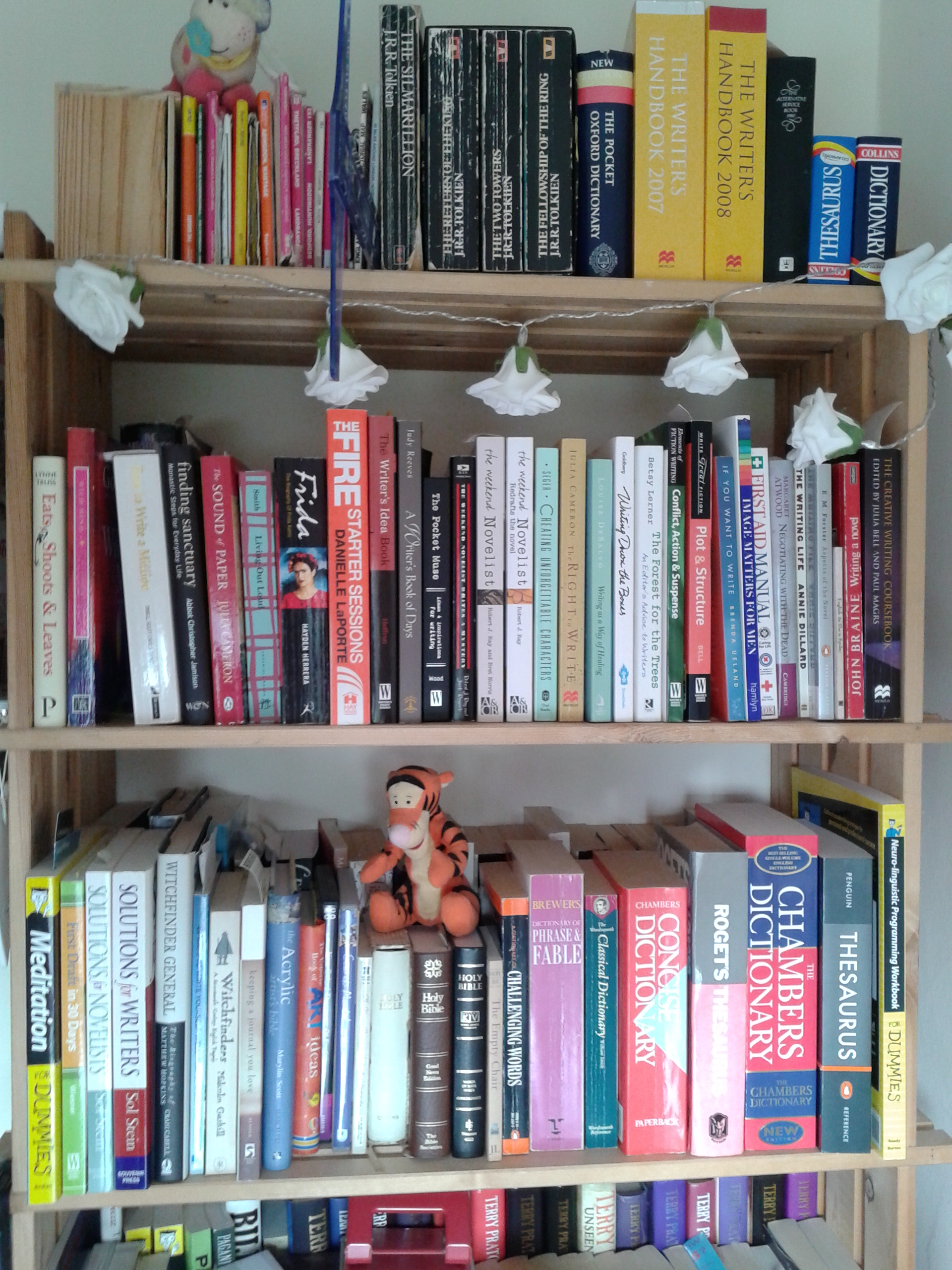
BookshelfIn the last post, I waxed lyrical about why you need a good dictionary on your bookself.  Have it to hand when you are reading.  Reading is an act of Input that every writer needs to undertake.  And no, its not stealing.  Its looking for inspiration, in the same way that artists study and copy the Old Masters in order to improve.  Reading helps you learn what works and what doesn’t, but more on that another day.

So that’s the Input.  What about the Output?  This is where the next book comes in – the writing part.

The Thesaurus

If you aren’t familiar with thesauri, my lovely Chambers Dictionary describes them as:

“…a book with systematically arranged lists of words and their synonyms, antonyms etc, a word-finder; a treasury.”

If you are serious about making your writing more vivid, you’ll need a Thesaurus.  I was introduced to Roget’s Thesaurus, probably the most famous thesaurus, while still at school, but the technique of using it is cumbersome and it completely foxed me.

Now I use a very nice, fat Penguin Thesaurus, which is alphabetical, and quite thorough enough to meet my needs.  I keep my Roget in reserve, just in case.  And yes, I have finally worked out how to use it properly, but it’s a pain, so I keep things simple.

The nice thing about a thesaurus is that it helps when you can’t think of a word (which for me is a lot!), or are looking for a more sumptuous way of explaining something.  You want a word like ‘magician’, for instance, but are looking for something a bit more, well, exotic.  Dip into your ‘thes’ and you will find:

Sorcerer, wizard, warlock, sorceress, witch, enchantress, necromancer, thaumaturge, miracle-worker.

Mmmm.  Never heard of thaumaturge before!  That’s pretty exotic, as exotic goes.  See what I mean?  Grab yourself a thesaurus and have a moodle about within its pages.  Yes, its perhaps just another way of defining words, but it defines around them too, enriching them in unexpected ways.  It will help you widen your vocabulary but also makes your stories more sumptuous.  As with anything rich, however, don’t go overboard.  Too much cream can make you sick.  Too many adjectives and adverbs (especially) will put your reader off completely.  Its a case of using the right word, not lots and lots of words.  Be vivid, not verbose.

The Others

Yes, there are other reference books I rely on on a regular basis.  I wouldn’t be without my Brewer’s Dictionary of Phrase and Fable, for example.  Or The Oxford Companion to English Literature, and the Chambers Biographical Dictionary.  All of them are fascinating and deeply useful – and not just when you are wrestling with a crossword!  But they are not what I could call ‘necessary’.

A dictionary and thesaurus are as necessary to a writer as a saw and chisel are to a carpenter. On a scale of need, they are prerequisites for the writing life.

As you can see from the picture at the top of this post, I have lots of books about writing.  I promise I will tell you about them in another post.  In the meantime, ferret out a good dictionary and thesaurus and keep them close at hand.  Look up any word you don’t recognise, and also those that you think you know what they mean, but have a lingering doubt about whether you are right.  Write down the ones you really love, and use them.    I promise you’ll have no regrets.

Happy wording,

EF

The Writing Life: Literary festivals

Finding your tribe as a writer, or in any kind of creative endeavour, is an important thing to do.  Being around other writers provides support and inspiration, and I think it’s a crucial thing to do.  Writing can be a very solitary activity, and its no surprise to find that many writers suffer from depression.  You try sitting on your own every day for six months of the year and see how it affects your mental health!  Its important to get out.

Literary Festivals and author signings are a really good way to fill your well and get affirmation for your work.  Maybe you won’t be able to present what you’ve written to other people, but being around those who are interested in the same things as you, undergoing similar challenges, really helps.

As a writer, you also need to gauge the market and be aware of your contemporaries’ work.  Reading is an important thing to do, and if you really love writing, you will love reading just as much!  Literary festivals give you a chance to be exposed to books you might never pick up otherwise, to hear authors speak about their work, and to ask questions about their writing process.   Think about it – a huge reservoir of inspiration and knowledge out there, just waiting for you to tap into it.  Why would you not?

Your local bookshop will probably have readings by authors scheduled, and these are worth attending because they are more intimate, and allow you more personal access.

Check the culture and review sections of newspapers, and the ads in writing magazines, as well as noticeboards in libraries, for details of the bigger events and festivals.  Some music festivals are starting to have literary strands too, so keep your eyes peeled.

My nearest festival in the one at the University of East Anglia, but its slightly different from a three day or week-long event, in that it studs two university terms with readings by authors, playwrights, poets and journalists.  This gives a wide variety of speakers over a six month period, and allows me to attend where I want, and to absorb what I learn over time.  And because it is such a prestigious centre for creative writing, it attracts some seriously big names.

I have attended events with Arthur Miller, Jeanette Winterson, Rose Tremain, Simon Armitage, Seamus Heaney, Iain Banks (need you ask!), Rachel Cusk, Alan Hollingshurst, Isabelle Allende, Richard E Grant and many others.  I went under sufferance with a friend to see Ian McEwan, whose writing I hate, only to be utterly charmed and instantly determined to reread everything he has written.  And I saw Doris Lessing the week after she had been awarded the Nobel Prize for Literature.  She was feisty, fascinating, and marvellous despite obviously being in terrible pain, and she tore the rather pompous interviewer to shreds, which was very satisfying.  At the end she received a spontaneous and heartfelt standing ovation, and I actually found myself crying.  You can’t find better inspiration than that!

Be warned, however.  Sometimes your idols can prove to have clay feet.  I went to see Graham Swift, whose books ‘Waterland’ and ‘Last Orders’ I had adored.  He read so badly, and was so miserably boring, that I felt insulted enough to vow never to read another one of his books.  And I haven’t.

Brett Easton Ellis was a writer whom I had worshipped since reading his work for my degree.  I clamoured to get a ticket to see him.  And now I can’t remember a thing about him, not even what he looked like, and certainly nothing of what he said.

I generally come away from these events feeling inspired and excited about doing new work, full of ideas and hope for the future.  It can be a dangerous game, however.  Be prepared, if you go to an author reading, to feel insignificant, and that you work is poor and will never be published.  It happens sometimes, though less often the more you write, and it will pass.

The important thing, however, is to go.  Attend events with even the least known authors, since they are often the ones who will inspire you the most.  (And one day, you might be up there too, so it adds to your own karma to support other people!)  Ask questions, and read the books.  This will enrich your own work, as well as introducing you to writing you might never have experienced otherwise.

Challenge yourself.  I don’t really do poetry, but went along with a poet friend of mine to see readings by several poets, and was enchanted.  I’ll never be a poet, but this form has opened my mind to the possibilities of language, and I’m so grateful.

Finding your tribe, and being amongst other writers is important.  It helps you feel part of a joint creative endeavour, but it also feeds your Muse.  There is a whole world of wonderful written joy out there, and literary festivals area an easy way into it.

Happy listening!

EF

Outflow: What the **** am I doing?

new study deskYou may have noticed that yesterday was Wednesday and that it was eerily quiet here at Evenlode’s Friend.  Oops.

Its not that I wasn’t thinking of you, believe me.  Its just that, well, I won’t go into too much sordid detail here, but there are some stomach complaints that leave little room for writing blog posts.  Yes, I was ill. I still am.  I’ve been hit by a particularly nasty bout of IBS, and its going to take some time to settle things down again.

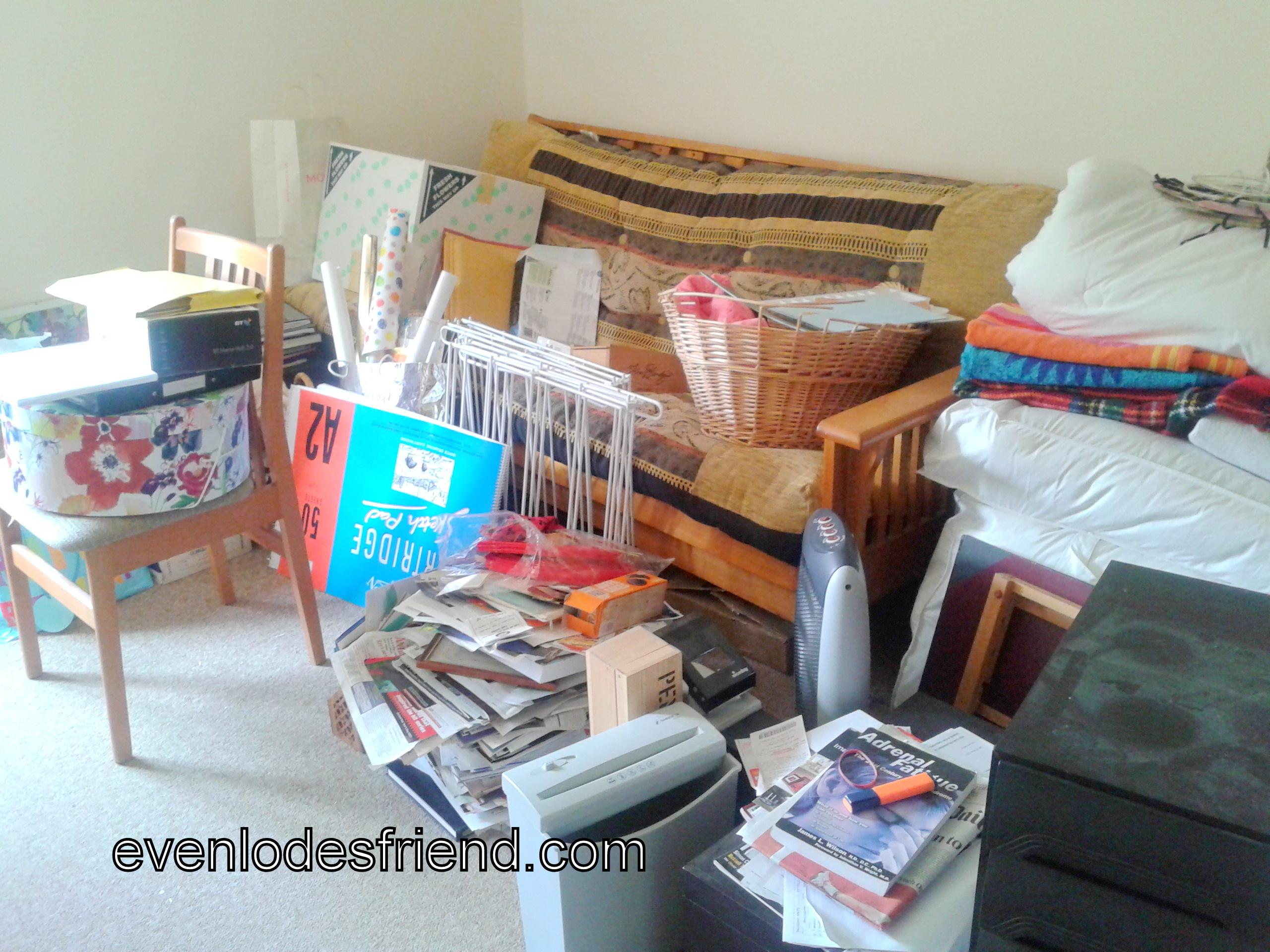
But of course, because I never do anything by halves, my darling husband is having a couple of days off right now and decided, for a whole bunch of really complicated reasons, that it would be a great idea for us to switch offices.  Yes, while I am ill.  No, he did not expect me to help move the furniture.  So now he has the north-facing back room, and I have the sunny, and much larger, front room with the sofabed-futon thingey to lounge on.  I suspect I may have got the best end of the deal, don’t you?

This brilliant wheeze unfortunately has its down side.  Evenlode OPs Centre now looks like a cross between a bad jumble sale and the aftermath of Chernobyl.  Major purge, rethink and planning are urgently required.  (Shame my brain is on illness-induced sabbatical, but there we are.)

new study messThis is not entirely a bad thing, however.  I need to be systematic about everything right now, and the study change is just the external materialisation of the internal mess I am in.  Because it turns out that this blogging thing is much harder than it looks, and I am going to have to be a lot more organised than I thought.  I can’t just fire off a post for this blog in half and hour from a standing start, as I do with my personal blog, because its not that kind of site.  I want my readers to be informed, and that means my research has to be spot on and my posts thorough and thoughtful.  I need to write ahead, and I haven’t worked out how I can do that and juggle my health issues and life at the same time.  I think its good, on the whole, to reassess what you are doing periodically, but I’ve never been one for planning systematically how to do something, as the state of my desk drawers unvariably show.

Yes, its cosmic learning time!

So, today’s Outflow is about two things, redesigning my work area, and planning my work method.  I must be mindful about what I’m going to need and the issues I am going to have to plan for, like not being well enough to write on a posting day.  I’m going to need a workspace that supports me, with all the tools for writing, painting, planning and running this little endeavour within easy reach.  And its got to be easy to keep tidy and organised because I am crap at being neat and perversely, as a Libran, I don’t like working in a messy, ugly space.  In this way, writing a blog isn’t any different from my other creative work, my writing and painting.  It just has to be more systematic and focussed.

If you keep a blog, I would love to know how you organise yourself ahead, and plan your posts.  And if, like me, you are lovingly embarking on making a new creative nest for yourself, I would love to hear about that too.  Please leave a reply (the tag appears at the top of each post for some reason, thats another design issue on my blog To Do list!) and maybe we can do a compendium post of all the shared ideas and wonderful ‘Rooms of Our Own’.

Happy Creating,

EF

The Writing Life: Writers Groups

DSCI2689

I belong to a writers group.  And it’s great!

It all began years ago, when I started the Diploma in Creative Writing at the University of East Anglia.  It was the first writing course I ever went on.  I walked into the room and found myself surrounded by people like me.  It was the first time I ever felt like I wasn’t different and strange.  I had found my tribe.

Writing is a solitary occupation, so it is crucial for both your mental health and your work to socialise.  And what better way to do that than with other writers who are going through the same trials and tribulations as you are?

As part of our diploma course, we went on a weekend retreat, involving taught sessions, visiting speakers, workshopping and private writing time.  It was a huge success and we bonded.  Many of us went on to study for the Advanced Diploma in Prose Fiction, which was primarily a workshop-based course, and that further cemented the group.

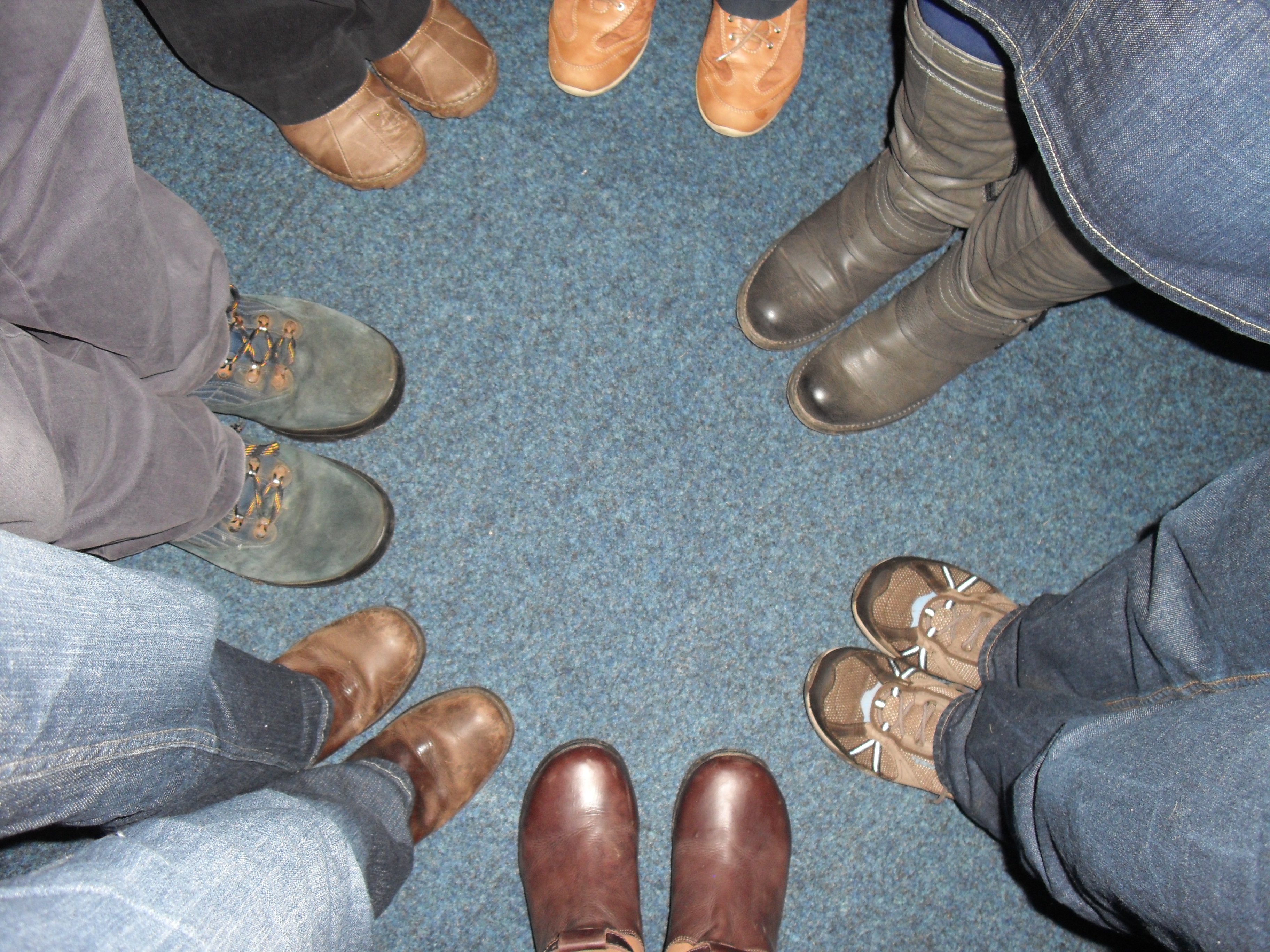
Since then we have continued to meet, once a month, to share our work, our experiences, problems and interests.  And an awful lot of tea and flap-jacks!  Members have come and gone, buts okay.  There is a core group who have stuck together for over a decade now, sharing life experiences, supporting one another through MA courses and publication.  We go on annual retreats together, about which more in future.  We meet at each other’s houses, planning dates ahead and each offering to the host nights most convenient.  Hot and cold drinks, nibbles and cakes are provided to lubricate the conversation.

Based on the old course model, each member brings a piece of new writing that they have done, and we try to keep it to around 1,000 to 2,000 words in length – any longer and it takes up too much time.  You can read your own piece, or ask someone else to read it.  (It is sometimes really helpful to hear another person read it in order to pick out the parts where the writing is less fluid.)  Then people comment.  Helpful and empathic criticism is offered.  We always make sure we start by pointing out what we like about the piece.  Often, if it is part of a larger work, people will ask questions about plot or backstory.  Because we know one another’s work so well, we can refer back to earlier stories, or earlier parts of the work, and kick around ideas to find out what might be a useful improvement for any problems.  At the end of every participant’s session, they are asked how they feel about what was said, which gives them the chance to say anything that has been missed in the discussion.  We usually manage to workshop about three pieces of prose in a 2.5 hour meeting.

Not everyone may have something they want to read, or will have had time to write that month, and that’s okay too.  They contribute by commenting on and supporting the work of others.  We have prose writers and poets.  We share news of any courses or day schools that may have been attended, and often discuss what books everyone is reading too.

And of course, we do a lot of nattering and gossiping too.

Outside the regular meetings, we have been known to circulate work and meet informally for writing sessions.  We even do writing sessions over the phone.

I encourage you to find your own tribe.  You can do it online or in person.  Libraries and publications such as Mslexia and the Writers Digest often have small ads for writers groups.  Or start one yourself, as we did.  Make sure you are happy with the atmosphere and ethos of the group you join, however.  There is no point in sharing your work and then having it brutally cut to pieces.  Gaining confidence in dealing with confidence is one thing.  Bullying is quite another.  There are pitfalls with joining any group, but the advantages with a good one will outweigh any glitches.

My pals in the group have stuck by me through thick and thin and seven novels, and I am eternally grateful to them for their kind support and criticism.  And for banning me from using the word ‘massive’.  Sometimes you need that kind of pal.

Dear Bridget, Clare, Heidi, Nina, and Sally, I love you.

And now I had better get myself together and go and put some flap-jacks in the oven, because they’ll be round tonight and I haven’t written anything yet!

Happy creating,

EF

How to Write: Write what you know, or not…

writing books

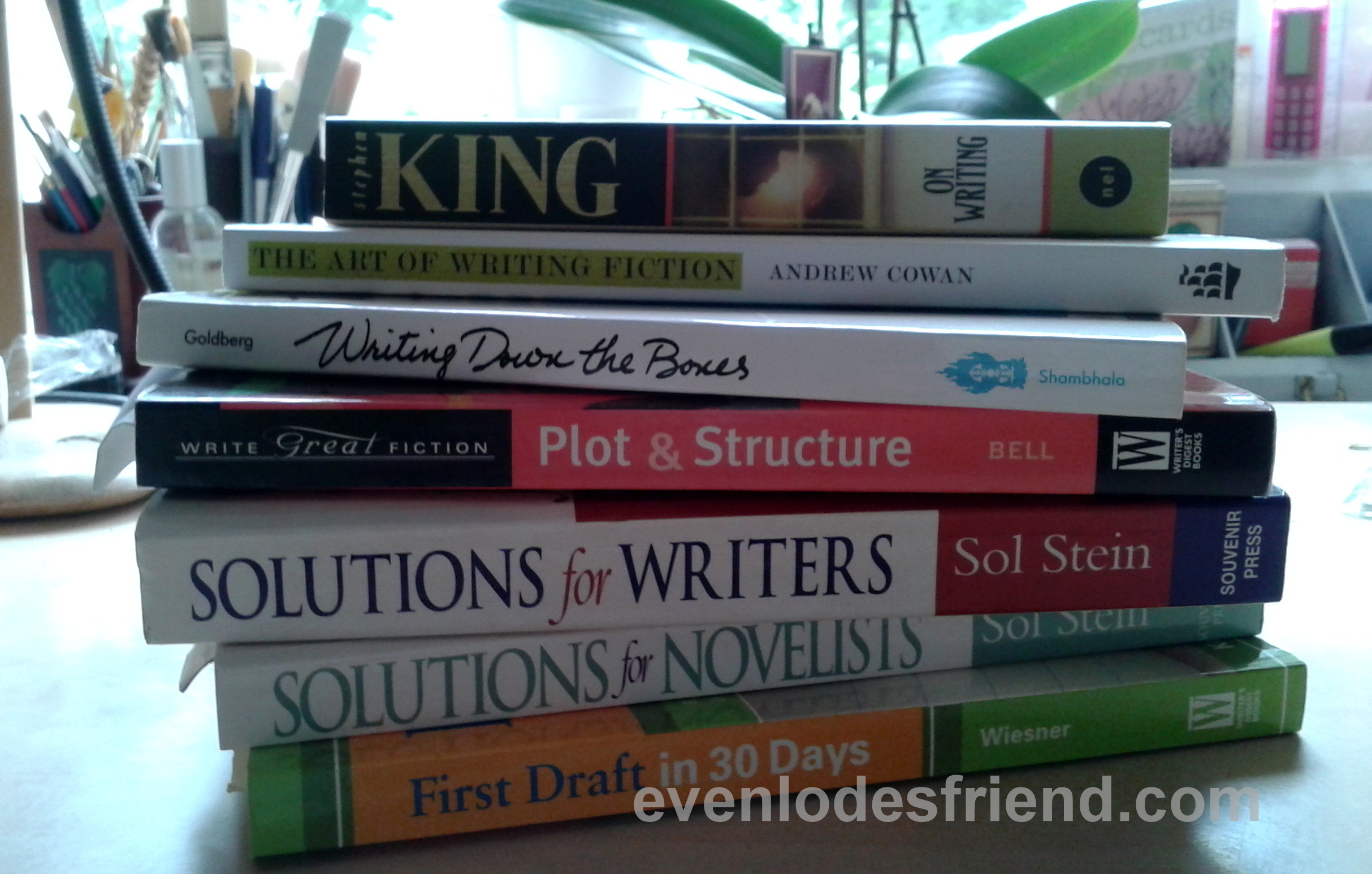
Most books on how to write will tell you this:  write what you know.

If you have some major area of expertise, they say, you should use that as a background for your novels.  Dick Francis, a famous jockey, wrote crime novels set against the backdrop of the horse-racing world, with spectacular success.  John Grisham was a criminal lawyer and politician before publishing fabulously successful legal thrillers.  Agatha Christie drew on her war work as a hospital dispenser when writing her detective fiction.  All of these authors, and many more, have made huge successes of writing about what they know.

BUT –

(And the word BUT has a bit of fairy dust in it that magically negates everything that comes before it, have you noticed that?)

I once heard novelist Rachel Cusk at a reading on the subject.  She was stridently against the idea of writing about what you know.  She said words to the effect of:

‘You know, we write fiction, and the clue is in the name.  Fiction.  It means we make it up.’

Take a moment to think about this:  the genre of science fiction would never have been invented if we only wrote about what we know.  No one has travelled across the Universe of the star ship USSS Enterprise, after all.  Fancy a world without ‘Harry Potter’ or ‘Game of Thrones’?  That would be the logical conclusion.

And what about crime?  Yes, I agree there are a number of very talented writers producing procedural crime novels who have a background in criminal pathology or forensics, but how many truly great crime writers have actually personally killed someone? (None, we hope.)

‘Write what you know’ does not, therefore, take account of the most wonderful asset we have, the thing that makes human beings extraordinary amongst all the myriad of life on this planet:

Imagination

Imagination enables us to fly beyond the stars at warp speed, fight dragons with broadswords, fall in love with Benedict Cumberbatch and have him love us back.  And all in our lunch break.  Think about it –who really wants to write about their day job when they can write about this stuff?

There is, of course, a caveat.  Sometimes you need to do research.  And research is a double-edged sword on which you fall at your own peril:

I wrote a book set in London.  I have not lived in London.  I gave it to a friend to read, and he was a Londoner, born and bred.  He asked me about the car chase – Where are they?  Where are they going?  What road are they on?  He was frustrated because he knew the city well and he could not orient himself within the action.  I had not done my research and I did not know the setting well enough to wing it.  The novel collapsed for the reader as a result.

The opposite is true.  I wrote this story, set partly in Oxford, a city I know well and visit often.  I was able to undertake the depicted walk myself, just to be sure I had the details and the route right.  The result was a story that was adored by readers who knew the city too.  I had a personal email from one who was delighted that memories of her student days had been rekindled by my work.

So, getting the details right is important.  If you don’t, you can look like an idiot who doesn’t know what he is talking about, and the credibility of your story collapses.

BUT

(Fairy dust again.)

There is such a thing as having too much detail.  The first novel I wrote was set in the Iron Age, around 230BC, on the Newbury Downs.  It is not an area I know well, though I have driven through it.  And I have no background in archaeology or prehistory, so I had to research it all myself.  It took me seven years to finish it, and I gave up doing word counts after 250,000.  I knew too much.  I had too much detail – there are things I know about Iron Age saddles that normal human beings really shouldn’t know.  It’s doubtful that any reader would care.

And yes, you always get the odd accuracy fiend who emails you to say (puts on squeaky voice) ‘Er, the spoon your hero was using in scene 23?  Well, those kinds of spoons were not invented till three hundred years after the date you posit…’ etc etc.  But those are not your average readers.  Unless you write sci-fi, in which case you had damn well know your warp cores from your improbability drives.

“The best way to become acquainted with a subject is to write a book about it.”

-Benjamin Disraeli

The point I am trying to make here is this:  Ignore the advice.

Write what you want to write.

Write what you need to write.

(And if you have to, do the research.)

I promise to talk more about research in a future post, but in the meantime, do this:

Write the novel you want to read.

Happy creating,

EF

Why you need to Moodle

Today, I have been moodling.

Mooching.  Pottering.  Puttering.  Loafing.  Fiddling.  Wandering.  Pootling.

It looks like I am doing nothing very important from the outside, or at least nothing creatively productive.  But that couldn’t be further from the truth.

Brenda Ueland, in her superb book ‘If you want to write’ (hardly bettered since it was published in 1938), calls creative revelations ‘little bombs’.

“You may find that the little bombs quietly burst in you when you are doing other things – sewing, or carpentering, or whittling, or playing golf, or dreamily washing dishes.” (p45)

“…So you see, the imagination needs moodling – long, inefficient, happy idling, dawdling and puttering.  Therse people who are always briskly doing something and as busy as waltzing mice, they have little, sharp, staccato ideas…but they have no slow, big ideas.  And the fewer consoling, noble, shining, free, jovial, magnanimous ideas that come, the more nervously and desperately they rush and run from office to office and up and downstairs, thinking by action at last to make life have some warmth and meaning.” (p32)

Ueland knew that we need to time to contemplate, to think and reflect, to be alone with ourselves, but also time to just let things percolate, soak in and mingle.  We may not look like we are working on our novel when we are washing up.  We may not even be thinking about it consciously.  But there it is, fizzing away behind our eyes, collecting connections, accumulating mass like a growing snowball tumbling down a mountain.

We are incubating miracles.

We need to moodle to charge our brains, to collect impressions, to drink from the well.  However, there is another reason to moodle.  What happens when the well is dry?

This comes back to self care, which I wrote about in an earlier post.  There are always going to be times of creative drought in our lives.  There will be times when life gets in the way, or when we are so busy dealing with our personal stuff that there is no energy left over to flow out into creation.

It is crucial to know that that is alright.  It happens.  It will pass.

And when these droughts occur, and to prevent them if you can, you need to moodle.  Have a nap.  Potter about.  Paint your toenails.  Fix that squeaky gate.  Go window shopping.  Give yourself a break, literally and metaphorically.  Resting will fill the well up again.

This is why I don’t really believe in writers block.  I think that either you are exhausted, or you are stopping yourself from creating out of fear.  If the latter is the case, you need to explore those fears, and work on them in your journal.  If the former, you need to let go of guilt, accept the creative season you are in, and lie around wiggling your toes until your brain is sufficiently rested, and finally ready to come up with a new ‘Aha!’ moment.

I urge you to read Ueland’s peerless book, whether you are a writer or not.  It is full of incredibly sensible advice for anyone who means to create.

I also urge you to take some moodling time this week.  Book it in your diary.  Tell the family to leave you alone in the bath tonight.  Go and lie in the park in the sun.  Not every expedition has to be an Artist Date.  Sometimes, its good just to refill the well.

Happy Moodling,

EF