Category Archives: Safe Space to create

Outflow: What the **** am I doing?

new study deskYou may have noticed that yesterday was Wednesday and that it was eerily quiet here at Evenlode’s Friend.  Oops.

Its not that I wasn’t thinking of you, believe me.  Its just that, well, I won’t go into too much sordid detail here, but there are some stomach complaints that leave little room for writing blog posts.  Yes, I was ill. I still am.  I’ve been hit by a particularly nasty bout of IBS, and its going to take some time to settle things down again.

But of course, because I never do anything by halves, my darling husband is having a couple of days off right now and decided, for a whole bunch of really complicated reasons, that it would be a great idea for us to switch offices.  Yes, while I am ill.  No, he did not expect me to help move the furniture.  So now he has the north-facing back room, and I have the sunny, and much larger, front room with the sofabed-futon thingey to lounge on.  I suspect I may have got the best end of the deal, don’t you?

This brilliant wheeze unfortunately has its down side.  Evenlode OPs Centre now looks like a cross between a bad jumble sale and the aftermath of Chernobyl.  Major purge, rethink and planning are urgently required.  (Shame my brain is on illness-induced sabbatical, but there we are.)
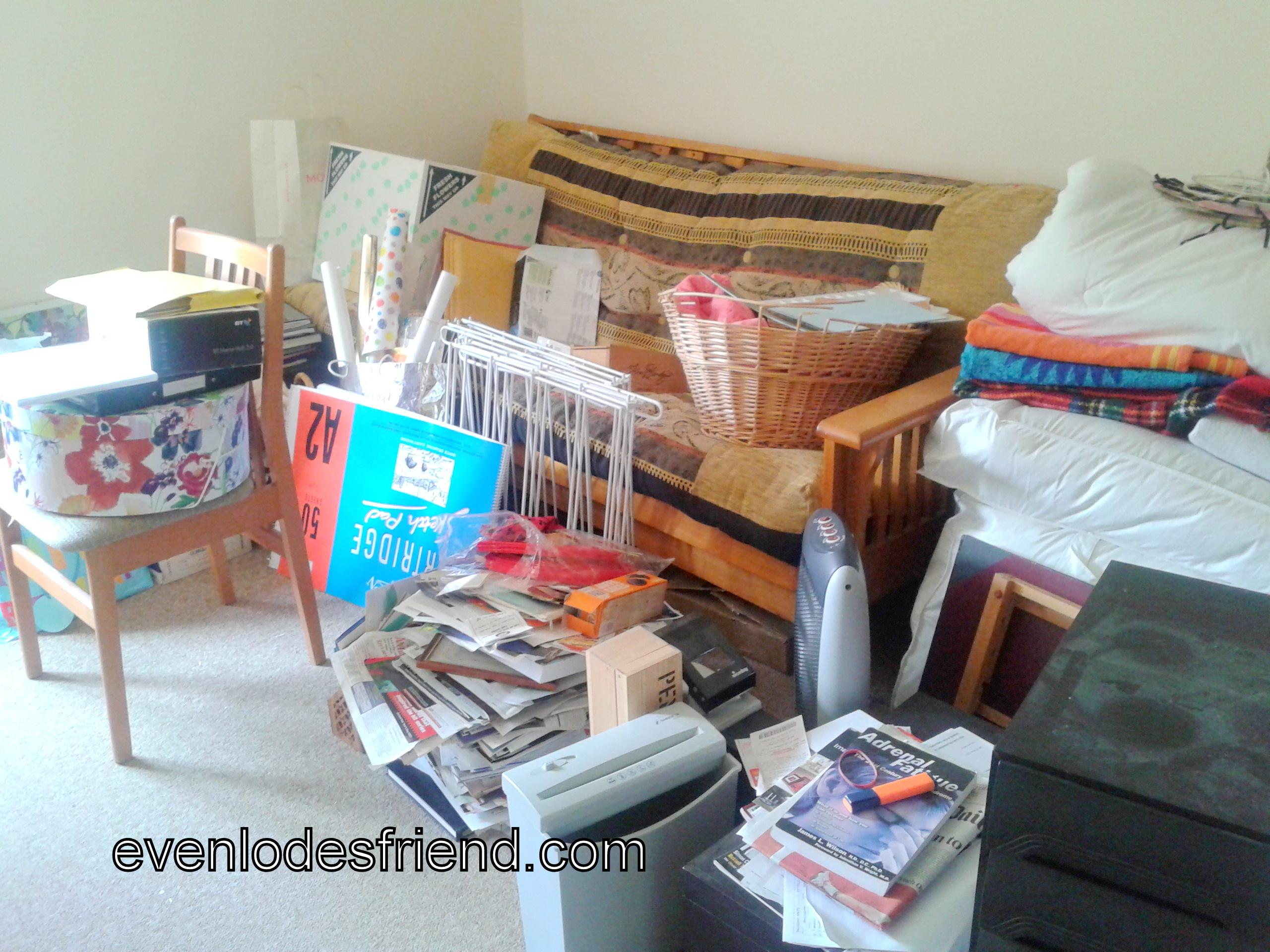
new study messThis is not entirely a bad thing, however.  I need to be systematic about everything right now, and the study change is just the external materialisation of the internal mess I am in.  Because it turns out that this blogging thing is much harder than it looks, and I am going to have to be a lot more organised than I thought.  I can’t just fire off a post for this blog in half and hour from a standing start, as I do with my personal blog, because its not that kind of site.  I want my readers to be informed, and that means my research has to be spot on and my posts thorough and thoughtful.  I need to write ahead, and I haven’t worked out how I can do that and juggle my health issues and life at the same time.  I think its good, on the whole, to reassess what you are doing periodically, but I’ve never been one for planning systematically how to do something, as the state of my desk drawers unvariably show.

Yes, its cosmic learning time!

So, today’s Outflow is about two things, redesigning my work area, and planning my work method.  I must be mindful about what I’m going to need and the issues I am going to have to plan for, like not being well enough to write on a posting day.  I’m going to need a workspace that supports me, with all the tools for writing, painting, planning and running this little endeavour within easy reach.  And its got to be easy to keep tidy and organised because I am crap at being neat and perversely, as a Libran, I don’t like working in a messy, ugly space.  In this way, writing a blog isn’t any different from my other creative work, my writing and painting.  It just has to be more systematic and focussed.

If you keep a blog, I would love to know how you organise yourself ahead, and plan your posts.  And if, like me, you are lovingly embarking on making a new creative nest for yourself, I would love to hear about that too.  Please leave a reply (the tag appears at the top of each post for some reason, thats another design issue on my blog To Do list!) and maybe we can do a compendium post of all the shared ideas and wonderful ‘Rooms of Our Own’.

Happy Creating,

EF

Journal Friday: Reflecting on Creative Blocks

paintbox

So, if you read my last post, you will know that I am increasingly drawn towards drawing and painting at the moment.  This is my current creative season and I want to honour it.  So today, no doubt, you will be expecting me to deluge you with jpegs of the beautiful pictures I have been creating.

Yeah, Right.

Nigel has been hard at work again.  I have produced the sum total of zero drawings in the last two days.  Yesterday I couldn’t even bring myself to go into the study to get out my sketchbook and paints.  The blank page suddenly seems terrifying.  I can’t even doodle.  How the hell have I lost the ability to doodle, for Gods’ sakes?

Bit not good.

This, my friends, is where the journal really comes into play.  I sat down with my trusty moleskine and pen, and thought about my childhood memories of drawing.

I used to draw all the time.  It was what I was known for, amongst family and friends.  I was never without a piece of paper and a pencil.  I made little books and illustrated them.  I wrote stories and illustrated them.  I wrote stories about my favourite TV programmes, like ‘Blakes 7’ (remember that one?  I had a terrible crush on Paul Darrow) and drew the characters all the time.  (If only I had known about fanfiction and fanart then!)  I was obsessed at one point with the Tudor monarchs, and copied their opulent portraits and clothes with fibre tipped colouring pens.  Then I got into the Ancient Egyptians, and copied their sideways style of representation.  I even copied the drawings of E.H Shepherd in the beautiful edition of Kenneth Graham’s ‘The Wind in the Willows’, which my father gave me – it was his favourite book.  And I painstakingly illustrated all my school work (except the Maths, of course, because that was too serious, which was probably why I was never any good at it.)  In other words, I spent hours absorbed in transferring images from my head onto the page.

What happened?  Senior school art classes.  Hours of drawing still lives of pots and pans. Teachers who made us draw boring subjects, and never gave us any information about technique.  I’ve learn everything I have ever learnt about art and how to use paint from copying, which my art teachers said was the worst possible sin.

(But I am getting ahead of myself, I’m supposed to be thinking about my childhood drawing.)

As a kid, art was my obsession, but it requires materials, and they were in short supply.  For paper, my dad bought home gash computer paper from work, the perforated kind that comes in a concertina, with holes along the edges, and with about the same handling quality as IZAL toilet paper.  I was occasionally bought coloured felt-tipped pens but in the 1970s they were rubbish, and the black ones were invariably dried out before they were even used.  At least 25% of the pens in the pack didn’t work within about two days of having them, and you had to conserve those that did with fiendish vigilance.  There were occasional gifts of watercolour pan boxes, but they were very low pigment, and anyway, painting in your bedroom is frowned upon by most mothers because it is messy.  And there wasn’t anywhere else to paint.  What I am trying to say is that I grew up yearning for those huge bottles of poster colour paint that stood on the trolley in school.  The thought of being able to just splash paint about willy-nilly was ridiculous.  My parents wanted to encourage my artistic side, but they didn’t have the disposable income or the mindset to invest in good raw materials for it.

The result is that the scarcity of my childhood has bloomed into a scarcity paranoia in adulthood.  As soon as I was earning, I went out and bought decent art materials, but then I couldn’t make myself use them.  I have drawers and boxes full of sketchbooks, pastels, inks and paint tubes that have never been opened because I still have the mindset that they have to be conserved.  I can’t waste a thing.  To the point where I can’t use a thing.

None of this would I know and understand, were it not for exploring it in my journal.  And in my journal have come the little glimmers of a solution, a plan to tackle my stuckness with baby steps so minute that I can fool Nigel into thinking I’m not even putting pen to paper at all!  Slowly and gently, I will con myself into the belief that making a tiny drawing is safe.  And then I will con myself into making a bigger one.  Until one day I will fulfil my dream of illustrating my own novels, and making huge abstract expressionist canvases like Rothko and Pollock.  But not yet.  To begin with, I will throw out everything I learnt in art class, scrunch up my eyes and begin again, as a child.  It will be hard, but I can do it.  I did it with the writing, after all…

Journal Exercise:

Are you also struggling with a creative block?  Is there something you used to do, and would like to do again, but are afraid to?  Perhaps you are just stuck and you can’t get out of your own way.  You probably don’t even know why.

Get out your journal and take a few deep breaths.  Close your eyes and let yourself fall backwards through time. Feel yourself become a child, doing that thing you loved do and don’t do anymore, whatever it is.  Immerse yourself in that memory.  How did it feel?  What was so satisfying, enticing, transcendently joyful or just effortless about it?  How did splashing paint on paper, sewing a doll’s dress or dancing to the radio help you express yourself?  Connect with the fun, the pleasure, the satisfaction.

Now write about it.  Take time to write out all you can remember about doing that creative activity, and take the memory from as early an age as possible.

Now take another deep breath and continue to write, this time about when you stopped pursuing that activity.  What happened?  What age where you?  Was there criticism from parents or responsible adults?  Or was it competition with other children who you regarded as being better at the skill than you?  Perhaps you reached puberty and decided that form of creativity was childish and no longer for you?  Or you felt you couldn’t go any further with it because you couldn’t make a living at it?  Whatever the reason, explore your memories of it.  Be as thorough as you can.

Give yourself some time to sit with these memories, to contemplate them.  Decide what aspects are still stopping you.  Are you, like me, fearful that your work won’t be ‘GOOD ENOUGH’ (thanks, Nigel), or still carrying that fear that there isn’t paper to waste?  Will doing this activity make you vulnerable in some way?  (If so, you don’t have to show it to anybody, just keep it for yourself.)

(If some major trauma is involved, it is wise to seek professional help.  A therapist is invaluable, and those who specialise in expressive arts or Gestalt might be just what you need.  Don’t suffer flashbacks alone as a result of this exercise.  Self care should always be the first rule of creative expression.)

Think about ways to ease yourself through these issues.  Maybe taking a beginners or taster course, where everyone will be fumbling about at the same starter level, could encourage you that what you make doesn’t have to be perfect.  Perhaps an online course that you can follow in private, and at your own pace (Alisa Burke has some brilliant art and sewing courses.)  Or you could buy some kids art materials and use them with your own kids (or borrow someone else’s for an afternoon).  Watch how kids are completely free of judgement when they make art.  They are just having fun.  You can, too.  (Actually, I think I may have to borrow some children and do this myself!)

Trust that what comes up in writing your journal is from deep within, an inner wisdom that will guide you back to your creative centre.  Above all, be gentle with yourself as your formulate your action plan, and give yourself as much time as you need.  You don’t have to become Picasso or Nijinsky overnight.

Happy Creating,

EF

The Writing Life: Writers Groups

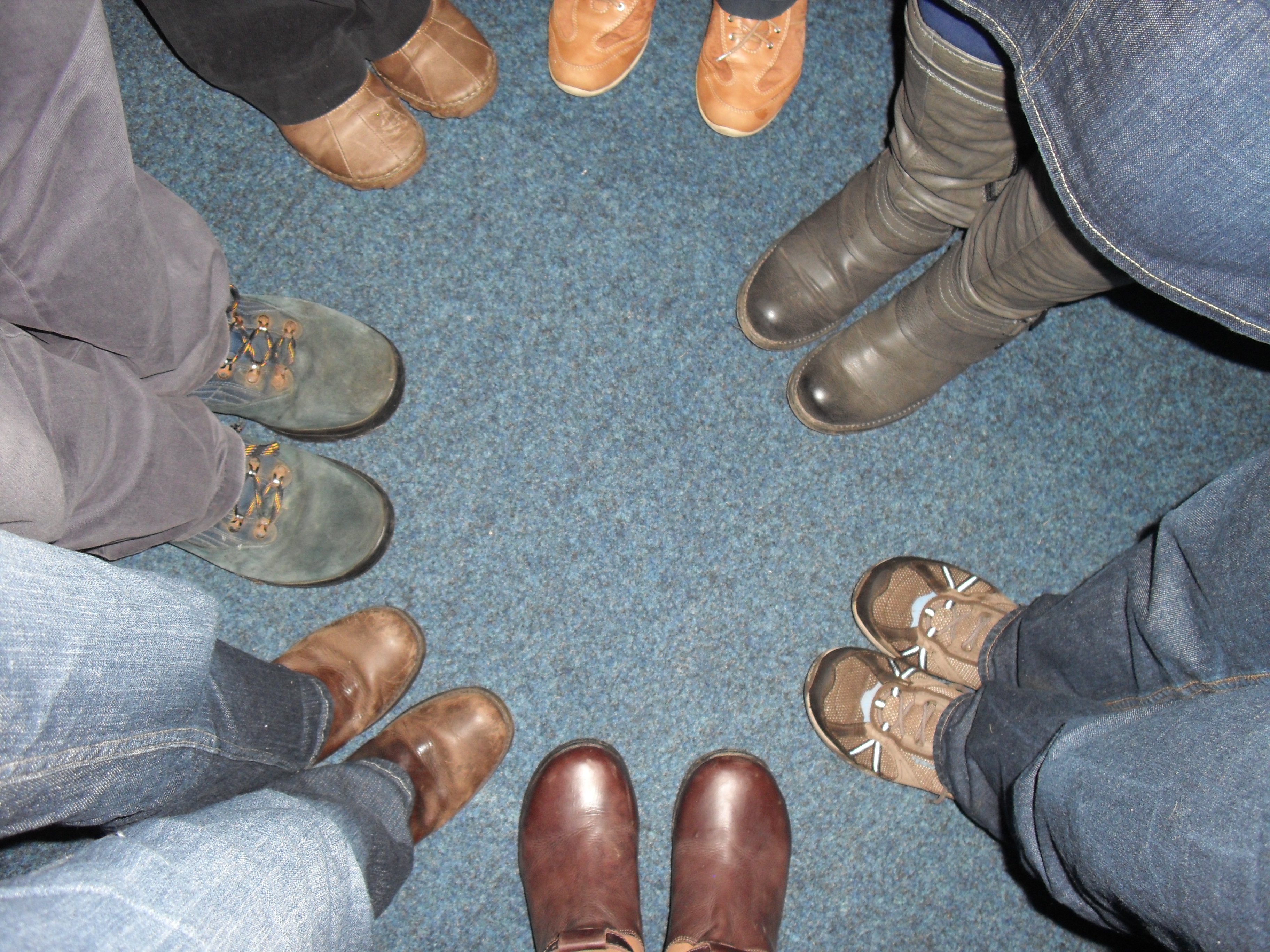
DSCI2689

I belong to a writers group.  And it’s great!

It all began years ago, when I started the Diploma in Creative Writing at the University of East Anglia.  It was the first writing course I ever went on.  I walked into the room and found myself surrounded by people like me.  It was the first time I ever felt like I wasn’t different and strange.  I had found my tribe.

Writing is a solitary occupation, so it is crucial for both your mental health and your work to socialise.  And what better way to do that than with other writers who are going through the same trials and tribulations as you are?

As part of our diploma course, we went on a weekend retreat, involving taught sessions, visiting speakers, workshopping and private writing time.  It was a huge success and we bonded.  Many of us went on to study for the Advanced Diploma in Prose Fiction, which was primarily a workshop-based course, and that further cemented the group.

Since then we have continued to meet, once a month, to share our work, our experiences, problems and interests.  And an awful lot of tea and flap-jacks!  Members have come and gone, buts okay.  There is a core group who have stuck together for over a decade now, sharing life experiences, supporting one another through MA courses and publication.  We go on annual retreats together, about which more in future.  We meet at each other’s houses, planning dates ahead and each offering to the host nights most convenient.  Hot and cold drinks, nibbles and cakes are provided to lubricate the conversation.

Based on the old course model, each member brings a piece of new writing that they have done, and we try to keep it to around 1,000 to 2,000 words in length – any longer and it takes up too much time.  You can read your own piece, or ask someone else to read it.  (It is sometimes really helpful to hear another person read it in order to pick out the parts where the writing is less fluid.)  Then people comment.  Helpful and empathic criticism is offered.  We always make sure we start by pointing out what we like about the piece.  Often, if it is part of a larger work, people will ask questions about plot or backstory.  Because we know one another’s work so well, we can refer back to earlier stories, or earlier parts of the work, and kick around ideas to find out what might be a useful improvement for any problems.  At the end of every participant’s session, they are asked how they feel about what was said, which gives them the chance to say anything that has been missed in the discussion.  We usually manage to workshop about three pieces of prose in a 2.5 hour meeting.

Not everyone may have something they want to read, or will have had time to write that month, and that’s okay too.  They contribute by commenting on and supporting the work of others.  We have prose writers and poets.  We share news of any courses or day schools that may have been attended, and often discuss what books everyone is reading too.

And of course, we do a lot of nattering and gossiping too.

Outside the regular meetings, we have been known to circulate work and meet informally for writing sessions.  We even do writing sessions over the phone.

I encourage you to find your own tribe.  You can do it online or in person.  Libraries and publications such as Mslexia and the Writers Digest often have small ads for writers groups.  Or start one yourself, as we did.  Make sure you are happy with the atmosphere and ethos of the group you join, however.  There is no point in sharing your work and then having it brutally cut to pieces.  Gaining confidence in dealing with confidence is one thing.  Bullying is quite another.  There are pitfalls with joining any group, but the advantages with a good one will outweigh any glitches.

My pals in the group have stuck by me through thick and thin and seven novels, and I am eternally grateful to them for their kind support and criticism.  And for banning me from using the word ‘massive’.  Sometimes you need that kind of pal.

Dear Bridget, Clare, Heidi, Nina, and Sally, I love you.

And now I had better get myself together and go and put some flap-jacks in the oven, because they’ll be round tonight and I haven’t written anything yet!

Happy creating,

EF

How to Give Good Criticism, or ‘Do as you would be done by’

This post follows on from my earlier one, about how to take criticism.

Now, before you get defensive, criticism is a good thing.  It can help you develop as an artist in whatever field you choose to pursue.  It can open your mind, make you a bigger, better human being.

BUT

It has to be CONSTRUCTIVE CRITICISM.

Constructive criticism is given from a place of concern and interest.  It is offered by someone who cares about your work and wants you to be the best you can possibly be.

Most people don’t know how to do this, which means criticism gets a bad rap.  It is seen as something damaging and negative, something that can potentially destroy you as an artist, and believe me, it is, if you do it wrong.

This is a guide on how to do it right.

 THE ONLY RULE IN GIVING CONSTRUCTIVE CRITICISM IS EMPATHY

Everything comes from this.

Put yourself in the place of the person whose work you are reviewing.  Think about what you want to say about it.  How would you feel if someone said something like that to you about your work?  Would you feel hopeful, buoyed up, enthused, or would you be utterly crushed?

Take the time to think before you type or speak.  This is especially important if you are reviewing someone’s fanfiction or online work.  It’s so easy to plonk a few keys and fire off a comment before you have thought about it, before you have considered the impact on the person receiving it.

Don’t say what you would have done instead.  So many readers think that helpful comments should be about ‘well, I would have written it this way.’  No.  Criticism is about pointing out what doesn’t work for you as a reader.  It is down to the writer/creator to decide what to do about that.  (However, helpful suggestions are often very well received.)  Remember that this work comes from someone’s unique perspective, and that they have made many artistic decisions for specific reasons.  Those are reasons that you may not share, understand or even perceive.    Give the writer/creator your respect.

Gauge the level of criticism the writer/creator may be ready to receive.  This can sometimes be quite hard, especially if there is seems a lot wrong with a piece.  Is the writer in need of help at the most basic level, i.e. the nuts and bolts of language and grammar?  This may, of course, be because the language used is not their native language, so they are learning.  If that is so, they may be very grateful for your help.  Perhaps the comments you need to make are at a higher level, in terms of plot, pace, character, structure or dialogue.  Again, this may be a problem with linguistic mastery.  Try to choose one area to comment on at a time.  Don’t deluge someone with criticism of all major aspects of their work, or they will go to pieces.

Knowing the writer’s other work helps.  This way you can refer back to it, and they feel known and appreciated.  If someone is commenting with knowledge of your back-catalogue, they can comment in context.  They know where you are coming from, and how your work has changed over time. It’s not necessary to read everything a writer has written before you comment, but if you have read one or two of their other works, and you think they are relevant, it can be a great boost, a recognition of the progress they have made and what they do right.

Practise constructive criticism in a writers group.  You can join them online or face to face.  Watch notice boards in your local library or bookshop, or scan the pages of literary and writers magazines like Mslexia to find a good group.  Alternatively, form your own, and workshop your work together.  Make the rule that all comments must be caring and constructive.  Always ask the recipient how they feel about what was said at the end of their workshop session, so that they have a chance to talk about any comments they found difficult to handle – trust is crucial.  (I’ll write more soon about writers groups and how useful they can be.)

Always point out and praise what does work, and be positive.  The writer/creator has put a lot of time and effort into producing something for your consumption and enjoyment, and that in itself is a great achievement.

Don’t EVER get personal.  This is about the work, not the person.

If you react in a strongly negative way to a piece, ask yourself whether this is because the content is touching on your own issues and triggers?  If it is, DO NOT comment.  I suggest you spend some time writing your rant out in your journal, rather than firing it off to some innocent writer who doesn’t know about your ‘stuff’.

Some examples of constructive criticism:

(These are all actual examples of constructive criticism I have received on my work, and are offered as illustrationss of general points.)

“I’m not really sure I understand the character’s motivation at this point.  Maybe I need to see them in a scene that shows them being attacked about this issue so I know why they are reacting so defensively later on, or maybe point to some backstory that suggests this?”

“And then he said it.  The thing he wasn’t supposed to say.  The one thing I never expected from him.”  – (section of text from my story)  This feels like overwriting to me.  If it was the one thing he wasn’t supposed to say, surely it is unnecessary to add that it was unexpected from him.  You are repeating the sense here.  Just take the second sentence out, and its perfect as it is.”

“The word xxxxxx stands out as awkward here for me.  Would they really use that kind of language?  It sounds more like modern slang than a Victorian expression, and it kind of bumped me out of the flow of reading.  Could you substitute something similar but gentler?”

“(Example given)  This sentence is really long.  It has so many commas that I got a bit confused as to what you were trying to say.  It would make much more sense for me if you made shorter sentences, so that I don’t have to consciously keep track of where you are going.”

 A final note:

Remember, it takes a lot of guts to put your creative work out into the public arena.  For many creative people it feels like sticking one’s head into the lion’s mouth.  Respect that fear and the bravery that outweighs it.  Always respect and have empathy for the creator of the work on which you comment, and it will be hard to go wrong.  If we support one another’s work lovingly, we can all learn together.

Incidentally, I would love to know if you have more tips on how to receive or make constructive criticism – if you do, please comment/reply!

Happy creating,

EF

How to Take Criticism

The idea for this post came to me last week when I got a pretty starchy comment on one of my stories.  It happens sometimes.  Actually, I have to say I can think of only two previous occasions when comments have upset me in three years of online publishing, so I suppose I am doing pretty well.  My pals were very supportive, as was my husband.  No sweat, right?

Hmmm.

It got me thinking about how as artists we approach taking criticism.  Art of whatever form is a subjective thing.  Whether we like it or not is a personal matter.  You can’t please all of the people all of the time, as they say.  It is just a fact of artistic life, and we can learn a great deal from it.

The problem with art in general, and writing in particular, is that it is the product of our soul.  That makes it very close to us, an expression of our feelings, of everything we believe in.  And that, in turn, makes it hard not to take criticism personally.  Which is why a negative review can feel like being emotionally disembowelled.  It can be crippling.  It can block us completely, so that we never creatively express ourselves again.  That is why it is so important to know how to deal with it.

It strikes me that there are two types of criticism.

  1. Constructive Criticism.  This is the kind that comes from readers who support your work, who appreciate what an emotional risk it is to put your work out there, and who want to help you to improve.  They give honest, caring feedback.
  2. Rants.  You know this kind of comment.  It is usually about content, not plot, pace, language or technique.  It is usually angry, often vindictive, and actually has nothing to do with your work, and everything to do with the commenter’s personal ‘stuff’.

Constructive criticism comes from a place of empathy and support.  Its aim is to help you along the road to expressing yourself better.  It may seem niggly (you missed a comma out, for instance, or left a typo in) but it is there with positive intent.

Rants are to do with issues that the critic has in their own life.  The first nasty experience I had with this was with my story, ‘Property Of:’.  A reviewer wrote a vicious snarl about how I had depicted the armed forces as being shagging frantically in trenches at every opportunity, and that it was disgusting that I should suggest this, or that Dr Watson could have been involved with a married person.  My (possibly misguided) response was to email the person in question and ask her to expand on her comments.  What I got back was a three page diatribe on the fact that Watson should be whiter-than-white and how dare I criticise the army.

Clearly she had issues surrounding infidelity and the armed forces.

I don’t write for Disney.  I deal with the real shit. Real life.   Real people.  And real people make mistakes and get scared and do weird, unexpected things under pressure.  She had her own reasons for not liking my story.  Fine.  I triggered them.  Okay.  But I am not going to change the whole tenor of what I write to please one person, however hurt they have been.

Now don’t get me wrong.  I love criticsm.  When it is constructive.

In the course of publishing daily episodes of ‘The Case of the Cuddle’, for example, I realised from comments being made that I had left out a whole area of the story between Lestrade and Mycroft.  Without it, their responses to later events made no sense.  If it had not been for those reviewers who were unafraid to ask awkward questions in a supportive way, I would not have noticed the gaping hole in my narrative.  I hacked together an extra two chapters to insert into the story, and fixed the problem.  Bravo critics.  I learnt something.  Thank you.

That is the point of contructive critisicm.  You learn something.  The way to approach any kind of criticism is to ask this question:

What can I learn from this?

So, how do you deal with criticism, nasty or kind?  Here are a few tips:

  • Take a deep breath.  Walk away.  Give yourself some space.  DO NOT immediately fire back a stroppy reply that will only provoke further attack.
  • Work out which kind of criticism is being offered.  Calmly.
  • If this person has been triggered by some issue in your work, accept their right to their emotions, however wrong they are in venting them on you.  Something horrible has clearly happened to them to provoke such an outburst.
  • You don’t necessarily have to email them, or reply at all.  If you are really upset, do not engage.
  • If you write about difficult stuff, things that are likely to trigger strong reactions in your readers, them you should expect rants a bit more often than if you only write fluff.  Be prepared, but DO NOT back off from writing about the tough stuff.  It is only if we talk about these things that we can address them in society and heal the suffering they cause.  You are doing good work.  Keep doing it.
  • If you find yourself reacting strongly to a challenging, or ranting comment, it is worth thinking about why.  Perhaps this review has triggered something for you?  My commenter from last week challenged me about a prejudice I had been kidding myself I didn’t have.  On reflection, I realised not that she had a point, because I stand by the artistic decision I made, but that there was an element of truth in her accusation.  From now on, I will think more carefully about my responses to certain situations and where they come from.  I have learnt from her, and not just in terms of my writing.
  • You do not have to rewrite your work just because someone negatively criticises it, nor should anyone expect you to do so.
  • Think about the reasons why you made the artistic or aesthetic choice you did.  If your choice is rationally defensible, ie there is a better argument than ‘because thats the way I want to do it!’ (accompanied with a stamping of the foot), then let it stand.  If, on reflection, you decide that it could have been done better had you made a different choice, then you can take the criticism on board, and maybe do it different next time.  Make the decision to learn from it.
  • Don’t sweat the small stuff.  I find myself getting very gnarly when someone is kind enough to point out where I left a typo in.  Gggggrrrrrrr!  But actually, they are doing me a favour.  Not only are they acting as a free proof reader, they are also helping tackle my Perfectionism, and giving Nigel a good kick in the teeth at the same time!
  • Allow yourself to absorb the helpful comments at your own pace.  Sometimes it can be very challenging to be told your sentence structure is a bit dense, or that your character’s motivation is shaky.  Are you ready, at this point in your development as a writer, to accept this criticism?  If you are, take it on board.  If not, put it aside, and keep doing your best.
  • Don’t trust your first defensive denial.  If the comment is offered sympathetically, with the earnest desire to help, then examine it.
  • As with all criticism, take what feels truthful to you, and leave the rest.  Just let it go.
  • NO ONE has the right to browbeat you, attack you, abuse you, or verbally savage you to the point where you give up writing.  Constructive comments on the work are helpful, personal attacks are not.  Report vicious repeat flamers where necessary.  Bullying is NOT ACCEPTABLE.
  • The internet gives you the opportunity to get free comments on your work in a way that never would have been possible twenty years ago.  It is a huge resource.  People take a great deal of time and effort to read your work.  Thank them for the time they take to respond to it, and choose to learn from what they say, as far as you can.
  • Relax.  No, really.  This is not personal.  Rejoice in the feedback you get.  Why?  because it means you are OUT THERE, being seen, and that, my friend is a HUGE blessing.

No doubt there is a great deal more that I could add.  Taking criticism constructively is something you learn by doing.  It really helps to join a writers group, where you can trust your fellows to offer you helpful feedback on a regular basis, so that you get used to it, and build up your ‘resistance’. (More on writers groups in a future post) In the meantime, I return to the following, which is the best advice I can offer:

Take what feels truthful to you, and leave the rest.

Next Wednesday, I will be writing another article about how to give constructive criticism, so stay tuned!

Happy writing,

EF

Journal Friday: Art in your Journal, or Why I had to lock Nigel in the Garden Shed this Morning.

Diary Page mental energy groundedThe title for this post, “Using images in your journal”, has been in my editorial diary for weeks, swimming around, getting crossed out and rescheduled.  I knew I had to write about it, because Art Journaling is a huge movement, and one everyone can enjoy.

So why couldn’t I bring  myself to write about them?

In a word, Nigel.

Nigel, if you haven’t already come across him on this blog, is the name I have given to my inner critic.  At least its the one only one thats printable!  He is the psycho-demon-fuckwit-critic-from-Hell that sits inside my head, barking orders at me, making sure I keep being a Good Girl so that people will love me.

Yeah.  Right.

In the case of my art, I can identify exactly when my drawing became unacceptable.  Nigel began with the voice of my ‘A’ level art teacher, Bob Taylor.  I had always been a passionate artist, and while I always knew I wanted to be a writer, I felt that earning a living might enable me to use my art skills.  So I took Graphics at ‘A’ level, intending to apply to Art College.  When I told Bob Taylor this, he said the following:

You’re a good draughtsman but you don’t have originality.

Yeah, right.

Looking back on it as a much wiser adult, I can see what he was saying.  My art at that time was very constrained.  I was too busy producing what I thought other people wanted, and not following what I wanted to do, or breaking out and breaking rules.  My art was, frankly, pretty boring.  But being a Good Girl makes for boring.  Regardless of that, its a pretty cruel thing to say to a 17-year-old who has always dreamt of a sunny studio in St ives.  I suppose he was trying to save me many years of misery and disappointment. I just was not ready for Art School.  Or perhaps he had picked up on the vicious Nigel voice inside my head that kept me in check.  Whatever the reason, I quickly lost my passion, and ultimately abandoned my art.

Now I am pretty blocked.  Nigel says I shouldn’t draw unless I can make something perfect and professional, something of the kind I admire in other artists.  Only the best is good enough for me and you, he says.  And if you can’t make it perfect, why do it at all?

This morning, I locked Nigel in the garden shed with a ball gag in his mouth, and got out my diaries.  Because, you see I do draw.  Sometimes.  Where no one can see.  Where no one can judge.  And because a picture, as I learnt so long in Graphics class, can say so much more than words in describing a feeling.  I draw how I am feeling.  Sometimes.  If I am feeling daring, or desperate enough.  In my diary, it doesn’t have to be perfect.  It just has to be got out on paper.

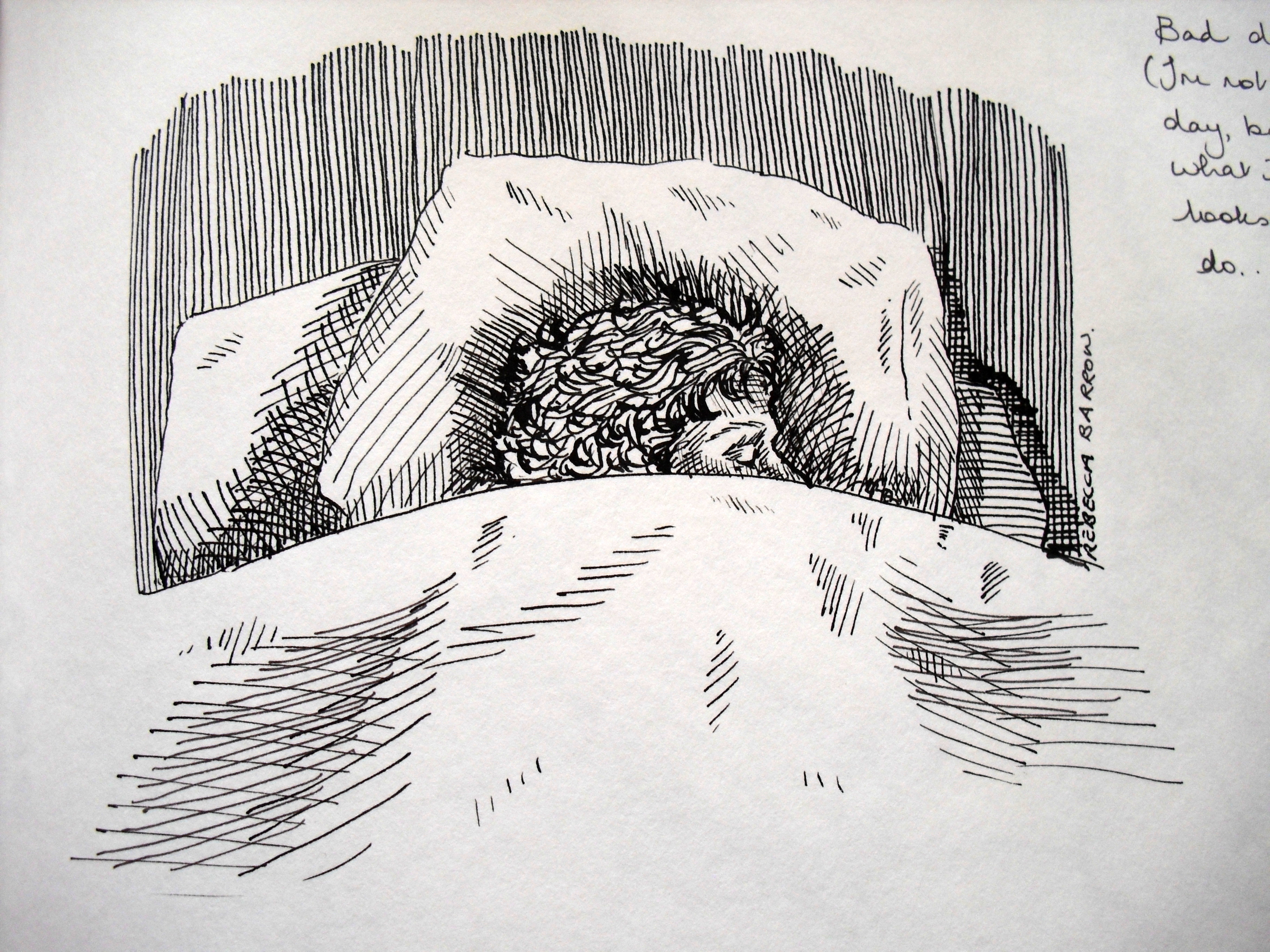
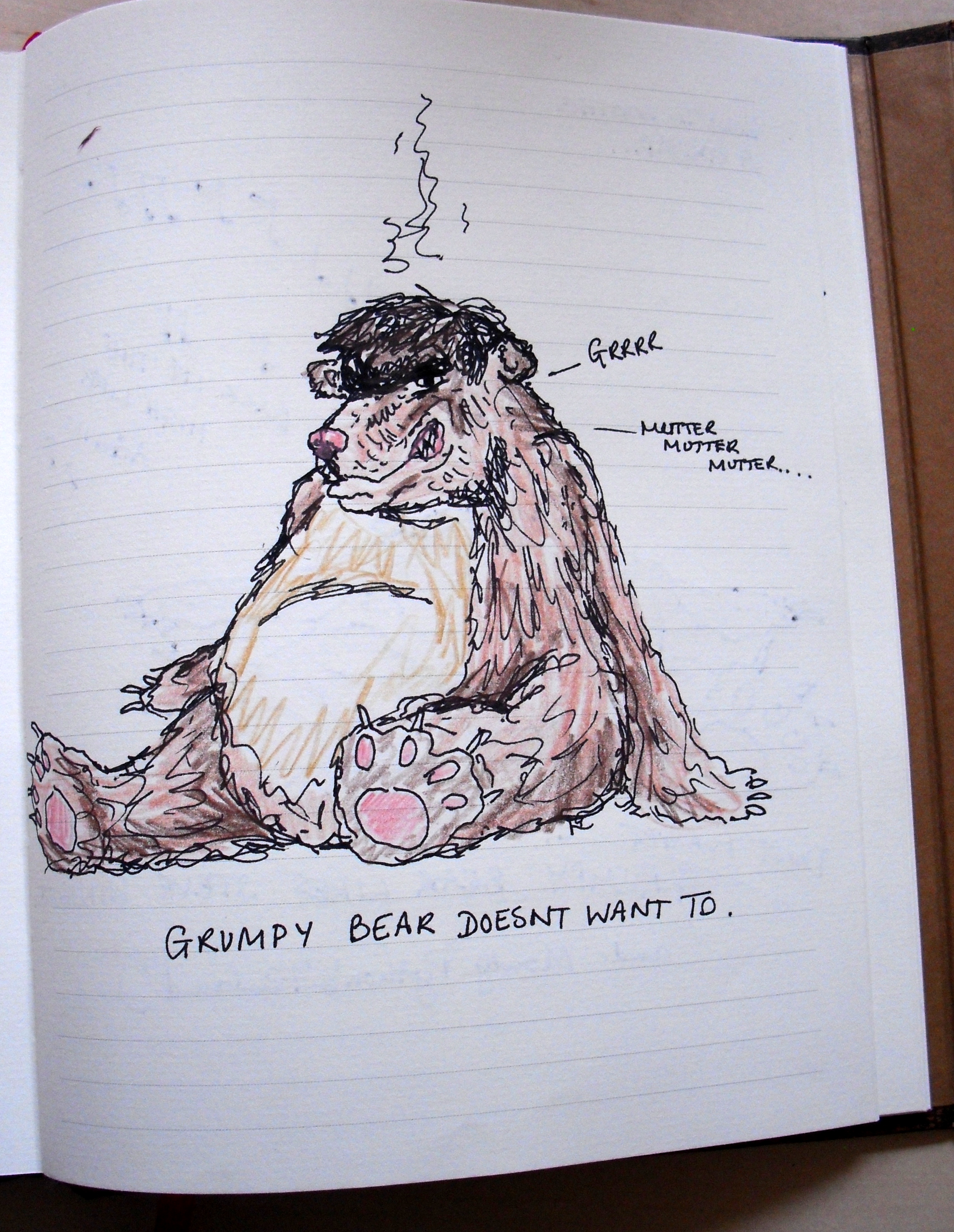
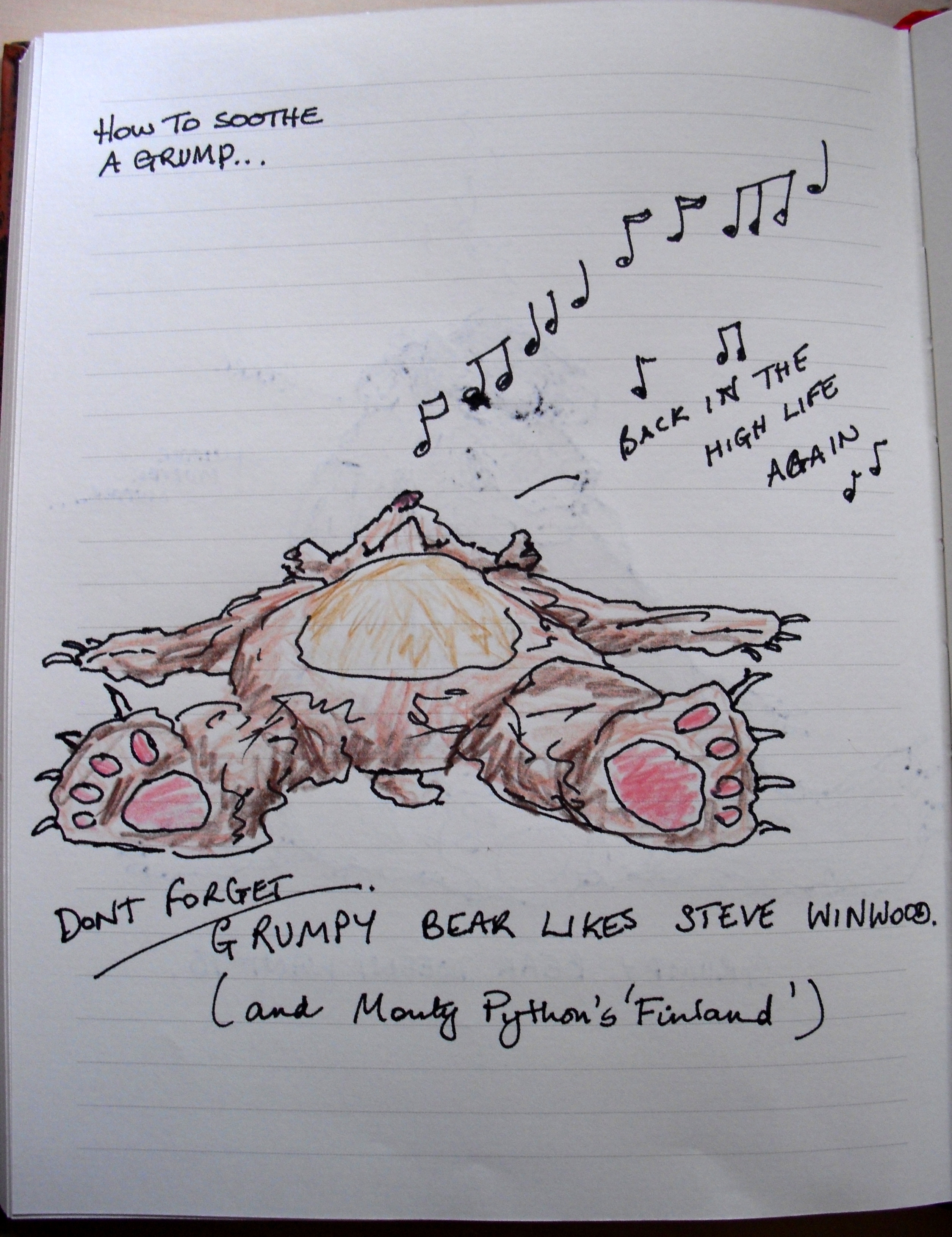
Here are a few of my drawings.  Nigel is very unhappy about my publishing them here, and he wishes me to point out that they are not up to my usual artistic standard.  I would like to point out that you don’t have to be able to draw, let alone draw like Rembrandt, if no one but you will ever see the images!

sleep sketchThis one is about my illness and the days I spend unable to get out of bed, which are frequent.

grumpy bear 1 grumpy bear 2

This is a feeling I had one day that I wanted to personify, in the hope of recording how to get rid of it.

hound sketchThis was the product of a night of insomnia.  Once I had drawn this rabid dog, something I felt compelled to do in a literally physical way, the feelings I was struggling with literally dissolved, and I went back to bed and slept for seven hours straight.

The point I want to make is not whether I can draw or not, but that you can use images to express your feelings in your journal without fear of judgement from others.  If you can’t draw, or can’t bring yourself to draw, paste in images cut from magazines, or postcards.  Collage is a great art form you can try without fear of criticism.  There are lots of ways to express what is pent up inside that are nothing to do with words.

Don’t let Nigel limit you.

Journal Exercise:

I am going to talk more about this, as I feel like I have opened up a rich seam, now that I have got over my block about it.  But in the meantime, you get to do some more shopping!  Go and buy yourself some nice coloured pens or pencils.  Sharpie ones are good and bright, but I like Staedtler Triplus fineliners and Berol Colour Brushes.

Reread my previous post about colour, and play with your pens or pencils inside your journal. Makes some marks.  Doodle.  If you fancy drawing, do, but don’t be critical of what you produce.  This is not about getting a grade A.  Just have a play.

What colours and shapes express particular feelings for you?  How do you feel when you use a particular colour?  What do certain shapes mean?

During the week, keep your eyes peeled when browsing newspapers and magazines, or even junk mail.  Pick out images that speak to you.  Pull them or snip them out and stash them in a box for future use, or stick them into the pages of your journal and write about how they speak to you.

Happy Journalling,

EF

On Process: The Myth of the Suffering Artist

Chatterton 1856 by Henry Wallis 1830-1916(Henry Wallis’s painting of  Thomas Chatterton (20 November 1752 – 24 August 1770), who was an English poet and forger of pseudo-medieval poetry. He died of arsenic poisoning, either from a suicide attempt or self-medication for a venereal disease.)

I was going to start this post with a list of all the Creatives who have damaged themselves for the sake of their art.  I lay in bed the other night, trying to compile a list of them.  There were a lot, and those were just the ones I could come up with at 3am!

And why bother?  We know who they were.  We know the names of Rothko, Hemingway, Woolf, Pollock, Kerouac, Kinski, Dylan Thomas, and so very many others.

We conveniently don’t notice the ones like Grayson Perry, and Tracey Emin, who credit their art with saving them. (I’ve made links to autobiographies here, and I encourage you to read them, as they are enormously inspiring.)

We certainly don’t remember the millions of artists who, over the course of the last two millennia, have lived happy, healthy and fulfilling lives as well as making art of all kinds.

You don’t have to suffer in a garrett to be an artist.  You don’t have to drink yourself to death, take drugs, cut yourself, starve yourself, tolerate life in abusive relationships, live in squallor or destroy your health.  That is not what an artist is.

An artist is someone who makes art.

(Whatever kind of art that is, from writing to painting to dance.)

Just that.  Nothing else.  Just that.

Creativity is the greatest healing force in the Universe.  I know this because I have seen it and felt it for myself.  When you begin to create, you end suffering.  You will feel better.  I promise.

And yes, it will be frustrating at times, and maybe you will cry your way through every chapter, every linocut, every sculpture, every pas de deux, as you work through all the difficult feelings that come up.  Because lets not kid ourselves, people who create great art of all kinds are often driven to do so because of their own difficult pasts.

So maybe writing 500 words a day is like getting blood out of a stone for you?  There are ways to deal with that, but remember that struggle often comes from deep hurts from long ago, from entrenched behaviours that stop you being your most luminous self.  And if you write those words, every day, you will get through those barriers, and you will feel wonderful.

I promise.

I know because it happened to me.  And continues to happen.  Every day.

If you think that you cannot communicate accurately to your readers the misery and suffering of your characters without having lived it yourself, I will tell you the secret of how you can do without nailing yourself to a cross.

Three little words:

Imagination, empathy and research.  And the most important of these is IMAGINATION.

Imagine yourself in their place.  How would you feel?  What would distress you the most about their position.  Read up.  Find out how other people felt who went through similar traumas.

DO NOT TRAUMATISE YOURSELF.

Eat well.  Get enough sleep.  Value yourself.  Work at having loving and fulfilling relationships with others. Exercise.  Meditate.   See the doctor and the dentist if you need to.  Use your art to heal whatever wounds you have.  Care for yourself, and your art will be the better for it.  As will you.

Happy Creating,

EF

On Process: A Room of One’s Own

In this new series of posts, On Process, we will talk a little about discovering your own creativity cycles, and how best to optimise them.  We’ll start with the most basic requirement: space.

Virginia Woolf coined the term ‘A Room of One’s Own’ in her book of the same name, in which she explored creativity and feminism.  Her thesis is that in order to be a serious artist, you have to have dedicated private space in which to work.  While I don’t think this is entirely true – many great books have been written at kitchen tables, for instance – I think it is an important consideration, and it really does help.

These days I am lucky enough to have a room of my own.

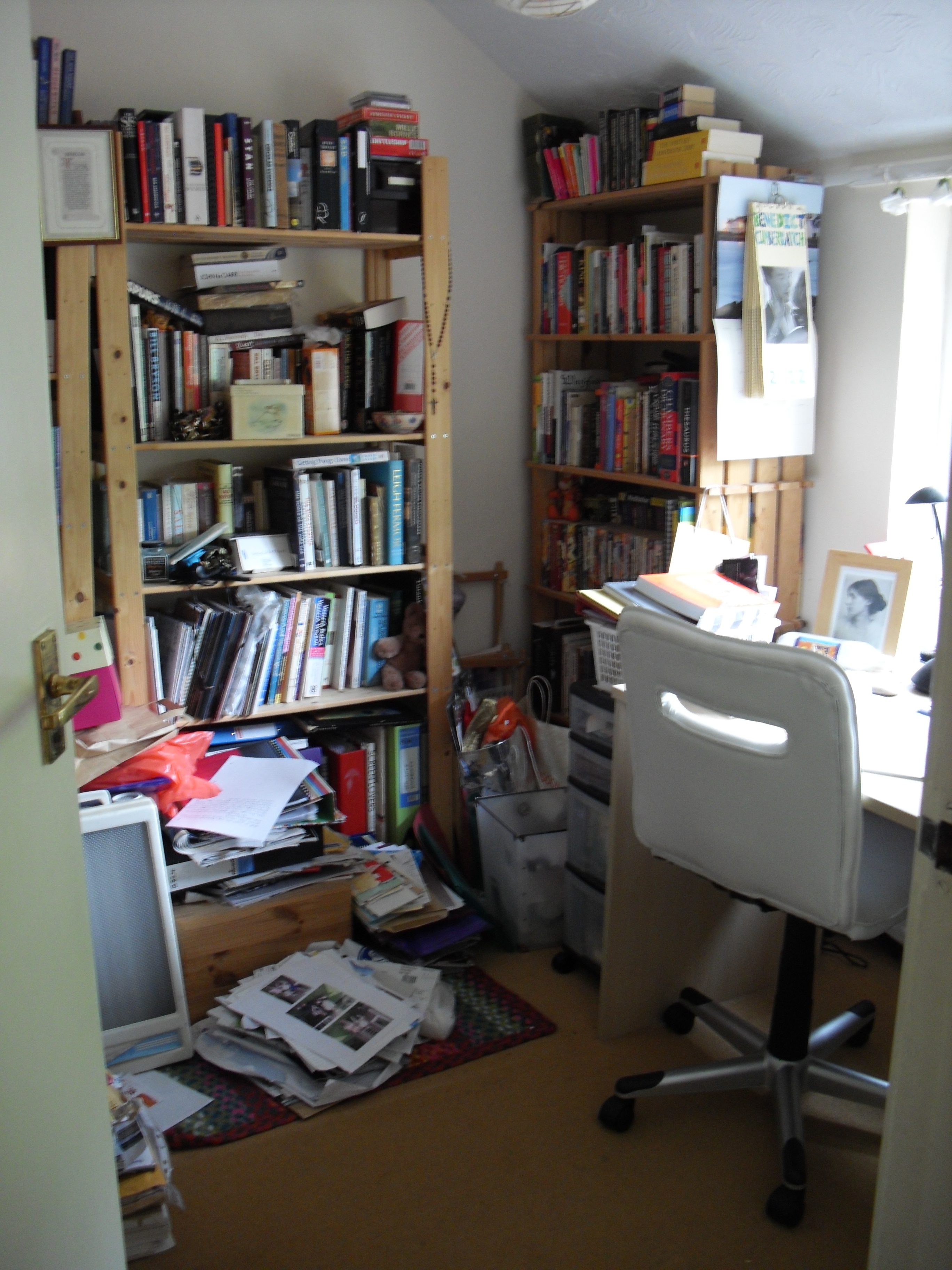
My study 1As you can see, its a mess.  Currently, it has a very nasty case of piles. (Piles of paper and junk, that is.)  The fact that it has become such a dumping ground, to the extent that I am now doing most of my writing sitting downstairs on the sofa, and I’m not doing any painting at all, is an important barometer for how much value I am attaching to my own art and writing practise.  In other words, not much.

One of my goals is to revamp my study.  This is because I need a Room of My Own.  Psychologically, I need to recognise my right to my own creative independence, and that is what my study signifies to me.  I need to make a gift to my creative self of a loving and beautiful space in which to make my dreams happen.  Its hard to claim that right, but I’m working on it.

You may not have the luxury of your own space, in which case, I sympathise because I spent many years in the same position, sharing a desk in the corner of our dining room with my husband.  (Even though he had his own office at work – not that I’m bitter, you understand!)  Still, there are ways to mark out some territory that you can call your own, a space where you feel totally free to create as you want.  That may be a corner of a shared room, the luxury of an actual studio, garden shed or study, or if you are not so territorial as I am, maybe a favourite table at a local cafe where you go to write, think or journal.

Where ever you choose, consider this space as not only a private area, safe from others, but also as sacred to your art – whatever form that takes.  When you go there, it should signal to your Artist Brain  that it is time to create.

Light candles, perhaps, and if you are so inclined, make a little altar to attract creative energy.  Surround yourself with pretty, evocative things.  Get some nice stationary and writing instruments.  A few pebbles can be delicious to handle and look at.  Make some inspiring signs to stick up, to remind yourself that you are entitled to this, that your voice is unique and deserves to be heard.  A painting that you like, objects that have emotional value for you, some nice furniture if you can afford it (I would love a comfy armchair to read in for my study), a noticeboard with inspiring images on it, wll all help to make even a small corner your own.

My Study 2In this picture of my study, you can see some of the things I cherish as part of my creative process.  (Sorry for the small lettering, I haven’t quite got the hang of Paint yet!)

I got the lovely chair for my birthday last year.  I’d never had a special, proper chair for my home office before. It still feels like an outrageous luxury!  There are fairy lights in the shape of roses around the window, which are nice when I am writing at night, as I usually prefer to.  There is my collection of books about writing, and books for reference, my Image Box for inspiration, and of course, my much cherished Benedict Cumberbatch calendar, which my adored niece made by hand for me last year.  On my desk, I keep a framed photograph of Virginia Woolf herself, because she is such an inspiration to me, both as a writer and as a person.

Try to carve out some personal space within your home environment to dedicate to your creativity.  Even if you are only able to keep your journals in a favourite tote bag down the side of the sofa to use when you can, it still counts.  It will help to enhance your creative process, and enable you to battle those critical voices that tell you your work isn’t good enough.

I’ll keep you updated on my efforts to reclaim my study from the mess and make it a place to snuggle down in to create.