Category Archives: What to do when life gets in the way

Writers: Know Your Limits! (or why I’m not doing NaNoWriMo again this year)

Husband and I often share a giggle over this Harry Enfield sketch when we talk about my limitations:

Yes, well, thank goodness its not so much like that anymore!

Women are especially bad at knowing their limits because we are brought up to be martyrs, to sacrifice our own well-being before that of others.  I’m no exception.  I’m useless at boundaries, and having ME has made me even worse for committing to something that I have no earthly hope of carrying through because of my  fluctuating energy and pain levels.  I continue to have expectations of myself that fall way beyond my capacities.

Anyway, a little while back I had this brainwave:  “I know,” I thought, with all the enthusiasm of a labrador puppy.  ‘I’ll do NaNoWriMo in November, and I’ll use the month to get the basis of my Viking novel done, and then I’ll have a book I can edit up and sell in the new year via Kindle.”

Great wheeze, No?

Hmm.  The thing is, November is always a really busy month for me.  Its the run-up to Christmas, which means getting the present shopping in early because I have to pace myself with all that trudging around the shops.  It usually involves an extended visit to elderly parents, taking a week out during which there is no spare time, and no internet access.  It is also the real onset of the bad weather, which always has a deleterious effect on my health. And if there is one thing I can always be sure of, its that I can never be sure when I am going to capable of getting out of bed in the morning!

I’d really like to do NaNoWriMo.    Its not that I am not capable of writing 1700 words a day.  I’m lucky in that, unlike many writers, I can crack through 3-5000 words a day when I’m well.  But writing 50,000 in under 3 weeks is probably beyond even me.

So with a sigh of realism, I have relinquished my claim on that November novel.  Another year will go by without me being a NaNoWriMo winner.

Instead, I have come up with another, more achievable goal, an ebook that I hope to bring you in the run-up to Christmas, so I hope that you’ll stay tuned to this blog to find out more about that.  I know you’ll love it!

In the meantime, here are a few ideas on how to judge whether you are over-reaching yourself on a creative project:

1. Be realistic about how much time it will take.  If you can, divide the task into measureable units, the way NaNoWriMo does with the word count.  How long does a unit take?  If you need three hours a day to write 1700 words or make a preparatory sketch, can you afford to carve out that time daily, or are you only likely to manage 3 hours once or twice a week?

2.  Schedule your units of time into your diary or planner and keep a date with yourself.  This might mean working other activities around them, bartering childcare with friends who are also mums, asking husband/partner or housemate to help out with basic chores.  But making an appointment with yourself to create, however much subtle manoevring it takes, will help you finish your project more easily in the long run.

3.  Expect the unexpected.  Be prepared for life to throw a spanner in the works (or, if you are like me, an entire socket set!).  Remember Murphy’s Law:  Anything that can go wrong, will go wrong.   So have a back-up plan.  Either that, or don’t get too wedded to a deadline, or you may find yourself disappointed, which could put you off for good.

If you are tackling NaNoWriMo this year, I wish you the best of luck!  If you have chosen to do something else, like me, then good luck with that too,  The point is to know how much, realistically, you can take on, and be at peace with that.

Happy Creating,

EF

Outflow: Stand Still and Listen

Shadow Selfie

Shadow Selfie

You didn’t get a post this morning.  You got an empty space where your post should have been.

Sometimes, life gets in the way.

Best Laid Plans, and all that.

I am in The Red Tent.  My Moon Palace.  The Painters have arrived.  Auntie Flo is in town.  And all the other euphemisms you can think of. A weekend spent caring for my elderly and very frail in-laws followed a busy week, alongside a developing cold, has caught up with me, and now my period has arrived.  And there is no juice left.  Nothing spare.  All I can do is lie here and contemplate.  Try to withstand the OUGHTs and the SHOULDs that are crowding my brain right now, pointing their fingers in accusation because of all that is left undone.

Learning to stop is the hardest thing about my illness.

At primary school, our teachers utilised a very simple form of crowd control.  On the first day, we were instructed about the first rule of school.  If the teacher says ‘Stand Still and Listen,’ thats what you do.  You stand where you are, don’t move.  You open your ears and your mind, and wait for the next instuction.  This was ostensibly about the need for safety, but it also meant that we learnt to pay attention.

Over the years, I have forgotten the importance of ‘Stand Still and Listen’.

Today I’ve been wondering whether ‘Stand Still and Listen’ is what my ME is here to teach me.

To listen to my body.

To listen for the pain.

To listen to my life.

To listen to the world and the people around me.

To be still, and know that I Am.

I will be gone soon enough.  We all are, eventually.  Better make the most of it while we are here.  But that doesn’t mean a frenzied whirl of activity, filling every moment with busyness because we are afraid of death.  It means savouring the moment, being mindful of NOW.

I am sure I have spoken on this theme many times on this blog, and I will do so, no doubt, over and over again in future.  I struggle to learn this lesson every day.  And yet, as a writer, I need to Stand Still and Listen even more than most other people.  Because if I do not observe the world around me with quiet reverence, if I do not record it with compassion and objectivity in my mind and in my notebook, then how can I record it in my stories?  How can I make my story worlds into believable places?

Whether you are a writer, an artist, or any other sort of creative, or whether you are someone who does not see themselves as such, take the time over the next week to practise Stand Still and Listen.  Whether you actually physically stand still or not is up to you.  But take a moment to be still and aware, a moment or a day or a week, or however long you need.  Take stock.  Be in the moment.  I promise the world will grow and deepen for you when you do.

With love from the Red Tent,

EF

On Perfectionism (and Timing)

Carpet makers in Turkey weave a mistake into every carpet they produce - because, they say, only what God makes is perfect.

Carpet makers in Turkey weave a mistake into every carpet they produce because, they say, only what God makes is perfect.

A friend was trying to finish his novel.

‘So many grammatical errors,’ he moaned.  ‘So many mistakes.’

He worked so hard that he wept.  It would never be perfect.  It would never be good enough.

All this effort, two days before he was due to be married.

There is perfectionism, and there is timing.

Perfectionism is a disease I suffer from myself.  It has blocked me for years.  Nothing can ever be good enough.

I set my standards so high, I never fail to fail.  And then I look at what I have failed to do, and tell myself I am useless, and that I will never finish anything.  Without noticing (conveniently) that I have set myself up for the perfect fall.

I am perfect at this.

So it is with this blog.  It had to be perfect.  It had to be faultless.

Never mind that I have a serious chronic illness that regularly prevents me from leaving the house, which affects my cognitive function to the extent that at times I can neither read nor write, nor understand what is said to me.

The blog still had to be perfect.  And I had to post three times a week.  Regardless.

Regardless of my health, or looking after elderly, sick parents, or my husband’s workload, or my marriage, or the weather, or having to attend friends’ weddings, or making time for much-needed holidays, or anything else that comprises having a life.

Add in the blog and perfectionism and you have a recipe for disaster.  Or at least a very poorly blogger.

This is as insane as my friend trying to perfect his novel two days before one of the most important and stressful days of his life.  (And happiest, lest we forget.)

Sometimes, you have to sit down and recognise that perfectionism is a disease created by Nigel.  Sometimes you have to stop, and realise you haven’t been very realistic about what you can achieve.

And you have to move the bar.

Perfectionism and timing have combined to create the perfect storm in my life right now.  I have been going through a bout of severe illness, and just at the start of August, the busiest month of my year so far.  My mother is coming to stay for a week.  Friends are getting married, and babies are being welcomed into the clan.  The garden needs watering, and I have a craving to write original fiction that I have not felt in many months.  With limited energy, and limited time, I can only do so much.

Conclusion:  this blog cannot be perfect.  It only has to be good enough.

It only has to be here to encourage you, dear reader, on your own journey of writing and creative discovery.  It only has to be witness to my own creative process, as I try to navigate a way through illness and into producing a novel that will make my soul sing, and make you turn the page with delight.  It doesn’t need to be the be-all and end-all of teaching writing – there are plenty of other people who can do that so much better than me.

Here are my good enough dreams:

I want to write that novel.  I want to write an ebook on journaling for you, too.

WARNING: RIDICULOUS DREAM SHARE ALERT

I want to make a collectors’ edition of my novel, illustrated with my own art, for you to buy.  Yes, I know, it’s crazy, but it’s something that is calling me, and somehow I know I have to follow its siren song.  And you are supposed to share your creative dreams, aren’t you, to help make them happen?  So I am sharing my dream with you to give it some karmic weight.  (Yeah, I believe in this stuff.  Bear with me.)

I also want to be well, have a holiday, enjoy some quality time with my mum, have a happy marriage (i.e. see my husband occasionally), water the garden and, well, have a life, really.

And I don’t want either perfectionism or bad timing to get in the way.

So I’ll make a deal with you:

I’m going to blog twice a week, instead of three times.

Sometimes I might only manage once, but if I do, I want you to know that the time I haven’t spent writing a blog post for you has been spent either a) getting well or, b) working on a creative project like my novel.  Because the blog can’t take up all my creative energy.  That just doesn’t make sense.  The blog is not the purpose, it is secondary to the purpose.  The purpose is the writing.

There was a time, this time last year, when I thought I would never have the courage to set up this blog.  Right now, I am scared that I will never have either an ebook or a novel to offer through it.  This time next year, I hope I’ll have proved at least one of those fears wrong.  In the meantime, I am moving the goalposts, lowering the bar, and whatever other clichés you care to insert.

I hope that you will stick with me.  I hope that you will share my journey, and tell me about yours too.  I hope that we can learn this together, that we can kick Nigel into touch and fill our lives with creative joy.

Happy creating,

EF

Journal Friday: The Structuring Absence

elephantWhen I did my English degree, way back in the late ‘80s, Literary Theory was all the rage.  I don’t know if they even study it now, but it was the thing then.  Literary theory is the place where literary criticism, philosophy and linguistics meet.  Throw in a good handful of politics, sexual politics and psychology and you have a seething mass of academic pretentiousness that no one with a reasonable sense of humour should be subjected to.  Literary Theory goes in fashions like everything else, and the Next Big Thing then was Postmodernism, which leant heavily on Poststructuralism and the work of theorists like Jacques Derrida and Roland Barthes. We read Thomas Pynchon and Paul Auster and pretended to know what they were on about.  We were encouraged to use words like signifier (word), signified (meaning), and problematize (make something difficult).  I find it deeply satisfying that Roland Barthes’s death resulted from being run over by a milk float.  It couldn’t be more pedestrian (sorry for the pun), or ironic, could it?

Now why am I ranting on about all this pretentious bollocks when I should be talking about journaling?  Well, let me explain the one phrase that poststructuralism gave me which I still cherish today:

The Structuring or Signifying Absence

This is actually another way of saying ‘The Elephant in the Room’.  It is the thing that is never spoken of, yet which underlies and give shape to everything that happens around it.  It is the empty space which is significant, which speaks of something profound.

It is ‘that which is left unsaid.’

Take a very simple example.  In Daphne du Maurier’s novel ‘Rebecca’, the character of Rebecca de Winter and her untimely death are the signifying absence.  Rebecca structures the whole novel, and the behaviour of all the characters revolves around her, even to the extent that we never learn the heroine’s name, because Rebecca is more important in everyone’s mind, including her own.  Rebecca is a tangible presence, even though she no longer exists.

Actually, this isn’t strictly a good example because its too overt.  Take the Wooster novels of P G Wodehouse.  Set in the 1920’s and ‘30’s England, they almost never mention the Great Depression or the First or Second World Wars, and yet the fact that as readers we know that the ridiculous events are going on against this backdrop makes them all the more ludicrous.  Wodehouse does lampoon the figure of fascist leader Oswald Moseley at one point, but basically, his choice is to exclude politics.

The point of the structuring absence is this:  that what the writer chooses to exclude is just, if not more, significant than what is left in.

How does this relate to writing a diary?

I am thinking right now of gaps.  I have been keeping a journal for nearly 40 years now (ouch!), but there are plenty of gaps.  And I am sure those gaps say as much about my life as the parts where I was writing.  They usually happened for two reasons:

  1. I was having a brilliant time and was too busy living life to bother writing everything, or anything, down.  My honeymoon is a great example of this.  I was determined I was going to record every detail of our tour across the south of England, but when it came to it, I was having too much fun!  So all I have is the photos we took.  And I think that is very significant.
  2. I was in a state of such terrible depression that I was incapable of writing.  This is far more common.  There are several gaps of months in my diary during my early 20s, when I was struggling with clinical depression so profound that it threatened my life, and it was impossible for me to write at that time.  So I didn’t.

What we don’t write about in our diaries is just as significant as what we do.  Every diary entry is an act of self-censorship, whether we know it or not.  By choosing what we write about, even if the choice is unconscious, we are in fact editing, fashioning a narrative of our lives structured by our choices and the responses we have to our life events.  Just as Wodehouse chose, out of what I believe was sheer political naiveté, not to write about politics (to his great cost as it turned out), we may choose not to write about our cancer, our son coming out as gay, our struggles with debt, even though these are massive issues which shape our lives in profound ways.  We may even choose at times simply not to write at all.

When I don’t write in my diary, I am always aware that something is going on for me.  I may be in denial about some issue that is obsessing me, or I am too sick to write, which is an issue in itself.  Either way, the gaps between dates in my journal are a red flag.

But they are not a reason for self-flagellation.

When I was a kid, I thought that you had to write a diary every single day.  A lot of people believe this, but very few manage it, and most give up because of this misconception.  Don’t beat yourself up when you have non-writing periods.  Accept these empty spaces as significant, as structuring absences, and consider what they might mean for you.  Above all:

Write when you need to write.

Journal Exercise:

At the moment a big gap is developing between today’s date, and the last one I wrote in my journal.  I know why this is.  I am ill.  Staring into space or lying on the sofa watching Harry Potter yet again is about as profound as I can manage right now, and I’m okay with that.  I will go back to it when I am ready, and because I don’t make a big deal about it, I won’t be creating any blocks, so the gap will be much smaller than it would have been otherwise.

Are you creating a journal gap, a structuring absence, consciously or not?  Take some time to contemplate why this might be happening for you – you don’t have to write about it in your journal, just allow it some kind and accepting thought.  It may because you are hung up on ‘doing it right’.  It may be because there is a HUGE elephant in your life that you are simply not ready to address yet.  It may just be because you are present in your life, too busy or, what a delight, having too much fun!

Whatever is going on for you with this, make peace with it.  Be accepting of yourself.  You might even want to write something in your journal to that effect:

‘I am not writing much here at the moment and I’m okay with that.  I’ll get to it when I need to.’

You may not want to write in the ‘why’.  Perhaps that is better left until you are ready to write again.

And if you are writing regularly, and getting lots out of it, make sure you relax into it and don’t make it an OUGHT.

Happy journaling,

EF

Outflow: What the **** am I doing?

new study deskYou may have noticed that yesterday was Wednesday and that it was eerily quiet here at Evenlode’s Friend.  Oops.

Its not that I wasn’t thinking of you, believe me.  Its just that, well, I won’t go into too much sordid detail here, but there are some stomach complaints that leave little room for writing blog posts.  Yes, I was ill. I still am.  I’ve been hit by a particularly nasty bout of IBS, and its going to take some time to settle things down again.

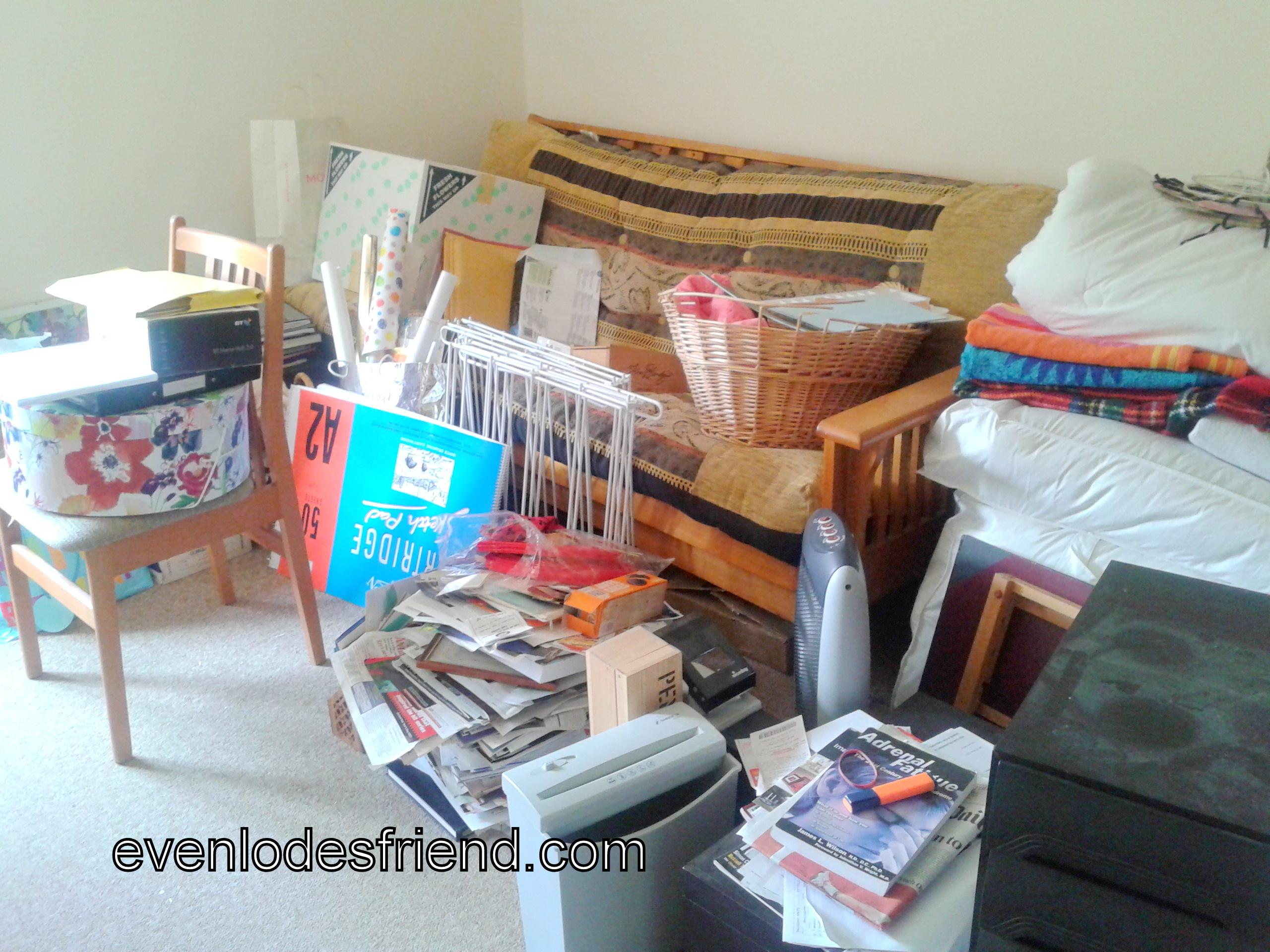
But of course, because I never do anything by halves, my darling husband is having a couple of days off right now and decided, for a whole bunch of really complicated reasons, that it would be a great idea for us to switch offices.  Yes, while I am ill.  No, he did not expect me to help move the furniture.  So now he has the north-facing back room, and I have the sunny, and much larger, front room with the sofabed-futon thingey to lounge on.  I suspect I may have got the best end of the deal, don’t you?

This brilliant wheeze unfortunately has its down side.  Evenlode OPs Centre now looks like a cross between a bad jumble sale and the aftermath of Chernobyl.  Major purge, rethink and planning are urgently required.  (Shame my brain is on illness-induced sabbatical, but there we are.)

new study messThis is not entirely a bad thing, however.  I need to be systematic about everything right now, and the study change is just the external materialisation of the internal mess I am in.  Because it turns out that this blogging thing is much harder than it looks, and I am going to have to be a lot more organised than I thought.  I can’t just fire off a post for this blog in half and hour from a standing start, as I do with my personal blog, because its not that kind of site.  I want my readers to be informed, and that means my research has to be spot on and my posts thorough and thoughtful.  I need to write ahead, and I haven’t worked out how I can do that and juggle my health issues and life at the same time.  I think its good, on the whole, to reassess what you are doing periodically, but I’ve never been one for planning systematically how to do something, as the state of my desk drawers unvariably show.

Yes, its cosmic learning time!

So, today’s Outflow is about two things, redesigning my work area, and planning my work method.  I must be mindful about what I’m going to need and the issues I am going to have to plan for, like not being well enough to write on a posting day.  I’m going to need a workspace that supports me, with all the tools for writing, painting, planning and running this little endeavour within easy reach.  And its got to be easy to keep tidy and organised because I am crap at being neat and perversely, as a Libran, I don’t like working in a messy, ugly space.  In this way, writing a blog isn’t any different from my other creative work, my writing and painting.  It just has to be more systematic and focussed.

If you keep a blog, I would love to know how you organise yourself ahead, and plan your posts.  And if, like me, you are lovingly embarking on making a new creative nest for yourself, I would love to hear about that too.  Please leave a reply (the tag appears at the top of each post for some reason, thats another design issue on my blog To Do list!) and maybe we can do a compendium post of all the shared ideas and wonderful ‘Rooms of Our Own’.

Happy Creating,

EF

Journal Friday: The Life Organiser

life org pages 2I’ve been enjoying Jennifer Louden’s The Life Organiser for a while now, and I wanted to share it with you.  It is a weekly practise that may offer those who struggle with daily journaling an easier way into self-expression.

Now I have to confess, I’ve got a bit of a thing about the whole Organising scene.  It is definitely a displacement activity for me.  I would much rather go out and drool over new Filofaxes than actually do the work to sort out my office.  I love stationery.  I love notebooks.  I love books about how to organise your life.  I love the websites too.  Call me a GTD addict.  It cons me into thinking I’m actually getting something done.  I am sure many of you can relate to that!

Lately, though, I have been wrestling with something of a mid-life crisis, and that, together with the complexities of actually writing on a regular basis for this website, as focussed my attention on the real core of the whole productivity mindset:

 Intention

Life Coaches and self-development gurus go on about formulating your life goals, having a vision, a mission statement, working towards SMART goals, and all that stuff.  Achievement, in other words.  All of which is great of you actually know where you are going, and what you want.

But what if, like me, you are about to fall off the edge of 45, and still don’t have a clue what you want to do when you grow up?

Deciding what direction you want to push your life in is a huge project.  It can feel overwhelming.  Jennifer Louden’s approach is more subtle and manageable.  Building on her work with The Women’s Comfort Book, and other invaluable tomes, she has written a workbook that gives the reader a chance to get in touch with their essential self, cut down empty busyness and focus on what is really important.  On a week-by-week and day-by-day basis, she encourages you to think about what is going on in your life, here and now, and what you need to help you flourish.  It feels quiet, comforting and manageable.  And it offers you a chance to choose direction and improve the quality of your life in a gentle, incremental way.  So how does it work?

 The Life Organiser Book

The book itself is a delightfully satisfying object to handle, even before you get inside.  It begins with some explanatory chapters, and then sets to work.  Each week of the year has a two page spread, offering journal prompts and questions to contemplate and answer, inspiring quotes and the chance to list things you have to do, would like to do, and can reasonably let go of (the latter is my favourite, because it is the most thought-provoking for me.)  It is all laid out so that you can use the actual book to write in if you like, but there are inspiring examples at the front of how other women have made their own notebooks and digital documents into Life Organisers too.

My Life Organiser Kit

My Life Organiser kit comes in this cute little bag...

My Life Organiser kit comes in this cute little bag…

I was given a little bag which is just the right size to keep my organiser kit in, and my day-to-day dates diary and journal fit in there nicely too.

 I like to use lots of bright colours when I am answering the questions, so I include coloured felt-tipped pens, both fine and brush point, so that I can do that.  I have settled on a colour scheme that I like, with particular colours for certain subjects, and that helps me if I want to check back through the pages of my notebook.

... and here is what's in it!… and here is what’s in it!

The notebook itself is one I bought from WH Smith because I liked the cover.  It has wide-spaced lines and lies open easily, which is great if I want to do a two-page spread for a mind map or such like.

Doing My Organising

I try to do my Organiser on Sundays or Mondays, so I can set a clear intention for myself for the week.

I like to write in my journal or do morning pages before I start on my organiser because it clears my mind, and helps me to focus on my needs rather than my complaints.  I like to check my date diary or calendar before I start too, so I know what appointments I’ve got coming up, and how my time and energy will have to be distributed for the ensuing week.

When I have done that, I put in the date, and then write a section I call:

Where I am right now

This is a way of grounding myself, working out where I am emotionally and physically, and what issues are coming up for me at present.  It isn’t in the Louden version, but I find it useful to do.

Once I know where I am, I start on the actual questions for the week.  I always write out the questions in, in full, in a bright pen.  (This year I am using pink, last year it was orange.) I answer in a kind of stream-of-consciousness.  Sometimes a list comes out, sometimes a paragraph, sometimes a complete rant!  It doesn’t matter what, it is all instructive.  It tells me what is important to me at the moment, what I need to encourage and nourish myself, what I need to take notice of.  From these realisations come the lists of what I could do, must do, and need to let go of.

I have found it is important not to make long lists of things to get done or to force myself to release things.  Once you become prescriptive, these things become OUGHTS, and just make yet more burdens to add to those we have already.  I keep my list of things I could do for the week to a minimum so I don’t pressure myself.  Sometimes it is just a couple of things I could think about.

The lists can then be transferred over into my day to day diary and calendar if appropriate.  I can make appointments to do the self-care things I have identified, and book rest time in, which I need because of my health.  I put my ‘Let Go Of:’ list in the margin of my diary too, so that when I refer to it every day, I reminded of what is important to me.

Life Org pagesI think the Life Organiser is a more mindful way of keeping true to my intentions and needs than the endless To Do lists most productivity tools offer.  It forms a kind of accounting process that lies on top of my journaling, a means of orienting myself in a more concrete way.  Because I do it on a weekly basis, (although sometimes I miss, in which case, I don’t worry about it)  it doesn’t feel so much like a chore, and I look forward to it.  It keeps me in touch with myself and has helped me formulate my dreams and visions into doable agendas in a gentle way that seems far less scary than other methods.

I recommend it.  Get yourself a copy, and have a bash.  You might find it bridges the gap between journaling and Filofaxes that you need!

(You can find out mroe about the amazing Jennifer Louden here.)

Happy journaling

EF

Journal Friday: Outflow – Making Lemonade

LemonsPart of being a writer is the dance of self-acceptance.

I have to deal with a chronic illness, which has radically altered my life for the last fifteen years, and shows no sign of waning.  This means I have to manage the delicate balance between self-care and doing too much.  When I overdo it, I end up exacerbating my symptoms and have to face extended periods of bed rest and being confined to the house.  Anf brain fog.

So sometimes I can’t write.  And its not that I don’t want to, its just that I literally can’t.

As I have said before, however, that doesn’t mean I’m not writing.  In my head, at least.

Sometimes life deals us lemons, and the lemonade is hard to make.  But even when I feel like I am buried under tonnes of lemons, the dream is still there.  The memory of how fantastic it feels when I am able to write, when the flow is happening and I am submerged in a scene.

This is where my diary comes in.  At times when I can process language, when I can hold my pen, I write in my journal.  It may only be a few lines, a sentence or two, but it is self-expression, getting the feelings out onto the page, and it feels fantastic.

At times when things are tough, my journal is my life raft.

At the moment, as I struggle with another period of sickness, I am working with this book.  When I have finished squeezing every drop of goodness from it, I will tell you how I got on, a little review of sorts.  In the meantime, I offer you this quote, from the marvellous SARK, patron saint of creative women, quoted by the author, Jackee Holder:

“I love journal keeping because it has helped me to discover and uncover myself, to encourage my own bravery, sort out difficulties with other people, to invent new ways of being.”

SARK, Juicy Pens, Thirsty Paper, 2008.

Happy Journalling,

EF

Why you need to Moodle

Today, I have been moodling.

Mooching.  Pottering.  Puttering.  Loafing.  Fiddling.  Wandering.  Pootling.

It looks like I am doing nothing very important from the outside, or at least nothing creatively productive.  But that couldn’t be further from the truth.

Brenda Ueland, in her superb book ‘If you want to write’ (hardly bettered since it was published in 1938), calls creative revelations ‘little bombs’.

“You may find that the little bombs quietly burst in you when you are doing other things – sewing, or carpentering, or whittling, or playing golf, or dreamily washing dishes.” (p45)

“…So you see, the imagination needs moodling – long, inefficient, happy idling, dawdling and puttering.  Therse people who are always briskly doing something and as busy as waltzing mice, they have little, sharp, staccato ideas…but they have no slow, big ideas.  And the fewer consoling, noble, shining, free, jovial, magnanimous ideas that come, the more nervously and desperately they rush and run from office to office and up and downstairs, thinking by action at last to make life have some warmth and meaning.” (p32)

Ueland knew that we need to time to contemplate, to think and reflect, to be alone with ourselves, but also time to just let things percolate, soak in and mingle.  We may not look like we are working on our novel when we are washing up.  We may not even be thinking about it consciously.  But there it is, fizzing away behind our eyes, collecting connections, accumulating mass like a growing snowball tumbling down a mountain.

We are incubating miracles.

We need to moodle to charge our brains, to collect impressions, to drink from the well.  However, there is another reason to moodle.  What happens when the well is dry?

This comes back to self care, which I wrote about in an earlier post.  There are always going to be times of creative drought in our lives.  There will be times when life gets in the way, or when we are so busy dealing with our personal stuff that there is no energy left over to flow out into creation.

It is crucial to know that that is alright.  It happens.  It will pass.

And when these droughts occur, and to prevent them if you can, you need to moodle.  Have a nap.  Potter about.  Paint your toenails.  Fix that squeaky gate.  Go window shopping.  Give yourself a break, literally and metaphorically.  Resting will fill the well up again.

This is why I don’t really believe in writers block.  I think that either you are exhausted, or you are stopping yourself from creating out of fear.  If the latter is the case, you need to explore those fears, and work on them in your journal.  If the former, you need to let go of guilt, accept the creative season you are in, and lie around wiggling your toes until your brain is sufficiently rested, and finally ready to come up with a new ‘Aha!’ moment.

I urge you to read Ueland’s peerless book, whether you are a writer or not.  It is full of incredibly sensible advice for anyone who means to create.

I also urge you to take some moodling time this week.  Book it in your diary.  Tell the family to leave you alone in the bath tonight.  Go and lie in the park in the sun.  Not every expedition has to be an Artist Date.  Sometimes, its good just to refill the well.

Happy Moodling,

EF

Journal Friday: The Gratitude Journal

If you trawl self help and wellbeing blogs like I do, you’ll probably have come across the idea of the Gratitude Journal before.  Lots of people swear by them.  You might think they are a bit of a cheesy idea, writing down what you are grateful for in your life every day.  I mean, isn’t it self-evident?

Maybe not.

Think about all the time you spend moaning and complaining about what is wrong with your life.  Our consumer culture programmes us to always want something else, something more than what we already have.  There might be a reason why all those slum dwellers you see in doumentaries look so happy.  Its not because they are glad to be living in squallor and poverty, that’s for sure.  Maybe it’s because they have so little that they value what they do have.

Let me tell you a story about one of the most inspiring people I have ever known:

My Great Auntie Kitty.

She was in her late 80s and early 90s when I knew her.  I was a small child – I think I was probably about 8 or 10 when she died.  I didn’t know her well because she lived in a town four hours drive from our home, so we were only able to visit her rarely, but she made a big impression.

Auntie Kitty was born disabled as a result of problems with her hips and legs, though I don’t remember specifically what.  Suffice it to say that she had never been able to walk properly and had worn calipers all her life.  By the time I knew her, she was severely crippled with arthritis, in appalling pain, and mostly blind from macular degeneration.  She was also quite deaf.  But she had a brain as sharp as a knife, and wit to match, loved to debate politics, ethics and religion, and kept up to the minute with all the news through her radio.  She also loved talking books, which she listened to continually as well.  She was funny, entertaining, and never let you get away with anything, especially self pity or fuzzy thinking.

Like many younger daughters, she had devoted her life to caring for others in her family, nursing her own parents and siblings through old age and into death.  She was the last of her generation to survive.  She had never married.  She had battled her way through a hard life through sheer force of will.

I remember her telling me this:

Every night, when she lay in the dark after the carer had come to put her to bed, she would think of three things in her life to be grateful for.  Sometimes she was in horrific pain, and thinking of anything to be thankful for was very difficult.  But she told me that no matter what, she could always find something.

Every night for the last thirty years, I have done the same.  Three things.  Just three.  Usually there are plenty more.  I could fill pages!  Some nights, if I’ve had a row with my husband or I’m in a lot of pain, as I sometimes am, I can struggle a bit. It can be pretty rudimentary on those occasions:

1.  I have a roof over my head.

2.  I have a bed to support me.

3.  There is ibuprofen in the cupboard.

Most of the time, there is plenty to be grateful for:

1.  I have a wonderful husband who loves me.

2.  I live in a beautiful place that most people would give a limb to inhabit.

3.  I have lots of friends who care for me very much.

4.  I get to write!!  (And so on)

I do this every night, come what may, partly in remembrance of Auntie Kitty, in celebration of her huge personality and bravery, and partly for myself.  Because it helps.

Being grateful shifts us into awareness, not only of what is real in our lives, but what is important.  Having that latest pair of shoes or the new Clarisonic really is not important compared with the people who we love and who love us.  Unlike the slum dwellers of the Developing World, most of us know we have a safe place to sleep tonight, and food in our bellies.  We have other, First World problems, I suppose, but there is still such a lot to be thankful for.  It is so easy to forget how fortunate we are.  Let’s not.

(I was going to take a picture of my Gratitude Journal to show you, but somehow it felt wrong.  An invasion.  Privacy, remember?  I find my reaction about that interesting itself, and I propose to explore it more in my own journal later, because I wasn’t expecting to feel that way.  Its interesting when you find boundaries you didn’t know were there, don’t you think?)

Journal Exercise:

Okay, you get to go out and indulge in the stationery shop again this week!  Go and choose yourself a nice little notebook, one with small pages.  I use this one.

Every night before you go to bed, get your notebook out and write at least three things that you are grateful for today.  Use a separate page every day, and date each.  Sometimes you will fill the page, and wish you had another.  Maybe you will go on a fill another, that’s up to you.  Some days you will be grumpy and resentful, and won’t feel like doing anything other than having a pity party for yourself.  Regardless, remember: write three things.  Just three.  It will help.

At the end of the first month, go back through your notebook and reflect on the things you have written down.  What are your lists showing about what important to you?  Write about this in your journal, if you like.  How has a daily gratitude practise changed the way you feel about your life?

Happy Journalling,

EF

On Process: Your Creative Clock

Ickworth Garden Temple - take a moment to reflect

Ickworth Garden Temple – take a moment to reflect

I don’t think I have ever read a book about how to write (and I’ve read a lot of books about how to write) that didn’t stipulate that writing first thing in the morning, as soon as you get up, is the best thing to do.

Excuse my “French”, but bollocks to that.

I am not a morning person.  Not in any way, shape or form.  I never have been, and I never will be.  In addition to this apparently genetic disadvantage (my mother is terrible in the mornings too), I suffer from a chronic illness which means I need about four hours to get going for the day.  My brain doesn’t normally come online in any meaningful way until about 11am.  And if I try to get going any earlier, I am totalled for days afterwards.

Writing first thing in the morning is never going to happen for me.  Its a biological impossibility.

Ask me about 9.30pm, though.  Yep, by then I am motoring!  I have suffered from insomnia since childhood, when I lay in bed making up stories in the dark to amuse myself while everyone else slept.  I think this is when I became a writer.  I am at my most creative in the hours of darkness, when my mind flies along, pumping out ideas and exciting images like Spielberg on speed.  I even dream in glorious technicolour.

And yes, I write during the day too, but mostly not before about 4pm.  I often have a big pulse of creativity between 4pm and 6pm that is great for finishing stories, and for writing blog posts, which is exactly what I am doing now – its 5.45pm and my brain is firing on all cylinders.

Ask me to invent something at 10am, though, and you are wasting both our times.  Ask me after 10pm and you probably couldn’t stop me with a sledge hammer!

We all have an internal body clock.  Some of us are naturally larks, and some owls.  If you are honest with yourself, you know which you are, when you function best.  You might be brilliant at doing advanced maths in the morning, or you might be better checking your email or dusting the objet d’art.

This doesn’t just apply to the hours of the day, but to your annual clock too.  I find I have a bit of a manic period in March, when the sap starts to rise and I can’t sleep at all because my brain is whirring so frantically with new ideas.  I actually get breathless!  By the time April comes in, I am mentally drained, and can barely come up with an idea for something for tea until July.  July is often my time for last bursts of activity on a project that needs finishing, the final sprint.  But during the summer months, I can safely say there are better things to do than sit inside with a laptop.

Once September comes in, I start to go into my creative cave, a kind of incubation period where I sit with ideas, mull them over, do my planning.  Then during the depths of winter I engage in my deepest writing, my most productive spells, when I can turn out 2-3000 words a day at times.  I find I draw best in the first half of the year, which to me is an exterior time, a period of surging energy.  The second half of the year is for going inside, for living with the images and tales in my head.

I’ve discovered this pattern over the years, observing myself and my creativity and making notes about how I am working in my writing notebooks.  Self reflection is something that helps your creative process and there should always be space in your writing notebooks, sketchbooks and journals for considering how you work best, and what you do when.  These things are important to know, because that way you can optimise your output.   I know, for instance, that there is no need for me to beat myself up in June when I realise I’m not writing.  That’s ok.  Its not the time to do it.  June is when I am out in the world, filling my well.  I know the time will come, and that the downtime in the summer is an important resting and refuelling stop.  Knowing when not to beat yourself up for not being creative is incredibly important for your self confidence and longevity as an artist, and for your mental health.

Writing Exercise:

Take out your notebook, journal or sketchbook – whatever is your creative workbench – and spend some time reflecting on when you have produced your best work, both in terms of the time of day, and of the year.  Do particular seasons have creative resonances for you?  Are the liminal times of dawn or twilight the moments when you come up with your best ideas?  Do you write or paint great stuff in the summer months, or when you are on holiday?  Are you stupified by the cold grey winter skies, or do they encourage you to look within for brighter pictures?

Make sure you take time periodically to reflect on this subject, as it will help you build up a clearer picture of your creative clock.  I like to do it at the beginning of each month, like a review, or quarterly, at the changing of the seasons.  The more you know yourself as a creative person in this way, the more easily you will be able to use your energy for your best work, and to avoid frustration and blocks.

Happy creating!

EF