Category Archives: Writing

The Wild Donkeys: A Strategy for Choosing a Creative Project

donkey

‘So, how’s the writing going?’

This from a man who is one of the Blessed Few.  A writer whose work was picked up by an agent straight from the much garlanded MA in Creative Writing at the Unversity of East Anglia.  Alumni include Ian McEwan, Rose Tremain, Hanif Kureshi, Tracey Chevalier and, well, you get the picture.  He is in glittering company.

He is also a really lovely man and a dear friend who takes a genuine interest in my work, so I rein in the envy monster and give him the polite and honest answer.

‘Fine.  Well, actually, I’m a bit stuck.’

‘Creative block?’

‘No, too many ideas.  I don’t know where to start.’

‘You should be writing a novel, you know.  I read some of your Sherlock stuff the other day.  It’s really good.’

‘Thank you.  I’ve written seven novels so far.  Writing a novel isn’t the hard part.  Its choosing which one to write that’s difficult.’

‘Well, just pick one and start.’

I love men.  Everything seems so easy to them.  And they are so good at handing out really practical advice.  (You’ll also notice that I don’t ask him how his novel is going.  That’s because I know.  I recognise that pained look.  I’ve seen it in the mirror too many times.)

OK, I know its good advice.  The right advice.

As Leonie Dawson puts it, I need to choose a wild donkey and ride the shit out of it till its done.

Every writer has a place where they habitually get stuck.  A psychological Marianas Trench on the road to getting their work into the readers’ hands, one that they tumble into every time.  For some it is grinding the words out, which for them is like sweating blood.  For others, it is coming up with the idea in the first place.  Some worry when they get to the middle because that’s always where they get bogged down, and some will spend ten years writing the first page.  We all have our Achilles’ heel.

For me, its choosing which idea to stick with.

So I have decided to take September off.  Not from writing; quite the opposite, in fact.  No, I’m taking the month off from worrying which novel to concentrate on.  I’m in a physically stuck place right now, and I need to concentrate on my health, on getting my body moving again after a summer of boom and bust energy.  I’m looking to create a smooth, even flow in my life, in my health, and my art.  I have faith that if I can manage to attain a relative level of consistency in my body, the answer will come to me.  Yes, maybe that sounds mad, but its just how my creative process works.

And in the meantime, I’m refreshing my theory knowledge, reading, working on my notebooking, and bashing out some major fanfiction.  I’m easily distracted, and having short stories and novellas on the go is a great way to handle that.  But sooner or later, I want to create something major.  Something big.  Something that shows both me and you, dear Reader, what I can really do.

Happy creating,

EF
The Only Two Books a Writer Needs (Part 2)

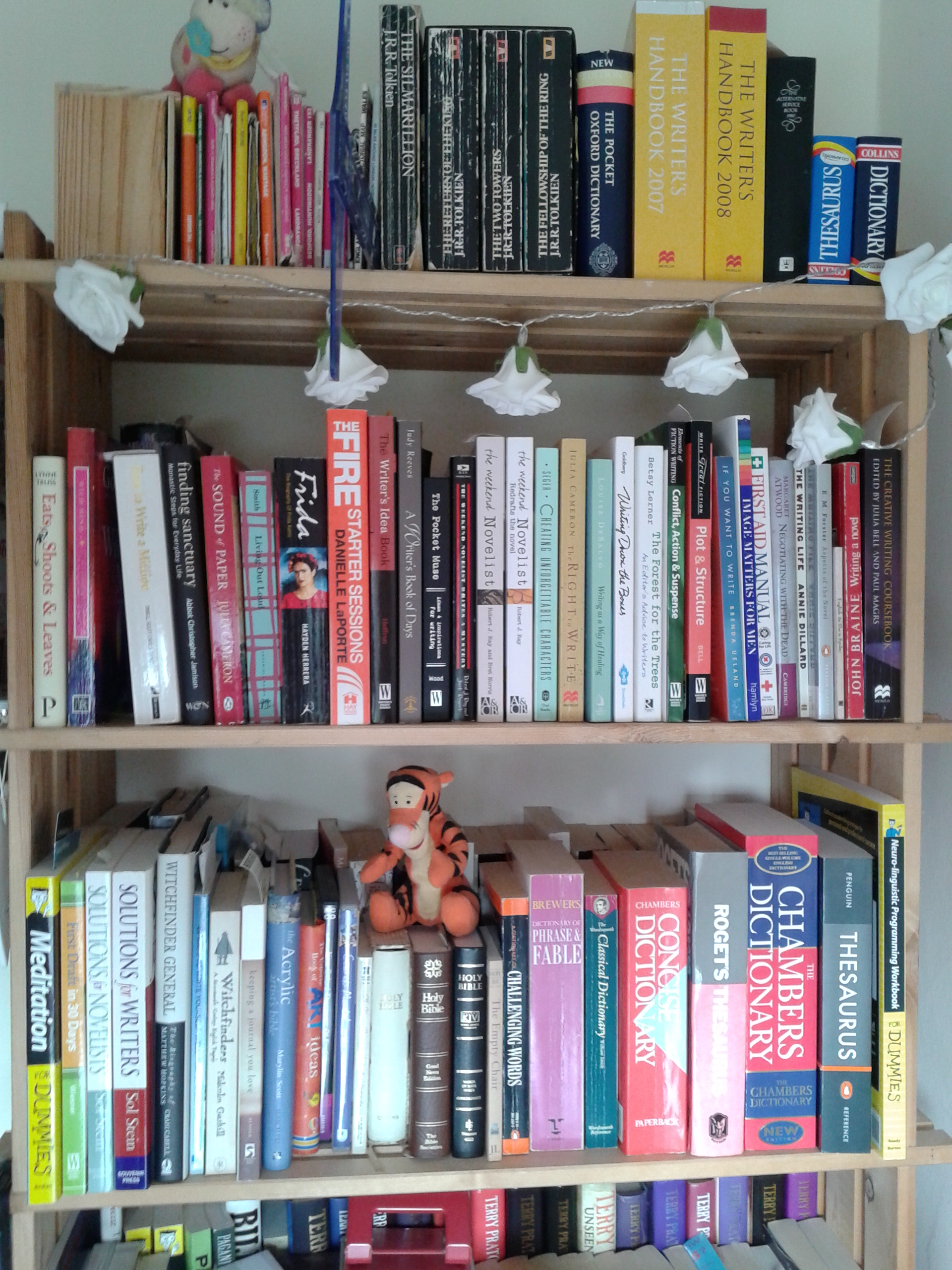
BookshelfIn the last post, I waxed lyrical about why you need a good dictionary on your bookself.  Have it to hand when you are reading.  Reading is an act of Input that every writer needs to undertake.  And no, its not stealing.  Its looking for inspiration, in the same way that artists study and copy the Old Masters in order to improve.  Reading helps you learn what works and what doesn’t, but more on that another day.

So that’s the Input.  What about the Output?  This is where the next book comes in – the writing part.

The Thesaurus

If you aren’t familiar with thesauri, my lovely Chambers Dictionary describes them as:

“…a book with systematically arranged lists of words and their synonyms, antonyms etc, a word-finder; a treasury.”

If you are serious about making your writing more vivid, you’ll need a Thesaurus.  I was introduced to Roget’s Thesaurus, probably the most famous thesaurus, while still at school, but the technique of using it is cumbersome and it completely foxed me.

Now I use a very nice, fat Penguin Thesaurus, which is alphabetical, and quite thorough enough to meet my needs.  I keep my Roget in reserve, just in case.  And yes, I have finally worked out how to use it properly, but it’s a pain, so I keep things simple.

The nice thing about a thesaurus is that it helps when you can’t think of a word (which for me is a lot!), or are looking for a more sumptuous way of explaining something.  You want a word like ‘magician’, for instance, but are looking for something a bit more, well, exotic.  Dip into your ‘thes’ and you will find:

Sorcerer, wizard, warlock, sorceress, witch, enchantress, necromancer, thaumaturge, miracle-worker.

Mmmm.  Never heard of thaumaturge before!  That’s pretty exotic, as exotic goes.  See what I mean?  Grab yourself a thesaurus and have a moodle about within its pages.  Yes, its perhaps just another way of defining words, but it defines around them too, enriching them in unexpected ways.  It will help you widen your vocabulary but also makes your stories more sumptuous.  As with anything rich, however, don’t go overboard.  Too much cream can make you sick.  Too many adjectives and adverbs (especially) will put your reader off completely.  Its a case of using the right word, not lots and lots of words.  Be vivid, not verbose.

The Others

Yes, there are other reference books I rely on on a regular basis.  I wouldn’t be without my Brewer’s Dictionary of Phrase and Fable, for example.  Or The Oxford Companion to English Literature, and the Chambers Biographical Dictionary.  All of them are fascinating and deeply useful – and not just when you are wrestling with a crossword!  But they are not what I could call ‘necessary’.

A dictionary and thesaurus are as necessary to a writer as a saw and chisel are to a carpenter. On a scale of need, they are prerequisites for the writing life.

As you can see from the picture at the top of this post, I have lots of books about writing.  I promise I will tell you about them in another post.  In the meantime, ferret out a good dictionary and thesaurus and keep them close at hand.  Look up any word you don’t recognise, and also those that you think you know what they mean, but have a lingering doubt about whether you are right.  Write down the ones you really love, and use them.    I promise you’ll have no regrets.

Happy wording,

EF

The Only Two Books A Writer Needs (Part 1)

BookshelfThe bookshelf by my desk

It’s that ‘Back to School’ time of year, when I can’t walk past a stationery shop without nearly having a heart attack.  Every time I go to Staples, I feel like I want to rip all the notebooks off the shelves and writhe about in them like an ecstatic horse.  The Martha Stewart Home Office line gives me palpitations.

But there isn’t enough money to buy everything I want, and besides, I have cupboards full of notebooks and pens already – how many does a writer really need?

Need is not something we really think about much these days.  It is not a First World problem, because most of have enough to meet our primary needs, and at that point, the word morphs into that seductive, purple velvet lined entity that is ‘Want’.

Want becomes most acute for me when I am in a book shop.  It is very hard to avoid the conviction that that my life will not be complete until I have the latest edition of wotsit, or that Benedict Cumberbatch will fall in love with me, if only I buy that particular tome.  I’m too much the magpie.  I like the latest sparkling things.  It’s a terrible affliction.

My new office space, and all the decluttering that went with it, has focussed my mind on this issue.  How many books does a writer really need?  And more to the point, how many books on writing does a writer really need?

The truth is, horrible though it may be, I don’t really need every copy of every book about writing that comes out.  I can get them from the library if I want them.  I only really need two books:

The Dictionary

In my opinion, no house or building, or even tent, is complete without a dictionary.  A reasonable one.  I’m not saying you have to go out and buy the full length Oxford English Dictionary, which runs to an insane number of volumes, and which only public institutions and Russian oligarchs are probably capable of affording.  You don’t even have to buy the two-volume Shorter version, which is still prohibitively expensive.  Lets face it, you could probably look up the more obscure words that these monsters contain online.

But you need a dictionary.

A dictionary is your friend.  A dictionary provides meaning in the world.  It provides knowledge.  It makes sense.  Even if English is your mother tongue, and you think you know everything it has to offer, believe me, there will always be a seven letter word beginning with L that turns out to be a seventeenth Hungarian stomach pump that you never knew existed.  That’s why I love the English language.  In all its glory, it is like an endless adventure through the Amazon jungle, where thrilling new words are always lurking under unexpected leaves.  And you never know when they might pop up.

Best to have a dictionary close at hand when you are reading.  You never know.  (You wouldn’t believe the number of times my husband has lost his temper with me in bed at night, when I have been reading my bedtime novel and found a word I don’t know – and asked him what it meant.  He’s got a PhD, and wields words like ‘hermeneutics’ on a daily basis, so I assume he knows everything.  He gets a bit short-tempered when asked about seventeenth century Hungarian stomach pumps when he’s sleepy!)

If you are intent on expanding your vocabulary, as I am, keep a little notebook too, to scribble down new words and meanings so that you remember them.

I have a very nice Chambers Dictionary, which my mother-in-law gave me.  It was second hand, but the meanings it gives are accessible, and it has a wide enough variety of words to satisfy my needs at the moment.  It is also a chunky 5.5cm thick, with nice fine paper, and so is a really satisfying thing to handle too.  You can pick up reasonable dictionaries in stationers and book shops this time of year at great ‘Back to School’ prices, but second hand bookshops and charity shops are always a good bet too, because dictionaries are slow to go out of date, and the basics will always be of use.

(Some readers will be bouncing around in their seats at this point, and crying the praises of online and digital dictionaries.  Yes, I get that they are useful, but they do not have the browsing dimension that real books do, and therefore I still recommend you get the hard copy.)

I originally wrote this as one post, but it got so big I decided to split it.  I think it words better that way, and I hope you agree!  So the next post, on Friday, will be about the second crucial book you need to have on your bookshelf.  The thesaurus.

Meanwhile, Happy wording,

EF

Inspiration Monday: Support your local library

the forum-norwichI am tempted to break into my own, rather wobbly version of Petula Clarke’s ‘Downtown’ here, but slight amendments the eponymous destination.

“When you’re alone

And life is making you lonely

You can always go:

To the Library!”

Okay, it doesn’t work, but you get the idea.  The Library is your friend.  It’s your soulmate.  It’s a world of excitement and adventure cocooned within four walls.  And it’s currently free (at least at the moment it is in the UK– but David Cameron, I’m watching you!)

I have always felt a strange sense of peace amongst books.  Not for me the sudden flash of panic as the realisation dawns that there are never going to be enough hours in one’s life to read everything one wants to.  Books en masse produce in me a kind of nirvana, a bliss, a calm.  It doesn’t matter how bad things are, a library is one of the two places I can go to know peace.  (The other is the beach, in case you were wondering, but that’s another story.)  This is no coincidence.

Jeanette Winterson, in her emotionally complex autobiography, credits working her way (alphabetically – how pragmatic) through her local library with saving her life from a traumatic and abusive childhood.  Books give us the power to escape, to transcend, to find knowledge and wisdom, happiness and peace.

And more than that – Terry Pratchett notes the strange distortion that occurs when books are gathered together.  He calls it L-space, a phenomenon in which the power of knowledge bends the time space continuum so that all places and times are accessible from the magnificent Library of the Unseen University (although travelling in L-space can be dangerous!). This is really just a charming metaphor for what Winterson reports.  Libraries open up unexplored and unimagined realms for us without our ever having to leave their environs.  Although, if you have ever visited Kim’s Bookshop in Arundel, Sussex, you might agree with Pratchett that L-space does indeed exist!

Libraries have changed greatly since the days when my Dad used to take me down to our village library every Friday night with my fist full of little cardboard pockets to exchange with the kindly librarian for books that enchanted and fascinated me all week long.  Now I frequent the UK’s most popular library, the Millennium Library at the Forum, Norwich, which is housed in a breath-taking vision of modern architecture, and has the highest borrowing numbers in the country.  No wonder.  Its great.

My favourite treat is to go to the library without a time limit, and just browse, as if I were in a sweet shop.  I can wander about, dipping into sections, picking out jewels here and there like a magpie.  I can have whatever I want to try, and I don’t have to worry about how much its going to cost me.  Often I find books I have been hanging my nose over on Amazon or favourite blogs, wondering whether I should buy them – with the library I can try them out, and see if they are worth the investment.

I always make sure I browse the ‘Just Returned’ trolleys too.  This is a great way to come across books that you would never have tried otherwise, because they are shelved in sections you would not normally think to visit.  These eclectic shelves are a great way to expand your reading by picking up whatever appeals to you.

Appeal is crucial.  Sometimes I go in with the challenge to choose books on the basis of their covers alone!  This is a fun thing to do with fiction particularly, because you end up not only with a bunch of stuff you would never have found otherwise, but also you get to sample the publishers’ strategies on book design, which is a useful thing to know about if you are a writer or illustrator.

If I find a book that proves especially useful for research purposes, I always make sure I record its Class Number as well as the author and title details in my writers notebook, so that I can find them easily again.

One of my most profound library revelations of recent years is the idea that if I choose a book that it turns out I don’t like, I don’t have to keep it the full three weeks.  Yes, I can take it back the very next day, if I like.  Nobody will judge me.  Its like test driving a car.  If it doesn’t prove useful, its not the end of the world.  I used to have such an investment in choosing the right books to borrow.  But there are so many books to delight in.  Why worry?  Just try a few on for size.  Its not as if you have to pay for them.

Libraries are an enormous resource.  As are librarians.  Many of them are highly trained, and they really love it when a borrower asks them a question which is something more interesting than ‘why won’t my card work in the machine?’  They love to ferret out unusual and rare tomes, and rifle through the vagaries of the inter-library loan system.  They are usually only too happy to help you with your research questions.  There is so much knowledge and expertise on offer, and most of time we don’t even know it is there.

This week, give yourself the best treat ever.  Go and gorge yourself at the library!

Happy browsing,

EF

On Process: Too Many Ideas, Too Little Time

Usually creative people complain about creative block.  I don’t.  For the most part, I have the opposite problem.  Too many ideas.  Not enough time to execute them.  I have this constant fear that I shall die suddenly without sharing all the pictures in my head.  That would be a great incentive to work if it weren’t for the fact that my poor health is a huge brake on my capacity to work.

And then there is the fact that I have the mind of a butterfly.

The Buddhist masters often refer to the concept of ‘Monkey Mind’.  This is what your mind does when you try to meditate, and your thoughts bounce around like gibbons, and feel impossible to control.

Welcome to my world.

Actually, that is not entirely true.  I can be deeply committed to one idea for a short period of time.  The most I can normally manage is about three months.  Then I bounce off to find another sparkly thing.  Most of the time, I come back.  Occasionally, I manage to actually finish something.  Occasionally it gets shelved for good, or the idea gets incorporated into something new, because its too good to waste.

I’ve been socialising a lot this summer, and people have repeatedly asked me the same questions:

‘How’s the writing going?  What are you working on at the moment?’

Below is the honest answer (i.e. the one I don’t give nice people at parties because its too complicated to explain, especially if they’ve never met me before.)

The things I am currently working on:

  • A series of short stories about John and Sherlock in a stable relationship
  • Finishing a work about Sherlock’s pursuit of public sexual humiliation because of his guilt about his faked suicide.
  • A novella about a Viking Princess
  • My novel about Victorian sexuality, currently titled ‘The Butler Did It’ (Please could somebody suggest a better title, I’m getting desperate!)
  • My journaling ebook

Other ideas I have churning about in my head include:

  •  A possible novella about a young man getting over the death of his male lover in a road accident
  • A short story based on a line from a deliciously naughty Johnlock fanfic I read the other day, The Red Box by Cleo2012
  • The third Evenlode novel (vampire gangsters ahoy!)
  • A Loki fanfic set after the end of Thor 1

(And this is before I have even begun to tell you about the paintings I want to make…)

I was explaining this smorgasbord to a friend, and she said ‘How on earth do you handle all that?’

The answer is, ‘I have no idea.’

I suppose I have a good memory, but the older I get, the more I am going to need to employ my writing notebooks to record all this.  The truth is that ideas are far easier to come by for me than the wherewithal to execute them.  And there just isn’t enough time in my day to get all this done, and execute my duties as wife, friend, aunt, guidemother, part-time carer to elderly, sick in-laws etc etc. and still protect my health.

Triage is necessary.

I just have to grab one sparkly thing and run with it for as long as I can.  I have to choose the most important thing to me at the time.

Most creative people complain about creative block, but the other side of the coin is equally disabling, and I know for a fact I am not the only one who experiences this problem.  Choosing which is the best idea to work on.

If you have any ideas on how best to deal with idea overspill, please let me know in the Replies section.  I’d love to know what you do.

Happy Creating,

EF

On Cabbages and Trombones – Making Language Strange

The expression ‘cabbages and trombones’ was one used by the poet Ian Macmillan at a recording of a poetry radio show which I went to see with a friend a while back, and the phrase stuck with me.  He was talking about how poets seek to make language strange and startling, how they seek to use it to weave a rich tapestry of image and idea.  That, after all, is the purpose of poetry, to enrich our experience of life with pattern and syllable.

The concept chimed with me again when my husband was wrestling with a writing problem of his own.  Besides being an academic, he runs an online whisky company, and occasionally works as a whisky writer.  He had been asked to contribute reviews of a variety of whiskies for this book.  Little bottles duly began to arrive in the post every morning, and off he went at a rate of three or so per evening.  Everything was fine for the first thirty tests or so.  But then he began to run out of descriptors.  Just how many new adjectives can you come up with when you’ve got 60 whiskies to review?  They can’t all taste of TCP or green jelly babies.  Can each review really be different from the last?

And today, as I busy myself with planning my new writing schedule, and working on new stories, it has come back again.

Experts say those with a college education generally have about 12,000-17,000 words in their vocabulary, but as writers we need to have far more and we need to use them in unusual and riveting ways.  I realise that I have dropped into the habit of reading very little but fanfiction, and if you are a fanfiction reader yourself, you will know that there are a lot of linguistic ruts involved.  Favourite words include laving, ravishing, carding (of luxuriant hair), trembling and so on.  No fanfic is complete without somebody emitting ‘ragged breath’.  If you have read enough of these, you begin to spot the clichés.  If you read too many, they scream out of the screen at you.  (I hold my hands up and say I am as guilty as any of falling into this trap!)

The trouble is that if you don’t read more widely than just what other people write on the internet, your vocabulary stays static.  This is what mine has been doing.  Now I am writing again on a daily basis, I have realised how stagnant my linguistic skills have become.  Of course, its not just words, but metaphors and similes.  I need to polish up my style, make it strange and new.  I need to expand my consumption, and open my mind.

 WARNING:  Incoming Master Plan for Expanding Lingustic Skills:

I’m taking a two-pronged attack:

  1. Widen my reading
  2. Use my notebook at all times

I’ve been reading just fanfics and nonfiction all summer, and its been a long time since I actually finished a proper novel.  You can’t be a writer if you don’t read.  Mostly I just read at bed time, a few paragraphs to help me drift off.  But I need to take Stephen King’s sage advice:

“If you want to be a writer, you must do two things above all others: read a lot and write a lot.”

Stephen King, “On Writing”,

Hodder and Stoughton (2000) p164

 Of course, I’ve got a whole pile of books lying around, waiting to be ploughed through.  Top of the pile are ‘The Night Circus’ by Erin Morgenstern, and ‘Atonement’ by Ian McEwan.  I don’t especially like McEwan, but I am determined not to let this bloody book defeat me.  It’s the third time I’ve tried to read it, after all, and I refuse to be beaten!

I have also decided to follow Ian Macmillan’s advice.  Poetry is the way to go.  I’m not a reader of poetry – I’ve barely read any since my degree – but if you want to know about making language strange, go to the experts.  I went to the library yesterday and got out two collections, one of Ted Hughes, and one of Simon Armitage, because I had heard of them.  I’ll let you know if it works.

The second prong (I love that word, don’t you?) is more nebulous.  Out comes my little red Moleskine.  I need to think about how I am going to get the ball rolling on this particular aspect, but just jotting down a few ideas on what the weather feels like, smells like, tastes like, or overheard conversations, or the colours of shadows, might be a good start.  Again, I’ll let you know how I get on.

In the meantime, here’s to cabbages and trombones.  And whisky that tastes of TCP and green jelly babies.  Both of which have taught me a lot about writing.

(Incidentally, you may like to know that I am currently publishing a new fanfic called ‘A Shadow of His Former Self’.  You can find it here at A03, and here at Fanfiction.net.  I hope it takes your fancy.)

Happy creating,

EF

Planning the Perfect Home Office – Progress Report

So, as I mentioned before, Husband, in his wisdom, decided that the best idea he had ever had would be for us to swap studies.  He gets the box room at the back of the house, north facing, looking over the boiler house roof and into the woods beyond.  And I get the room at the front of the house, south-facing and a little more than twice the size, with accompanying futon and a big space to lay out my yoga mat, should I be so inclined.  Yes, I will have to share this space when friends come to stay, but frankly that doesn’t happen very often because we live so bloody far from everyone else we know on the planet!  On the other hand, my new desk overlooks the front garden, with a view down the lane and across the fields to the poplar plantation, about half a mile away.  Not only is it a great view, but I can see people coming!

So far so good.

What I was not bargaining for is the sheer accretion of junk that has built up over five years of occupancy.  There are mountains of magazines to sort through, clippings to find a home for, bills to file, and then there are the hundreds of other bits I never knew had.  A bellpull made of six gaudily decorated velour camels, given by a distant-travelling cousin.  A mug from an old work project with a cartoon on it of my own design.  Sufficient packs of playing cards to run a sizeable poker tournament – we never play cards.  Tiny audio tapes from an old Dictaphone machine, now long lost.  A bag of marbles – blamed on Husband.  A slightly used Barbie doll with complete wedding trousseau.  Empty A4 clip files and notebooks galore.  And how many packets of staples does one person really need?

(I’m not even going to mention the host of dead biros, fluff and ancient receipts for distantly deceased electronic equipment.)

It turns out that Number One on the list of activities when planning your home office is:

CONDUCT THE MOTHER OF ALL DECLUTTERINGS!

Having spent long hours toiling over heaps of useless junk, diligently throwing out anything I hadn’t looked at in six months, I then went through the following process.

Start by being proactive:  Being me, I went out and got a book from the Library on how to plan your home study.  It has lots of pretty pictures.  What it does not have is a list of things you will need.  It says you must work it out yourself.

Thanks.

Question 1 in the book:  How much storage will you require?

Answer:  How the fuck do I know?  I’m a writer!  By definition, I generate vast quantities of paper! And I draw too, so double that!

Cunning Strategy:  Make sure the Husband takes on responsibility for household filing so at least I don’t have to think about that.  I hate it anyway.  He can have it in his office so I never have to think about it again.  Plus, its one less filing cabinet to fit in.

Concern:  I have all these writing notebooks that I may need to refer to as a part of my work, so they will need to be handy.  But what do I do with all the Morning Pages notebooks and diaries?  I need to keep them because they record my life, but I doubt I shall need to drag them off the shelf on a regular basis.

Hesitant solution:  Bung them in big plastic crates with mouse-proof lids and store them in the boilerhouse?  Discard on the basis that its too risky because mice are fiendishly devious little bastards.

Sneaking suspicion:  I would rather go out and spend a fortune on funky stationery than plan any of this stuff.

Probable outcome:  I will be cheap and impulsive, go out to The Range and buy a bunch of ugly stuff I don’t like instead of working out how much I need and saving for the really nice stuff I do like, and none of it will do what I want/need it to, and then I shall not want to use my new office as a result, i.e. back to square one.

Sudden flash of determination:  I am not going to ‘cheap out’ again.  I’m going to do it right this time.  Because I deserve a nice place to create.

(Sneaking suspicion and Probable outcome persist in the back of my mind.)

Intermediate action:  Go on fact-finding mission.  In other words, hang out in posh shops looking at all the kit I can’t afford but would dearly love.  Come home feeling resentful, poor and even less determined to plan sensibly than I was before.

Current state of affairs: sulking.

Yes, I would love to be able to say I went out and bought a label maker and some washi tape and now my life is complete, but it hasn’t happened yet.  I have a desk and a chair, and three bookshelves double stacked with books, and a slightly denuded pile of Sherlock clippings, but my magnificent new working space has yet to materialise.

I’ll keep you posted.

(And if you have any tips, let me know.  Please?)

EF

On Perfectionism (and Timing)

Carpet makers in Turkey weave a mistake into every carpet they produce - because, they say, only what God makes is perfect.

Carpet makers in Turkey weave a mistake into every carpet they produce because, they say, only what God makes is perfect.

A friend was trying to finish his novel.

‘So many grammatical errors,’ he moaned.  ‘So many mistakes.’

He worked so hard that he wept.  It would never be perfect.  It would never be good enough.

All this effort, two days before he was due to be married.

There is perfectionism, and there is timing.

Perfectionism is a disease I suffer from myself.  It has blocked me for years.  Nothing can ever be good enough.

I set my standards so high, I never fail to fail.  And then I look at what I have failed to do, and tell myself I am useless, and that I will never finish anything.  Without noticing (conveniently) that I have set myself up for the perfect fall.

I am perfect at this.

So it is with this blog.  It had to be perfect.  It had to be faultless.

Never mind that I have a serious chronic illness that regularly prevents me from leaving the house, which affects my cognitive function to the extent that at times I can neither read nor write, nor understand what is said to me.

The blog still had to be perfect.  And I had to post three times a week.  Regardless.

Regardless of my health, or looking after elderly, sick parents, or my husband’s workload, or my marriage, or the weather, or having to attend friends’ weddings, or making time for much-needed holidays, or anything else that comprises having a life.

Add in the blog and perfectionism and you have a recipe for disaster.  Or at least a very poorly blogger.

This is as insane as my friend trying to perfect his novel two days before one of the most important and stressful days of his life.  (And happiest, lest we forget.)

Sometimes, you have to sit down and recognise that perfectionism is a disease created by Nigel.  Sometimes you have to stop, and realise you haven’t been very realistic about what you can achieve.

And you have to move the bar.

Perfectionism and timing have combined to create the perfect storm in my life right now.  I have been going through a bout of severe illness, and just at the start of August, the busiest month of my year so far.  My mother is coming to stay for a week.  Friends are getting married, and babies are being welcomed into the clan.  The garden needs watering, and I have a craving to write original fiction that I have not felt in many months.  With limited energy, and limited time, I can only do so much.

Conclusion:  this blog cannot be perfect.  It only has to be good enough.

It only has to be here to encourage you, dear reader, on your own journey of writing and creative discovery.  It only has to be witness to my own creative process, as I try to navigate a way through illness and into producing a novel that will make my soul sing, and make you turn the page with delight.  It doesn’t need to be the be-all and end-all of teaching writing – there are plenty of other people who can do that so much better than me.

Here are my good enough dreams:

I want to write that novel.  I want to write an ebook on journaling for you, too.

WARNING: RIDICULOUS DREAM SHARE ALERT

I want to make a collectors’ edition of my novel, illustrated with my own art, for you to buy.  Yes, I know, it’s crazy, but it’s something that is calling me, and somehow I know I have to follow its siren song.  And you are supposed to share your creative dreams, aren’t you, to help make them happen?  So I am sharing my dream with you to give it some karmic weight.  (Yeah, I believe in this stuff.  Bear with me.)

I also want to be well, have a holiday, enjoy some quality time with my mum, have a happy marriage (i.e. see my husband occasionally), water the garden and, well, have a life, really.

And I don’t want either perfectionism or bad timing to get in the way.

So I’ll make a deal with you:

I’m going to blog twice a week, instead of three times.

Sometimes I might only manage once, but if I do, I want you to know that the time I haven’t spent writing a blog post for you has been spent either a) getting well or, b) working on a creative project like my novel.  Because the blog can’t take up all my creative energy.  That just doesn’t make sense.  The blog is not the purpose, it is secondary to the purpose.  The purpose is the writing.

There was a time, this time last year, when I thought I would never have the courage to set up this blog.  Right now, I am scared that I will never have either an ebook or a novel to offer through it.  This time next year, I hope I’ll have proved at least one of those fears wrong.  In the meantime, I am moving the goalposts, lowering the bar, and whatever other clichés you care to insert.

I hope that you will stick with me.  I hope that you will share my journey, and tell me about yours too.  I hope that we can learn this together, that we can kick Nigel into touch and fill our lives with creative joy.

Happy creating,

EF

The Writing Life: Literary festivals

Finding your tribe as a writer, or in any kind of creative endeavour, is an important thing to do.  Being around other writers provides support and inspiration, and I think it’s a crucial thing to do.  Writing can be a very solitary activity, and its no surprise to find that many writers suffer from depression.  You try sitting on your own every day for six months of the year and see how it affects your mental health!  Its important to get out.

Literary Festivals and author signings are a really good way to fill your well and get affirmation for your work.  Maybe you won’t be able to present what you’ve written to other people, but being around those who are interested in the same things as you, undergoing similar challenges, really helps.

As a writer, you also need to gauge the market and be aware of your contemporaries’ work.  Reading is an important thing to do, and if you really love writing, you will love reading just as much!  Literary festivals give you a chance to be exposed to books you might never pick up otherwise, to hear authors speak about their work, and to ask questions about their writing process.   Think about it – a huge reservoir of inspiration and knowledge out there, just waiting for you to tap into it.  Why would you not?

Your local bookshop will probably have readings by authors scheduled, and these are worth attending because they are more intimate, and allow you more personal access.

Check the culture and review sections of newspapers, and the ads in writing magazines, as well as noticeboards in libraries, for details of the bigger events and festivals.  Some music festivals are starting to have literary strands too, so keep your eyes peeled.

My nearest festival in the one at the University of East Anglia, but its slightly different from a three day or week-long event, in that it studs two university terms with readings by authors, playwrights, poets and journalists.  This gives a wide variety of speakers over a six month period, and allows me to attend where I want, and to absorb what I learn over time.  And because it is such a prestigious centre for creative writing, it attracts some seriously big names.

I have attended events with Arthur Miller, Jeanette Winterson, Rose Tremain, Simon Armitage, Seamus Heaney, Iain Banks (need you ask!), Rachel Cusk, Alan Hollingshurst, Isabelle Allende, Richard E Grant and many others.  I went under sufferance with a friend to see Ian McEwan, whose writing I hate, only to be utterly charmed and instantly determined to reread everything he has written.  And I saw Doris Lessing the week after she had been awarded the Nobel Prize for Literature.  She was feisty, fascinating, and marvellous despite obviously being in terrible pain, and she tore the rather pompous interviewer to shreds, which was very satisfying.  At the end she received a spontaneous and heartfelt standing ovation, and I actually found myself crying.  You can’t find better inspiration than that!

Be warned, however.  Sometimes your idols can prove to have clay feet.  I went to see Graham Swift, whose books ‘Waterland’ and ‘Last Orders’ I had adored.  He read so badly, and was so miserably boring, that I felt insulted enough to vow never to read another one of his books.  And I haven’t.

Brett Easton Ellis was a writer whom I had worshipped since reading his work for my degree.  I clamoured to get a ticket to see him.  And now I can’t remember a thing about him, not even what he looked like, and certainly nothing of what he said.

I generally come away from these events feeling inspired and excited about doing new work, full of ideas and hope for the future.  It can be a dangerous game, however.  Be prepared, if you go to an author reading, to feel insignificant, and that you work is poor and will never be published.  It happens sometimes, though less often the more you write, and it will pass.

The important thing, however, is to go.  Attend events with even the least known authors, since they are often the ones who will inspire you the most.  (And one day, you might be up there too, so it adds to your own karma to support other people!)  Ask questions, and read the books.  This will enrich your own work, as well as introducing you to writing you might never have experienced otherwise.

Challenge yourself.  I don’t really do poetry, but went along with a poet friend of mine to see readings by several poets, and was enchanted.  I’ll never be a poet, but this form has opened my mind to the possibilities of language, and I’m so grateful.

Finding your tribe, and being amongst other writers is important.  It helps you feel part of a joint creative endeavour, but it also feeds your Muse.  There is a whole world of wonderful written joy out there, and literary festivals area an easy way into it.

Happy listening!

EF

The Writing Life: Go On Retreat

DSCI2692It’s getting to that time of year.  The sun is out, schools are breaking up, and the beach is calling.  You may have already enjoyed a holiday, or you are preparing to join friends, your significant other and/or family for a week or fortnight chilling out.

I love annual holidays, believe me.  These days, though, my system won’t handle hot weather anymore, and money is thin on the ground, so we don’t do the foreign holidays like we used to.  A week in the Inner Hebrides, surrounded by fantastic scenery (and enough whisky to entertain the husband) is the most we occasionally manage.

Holidays are great, especially if they include sun (we don’t have unreasonable expectations when we go to Scotland, put it that way!).  You can spend a week by the pool reading and relaxing, visit a few local sites, enjoy slow evening meals in a tavern while you watch the sun sunk into the azure sea.  Bliss.

But have you ever thought of taking a holiday with your creative passion?

And no, I am not talking about one of those great holidays where you go painting with a tutor in the South of France, or take tutorials with a famous poet at Arvon, although I have no doubt they are fantastic!.

I’m talking about just you and your muse.  One on one.  Taking time out for what may be the most important romance of your life.  Your relationship with yourself.

Once a year, our writers group gathers at a local conference centre in the South Norfolk countryside.  We arrive on Friday afternoon and leave on Sunday afternoon.  Three hot, delicious meals a day are provided, together with morning coffee and afternoon tea.  We each have an en suite study bedroom with bed and desk, and views across the fields.  The welcome is friendly, and you can practically hear the collective sigh of relief as we all turn inward, away from our busy lives, to concentrate on our writing.

Imagine that.  An entire weekend, just you, and your stories.

No having to food shop, cook meals, prize your angry children from each other’s throats or soothe your spouse’s ego when their team lost at whatever sport they are obsessed with.  A whole weekend where you can sleep, soak in the bath, so some yoga, walk through the countryside, listen to the birds, and pick up your pen when the muse strikes you.  There are familiar friends from the writers group to discuss your work with, to talk about writing and reading and the ideas that fill your head.  But there are no everyday worries to distract you from your work.

It doesn’t have to be expensive.  Our retreat costs around £140, which I think is pretty impressive for full board for two and a half days.  We don’t have luxury, but we don’t need it.  The luxury is being able to spend time with our stories.

Each evening, we gather together after supper.  On the Friday night, we are still settling down, orienting ourselves within the space we have set aside to be with our work.  We bring bottles of wine and soft drinks, and snacks to share.  We also bring pieces of writing by other writers from books and poetry collections that we have recently enjoyed, and take turns to read to one another.  This provides a cross-fertilisation, and a chance to reconnect.  During the weekend, we meet for meals and coffee breaks, but mostly we spend time alone, working or moodling, feeding our souls, communing with our creativity.  On Saturday evenings, we gather again, to read and workshop what we have written through the day.  And we always gather for afternoon tea on Sunday, about 4pm, to finish off and say goodbye.

Sometimes, when someone is going through a difficult time in their lives, this retreat is simply time spent with themselves, refilling the creative well.  It doesn’t have to produce anything in particular apart from a chance to ground in one’s own needs and interests, to find a bit of peace.  At other times, we come with a sense of what we specifically want to achieve, meaning to address some particular aspect of a current work, or a precise task, such as preparing a synopsis for an agent.  Having a plan is good, but its better to go with your creative season.  If you just need to down tools from a busy life and immerse yourself in creativity, that’s the thing to do.  Each of us seems to find her own need for every retreat, and we look forward to each new one from the moment we leave the last!

Even if you can’t find a group to go with, you might have a friend who could join you.  This weekend, I had the pleasure of greeting two of my fanfiction writing friends who came up to Norwich for a weekend, shared a cheap hotel room, and enjoyed a break for writing, creativity and fun.  We got together, had a meal, and shared our interests.  It was so refreshing!  Making time to go somewhere different allows you to depart from your everyday cares, and concentrate on the art form that you love.  This more informal approach might be a good way of managing a retreat for you.

I heartily encourage you to find a way to take time out for a writing or creativity retreat.  It is a practise that I think every creative person should incorporate into their process and their life.  It revives and stimulates.  It also reminds me that I am part of a tribe, however hidden we are.  It stimulates new ideas and new interests, and above all, it gives peace of mind.

So if you are planning a hectic family break right now, why not take the time to dream up a way of escaping on your own, however you do it, just you and your muse, as part of a group, or alone, to feed your soul.

Happy retreating,

EF