How to Take Criticism

The idea for this post came to me last week when I got a pretty starchy comment on one of my stories.  It happens sometimes.  Actually, I have to say I can think of only two previous occasions when comments have upset me in three years of online publishing, so I suppose I am doing pretty well.  My pals were very supportive, as was my husband.  No sweat, right?

Hmmm.

It got me thinking about how as artists we approach taking criticism.  Art of whatever form is a subjective thing.  Whether we like it or not is a personal matter.  You can’t please all of the people all of the time, as they say.  It is just a fact of artistic life, and we can learn a great deal from it.

The problem with art in general, and writing in particular, is that it is the product of our soul.  That makes it very close to us, an expression of our feelings, of everything we believe in.  And that, in turn, makes it hard not to take criticism personally.  Which is why a negative review can feel like being emotionally disembowelled.  It can be crippling.  It can block us completely, so that we never creatively express ourselves again.  That is why it is so important to know how to deal with it.

It strikes me that there are two types of criticism.

  1. Constructive Criticism.  This is the kind that comes from readers who support your work, who appreciate what an emotional risk it is to put your work out there, and who want to help you to improve.  They give honest, caring feedback.
  2. Rants.  You know this kind of comment.  It is usually about content, not plot, pace, language or technique.  It is usually angry, often vindictive, and actually has nothing to do with your work, and everything to do with the commenter’s personal ‘stuff’.

Constructive criticism comes from a place of empathy and support.  Its aim is to help you along the road to expressing yourself better.  It may seem niggly (you missed a comma out, for instance, or left a typo in) but it is there with positive intent.

Rants are to do with issues that the critic has in their own life.  The first nasty experience I had with this was with my story, ‘Property Of:’.  A reviewer wrote a vicious snarl about how I had depicted the armed forces as being shagging frantically in trenches at every opportunity, and that it was disgusting that I should suggest this, or that Dr Watson could have been involved with a married person.  My (possibly misguided) response was to email the person in question and ask her to expand on her comments.  What I got back was a three page diatribe on the fact that Watson should be whiter-than-white and how dare I criticise the army.

Clearly she had issues surrounding infidelity and the armed forces.

I don’t write for Disney.  I deal with the real shit. Real life.   Real people.  And real people make mistakes and get scared and do weird, unexpected things under pressure.  She had her own reasons for not liking my story.  Fine.  I triggered them.  Okay.  But I am not going to change the whole tenor of what I write to please one person, however hurt they have been.

Now don’t get me wrong.  I love criticsm.  When it is constructive.

In the course of publishing daily episodes of ‘The Case of the Cuddle’, for example, I realised from comments being made that I had left out a whole area of the story between Lestrade and Mycroft.  Without it, their responses to later events made no sense.  If it had not been for those reviewers who were unafraid to ask awkward questions in a supportive way, I would not have noticed the gaping hole in my narrative.  I hacked together an extra two chapters to insert into the story, and fixed the problem.  Bravo critics.  I learnt something.  Thank you.

That is the point of contructive critisicm.  You learn something.  The way to approach any kind of criticism is to ask this question:

What can I learn from this?

So, how do you deal with criticism, nasty or kind?  Here are a few tips:

  • Take a deep breath.  Walk away.  Give yourself some space.  DO NOT immediately fire back a stroppy reply that will only provoke further attack.
  • Work out which kind of criticism is being offered.  Calmly.
  • If this person has been triggered by some issue in your work, accept their right to their emotions, however wrong they are in venting them on you.  Something horrible has clearly happened to them to provoke such an outburst.
  • You don’t necessarily have to email them, or reply at all.  If you are really upset, do not engage.
  • If you write about difficult stuff, things that are likely to trigger strong reactions in your readers, them you should expect rants a bit more often than if you only write fluff.  Be prepared, but DO NOT back off from writing about the tough stuff.  It is only if we talk about these things that we can address them in society and heal the suffering they cause.  You are doing good work.  Keep doing it.
  • If you find yourself reacting strongly to a challenging, or ranting comment, it is worth thinking about why.  Perhaps this review has triggered something for you?  My commenter from last week challenged me about a prejudice I had been kidding myself I didn’t have.  On reflection, I realised not that she had a point, because I stand by the artistic decision I made, but that there was an element of truth in her accusation.  From now on, I will think more carefully about my responses to certain situations and where they come from.  I have learnt from her, and not just in terms of my writing.
  • You do not have to rewrite your work just because someone negatively criticises it, nor should anyone expect you to do so.
  • Think about the reasons why you made the artistic or aesthetic choice you did.  If your choice is rationally defensible, ie there is a better argument than ‘because thats the way I want to do it!’ (accompanied with a stamping of the foot), then let it stand.  If, on reflection, you decide that it could have been done better had you made a different choice, then you can take the criticism on board, and maybe do it different next time.  Make the decision to learn from it.
  • Don’t sweat the small stuff.  I find myself getting very gnarly when someone is kind enough to point out where I left a typo in.  Gggggrrrrrrr!  But actually, they are doing me a favour.  Not only are they acting as a free proof reader, they are also helping tackle my Perfectionism, and giving Nigel a good kick in the teeth at the same time!
  • Allow yourself to absorb the helpful comments at your own pace.  Sometimes it can be very challenging to be told your sentence structure is a bit dense, or that your character’s motivation is shaky.  Are you ready, at this point in your development as a writer, to accept this criticism?  If you are, take it on board.  If not, put it aside, and keep doing your best.
  • Don’t trust your first defensive denial.  If the comment is offered sympathetically, with the earnest desire to help, then examine it.
  • As with all criticism, take what feels truthful to you, and leave the rest.  Just let it go.
  • NO ONE has the right to browbeat you, attack you, abuse you, or verbally savage you to the point where you give up writing.  Constructive comments on the work are helpful, personal attacks are not.  Report vicious repeat flamers where necessary.  Bullying is NOT ACCEPTABLE.
  • The internet gives you the opportunity to get free comments on your work in a way that never would have been possible twenty years ago.  It is a huge resource.  People take a great deal of time and effort to read your work.  Thank them for the time they take to respond to it, and choose to learn from what they say, as far as you can.
  • Relax.  No, really.  This is not personal.  Rejoice in the feedback you get.  Why?  because it means you are OUT THERE, being seen, and that, my friend is a HUGE blessing.

No doubt there is a great deal more that I could add.  Taking criticism constructively is something you learn by doing.  It really helps to join a writers group, where you can trust your fellows to offer you helpful feedback on a regular basis, so that you get used to it, and build up your ‘resistance’. (More on writers groups in a future post) In the meantime, I return to the following, which is the best advice I can offer:

Take what feels truthful to you, and leave the rest.

Next Wednesday, I will be writing another article about how to give constructive criticism, so stay tuned!

Happy writing,

EF

Inspiration Monday: Art

I’ve talked a bit about using images for inspiration before, here.  Today, I want to say a little about the inspiration specific pieces of art can offer.

Girl with a Pearl Earring by Johannes Vermeer

Girl with a Pearl Earring by Johannes Vermeer

I hope you have seen the film ‘The Girl with a Pearl Earring’ with Colin Firth and Scarlett Johannson.  But have you read the incredible book on which it is based, by Tracy Chevalier?  Chevalier’s work is spare and beautiful, as atmospheric as the eerily beautiful painting which inspired it.

The Nightwatch by Rembrandt van Rijn

The Nightwatch by Rembrandt van Rijn

A film I sincerely doubt you have seen unless you are a particularly rabid Martin Freeman fan, or a Peter Greenaway fanatic, is ‘Nightwatching’, which deals with the events behind the making of Rembrandt van Rijn’s most famous work, The Night Watch, above.  While it is a stagey and self-aware production, typical of Greenaway’s work, Freeman’s performance as Rembrandt is devastating, for if ever there was a part he was born to play, it is this one.  Greenaway takes the making of the painting, and interweaves it with conspiracy, murder and an ironic portrait of seventeenth century Dutch life and commerce.  Add to this the tragic downfall of the artist with which the picture is associated, and you can see how a single painting can be the starting point for a many-faceted new artistic endeavour.

Coal Face Drawers by Oliver Kilbourn

Coal Face Drawers by Oliver Kilbourn

‘The Pitmen Painters’ by Lee Hall, is not specifically inspired by an individual work, but by the collective experience of a group of miners  from Ashington, near Newcastle upon Tyne, who set up a long-lived and much praised art group.  It is as inspiring a piece of theatre as I have seen, and  brings proper credit to the work of the pioneering men who took up painting against society’s expectations in the 1930s.  The fascinating painting above is Coal Face Drawers, by Oliver Kilbourn, a scene from a miner’s own life.

Rothko Seagram Murals

When I was seventeen, I visited the Tate Gallery for the first time.  The Tate Modern had not yet been created, and the fabulous Seagram Murals by Mark Rothko were at the old Tate Gallery, what is now Tate Britain.  The Murals now have an area designed to Rothko’s original specifications in the Tate Modern, but then, they were in a much smaller, but still impressive room.  I sat there amidst these vast panels of claret and black for nearly two hours, completely mesmerised.  Rothko’s huge blocks of colour have been much derided by those who dislike abstract art, but his work is about the effects of colour on the emotions, and I can definitely tell you that those paintings had an intense effect on my teenage brain that day that I will never forget.  I have never felt so calm, so peaceful, so at one with myself and the world, and I have spent my life since chasing after that feeling, hoping somehow to replicate it.

As a result I became interested not only in Rothko’s work, but in other abstract artists and their theories.  I read Kandinsky’s ‘Concerning the Spiritual in Art’, and was intrigued by the idea of the painter imbuing a work with some kind of spiritual presence.  Eventually I used this idea for a novel, in which a much-coveted and rare painting is imbued with occult properties that devastate the lives of its owners.

It is important to state that I am not encouraging you to steal other people’s art.

Proper credit MUST be given.  We must always acknowledge where we come from, and the ideas that have influenced us along the way.  That is part of being an artist, in whatever medium.

What I am suggesting here is that the great works of those who have gone before us can inspire original and unique responses of our own.  It would not be so far from the truth to say that this is what fanfiction is – and if you are sceptical about fanfiction, I refer you to the literary responses to great art that are much lauded:  Jean Rhys’s novel, ‘Wide Sargasso Sea’, which is a retelling of Charlotte Bronte’s Jane Eyre, or perhaps ‘Death Comes to Pemberley’, PD James’s sequel to Jane Austen’s ‘Pride and Prejudice’.  Milton’s ‘Paradise Lost’ is inspired by the Bible, so don’t be sniffy about your inspiration!

Creative Exercises:

Visit an art gallery.  You would be amazed what fabulous works of art are available to view in your local county town or art sellers.  Treat yourself to a big trip, and visit a major city where you can enjoy a large museum.  Take time to wander about and figure out what you like and why.  Buy postcards of your favourite pieces.  Do a bit of research about the artist and their ideas.  Salt this inspiration away for future reference in your writing notebook and your image box, or let it fizz away in your brain like a vortex, spitting out new ideas as debris as it spins.

Alternatively, you could check out the suggestions above, watch the DVD of ‘Girl with a Pearl Earring’ or ‘Nightwatching’, or read Chevalier’s wonderful novel, and see where they take you.

Happy Creating,

EF

Journal Friday: Art in your Journal, or Why I had to lock Nigel in the Garden Shed this Morning.

Diary Page mental energy groundedThe title for this post, “Using images in your journal”, has been in my editorial diary for weeks, swimming around, getting crossed out and rescheduled.  I knew I had to write about it, because Art Journaling is a huge movement, and one everyone can enjoy.

So why couldn’t I bring  myself to write about them?

In a word, Nigel.

Nigel, if you haven’t already come across him on this blog, is the name I have given to my inner critic.  At least its the one only one thats printable!  He is the psycho-demon-fuckwit-critic-from-Hell that sits inside my head, barking orders at me, making sure I keep being a Good Girl so that people will love me.

Yeah.  Right.

In the case of my art, I can identify exactly when my drawing became unacceptable.  Nigel began with the voice of my ‘A’ level art teacher, Bob Taylor.  I had always been a passionate artist, and while I always knew I wanted to be a writer, I felt that earning a living might enable me to use my art skills.  So I took Graphics at ‘A’ level, intending to apply to Art College.  When I told Bob Taylor this, he said the following:

You’re a good draughtsman but you don’t have originality.

Yeah, right.

Looking back on it as a much wiser adult, I can see what he was saying.  My art at that time was very constrained.  I was too busy producing what I thought other people wanted, and not following what I wanted to do, or breaking out and breaking rules.  My art was, frankly, pretty boring.  But being a Good Girl makes for boring.  Regardless of that, its a pretty cruel thing to say to a 17-year-old who has always dreamt of a sunny studio in St ives.  I suppose he was trying to save me many years of misery and disappointment. I just was not ready for Art School.  Or perhaps he had picked up on the vicious Nigel voice inside my head that kept me in check.  Whatever the reason, I quickly lost my passion, and ultimately abandoned my art.

Now I am pretty blocked.  Nigel says I shouldn’t draw unless I can make something perfect and professional, something of the kind I admire in other artists.  Only the best is good enough for me and you, he says.  And if you can’t make it perfect, why do it at all?

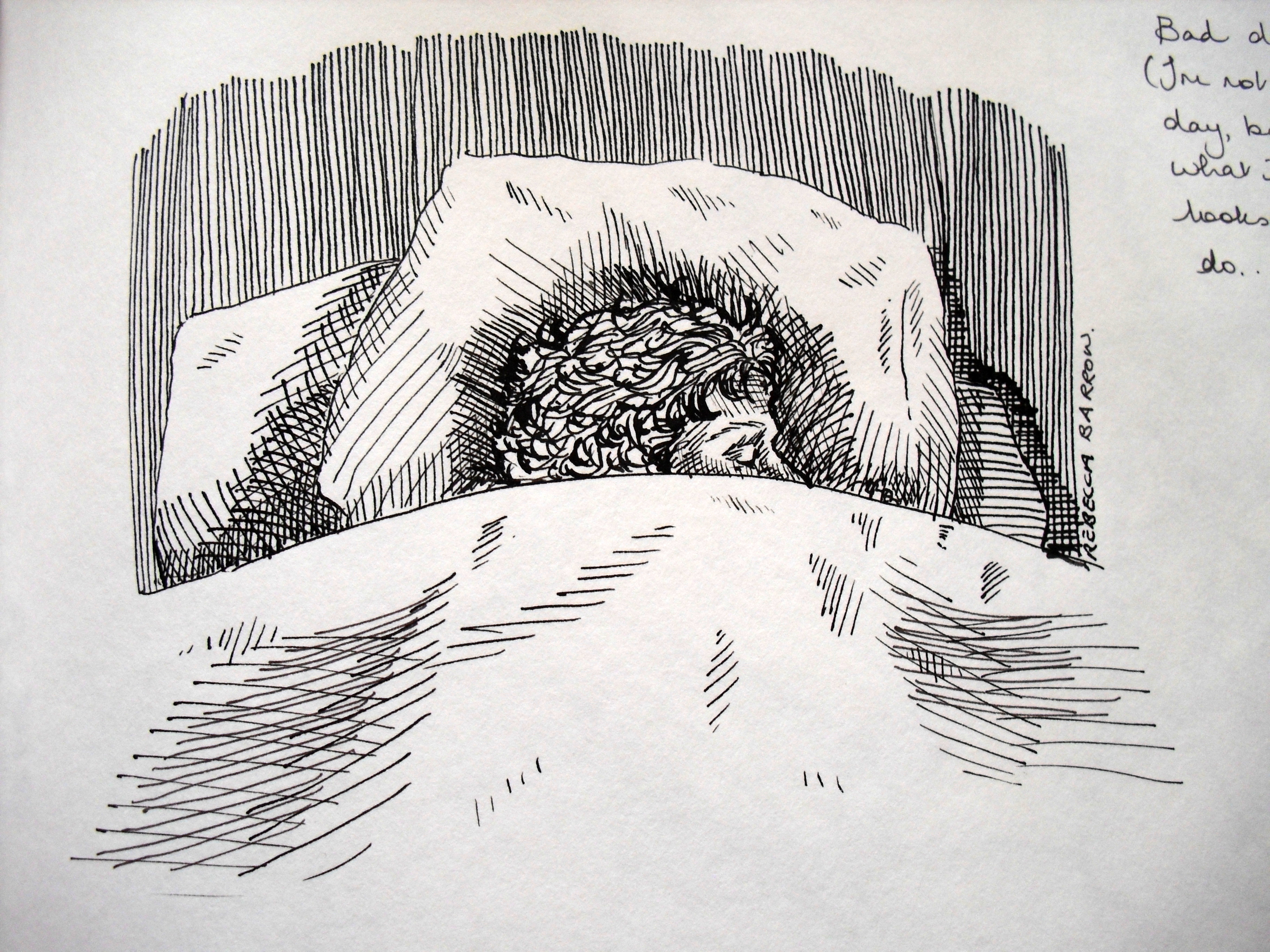
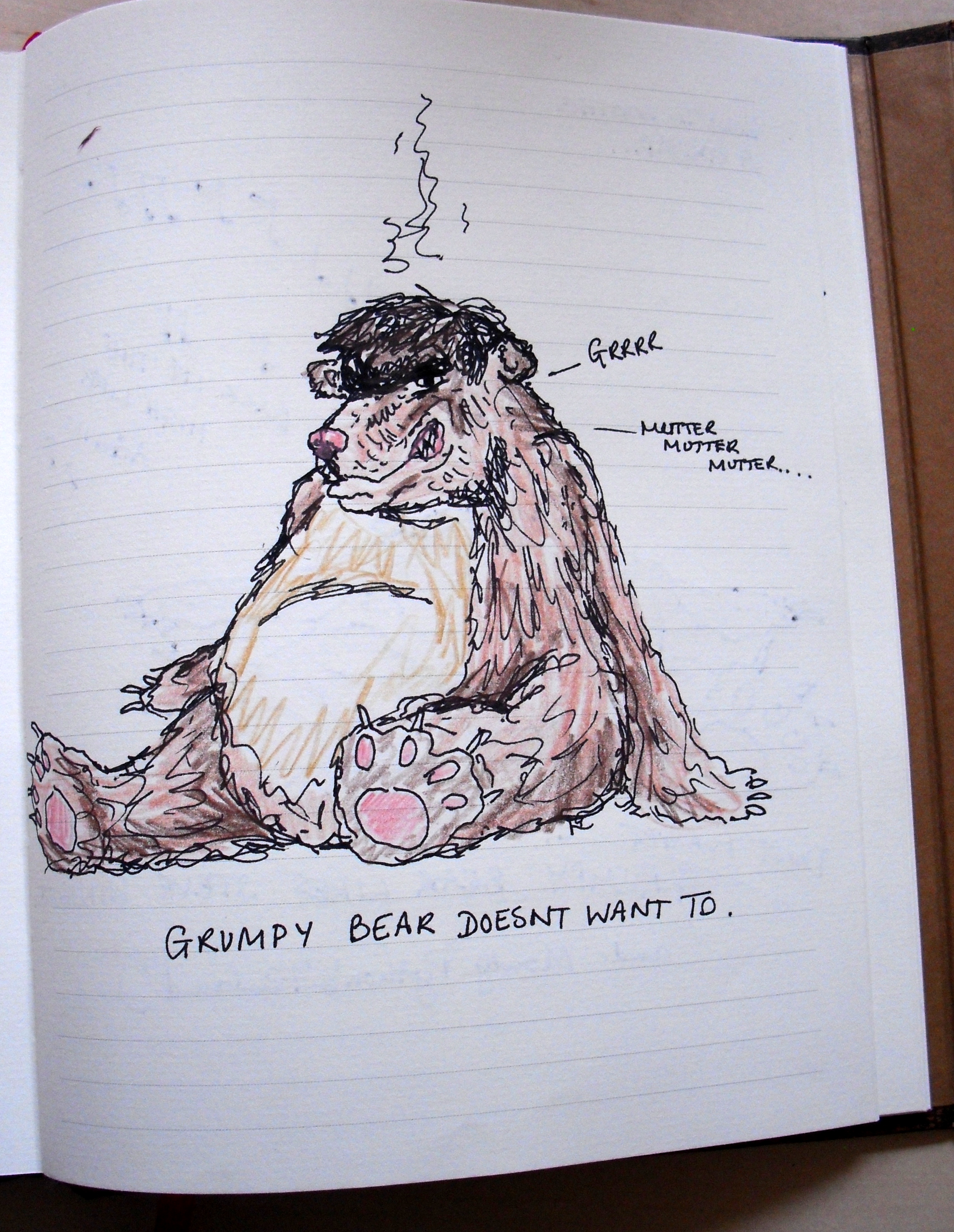
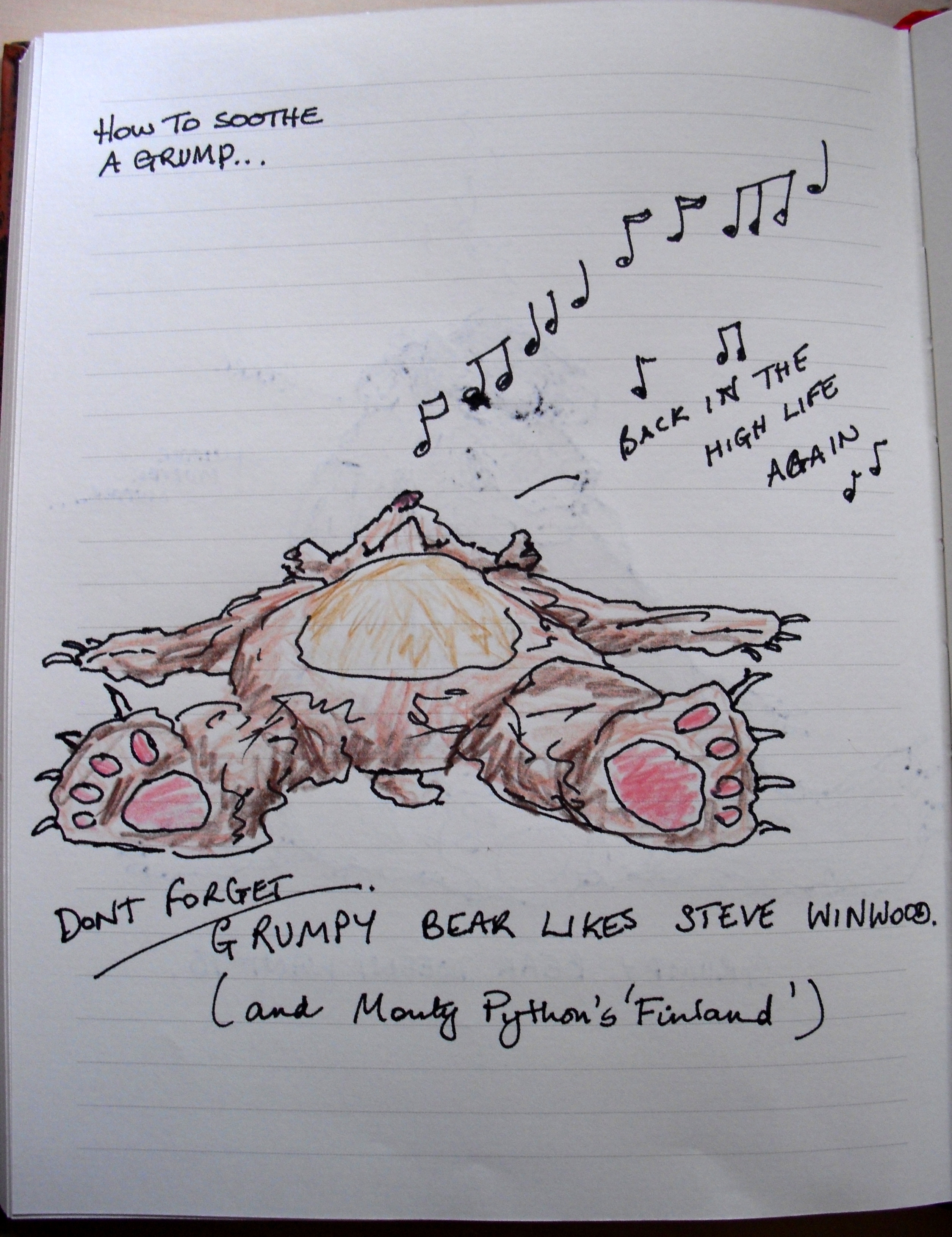
This morning, I locked Nigel in the garden shed with a ball gag in his mouth, and got out my diaries.  Because, you see I do draw.  Sometimes.  Where no one can see.  Where no one can judge.  And because a picture, as I learnt so long in Graphics class, can say so much more than words in describing a feeling.  I draw how I am feeling.  Sometimes.  If I am feeling daring, or desperate enough.  In my diary, it doesn’t have to be perfect.  It just has to be got out on paper.

Here are a few of my drawings.  Nigel is very unhappy about my publishing them here, and he wishes me to point out that they are not up to my usual artistic standard.  I would like to point out that you don’t have to be able to draw, let alone draw like Rembrandt, if no one but you will ever see the images!

sleep sketchThis one is about my illness and the days I spend unable to get out of bed, which are frequent.

grumpy bear 1 grumpy bear 2

This is a feeling I had one day that I wanted to personify, in the hope of recording how to get rid of it.

hound sketchThis was the product of a night of insomnia.  Once I had drawn this rabid dog, something I felt compelled to do in a literally physical way, the feelings I was struggling with literally dissolved, and I went back to bed and slept for seven hours straight.

The point I want to make is not whether I can draw or not, but that you can use images to express your feelings in your journal without fear of judgement from others.  If you can’t draw, or can’t bring yourself to draw, paste in images cut from magazines, or postcards.  Collage is a great art form you can try without fear of criticism.  There are lots of ways to express what is pent up inside that are nothing to do with words.

Don’t let Nigel limit you.

Journal Exercise:

I am going to talk more about this, as I feel like I have opened up a rich seam, now that I have got over my block about it.  But in the meantime, you get to do some more shopping!  Go and buy yourself some nice coloured pens or pencils.  Sharpie ones are good and bright, but I like Staedtler Triplus fineliners and Berol Colour Brushes.

Reread my previous post about colour, and play with your pens or pencils inside your journal. Makes some marks.  Doodle.  If you fancy drawing, do, but don’t be critical of what you produce.  This is not about getting a grade A.  Just have a play.

What colours and shapes express particular feelings for you?  How do you feel when you use a particular colour?  What do certain shapes mean?

During the week, keep your eyes peeled when browsing newspapers and magazines, or even junk mail.  Pick out images that speak to you.  Pull them or snip them out and stash them in a box for future use, or stick them into the pages of your journal and write about how they speak to you.

Happy Journalling,

EF

Why you need to Moodle

Today, I have been moodling.

Mooching.  Pottering.  Puttering.  Loafing.  Fiddling.  Wandering.  Pootling.

It looks like I am doing nothing very important from the outside, or at least nothing creatively productive.  But that couldn’t be further from the truth.

Brenda Ueland, in her superb book ‘If you want to write’ (hardly bettered since it was published in 1938), calls creative revelations ‘little bombs’.

“You may find that the little bombs quietly burst in you when you are doing other things – sewing, or carpentering, or whittling, or playing golf, or dreamily washing dishes.” (p45)

“…So you see, the imagination needs moodling – long, inefficient, happy idling, dawdling and puttering.  Therse people who are always briskly doing something and as busy as waltzing mice, they have little, sharp, staccato ideas…but they have no slow, big ideas.  And the fewer consoling, noble, shining, free, jovial, magnanimous ideas that come, the more nervously and desperately they rush and run from office to office and up and downstairs, thinking by action at last to make life have some warmth and meaning.” (p32)

Ueland knew that we need to time to contemplate, to think and reflect, to be alone with ourselves, but also time to just let things percolate, soak in and mingle.  We may not look like we are working on our novel when we are washing up.  We may not even be thinking about it consciously.  But there it is, fizzing away behind our eyes, collecting connections, accumulating mass like a growing snowball tumbling down a mountain.

We are incubating miracles.

We need to moodle to charge our brains, to collect impressions, to drink from the well.  However, there is another reason to moodle.  What happens when the well is dry?

This comes back to self care, which I wrote about in an earlier post.  There are always going to be times of creative drought in our lives.  There will be times when life gets in the way, or when we are so busy dealing with our personal stuff that there is no energy left over to flow out into creation.

It is crucial to know that that is alright.  It happens.  It will pass.

And when these droughts occur, and to prevent them if you can, you need to moodle.  Have a nap.  Potter about.  Paint your toenails.  Fix that squeaky gate.  Go window shopping.  Give yourself a break, literally and metaphorically.  Resting will fill the well up again.

This is why I don’t really believe in writers block.  I think that either you are exhausted, or you are stopping yourself from creating out of fear.  If the latter is the case, you need to explore those fears, and work on them in your journal.  If the former, you need to let go of guilt, accept the creative season you are in, and lie around wiggling your toes until your brain is sufficiently rested, and finally ready to come up with a new ‘Aha!’ moment.

I urge you to read Ueland’s peerless book, whether you are a writer or not.  It is full of incredibly sensible advice for anyone who means to create.

I also urge you to take some moodling time this week.  Book it in your diary.  Tell the family to leave you alone in the bath tonight.  Go and lie in the park in the sun.  Not every expedition has to be an Artist Date.  Sometimes, its good just to refill the well.

Happy Moodling,

EF

Inspiration Monday: Colour

colorful-paints-WallpaperThe fact that human beings can perceive colour has been a huge influence on our development and our cultures. Colour has helped to protect us from danger, and find good things to eat.  It has helped us to define who we are in relation to others, as well as what we believe.  These days, it is as widely used in marketing and medicine as it always has been in art and fashion.  Colour blindness can prove a significant disability.

Thinking about how we respond to colour can be a rich seam to plunder for creative purposes.  The artists of the Fauvist movement, such as Matisse, and later Abstract Expressionists such like Mark Rothko, used intense shades of colour to convey and provoke emotion.  Both Matisse and Picasso made blue nudes, but look at the images they produced:

blue-nude picasso

Picasso Blue Nude 1902

blue nude Matisse 1952

Matisse Blue Nude 1952

Matisse’s vibrant cutout provokes a very different response to Picasso’s sombre meditation on grief.

Blue is the perfect colour to think about as an example.  It is culturally significant in many ways.  For example, the pigment lapis lazuli, a vibrant blue, was the most expensive pigment available to Medieval and  Renaissance artists, so was reserved for only the most important figures. Thus, the Virgin Mary is always pictured wearing a blue robe.  In Medieval England, blue was worn as an amulet to ward off ill-health, probably because of its Marian associations.  (This is why brides still wear ‘something blue’.)  In contrast, in some cultures, blue is shunned as the token of death, ghosts and bad luck.

We identify blue with calm and peace, and blue light has been used in urban areas with some success to reduce violence.  Blue can also be associated with depression – we talk of ‘having the blues’.

Conversely, red is seen as a vivid, energetic colour, associated with lust and sex.  We speak of the ‘scarlet woman’ for example.  It can also be interpreted as a warning of danger, as in ‘Stop’ signs and traffic lights.  Rooms painted red look smaller to our perception, but also warmer and cosier.  A blue room looks airy and spacious, but can seem rather cold.

Our emotional response to colour is also of interest.  We speak of ‘warm’ and ‘cool’ colours, and choose the clothes we wear by colour according to our mood.  I wear bright red all the time, but my mother accuses me of looking ‘too bright’ when I do!  My sister has such a visceral response to the colour lilac that it actually makes her nauseous.

I never really appreciated the importance of colour in the landscape around me until I moved to East Anglia.  I grew up on the south coast of England, by the sea.  There, the beaches are formed of toffee-coloured flints and broken, bleached shells.  The sea is often edged with emerald green seaweed, and is invariably the colour of cold coffee.  The crumbling sandy cliffs are the colour of ginger, and are held together by clumps of dark green gorse which turns acid yellow in spring.

The colours of the Norfolk coast are much more muted.  The beaches are pale sand, bound with dunes of khaki marram grass.  The sea is often indigo or petrol blue, and the skies are milky even in the most brilliant of summer weather.  Here, the prevailing colours are buff, dun, woad, grey.  They make the south coast seem gaudy by comparison.

As an artist or writer, you can use all this to your advantage.  The psychology and culture of colour can set the scenes for your images and stories.  Imagine a woman walking into a grey room in a scarlet dress?  (Artist Jack Vettriano uses this kind of contrast to huge effect!)  Imagine what people would be whispering behind her back.  Imagine what the response of the man she is meeting for dinner might be.

Creative Exercises:

Spend some time thinking about your own responses to colour.  What colours do you have in your home, and why?  Do they remind you of happy memories, or are they just there?

What are the colours you predominently wear?  How do you feel in them?  Go to the shops and try on garments in colours you would never normally wear.  How do they feel?  Why would you normally shy away from them?  What do you think the colours would say about you if you appeared in public in them?

Spend some time sitting on a bench in the high street, watching passers-by.  Note what colours they are wearing.  Are you drawn to them because of their colour choices, or repelled?  What do you think their colour choices say about them?  And what do you think they are trying to say with colour?

Keep your eyes peeled for colour around you.  What colour is your front door, the doctors’ waiting room, the toilet in your favourite restaurant, the plaster of the building across the road?  What shades are the trees, the earth, the sky?  What do these colours mean to you personally?  How do they make you feel?

You might like to spend some time with your writing notebook.  Choose a colour and write a word association exercise, scribbling all the words that come into your mind in connection with that colour, no matter how outlandish they might seem.  Now go back and examine what you have written.  Does your list suggest an atmosphere, a story, an image?  Play with whatever comes up as a response and see where it takes you.

There are a host of books you might like to read in connection with this subject.  Here are a few:

The Virgin Blue by Tracy Chevalier

The Colour by Rose Tremain

Colour: Travels through the Paintbox by Victoria Finlay

Happy Colouring,

EF

Outflow: New FanFiction!

ginger catYou can now read daily portions of my new fanfic, ‘The Melted Man’, here at A03, or here at FF.net.

‘The Melted Man’ is my version of the Sir Arthur Conan Doyle story, ‘The Crooked Man’, updated to take account of the Iraq war.  Its a bit of a new departure for me, effectively adapting a story, and its more of a mystery than a romance, which is what I am used to writing.

And yes, I am copping out of writing today’s Journal Friday post, partly because I have a cold, and partly because I think presenting new writing is just as important, if not more so.  I’ve got half a dozen story ideas rattling around my brain at the moment, plus a new novel idea forming, which is a bit scary. since I’ve already got two in process at the moment.  I am being drawn towards writing something about grief, but I probably need to get something finished and under my belt first.  A bird in the hand and all that.  I’ll let you know how I am getting on.

In the meantime, here is a little excerpt from ‘The Melted Man’ to tempt your appetite:

“‘Well, difficult one, this one,’ Professor James-not-Bunsen-Honeydew said, grinding his palms together awkwardly.  ‘I’d definitely say he died because his heart stopped.  Beyond that, it gets a little problematic.’

‘Everybody dies because their heart stops,’ Sherlock snapped.  ‘Can’t you be more specific?’  He shot John his ‘what am I doing out here in this godforsaken rustic backwater – you’d better be bloody grateful is all I can say’ glare.

‘First off, there are no marks on the body, no sign of disease, puncture wounds or congenital heart defects,’ James went on.  ‘I’ve run the standard tox screens, which have all come back negative.  I’ve sent off a second panel, more specific to poison indicators, but to be frank, I don’t expect any positive hits on those either.  Colonel Cornforth was as fit as a fiddle.  Possibly fitter.  And then, well, there’s this-‘

He pulled back the sheet, revealing the late Colonel Cornforth’s head and shoulders.

John had to look away.  He had seen far too many corpses that looked like that.  Frankly, even one was too many.

Jeffries gasped, ‘Jesus!’ under his breath.”

Happy reading,

EF

Outflow: What is Your Definition of Success?

I was having a conversation yesterday with my therapist about the definition of success, and Life Purpose.  If you are a bit of an addict for self-help blogs, as I am, you will be familiar of the idea of Life Purpose.  Everybody talks about it.  Why am I here?  The self help industry wants you to define your Life Purpose, because they say it will help with setting goals and achieving success – yes, there is that word again.  The thing we all want to achieve, or are told we do.

I always believed that my Life Purpose was to write and publish books.

Unfortunately that sentence has a big fat bear trap in it.

When I meet someone new at a party, and they ask me (as people invariably do when they are making small talk with strangers) “what do you do?”, I have always replied:  “I am a writer.”  Two questions then follow:

“What sort of books do you write?”

and, “Can I get your books in Waterstones?” (Insert the name of your local bookseller chain as appropriate).

When I explain that I haven’t been published by a conventional publisher yet, I can see the light die in their eyes.  The words are practically written in neon on their faces:

“Oh, well you aren’t really a writer then, are you?  You’re just one of those hobbyists who likes to talk about themselves like they are the next JK Rowling, but what you actually do is write crap that nobody wants to read!

Society’s definition of success is publication by the conventional publishing trade.  You aren’t a writer till you are in print.

The fact is, I have written seven novels.  I have published nearly thirty short stories and novellas which get an average of 100+ readers a day on the internet, an audience size which most conventionally published writers would kill for.  I have taught writing dayschools, mentored other writers and judged short story competitions.  I have written a monthly column for a paper with a circulation of 7000, and have two academic papers to my name.  And I have kept a diary for more than thirty years.  What part of this does not constitute success?

The more I have written, the more I have realised that my definition of Life Purpose is flawed.  My purpose is not to get published, because that is only half the story, and frankly, its really not the important, interesting or exciting half.  I have realised that the part of writing I really love is the writing part, the process.  I love coming up with new stories and characters.  I love visualising scenes and dialogue.  I love the rush I get when I am in full flow, in the middle of writing a scene or chapter, when I am in the action, experiencing what my characters do, feeling their feelings, seeing through their eyes.  And I love the sense of satisfaction when I come out the other end  and look at what I’ve done.

My purpose is to write.  Simply that.

Because the thing is, you are a writer if you write.

Talking about getting your novels published, dreaming of a bestseller, imagining yourself on talk shows explaining how your stories have been adapted for film or TV – none of these things are what a writer is, although it is true that they may occasionally have to do these things.  To be a writer, you have to love the process enough to do it.

The point I think I am trying to make here is this:  what is your definition of success as a writer (or in whatever art form you choose)?  Are you measuring yourself against society’s outdated or material idea of success, or do you really see what you have achieved, regardless of what other people think?

I struggle continuously with the idea that I have failed in life or as a writer because I am still at the bottom of somebody’s slush pile.  I have to fight constantly against that prejudice within myself, as well as in others.  But the truth is, I am a writer because I write.

These days, when someone asks me what I do at a party, I say:

“I write gay erotic fiction for the Internet.”

This solves both the patronising questions at once, gives me a sense of my own achievement, and also tells me a lot about the person I am talking to, through their response.  Either they blanch and change the subject, or they look fascinated or perplexed, and want to find out more.  And then we really have a conversation worth taking part in!

Happy Creating,

EF

Inspiration Monday: Heroes

Iain Banks

Iain Banks

Life is what happens when you are making other plans.  Today I am once again deviating from my plan because something momentous happened yesterday.  The Scottish novelist, Iain Banks died, aged 59.  He was the author of ‘The Wasp Factory’, voted one of the Great Novels of the Twentieth Century, as well as ‘The Crow Road’, a book which begins with the immortal line:

“It was the day my grandmother exploded.”

Iain Banks, The Crow Road, Scribners 1992.

Surely, this is the greatest first line of any novel since Jane Austen’s ‘Pride and Prejudice’, and Orwell’s ‘1984’.

Regular readers will know that Banksie was a hero of mine.  I went to see him speak several times, as he was a regular visitor to Norwich, near where I live.  He was best described in three words, in my experience:

Angry.  Talented.  Funny.

He introduced me to a Scotland that I fell in love with, and to a way of writing that is spare, funny and insightful.  He was extraordinarily productive and his work covered a wide range of subjects, genres and styles.  When you opened a new Banksie novel, you never knew quite what you were going to get next.

If you want to read the best of Banks’s literary fiction, I recommend ‘The Wasp Factory’, ‘The Crow Road’, and ‘Complicity’.  I can’t comment on his science fiction, for which he was also justly famous, because I never managed to get through one.  Space operas aren’t really my thing.  But as I have said before,  his ‘Raw Spirit’, a book about whisky, driving, Scotland and being a writer, is one of the most charming I have read.

It is sad that a writer so talented and prolific has been taken from us so young, but why am I writing about this?  Because Banksie was a writing hero of mine, that’s why.  A writer I admired and wanted to emulate.  Like Virginia Woolf, his photograph hangs in my study to inspire me.  He taught me that protagonists don’t have to be likeable, and that little memories from growing up can serve as icons of our internal psychology.  He taught me that you should keep at it, and write what you love.  And that it’s okay to be funny, and a bit geeky.

Creative Exercise:

Who are the people that inspire you?  Whose work do you seek to emulate, or admire?  Whose biography have you read for a better understanding of the creative process?  Who are your artistic heroes?

These people are your creative ancestors, and you must always acknowledge where you come from.  Take time in your notebook to name the people who inspire you, whether it is their life struggle from which you take courage, as I do with Woolf and Frida Kahlo, or their creative process which fascinates you.  Perhaps it is their politics, or religious faith you admire, or their down-to-earth attitude.  Perhaps it is simply the creative work they produced.  Whether your hero is Steven Spielberg, Gandhi, Maya Angelou or Picasso, explore what they mean to you, what their example says about where you want to take your art.

Happy Creating,

EF

Journal Friday: The Gratitude Journal

If you trawl self help and wellbeing blogs like I do, you’ll probably have come across the idea of the Gratitude Journal before.  Lots of people swear by them.  You might think they are a bit of a cheesy idea, writing down what you are grateful for in your life every day.  I mean, isn’t it self-evident?

Maybe not.

Think about all the time you spend moaning and complaining about what is wrong with your life.  Our consumer culture programmes us to always want something else, something more than what we already have.  There might be a reason why all those slum dwellers you see in doumentaries look so happy.  Its not because they are glad to be living in squallor and poverty, that’s for sure.  Maybe it’s because they have so little that they value what they do have.

Let me tell you a story about one of the most inspiring people I have ever known:

My Great Auntie Kitty.

She was in her late 80s and early 90s when I knew her.  I was a small child – I think I was probably about 8 or 10 when she died.  I didn’t know her well because she lived in a town four hours drive from our home, so we were only able to visit her rarely, but she made a big impression.

Auntie Kitty was born disabled as a result of problems with her hips and legs, though I don’t remember specifically what.  Suffice it to say that she had never been able to walk properly and had worn calipers all her life.  By the time I knew her, she was severely crippled with arthritis, in appalling pain, and mostly blind from macular degeneration.  She was also quite deaf.  But she had a brain as sharp as a knife, and wit to match, loved to debate politics, ethics and religion, and kept up to the minute with all the news through her radio.  She also loved talking books, which she listened to continually as well.  She was funny, entertaining, and never let you get away with anything, especially self pity or fuzzy thinking.

Like many younger daughters, she had devoted her life to caring for others in her family, nursing her own parents and siblings through old age and into death.  She was the last of her generation to survive.  She had never married.  She had battled her way through a hard life through sheer force of will.

I remember her telling me this:

Every night, when she lay in the dark after the carer had come to put her to bed, she would think of three things in her life to be grateful for.  Sometimes she was in horrific pain, and thinking of anything to be thankful for was very difficult.  But she told me that no matter what, she could always find something.

Every night for the last thirty years, I have done the same.  Three things.  Just three.  Usually there are plenty more.  I could fill pages!  Some nights, if I’ve had a row with my husband or I’m in a lot of pain, as I sometimes am, I can struggle a bit. It can be pretty rudimentary on those occasions:

1.  I have a roof over my head.

2.  I have a bed to support me.

3.  There is ibuprofen in the cupboard.

Most of the time, there is plenty to be grateful for:

1.  I have a wonderful husband who loves me.

2.  I live in a beautiful place that most people would give a limb to inhabit.

3.  I have lots of friends who care for me very much.

4.  I get to write!!  (And so on)

I do this every night, come what may, partly in remembrance of Auntie Kitty, in celebration of her huge personality and bravery, and partly for myself.  Because it helps.

Being grateful shifts us into awareness, not only of what is real in our lives, but what is important.  Having that latest pair of shoes or the new Clarisonic really is not important compared with the people who we love and who love us.  Unlike the slum dwellers of the Developing World, most of us know we have a safe place to sleep tonight, and food in our bellies.  We have other, First World problems, I suppose, but there is still such a lot to be thankful for.  It is so easy to forget how fortunate we are.  Let’s not.

(I was going to take a picture of my Gratitude Journal to show you, but somehow it felt wrong.  An invasion.  Privacy, remember?  I find my reaction about that interesting itself, and I propose to explore it more in my own journal later, because I wasn’t expecting to feel that way.  Its interesting when you find boundaries you didn’t know were there, don’t you think?)

Journal Exercise:

Okay, you get to go out and indulge in the stationery shop again this week!  Go and choose yourself a nice little notebook, one with small pages.  I use this one.

Every night before you go to bed, get your notebook out and write at least three things that you are grateful for today.  Use a separate page every day, and date each.  Sometimes you will fill the page, and wish you had another.  Maybe you will go on a fill another, that’s up to you.  Some days you will be grumpy and resentful, and won’t feel like doing anything other than having a pity party for yourself.  Regardless, remember: write three things.  Just three.  It will help.

At the end of the first month, go back through your notebook and reflect on the things you have written down.  What are your lists showing about what important to you?  Write about this in your journal, if you like.  How has a daily gratitude practise changed the way you feel about your life?

Happy Journalling,

EF

On Process: The Myth of the Suffering Artist

Chatterton 1856 by Henry Wallis 1830-1916(Henry Wallis’s painting of  Thomas Chatterton (20 November 1752 – 24 August 1770), who was an English poet and forger of pseudo-medieval poetry. He died of arsenic poisoning, either from a suicide attempt or self-medication for a venereal disease.)

I was going to start this post with a list of all the Creatives who have damaged themselves for the sake of their art.  I lay in bed the other night, trying to compile a list of them.  There were a lot, and those were just the ones I could come up with at 3am!

And why bother?  We know who they were.  We know the names of Rothko, Hemingway, Woolf, Pollock, Kerouac, Kinski, Dylan Thomas, and so very many others.

We conveniently don’t notice the ones like Grayson Perry, and Tracey Emin, who credit their art with saving them. (I’ve made links to autobiographies here, and I encourage you to read them, as they are enormously inspiring.)

We certainly don’t remember the millions of artists who, over the course of the last two millennia, have lived happy, healthy and fulfilling lives as well as making art of all kinds.

You don’t have to suffer in a garrett to be an artist.  You don’t have to drink yourself to death, take drugs, cut yourself, starve yourself, tolerate life in abusive relationships, live in squallor or destroy your health.  That is not what an artist is.

An artist is someone who makes art.

(Whatever kind of art that is, from writing to painting to dance.)

Just that.  Nothing else.  Just that.

Creativity is the greatest healing force in the Universe.  I know this because I have seen it and felt it for myself.  When you begin to create, you end suffering.  You will feel better.  I promise.

And yes, it will be frustrating at times, and maybe you will cry your way through every chapter, every linocut, every sculpture, every pas de deux, as you work through all the difficult feelings that come up.  Because lets not kid ourselves, people who create great art of all kinds are often driven to do so because of their own difficult pasts.

So maybe writing 500 words a day is like getting blood out of a stone for you?  There are ways to deal with that, but remember that struggle often comes from deep hurts from long ago, from entrenched behaviours that stop you being your most luminous self.  And if you write those words, every day, you will get through those barriers, and you will feel wonderful.

I promise.

I know because it happened to me.  And continues to happen.  Every day.

If you think that you cannot communicate accurately to your readers the misery and suffering of your characters without having lived it yourself, I will tell you the secret of how you can do without nailing yourself to a cross.

Three little words:

Imagination, empathy and research.  And the most important of these is IMAGINATION.

Imagine yourself in their place.  How would you feel?  What would distress you the most about their position.  Read up.  Find out how other people felt who went through similar traumas.

DO NOT TRAUMATISE YOURSELF.

Eat well.  Get enough sleep.  Value yourself.  Work at having loving and fulfilling relationships with others. Exercise.  Meditate.   See the doctor and the dentist if you need to.  Use your art to heal whatever wounds you have.  Care for yourself, and your art will be the better for it.  As will you.

Happy Creating,

EF