Tag Archives: Creativity

Word of the Year 2014

So, we have thought about intentions, and we have begun to consider the words that identify how we want to feel.  Those (five) words are the place from whence our intentions arise.  Because every day we can choose to do things that make us feel that way.

Clever, eh?

But there’s more:

You may have bumped into the idea of having a Word of the Year.  You can find out more about this habit here.

A Word of the Year is a kind of overall intention.  It gives you a direction, a way of formulating how you want to be in the world. It also has an uncanny habit of bringing into your life exactly what it says.

My word for 2013 was

Revolutionary

And oh boy, was it?!

This year has fundamentally changed how I feel about myself.  I have undergone a revolution in my core beliefs and my way of approaching the world.  I have turned my attitudes about my place in the world and, most particularly, in the world of work, on their heads.  In some ways, I have also revolved (the other meaning of revolutionary), coming back full circle to revisit issues that I thought I had dealt with before.

I have revolutionised the way I write and the way I feel about my writing.  I have set up this website and begun to dream new dreams about the kind of things I want to create.  It is exhilarating.

Let me tell you, revolution doesn’t have to be a violent upheaval that ends with tyranny and blood.

I have to confess that when the word first came to me, in the form of just revolution, (while I was still in the malaise of a serious bout of influenza which brought me close to being hospitalised), I was a bit scared.  I knew it was the word I needed, but it sounded frightening, as if I could be inviting an earthquake into my life.  Was I really ready for that much change?  After all, with limited energy, poor health and a susceptibility to anxiety and stress, it didn’t really sound a good idea to invite those kinds of energies into my world.  So I fiddled with it until it felt more friendly, more manageable.  And more appropriate to what I could cope with.  It became:

I AM REVOLUTIONARY

And this year, I have been.

So the question then becomes, what do I want to be next?

I don’t have to stop being revolutionary, of course, but 2014 needs a new word, something that allows new energies into my life, allowing me to blossom and grow in new ways.

I have been sitting with my five words and my journal and calendar, contemplating what I want to be and do next year.  How I want to build on the intentions and lessons that revolutionary brought with it?  I thought about kind, lovingkindness, courage, and strength.  The first two felt too soft, and the last two, too tough.  I needed something flexible, something I can grow with, something I can work with whilst still treating myself with lovingkindess.  And this is what I came up with:

DARE

Dare feels good.  It popped into my head at 2am on the way back to bed after a loo break (TMI), and I knew it was the right word.

Dare is about having a go, putting yourself out there, but not in a way that is perfectionist.  Not in a Nigel way.  Dare means trying something out and seeing if it fits.  It means trying something, and knowing that it doesn’t matter if I fail or if I don’t get it exactly right the first time, or even if it turns out to be the wrong thing after all.  At least I will have tried.  At least I will be in the arena fighting, as Roosevelt would put it.

Journal Exercise:

So, I invite you to take time to sit with your feelings words, with your creative and life intentions, and to consider what word might truly describe and inspire how and who you want to be in 2014.  What feelings and new adventures do you want to manifest in your life?  What energies do you want to invoke?

When you consider this, do it in the spirit of lovingkindness towards yourself.  Look at your life with a gentle hope, not in the spirit of forcing yourself into new contortions.  This is not some New Agey wishing, some pseudo-psychobabble soppy thing.  This is a life affirming way of moving yourself to new levels, of becoming more yourself every day, and of being deeply, affirmatively and satisfyingly creative.

Everyday life is a continual act of creativity.

When I say ‘sit with it’, I mean: allow yourself time to consider.  Allow ideas to filter, percolate and bubble in your mind.  Don’t force it.  It will come to you.  Let it happen.  You know deep inside what you want for yourself as a creative being.  Allow it to emerge.  And then rejoice in it.  Allow it to inspire every corner of your life for the whole year.

I guarantee it will take you places you can’t even begin to imagine right now.

Happy Creating,

EF
How do you want to feel?

“Be willing to look at your own life and want more for yourself without beating yourself up or making it about another self-improvement plan.” -Jennifer Lounden

Jennifer Louden’s recent post about Freedom from Self-Improvement seems completely apposite right now, in the run-up to Christmas, when we are all feeling the ‘we’re not worthys’ very badly.

Everyone else seems to have a nicer house, prettier, more stylish decorations, tastier cocktail treats, better fashion sense, better-behaved kids.  My own melt-down usually comes with present-wrapping.  Everyone these days makes present wrapping into an art form.  Me, I struggle to fold neat corners in my artfully chosen, blends-with-the-bauble-colour-scheme wrapping paper, never mind the hand-cut decorative snowflakes and layers of gauzy ribbon that some people cook up!

Christmas is a bunch of big red emotional triggers for me anyway.  So right now, I am choosing how I want to feel, and doing only those things that make me feel the way I want.

Sounds too good to be true?  Too many SHOULDS on your plate to even think its possible?

Remember, you always, always have a choice.

In the last post, I was talking about Intentions as an alternative to goals.  There is a process to setting intentions, and it starts with this:

How do you want to feel?

I found this exercise in Danielle LaPorte’s excellent book, The Firestarter Sessions.  It is another book I heartily recommend, and if you want to know how to do it properly, I suggest you grab a copy and check out the worksheet on page 73.

Journal Exercise:

Take some time with your journal.  Write about the feelings that give you a sense of wholeness, enoughness, satisfaction, happiness.  How do you want to feel about yourself?  How do you want others to see you?  What qualities do you admire in yourself and others?

Come up with between three and five words that describe how you want to feel/be in your life.

Mine are:

Radiant

Calm

Wise

Joyful

Creative

Take your time over this.  Make a long list, if you like, and sit with it for a while, weeks if necessary.  Then hone it, edit it, pick and choose until you come up with a series of words that describe heart of who you are.  How do you want to feel in the future?  What symphony do you want to start in your heart?

Key to this part of the process is NOT BEATING YOURSELF UP.

Choose words that resonate with you.  Not what other people would like you to be, or what you think you OUGHT to feel.  You are shaping your life, your coming year.  What feelings do you want to feel?

This is not about self improvement.  It is about self-actualisation.  It is about being fully and deeply yourself.  And by being fully yourself, you can let your innate creativity loose.  You can choose your creative direction and flow with it.

For more on this, check out Danielle LaPorte’s website.

In the next post, I will be talking about your word for the New Year

Happy Journaling,

EF

Reflecting on our Creative Achievements

2010-12-25 13.48.32

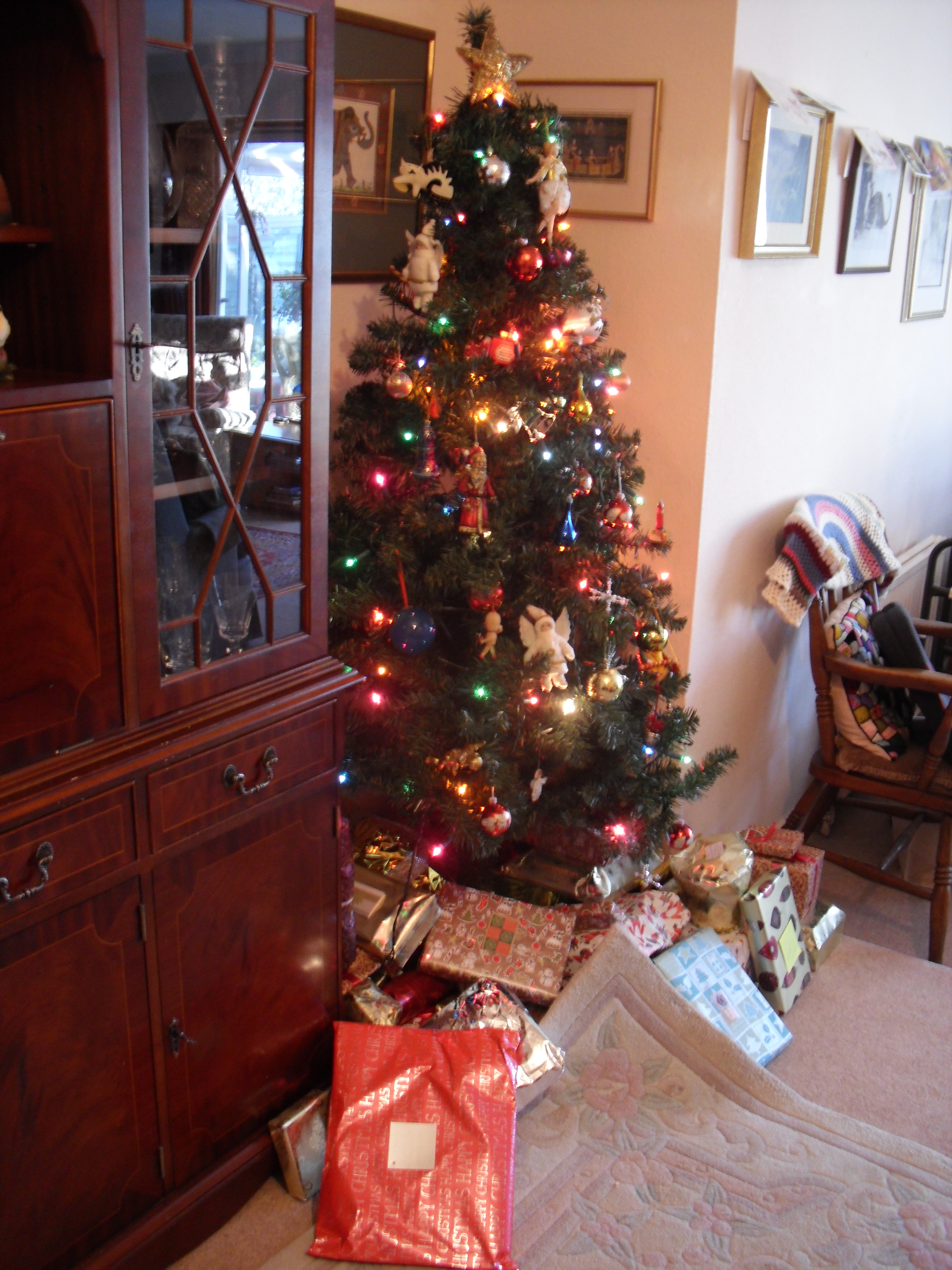
My mother-in-law’s mad Christmas tree. Apologies that the carpet is all ruckled up!

Christmas is coming.  We are all rushing around panicking about what to buy Great Auntie Flossie, trying to get trees up and mince pies made.  And once all the kerfuffle dies down, we’ll be trying to formulate New Year’s Resolutions while our heads are still spinning from the tinselly onslaught.

The blogs I follow are already jam-packed with ideas for resolutions and how to plan your goals for next year.

Aren’t we exhausted enough?

Let’s just take some time to stop and reflect.  To consider what we have achieved this year, before we start pushing ourselves about next.

I don’t think we take enough time to recognise and celebrate what we achieve. We are constantly encouraged to move on to the next thing, the next goal, always more, more, more!

Because we are never enough.

Yesterday I came across Dr Brene Brown’s book, ‘Daring Greatly’, in the library.  I have read and benefitted greatly from her earlier works, but I had avoided this one because for some reason I had got it into my head that it was about parenting, which isn’t exactly relevant to me.  I was wrong.  The first chapter, on Scarcity, had my head spinning!  I highly recommend you read it.

As writers, scarcity is a constant problem.  After all, in such a subjective realm, how can you measure enough?  I wrote recently about the problem of owning yourself as creative.  This is intimately linked to the problem of enough.  How can you know when you have done enough, produced enough, published enough?

I think one way to tackle this sense of dearth is to recognise and celebrate what we have done.

This year I have started this website, something I really didn’t think I had the guts to do.  This is my 86th post.  That’s a whole lot of words.  A big achievement?  You’d better believe it!  I have published over 40 fanfics too.  I have put myself out there.

This is not blowing my own trumpet.  This is stating the facts.

I am proud of what I have made this year.  It may not tally with the list of goals I made in January, but I’m okay with that – I’ll tell you why in the next post.  I’ve been telling myself I didn’t achieve a lot this year, but actually when I sit down and reflect on what I’ve done, I’ve moved mountains!

Journal Exercise:

Before you get too lost in the melee of Christmas, set aside some time to take stock.  Sit down with your journal, and a glass of wine if you like.  Perhaps light a candle, and put on some gentle music.

Think about what you have done this year.  Don’t look at your list of goals and resolutions.  Don’t think about all the things you planned to do, and didn’t.  Think about all the things that did get done, and the unexpected achievements too, things that came out of nowhere, the gifts the Universe has given you.

Count everything, from getting to see your favourite actor in a play, to passing that exam, from painting your biggest picture yet, to being in the village Christmas Panto.  Maybe you had a poetry collection or a novel published, exhibited your art, won a competition, or maybe you read out your first poem in public, or tried painting or drawing for the first time.  No matter how big all small, list everything.  Think about all the creative things you did, the cakes you made, the dances you went to, the pumpkin you carved, the costume you made for your kid’s school play.

Be proud of yourself, of where you are now.  Do it for yourself.  Savour it.

Because you are enough.

Happy Reflecting,

EF

Its Never Too Late…

Whenever I see an article in the paper about some young person who has won an important first novel award, or got a massive advance on their first book, I have a mini meltdown.  Its not that I would take their achievement away from them.  Its just that I am now 46, and still struggling to finish a book that I am happy enough with to publish.

But how old is too old?

I could probably quote a dozen examples of authors who didn’t publish their first book until they were in their 60s or 70s.  There are always the exceptions.  I keep telling myself that its never too late to fulfil the dream of that first novel I wrote at the age of 16.  But you have to really understand the fact in your heart, as well as in  head.

Let me tell you a little story about fulfilling your dreams at any age.

The other day I went to my first Masked Ball.  I’m not a dancer by any stretch of the imagination, but we had been invited to go by friends who are.  It was an event run by the dancing school our friends attend, and as part of the entertainment, several of the school’s students danced exhibition dances.  To uproarious applause, there were paso dobles and waltzes and tangos.  (And there were lots of sparkles too, and I just love sparkles!)

Marvellous.

And then a tiny little old lady in a lacy top and a bow in her hair got up, and danced the foxtrot with her lady teacher.  And it was lovely.  She got the biggest round of applause of the night.

Then the evening’s compere told us about her.  How she had fulfilled a lifetime’s ambition recently by dancing in the British Ballroom Championships at the legendary Tower Ballroom in Blackpool.

Turns out, this lady, who reminded me a great deal of Mrs Pepperpot (if you remember her), was 86.

Eighty-six years old and still ballroom dancing.  Competitively.  Eighty-six years old and still pursuing her creativity.  Eight-six years old and still fulfilling her dreams.

How old is too old?

Ask me when I get to 87.

Happy Creating,

EF


The Perils of Getting Lost

There is no SatNav system for the artistic life.

Most of the time, we creative people complain about the problems of not being able to get into the Zone.  Not being able to find the door into the imagination.  Not being able to make our art.

Or we complain about not being able to get out of our own way.  We get hung up on the avoidance tactics and displacement activities we use so we don’t have to think about the empty page, the blank canvas.

Be honest, how many loads of washing have you done to avoid that novel you’ve been meaning to write?  How many drawers and cupboards have you cleaned out as an excuse to get away from your easel or your desk?

Seriously, its amazing how interesting cleaning can become when you need to be doing something else.

However, one of the perils of the artistic life that we rarely talk about, let alone complain about, is that of getting lost.

Lost in your imagination.

Lost in that place where the stories never end.

Lost where the romance and the passion and the adventure and the danger go on and on, and there is never, never washing to be done, unless it is in a picturesque stream with the sun sparkling on its surface, and requires both hero and heroine to divest themselves of their clothes in as romantic/modest/passionate (delete as appropriate) way as possible.

Suddenly you will wake up one morning and realise that you have been trapped on the island of the Lotus Eaters, so lost in the pleasures of your mind that you have forgotten to live.

Marriages founder this way.  Bankruptcies are forged, friendships lost, loved-ones go unmourned.  It happens all the time.

We lose ourselves constantly.  Often it is complusive shopping, gambling, drinking, eating or other drugs that claim us.  Addictions can be apparently harmless.  Surfing the internet seems harmless enough, until you realise you have lost days and weeks of your life doing it.  We lose ourselves in meaningless busyness, in rushing round fulfilling empty tasks, in competing with friends and neighbours, in acquiring the latest TV, sofa, car, clothes.  Modern life encourages us to find an addiction to dull the ennui.

Being present is hard.  Its even harder if you have an over-active imagination.  It is so much nicer to be lost in a story than facing the reality of life.  Doing the work of living.  Being real.  It is so easy to slip away and not come back.

Lately I have been away.  In the last couple of days, I’ve realised that life is tugging at the hem of my skirts, wanting me back, needing my attention.  I’m fighting it.  I don’t want to come back.  I want to stay in my fantasy world.

But life needs living.  We only get one go.  The art needs making, yes.  But our lives are our art too.

Don’t forget to live as well.

Happy Creative Living,

EF

PS – You might like to know that I have a new story out, The Retirement Party, a ‘Lewis’ romance, which you can read here at AO3 and here at FF.net.

When to Share

I’ve been thinking a lot lately about timing.  Specifically, the timing involved in releasing our artistic work into the world.  This may arise from the fact that after nearly two years I am still wrestling with the second part of ‘Three Weddings and an Explosion’, one of my johnlock stories.

My natural writing process is to write a story and then let it sit for a while.  There’s no set time limit in my head.  I just like to let it ‘cook’ for a bit.  Then I can go back to it, and edit with a fresh eye.  By then, I feel so much less attached.  I can pick out most of the typos, and identify the things that really don’t work about the original piece.  Letting your work sit allows space for objectivity.  It’s easier to ‘kill your darlings’ as they say – to cut or change the scenes you are really proud of, but that simply don’t work in their current context.

(That is why my recent series of ‘Friday Quick Fics’ has been such a challenge – they are invariably stories I have knocked off the day before and not allowed to rest, but published immediately instead.  That is a real challenge to my writing confidence, and let me tell you, it takes guts!)

I’m also a huge believer in the idea that our writing helps us explore our own psychodramas.  My story, ‘The Case of the Cuddle’ allowed me to revisit a time when I was starting to deal with a traumatic experience, and much of the reactions of Sherlock in that story are actually my own.  Writing that story allowed me not only to come to terms with the original experience, but also with memories of the distressing period during which I processed it.  It helped profoundly with my own healing.

My stories continue to represent what is going on in my subconscious as well as my conscious mind.  I wrote a very long MPREG story while a close friend was pregnant two years ago, work that enabled me to begin to come to come to terms with my own childlessness.  And only the other day, when I came home from visiting my mother for a few days, I sat down and, in a single sitting, wrote a 2600 word story about Sherlock’s relationship with Mrs Hudson.  After I had finished, I looked it over and thought: ‘Oh, yeah, Mother issues.’

So now perhaps you are sitting there thinking ‘I’d really like to read that MPREG story, why haven’t I seen it?’

The answer is that I am not ready to share it yet.

Perhaps the emotional odyssey of my not being a mother is not over.  Perhaps the issue for me is still too raw.  Or perhaps I am just not artistically satisfied with what I have done.  Either way, I am not yet comfortable with releasing that story into the wild.

The other day I was reading something written by Leonie Dawson about being spiritually ready to share one’s art.  About how she made the decision to put her paintings up for sale only when she felt that they had done their work in her own life.  She made a conscious choice to follow her own instinct about when she was ready to sell.

This is something that is really hard to do.  It takes confidence in your own artistic decisions and your spiritual connection to yourself.  But if you can do it, if you can hold out despite all those voices of readers, hungry for more (which means you are doing your job right, by the way), or buyers wanting your paintings for their own walls, you will open an artistic integrity in your work.  You will know when a piece is ready to leave home.  And you will be happy to let it go, knowing it will go on to do its healing in someone else’s life.

And art is healing, believe me.

When I unleashed ‘The Case of the Cuddle’ on the world, I had a number of emails from readers, saying how it had helped them with their own healing.  The story helped me, and now it continues to do the same for others.  Which, to me, is what art of any kind is for.

Part of the skill of being an artist of any kind, in any medium, is knowing when the time is right to release your work to others.  To know when you are ready to let go.  It is not just about being satisfied that something is finished, or about perfectionism.  (That is a whole ‘nother story!)  It is about being emotionally and spiritually ready too.

Letting go too soon, whether it is because the work is not yet finished to your own standards, or because it is still to raw and personal for you, can be a nightmare, as I discovered this summer when I published a story I loved but was not happy with.  It caused me untold grief.  I learnt my lesson.  The work wasn’t cooked.  It was not ready to leave me.  And I was not ready to leave it.

Try to trust where you are in your artistic life.  Take time to ask yourself whether this is the right time for your work to leave home and begin its new life in the hearts and minds of others.  Maybe you will never be ready to do that – there are plenty of artists if all kinds whose work is never seen in their lifetime.

That’s okay.

Learn to trust the reasons why you release your work in the way you do – or choose not to.  Maybe you choose your timing for purely practical reasons – taking into account such considerations as when you are struggling with a large parallel workload, or major life upheavals such as moving house.  At such times, it may simply not be feasible to expect to present work to the public.  Or maybe the work is too close to raw emotions.  Maybe you just aren’t ready.  Maybe it just isn’t cooked yet.  Trust that.  Sit with it.  When the time is right, you will know.

Happy Creating,

EF

Owning It

Have you been there too?  That cringe-making moment at a social event when you meet someone new and they ask you what you do.

For me it is a doubly difficult dilemma.

Do I give them one version of the truth:  I haven’t been able to do paid work since 2001 because of chronic health difficulties.  Which either makes me look like I am scrounging off the State, or like a whinging hypochondriac.  Either one pretty much means the end of the conversation.

Or do I say, Oh, I’m a writer and artist.  To which I get the next question:  where can I get your books?  So thats a whole ‘nother minefield.  Yes, I have written seven novels.  No, you cannot buy them in the shops. I publish on the internet.

(Oh, well you aren’t a proper writer, then, are you?  You’re just one of those middle class kept wives who plays at being a creative but is actually too mediocre at it to cut it in the real world.)

Admittedly, this last is probably supplied by Nigel, who is only too happy to make me feel like a loser and a waste of space, so that I will never take any risks or put my work out there.

These days, its even worse if I mention that I write fanfiction, because people have finally heard of it, and they always, always want to talk about 50 Shades of Grey.  Don’t mention that book in front of me.  Please.  (You wouldn’t like me when I’m angry.)

The other day I was at a social event and met someone new.  She was a fascinating person, and great fun.  I liked her a lot.  She asked me what I did.  I said, ‘I’m a writer and artist.’  Cue discussion about novels not yet published, how I am trying to make a go of this website, and why I am interested in creativity, which happened to be her field of research.

All fine.

I came home and felt like a total fraud.

Why is it so difficult to own our creativity?

I may not have had a novel published in conventional form, but then I’ve never really submitted one to a publisher.  I’ve written and published 42 works of fanfiction on the internet, some of which have novel-sized wordcounts.  I get around 100 readers per day of my fictions, and regularly get daily reader numbers over 500, figures that most conventionally published writers would give their eye-teeth for.  This website has over 300 followers.  What is it about these statistics that makes me not a writer?

What really makes me a writer is that I write.  Every day.  Being published does not make me a writer.  Public recognition does not make me a writer.  Having books on the shelves does not make me a writer, if I am not writing.

Being a writer is not something that other people tell you that you are.

Being a writer is what you do.  Day in. Day out.    I write because I need to write, not for the end result.  I write because it comes to me as naturally, and as necessarily, as breathing.

So why can I not own it?  Why do I not feel entitled to it?  Why am I embarassed to say it in front of someone new because Society says I do not tick the boxes required (ie publications, awards etc etc)?  Will I have to wait until I am as old and lauded as the late Nobel Prize laureate Doris Lessing before I can finally say I am a writer, and feel entitled to it?  (I really hope not.)  Do any writers ever feel entitled to the label?

Do you feel entitled to your creativity?  Do you make excuses that you are only a hobbyist painter or dancer, whether to yourself or others?  Do you feel you must keep your creative projects secret for fear that they will not be understood?  And is it really necessary to have public recognition for our art?

I’m not saying there are anwsers, or even right answers.  I think the answer is different for every one of us.  It is a complex tangle.  I simply think we have to address it in some way as artists in whatever medium, if only to find out what stifles or liberates our own voices.

And maybe this time next year, when I meet someone new at a party, I will feel entitled to say: ‘I am a writer’, and own it.

Happy Creating,

EF

For Creativity, Press The ‘OFF’ Button Now

This morning, my part of the UK was hit by the worst Atlantic storm in some years.  Trees came down, houses flooded, power cables snapped, cars were crushed, trains and planes came to a standstill, and double decker buses were lifted off their wheels.  It was not nice.  Its over now, blazing across the county in under three hours, leaving a trail of destruction in its wake.

Which got me thinking, you will not be surprised to hear.

Husband and I spent most of yesterday glued to various forms of news media, trying to gauge the progress and destructive force of Storm St Jude, working out which hatches to batten down, what damage might ensue, and whether, in Husband’s case, it was sensible to cancel his 9am lecture this morning. (He did, and I think it was the right decision).  The upshot of all this digital frenzy was that I didn’t get anything much done.  Which was an annoying waste of a whole day.  And made me think about something I had read a few days earlier:

I came across the work of Linda Stone, and in particular, her term ‘Continuous Partial Attention’, which is when we multitask cognitive functions such as talking with a friend at coffee whilst checking our email on our android under the table, surfing the internet when we are on the phone, and all those other digital things we do these days that we never used to.  Linda Stone says:

“Continuous Partial Attention involves an artificial sense of constant crisis, of living in a 24/7, always-on world.  It contributes to feeling stressed, overwhelmed, overstimulated and unfulfilled; It compromises our ability to reflect, to make decisions and to think creatively.”

Lindastone.net/qa/continuous-partial-attention quoted in Sharon Salzberg, The Power of Meditation: A 28-Day Programme for Real Happiness, Hay House 2011.

It compromises our ability … to think creatively.

Just think about that for a minute.  I did.

I thought about how long I spend on Facebook every day, how many hours I lose cruising Tumblr and reading fanfics, checking my phone, watching BBC News 24.  These are what Jennifer Louden calls Time Monsters, habits you fall into that eat up the spare time you have and leave you feeling rushed and stressed out because you aren’t left with enough time to do the things you really want or need to do.  I have been known to lose whole weeks to my Time Monsters.  Yesterday, thanks to Storm St Jude, I lost an entire day.

I’m 46!  I don’t want to waste any more time!

Increasingly, I am finding that it is a luxury to switch off my phone and not look at my laptop.  I don’t want it to feel like a luxury to disconnect.  I want it to be the constructive core of my working life as a writer.  I don’t want to have to employ some kind of app to shut me out of the internet in order to finish a story, just because I can’t resist looking at yet another iteration of the same picture of Benedict Cumberbatch.

I want the sense of calm that comes with not knowing what is happening in the outside world.  The same calm I felt lying in bed this morning, listening to the wind riffling the roof tiles, blissfully ignorant of what speed it was going or when the next pulse of the storm was going to hit, courtesy of the Met Office website.

The question is, can I do this?  I caught myself the other day thinking that I couldn’t write down a snatch of dialogue I had going around my head because I didn’t have my laptop open.  As if a pen and paper weren’t good enough.

To be creative, in whatever art form you choose, from cookery and sewing singing, tango, writing or painting, you need time and space.  You need to reflect.  Being connected doesn’t give you that space.

For our own creative self-care, we need to make time to switch off.

I don’t want the stress of Continuous Partial Attention to wreck my creativity through anxiety, perceived comparison or peer pressure, or just from lack of time to create.  I want to make space.  Space to think more, reflect more, make more.

You can too.

Creativity Exercises

1. How do you use your time?  What are your chief Time Monsters?  What are the digital munchers in your life?

2. Once you have identified your Time Monsters, you can decide whether you want to continue feeding them, or jettison them to make room to do the things that really make you happy, instead of just keeping boredom and despair at bay.  Its nice to keep a few on standby, for days when you really are frazzled and just need to stare at the telly and not think, but that shouldn’t have to be every night.  If it is, maybe you need a major rethink.

3.  Consciously switch off.  Turn off the telly, your phone, your lappy.  Sit in an armchair and read a book, bake a cake, go for a walk, paint or garden or see friends.  Do something that involves experiencing the world directly, not digitally.   Use your time to think and create.

4.  Do one thing at a time.  Don’t surf on your phone when you are out with your pals, that’s rude.  Don’t have the telly on when you are painting (a bit of inspiring music might help, but nothing you have to think about.)  When you have a conversation with your mum on the phone, concentrate on her, don’t keep one eye on the news.  If something is worth doing, its worth giving your whole attention to.

I’m not advocating digital purdah, believe me.  The digital world has its place, but it is down to us to keep it in it.  I’m just saying we need to use our time more mindfully.  Which is what, from now on, I am going to try and do.

Happy Creating,

EF

Retreat Debriefing

The house is cold and damp, and the fridge is empty.  Coming home from a retreat can feel a bit like being marooned on the shores of real life after a blissful dream.  It is wonderful to have your own space, and three two-course meals a day, plus a continual stream of tea and cake, laid on for you.  I feel as fat as a walrus.  Two and a half days with nothing to do except write, and talk about writing with your writing friends – it’s hard to beat.

As idyllic as it sounds, it can come as a bit of a shock to start with.  I woke up on Saturday morning and immediately plummeted into a panic attack of ‘Oh, Gods, I can’t do this!’  The day stretched out before me, packets of emptiness between appointments with the dining rooms.  Just me and my four walls, my pen, paper and laptop.  Suddenly writing was inescapable.  No more displacement activities.  There are only so many indulgent baths and long, breezy walks you can have before you can no longer avoid the inevitable contact of nib with paper.

By about 11.30am on Saturday morning, I had done every displacement activity available to me, and there was no choice but to get down to it.  I opened a fresh page of my notebook and off I went.

And it was wonderful.

I wrote and wrote and wrote.  I didn’t judge or edit myself.  I put down everything that came into my head, page after page of it.  Story after story fell onto the paper.  My two favourite pens ran out in the course of the weekend.  By afternoon tea at 3.30pm, I had 12 pages of A4 paper covered with my spindly scribble, and I had discovered things about my new hero that I had never dreamt of.  By supper time, I had two pages of polished script to read out at our evening meeting, where we gather to share our progress so far.  On Sunday morning, again about 11.30am, I started again, and by lunchtime had an idea of what research I would need to do, and a list of indigenous names for my characters, gleaned from the one book I had bought with me for research purposes.  By tea time I was exhausted but happy.  I had worked so much out.  I had a better idea of what needed doing next.  And I had learned to write lying down on my back (which became necessary because my back has really been playing up the last few days, and sitting up proved a nightmare).

I felt a bit dazed when I got home.  I stared at the telly for a couple of hours and then went to bed.  This morning, when I woke up, I felt slightly hung-over.   Just as you can eat and drink too much, it seems you can write too much too.

So I am having a bit of a day off.  I am just lolling about, digesting the weekend, getting my head around this week’s diary appointments, catching up on the laundry, and reading comforting books.

Tomorrow I will start again.  I will get back to my blank A4 pages and start downloading backstory with my biro, and my soul will soar.  In the meantime, I think a little time on the yoga mat may be what my back needs!

Happy creating,

EF

Journal Friday: Derek Jarman’s Sketchbooks

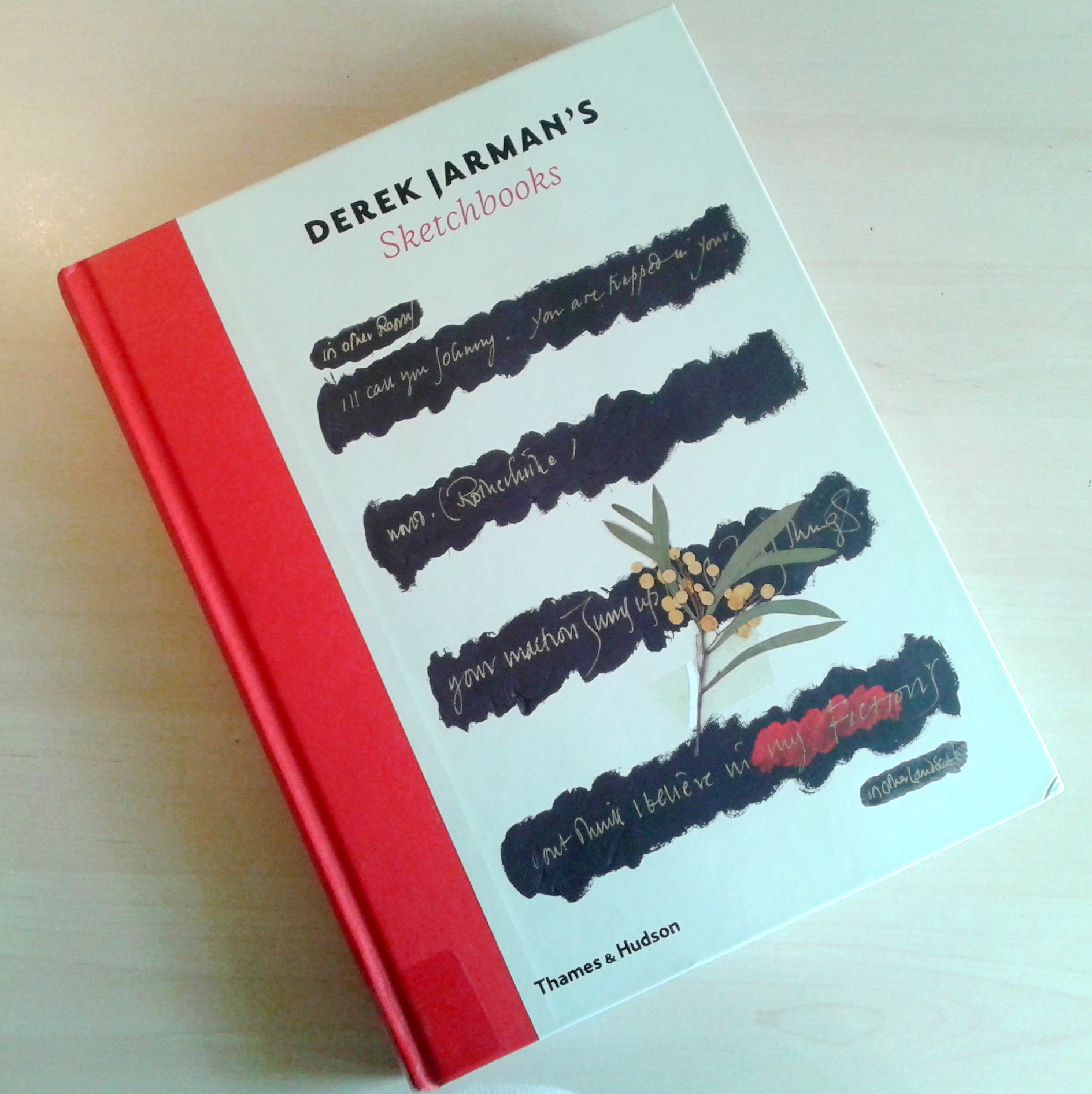
jarman diariesIt’s been a very busy week, and I’ve been diving into all kinds of exciting new and inspirational activities, including the UEA Literary Festival.  I’ve also been submerged in the magical world of Derek Jarman’s Sketchbooks, edited by Stephen Farthing and Ed Webb-Ingall, and I want to share the inspiration I’ve found in them with you.

derek_jarmanIn case you have never heard of Derek Jarman, he was a fabulously talented artist, film-maker, designer, writer, gardener and Gay Rights activist whose career was tragically cut short by AIDS in 1994, aged 52.  He directed music videos for the Pet Shop Boys and designed the sets for Ken Russell’s landmark 1971 film, ‘The Devils’.  At his home in Dungeness, he created one of the most haunting modern gardens in Britain, one that I am deeply in love with.

I first became aware of Jarman when I saw his film, Caravaggio (1986), starring Nigel Terry, Sean Bean, and Tilda Swinton in her first film role.  Later, in 1991, I wept my way through his heart-breaking ‘Edward II’, an adaptation of Marlowe’s play that spoke of Jarman’s outrage at homophobia in Thatcherite Britain.  These are not easy and accessible films.  They are, however, fabulous to look at, and very moving.

When I came across this edition of the sketchbooks in the library the other day, quite by chance, I had no idea that Jarman was a committed visual diarist.  The sketchbooks themselves are large – family photo album sized – and each cover is decorated in black and gold, making a slightly varied but pleasing continuity.  Inside them, Jarman uses ephemera, calligraphy, drawing and painting, poetry, pages of film scripts, actors’ head shots from casting sessions, clippings from newspapers, reviews, photographs of friends and colleagues, bits of feathers and pressed flowers to document his life and each of his projects.  The sketchbooks contain his thoughts on everything from his garden (there is a carefully drawn planting plan), to his illness, to sex, history and death.

Jarman made a series of paintings, the ‘GBH’ series, of black on gold abstracts, inspired by Goya’s Black paintings, and a film called ‘Imagining October’, which arose from finding Sergei Eisenstein’s own copy of ‘Ten Days that Shook the World’, the famous book on the Russian Revolition, and on which Eisenstein had based his ground-breaking film, ‘Battleship Potemkin’.  Jarman had been shocked to discover how much of the book had been redacted with blacked-out text by the Communist authorities.  Both of these concepts are reflected in the sketchbooks, where you can see Jarman working on the idea of black bars with gold writing, seen on the cover of the volume.  Jarman’s anger at the political situation for Gays in the UK shines through these blackened pages.

One of the things that particularly strikes me is the simplicity of the layouts he uses.  Even when he is writing pages of text, making notes or journalling, there is a sense of space.  Nothing is cramped.  He spreads out, not denying himself room to work, enjoying the clarity of white space around his words and images.  This is something I will definitely take away. My diaries always feel cramped.  I always feel that every inch of space must be used, because materials are scarce.  This denial of room to grow is cramping my creativity, something I need to break out of.

I want to draw inspiration from the sheer range of activities Jarman undertook, too.  For him, there is no line in his sketchbooks between diary, writer’s notebook, sketchbook, planner or scrapbook, anymore than there were boundaries between the creative areas he worked in.  Although he was primarily a film-maker, he was so many other things as well.  Jarman teaches me that I don’t just have to stick to writing.  I can follow where ever my Muse leads me.

There are no limits to what we can create, only the ones we impose on ourselves.

Things to try:

  • See if you can get hold of a copy of Jarman’s sketchbooks.  It isn’t cheap – £28 – so maybe you can order it from your library.  You may not like his style of modernist art, but you can appreciate how he puts every aspect of his life into these visual journals to make a record of his thinking.
  • Use your own sketchbook or diary as a kind of studio to record everything you do and think about a particular project.
  • Collect clips, postcards, photos, anything relevant to stick in – Jarman even stuck a ten pound note into his!
  • Luxuriate in space.  Allow each of your drawings, paragraphs, or collaged pieces to bask in a frame of white space, so that they can shine out, and be seen for what they are.  Don’t fall into my scarcity trap – there will always be more paper.
  • Decorate the covers of your sketchbooks or journals in a similar way, as Jarman did, each one slightly different, but using the same colours or materials.  Maybe you could do ‘series’ of notebooks, with matching covers, for different projects.  Don’t be precious about them, however.  Jarman once stuck a heavy bronze seal on the front of one of his books, but it was too heavy to carry and got in the way, so he ended up prizing it off.  The scarred gold cover is even more interesting as a result.

Happy journalling,

EF