Tag Archives: Writing

Inspiration Monday: Dreams

angrysea

Angry Sea by John Lewis Photography

Everybody dreams.  Maybe you don’t remember all your dreams, but they are there as a window into your own psyche, and to explore as a source of inspiration.  Dreams are a chance for your imagination to go completely wild, places where the impossible really can happen.

I’ve always been very fortunate to dream in vivid technicolour.  Many of my dreams are coherent stories in filmic form.  I am often aware that I am dreaming, and find myself enjoying the stories playing out inside my head.  Maybe you don’t have that capacity, but through the technique of lucid dreaming, you can develop more.  Maybe you only have occasional images, snapshots of your dreamworld.  Even these can be fodder for your art.

One Christmas Eve I had a dream.  I know it was a coherent one, I was aware of it at the time.  When I woke in the morning, I had only one image left in my memory, but it was a compelling one.  Imagine a man, looking very like Richard Armitage, tied to a chair.  A demon stands in front of him and sinks its hand into his chest, and pulls out his still-beating heart.

That was all there was.

No context.  No meaning.  Just this image.

That was where my five book series of Evenlode novels began.  Five novels, which began with one blurrily remembered image from a dream.

Here is the dream I had last night:

Two teenaged boys are living in a run-down, poverty-stricken, former industrial city in the North of England.  They roam a half-derelict, grey landscape pocked with disused steel works and the skeletons of mine engines.

One is tall, dark and skinny, the other short, stocky and blonde.  They are both outsiders, clinging together for support because they have no one else.  They are hunted by a gang of other boys who regularly attack them, and call them names.  They accuse the two friends of being gay.  That is the reason they give for their hatred.

One day, the blonde boy helps his friend through the front door of the dark boy’s parents house.  He has been badly beaten.  His father is at home.  When the father finds out the reason why his son has been beaten, he assumes the accusers are correct.  He starts to beat his son for being gay, for being weak.  His belt will make the boy a proper man, he claims.  The blonde boy stands between father and son.

‘Your son is a proper man.  A real man.  He protects me.  He takes the heat for me, because I am gay, not him.”

The blonde boy has already been rejected by his own family for his sexuality.

Later, broken and despairing, the boys walk, hand in hand, up the hill to where a huge World War Two concrete bunker stands, clinging to the top of a sea cliff above the town.  The sea is rough, the wind strong, the air full of swirling grey drizzle.  The cavernous interior of the bunker has been taken over by the council, and is being used as a reahearsal space for the city’s orchestra.  They are practising a piece as swirling as the tormented weather outside.

Together the boys walk through long dark corridors buried in the hillside, swelling music echoing around them,  until they reach the roof of the bunker, where the Ack-Ack guns were once mounted.  Together, they stand up on the narrow wall around the edge, and kiss.  And then, together to the last, they jump and fall, still holding hands, down the cliff and into the churning seas below.

Yes, it is messy and there are holes and cliches in it.  But that is what I dreamt, in its entirety, as I remember it.  It is atmospheric and tragic, and I don’t even want to think about doing a psychological reading of it.  But wouldn’t it make a great short story?  Or even a short film?

Dreams are a free resource just floating about inside your own head, begging to be used.  Don’t waste a minute.  After all, isn’t that a great excuse to sleep more?

Writing Exercises:

You can find our more about Lucid dreaming here and here.

Keep a notebook by your bed and write down your dreams as soon as you wake.  Don’t wait.  You will forget them.  Write down whatever you can remember, no matter how disjointed it may seem.  Describe what you saw in as much detail as you can.  I get enormous, almost baroque detail in my dreams.  Get as much down as possible, even if it seems too weird, complicated or just completely insane!  You never know what may be useful later.

(I find this technique especially helpful with troubling dreams or nightmares, which I have a lot.  These sorts of dreams can follow me around during the day, filling my waking heart with dread or sadness.  However, I find that once I write them out, their power over me wanes, and I don’t get the ‘after effects’.)

Now, dip into your dream notebook whenever you are looking for an idea or a writing exercise to play with.  Choose a dream, a scene, an image, or a whole story if you get them, and use it as a starting point.  Write stream of consciousness for fifteen or thirty minutes and see what comes out.  Can you use this as the start of a short story?  A screenplay?  Is there an interesting character here for you, as there was with my Christmas Eve dream?

If you are a visual artist, what colour palette comes out of this dream for you?  What striking images, silhouettes, shapes stick in your mind?  For example, in my ‘two boys’ dream, the colour palette was greys and blues, the shapes of derelict buildings were jagged silhouettes against the lowering sky.  Explore the colours you recall in your sketchbook.  What would a painting of your dream look like?

A musician might take from my dream the echoing strings of the orchestra, muffled by the concrete, and backed by the roaring of the waves as they crash against the cliff below, and turn that into some kind of soundtrack.

Where can you take your dreams?  How far can you drive your limitless imagination?

Happy dreaming,

EF

How to Take Criticism

The idea for this post came to me last week when I got a pretty starchy comment on one of my stories.  It happens sometimes.  Actually, I have to say I can think of only two previous occasions when comments have upset me in three years of online publishing, so I suppose I am doing pretty well.  My pals were very supportive, as was my husband.  No sweat, right?

Hmmm.

It got me thinking about how as artists we approach taking criticism.  Art of whatever form is a subjective thing.  Whether we like it or not is a personal matter.  You can’t please all of the people all of the time, as they say.  It is just a fact of artistic life, and we can learn a great deal from it.

The problem with art in general, and writing in particular, is that it is the product of our soul.  That makes it very close to us, an expression of our feelings, of everything we believe in.  And that, in turn, makes it hard not to take criticism personally.  Which is why a negative review can feel like being emotionally disembowelled.  It can be crippling.  It can block us completely, so that we never creatively express ourselves again.  That is why it is so important to know how to deal with it.

It strikes me that there are two types of criticism.

  1. Constructive Criticism.  This is the kind that comes from readers who support your work, who appreciate what an emotional risk it is to put your work out there, and who want to help you to improve.  They give honest, caring feedback.
  2. Rants.  You know this kind of comment.  It is usually about content, not plot, pace, language or technique.  It is usually angry, often vindictive, and actually has nothing to do with your work, and everything to do with the commenter’s personal ‘stuff’.

Constructive criticism comes from a place of empathy and support.  Its aim is to help you along the road to expressing yourself better.  It may seem niggly (you missed a comma out, for instance, or left a typo in) but it is there with positive intent.

Rants are to do with issues that the critic has in their own life.  The first nasty experience I had with this was with my story, ‘Property Of:’.  A reviewer wrote a vicious snarl about how I had depicted the armed forces as being shagging frantically in trenches at every opportunity, and that it was disgusting that I should suggest this, or that Dr Watson could have been involved with a married person.  My (possibly misguided) response was to email the person in question and ask her to expand on her comments.  What I got back was a three page diatribe on the fact that Watson should be whiter-than-white and how dare I criticise the army.

Clearly she had issues surrounding infidelity and the armed forces.

I don’t write for Disney.  I deal with the real shit. Real life.   Real people.  And real people make mistakes and get scared and do weird, unexpected things under pressure.  She had her own reasons for not liking my story.  Fine.  I triggered them.  Okay.  But I am not going to change the whole tenor of what I write to please one person, however hurt they have been.

Now don’t get me wrong.  I love criticsm.  When it is constructive.

In the course of publishing daily episodes of ‘The Case of the Cuddle’, for example, I realised from comments being made that I had left out a whole area of the story between Lestrade and Mycroft.  Without it, their responses to later events made no sense.  If it had not been for those reviewers who were unafraid to ask awkward questions in a supportive way, I would not have noticed the gaping hole in my narrative.  I hacked together an extra two chapters to insert into the story, and fixed the problem.  Bravo critics.  I learnt something.  Thank you.

That is the point of contructive critisicm.  You learn something.  The way to approach any kind of criticism is to ask this question:

What can I learn from this?

So, how do you deal with criticism, nasty or kind?  Here are a few tips:

  • Take a deep breath.  Walk away.  Give yourself some space.  DO NOT immediately fire back a stroppy reply that will only provoke further attack.
  • Work out which kind of criticism is being offered.  Calmly.
  • If this person has been triggered by some issue in your work, accept their right to their emotions, however wrong they are in venting them on you.  Something horrible has clearly happened to them to provoke such an outburst.
  • You don’t necessarily have to email them, or reply at all.  If you are really upset, do not engage.
  • If you write about difficult stuff, things that are likely to trigger strong reactions in your readers, them you should expect rants a bit more often than if you only write fluff.  Be prepared, but DO NOT back off from writing about the tough stuff.  It is only if we talk about these things that we can address them in society and heal the suffering they cause.  You are doing good work.  Keep doing it.
  • If you find yourself reacting strongly to a challenging, or ranting comment, it is worth thinking about why.  Perhaps this review has triggered something for you?  My commenter from last week challenged me about a prejudice I had been kidding myself I didn’t have.  On reflection, I realised not that she had a point, because I stand by the artistic decision I made, but that there was an element of truth in her accusation.  From now on, I will think more carefully about my responses to certain situations and where they come from.  I have learnt from her, and not just in terms of my writing.
  • You do not have to rewrite your work just because someone negatively criticises it, nor should anyone expect you to do so.
  • Think about the reasons why you made the artistic or aesthetic choice you did.  If your choice is rationally defensible, ie there is a better argument than ‘because thats the way I want to do it!’ (accompanied with a stamping of the foot), then let it stand.  If, on reflection, you decide that it could have been done better had you made a different choice, then you can take the criticism on board, and maybe do it different next time.  Make the decision to learn from it.
  • Don’t sweat the small stuff.  I find myself getting very gnarly when someone is kind enough to point out where I left a typo in.  Gggggrrrrrrr!  But actually, they are doing me a favour.  Not only are they acting as a free proof reader, they are also helping tackle my Perfectionism, and giving Nigel a good kick in the teeth at the same time!
  • Allow yourself to absorb the helpful comments at your own pace.  Sometimes it can be very challenging to be told your sentence structure is a bit dense, or that your character’s motivation is shaky.  Are you ready, at this point in your development as a writer, to accept this criticism?  If you are, take it on board.  If not, put it aside, and keep doing your best.
  • Don’t trust your first defensive denial.  If the comment is offered sympathetically, with the earnest desire to help, then examine it.
  • As with all criticism, take what feels truthful to you, and leave the rest.  Just let it go.
  • NO ONE has the right to browbeat you, attack you, abuse you, or verbally savage you to the point where you give up writing.  Constructive comments on the work are helpful, personal attacks are not.  Report vicious repeat flamers where necessary.  Bullying is NOT ACCEPTABLE.
  • The internet gives you the opportunity to get free comments on your work in a way that never would have been possible twenty years ago.  It is a huge resource.  People take a great deal of time and effort to read your work.  Thank them for the time they take to respond to it, and choose to learn from what they say, as far as you can.
  • Relax.  No, really.  This is not personal.  Rejoice in the feedback you get.  Why?  because it means you are OUT THERE, being seen, and that, my friend is a HUGE blessing.

No doubt there is a great deal more that I could add.  Taking criticism constructively is something you learn by doing.  It really helps to join a writers group, where you can trust your fellows to offer you helpful feedback on a regular basis, so that you get used to it, and build up your ‘resistance’. (More on writers groups in a future post) In the meantime, I return to the following, which is the best advice I can offer:

Take what feels truthful to you, and leave the rest.

Next Wednesday, I will be writing another article about how to give constructive criticism, so stay tuned!

Happy writing,

EF

Outflow: What is Your Definition of Success?

I was having a conversation yesterday with my therapist about the definition of success, and Life Purpose.  If you are a bit of an addict for self-help blogs, as I am, you will be familiar of the idea of Life Purpose.  Everybody talks about it.  Why am I here?  The self help industry wants you to define your Life Purpose, because they say it will help with setting goals and achieving success – yes, there is that word again.  The thing we all want to achieve, or are told we do.

I always believed that my Life Purpose was to write and publish books.

Unfortunately that sentence has a big fat bear trap in it.

When I meet someone new at a party, and they ask me (as people invariably do when they are making small talk with strangers) “what do you do?”, I have always replied:  “I am a writer.”  Two questions then follow:

“What sort of books do you write?”

and, “Can I get your books in Waterstones?” (Insert the name of your local bookseller chain as appropriate).

When I explain that I haven’t been published by a conventional publisher yet, I can see the light die in their eyes.  The words are practically written in neon on their faces:

“Oh, well you aren’t really a writer then, are you?  You’re just one of those hobbyists who likes to talk about themselves like they are the next JK Rowling, but what you actually do is write crap that nobody wants to read!

Society’s definition of success is publication by the conventional publishing trade.  You aren’t a writer till you are in print.

The fact is, I have written seven novels.  I have published nearly thirty short stories and novellas which get an average of 100+ readers a day on the internet, an audience size which most conventionally published writers would kill for.  I have taught writing dayschools, mentored other writers and judged short story competitions.  I have written a monthly column for a paper with a circulation of 7000, and have two academic papers to my name.  And I have kept a diary for more than thirty years.  What part of this does not constitute success?

The more I have written, the more I have realised that my definition of Life Purpose is flawed.  My purpose is not to get published, because that is only half the story, and frankly, its really not the important, interesting or exciting half.  I have realised that the part of writing I really love is the writing part, the process.  I love coming up with new stories and characters.  I love visualising scenes and dialogue.  I love the rush I get when I am in full flow, in the middle of writing a scene or chapter, when I am in the action, experiencing what my characters do, feeling their feelings, seeing through their eyes.  And I love the sense of satisfaction when I come out the other end  and look at what I’ve done.

My purpose is to write.  Simply that.

Because the thing is, you are a writer if you write.

Talking about getting your novels published, dreaming of a bestseller, imagining yourself on talk shows explaining how your stories have been adapted for film or TV – none of these things are what a writer is, although it is true that they may occasionally have to do these things.  To be a writer, you have to love the process enough to do it.

The point I think I am trying to make here is this:  what is your definition of success as a writer (or in whatever art form you choose)?  Are you measuring yourself against society’s outdated or material idea of success, or do you really see what you have achieved, regardless of what other people think?

I struggle continuously with the idea that I have failed in life or as a writer because I am still at the bottom of somebody’s slush pile.  I have to fight constantly against that prejudice within myself, as well as in others.  But the truth is, I am a writer because I write.

These days, when someone asks me what I do at a party, I say:

“I write gay erotic fiction for the Internet.”

This solves both the patronising questions at once, gives me a sense of my own achievement, and also tells me a lot about the person I am talking to, through their response.  Either they blanch and change the subject, or they look fascinated or perplexed, and want to find out more.  And then we really have a conversation worth taking part in!

Happy Creating,

EF

Inspiration Monday: Architecture

Travel Pictures Ltd

Shark House, Oxford

The Inspiration Monday series is designed to give you a selection of places to look for inspiration for whatever art you create, from writing to quilting, from dance to pottery.  There are places and things to inspire you everywhere, no matter how blocked you feel!

Alright, I confess.  I’m a bit of an architecture nut.  I’m lucky.  I live in a country that is just bursting with fabulous buildings, from the modest to the outrageous.  So much has survived from our long past, and so much is being produced now that is thrilling and new.

Architecture provides a great inspiration, even if you are not into history, as I am.  It is especially useful as a starting point for the visual arts (how about making a quilt based on architectural motifs from your local area, especially if you live in a place that has an interesting and original vernacular architecture of its own.)

For a writer, architecture can be more than just set dressing.  Think of the magnificence of the stately home, Brideshead, in Evelyn Waugh’s novel, ‘Brideshead Revisited’, a building whose ornate Catholic imagery permeates the relationships of all the characters.  Or perhaps the dark secrets represented by the rambling corridors of Manderley in Daphne du Maurier’s ‘Rebecca’, where the gothic corners hide secrets that threaten the happiness of the unnamed heroine.

Architecture is not just about the grand mansions of the rich and privileged.  The sqallid, shabby, utilitarian flats of Orwell’s ‘1984’ are just as terrifying as the monumental Ministry of Truth.  Or perhaps the rickety walkways and rookeries of Oliver Twist’s Victorian slum dwellers, or the eponymous ‘L-Shaped Room’ described by Lynne Reid Banks.

Peter Mothersole's House

Peter Mothersole’s House, Norwich

I’ve had a fascination with the building pictured above for some years now.  It’s eccentric and rather alarming pitch to one side only makes me love it more.  I’ve made it the home of one of the characters in my new novel.  In fact, it would not be so far fetched to say that this house has inspired the entire novel.

Compare the pictures below, and consider the kinds of stories that might happen in each, architecturally different, setting:

Speedies

Speedy’s, well known to all ‘Sherlock’ fans.

Greek villa

Greek Holiday Villa, Lesvos

terrace houses

Terraced Houses, Northern UK

awesome-modern-house-mediterranean-coast-1

Modernist Mediterranean house

Architecture can be the starting point for your art and writing.  It can be set dressing, atmosphere, even a character in its own right.  Using architecture as a starting point can ground your work in it’s local context, add weight to the story, place it in a particular time, economic class, religious mode or social millieu.  You can say a great deal about your characters through the kinds of houses they live in, the buildings where they work and worship, and why they choose these and not others.

Writing Exercise:  Look Up

Porch heraldry, Blickling Hall, Norfolk (NT)Porch heraldry, Blickling Hall, Norfolk (NT)

Next time you are walking around town, look up above the shop fronts.  You usually spend your time looking into the plate glass windows at all those gorgeous things you can’t afford.  You may not notice the kinds of buildings they are housed in.

In Britain and across Europe, you may see fascinating architectural details that you never noticed before, even in a street you have walked up all your life.  In other countries, you may see less history, and more the story of the way the architecture is used by it’s inhabitants, the way they have added to it, moulded it to their own needs over time.  What kind of lives are lived out behind these walls?  What stories have these beams and doorframes witnessed?

You might like to learn to read a building, to spend some time researching architecture in your area, the little quirks that are local.  In most countries you will find builders have used the materials that come to hand: wooden logs, local stone, thatch, reeds, brick of different colours, pantiles. What is local to your area?  What is the local style? What shapes do the buildings make – are they low, huddling to the ground against the weather, or do they tower above the streets, dwarfing the inhabitants, statements of power and wealth?  Can you incorporate this into your art?  What does it say about the kinds of lives people live, and have lived, around you?

Happy Creating!

EF

Outflow: Sticking to the Vision

Shadow Selfie

I have a confession to make.  When I started this blog, I was all business-like.  I made an editorial calendar, and wrote down what I was going to post and when.  I made plans.  I’ve got a really scrummy notebook full of notes on what I am going to write for you.  I researched it all for months.

Because this is what you do.

Professional.  Business-like.

All the things I am not.

It was a huge emotional step to start the site.  It took months to work up the courage to put myself ‘out there’, and I guess you could say that a lot of the research I did was just procrastination – I can’t do it till I know all about x.  And then, when I did it, and go it going, I wondered what the fuss had been all about.

And then the SHOULDs came home to roost.

You do what you think you ought to do, and then somewhere along the way it becomes a chore, a SHOULD.  The only SHOULD there is right now is this one:  I SHOULD have known.  Because if there is one thing I have learnt about myself in this life, its this:

Nothing gets done if it ain’t fun.

I missed my ‘Journal Friday’ post last week, partly because life caught up with me, partly because I was not well (long story), and partly because I realised that it had become a SHOULD, and I didn’t know what to do about it.  And then I found this, my Vision Statement for the site:

“The purpose of Evenlodesfriend.com is:

  • To empower other people to improve their writing, to enjoy and rejoice in their own creativity, and to claim their lives as writers regardless of whether they have been published or not.
  • To promote the idea of writing as a healing process and a psychological tool for wellbeing that anyone can use – and to give readers the confidence to use it.
  • To bring my own writing to others for their enjoyment, for my own voice and independence.”

And it occurred to me that I need to take this as seriously for myself as I would for you.  Which means recognising that part of my creativity is spontaneous outflowing.  Something from the Heart.  My Heart.

So sometimes I plan to break out of the editorial calendar and spread my wings a bit.  Sometimes I will share with you about how my writing is going, what problems I am up against, ideas that I have come across, things I am interested in.  I hope that you will get to know me better (and I know I will get to know me better!).  I hope that you will know I am going through the same struggles as you are.  We are all in this Creativity Boat together. (Actually, I may need to do a cartoon on that, possibly with owls and pussycats included!)

So welcome to a new phase at Evenlodesfriend.  You will get your Monday, Wednesday and Friday posts, I promise.  But I hope you will get a bit more, maybe a bit of reality too.

With all my love and Best Wishes,

Evenlode’s Friend.

Inspiration Monday: On Walking

Footprints Ardnave 1Many great writers have also been great walkers.  Imagine Jane Austen striding across the Hampshire countryside around Chawton, her home village, the hem of her white muslin gown getting stained with mud, or Virginia Woolf stomping over the Sussex Downs, hands buried deep in her pockets, muttering sentences and paragraphs for her current work under her hat brim.  The Romantic poets were famous for striding around the Lake District, soaking up the epic scenery and composing all the while.

There is something meditative about walking, a rhythm that comes with stomping feet, the steady repetition of step after step over the ground.  The act of walking induces a kind of trance, a change in consciousness that opens up our minds.  When I am able to walk, I can exorcize even the foulest of moods, and I always come home with an idea, an image, a sentence at the very least.

Walking gets us close to our environment in a way that travelling by other means can’t.  You cannot see details from a car the way you can on foot.  A cat lazing on a sunny windowsill.  The colour of a starling’s wing.  A family gathered around the kitchen table, enjoying a late sunday lunch together as you pass.  On foot, you can surreptitiously peer in through windows, or linger to observe a view, a cloud or a flower.  We can even listen in to conversations we might miss otherwise:

‘Andrew, did you put the blood and bone tub back in the shed last week, because I can’t find it?’

Walking allows us to observe the world whilst being part of it.  It brings us into Flow, a place where our thoughts smoothe into a creative stream.  We can walk ourselves out of being stuck on a project, and we can walk ourselves into a new one.  Plus, it burns calories and keeps you fit and, well, and who doesn’t love that?

Creative Exercise:

Put a notebook or sketchbook and a pencil in the pocket of your jacket.  You could even take a camera.  Put on a sturdy pair of shoes and go for a walk around your neighbourhood.  Take twenty minutes, more if you have it.  Try to walk with a steady motion, a regular rhythm.  Drum out a beat with your soles. Open your mind to whatever thoughts come up.

Look around you.  What little details, or big stories to you witness?  You can scribble things down on your way, or you can stop, if you have the time, to take notes, draw a sketch or two, snap a few photographs.  You don’t have to photograph people, remember –  a wonky chimney stack or a graffitied sign might spark your interest, perhaps even an interesting pattern made by litter in the gutter.  Take the time to witness and observe.  Combine this with the meditative beat of footsteps.  A treasure trove is outside your door.  Even if you only walk and see, do that much.  When you get home, note down what you have seen for use later, and enjoy feeling refreshed.

Walk twice a week for preference, daily if you can.  Get to know your locale.  Push yourself by walking in new places.  Extend and vary your routes.  Walk whether you feel like it or not.  Especially when not.  Putting one foot in front of another gets your mind to a new place that is always worth exploring.

On Process: A Room of One’s Own

In this new series of posts, On Process, we will talk a little about discovering your own creativity cycles, and how best to optimise them.  We’ll start with the most basic requirement: space.

Virginia Woolf coined the term ‘A Room of One’s Own’ in her book of the same name, in which she explored creativity and feminism.  Her thesis is that in order to be a serious artist, you have to have dedicated private space in which to work.  While I don’t think this is entirely true – many great books have been written at kitchen tables, for instance – I think it is an important consideration, and it really does help.

These days I am lucky enough to have a room of my own.

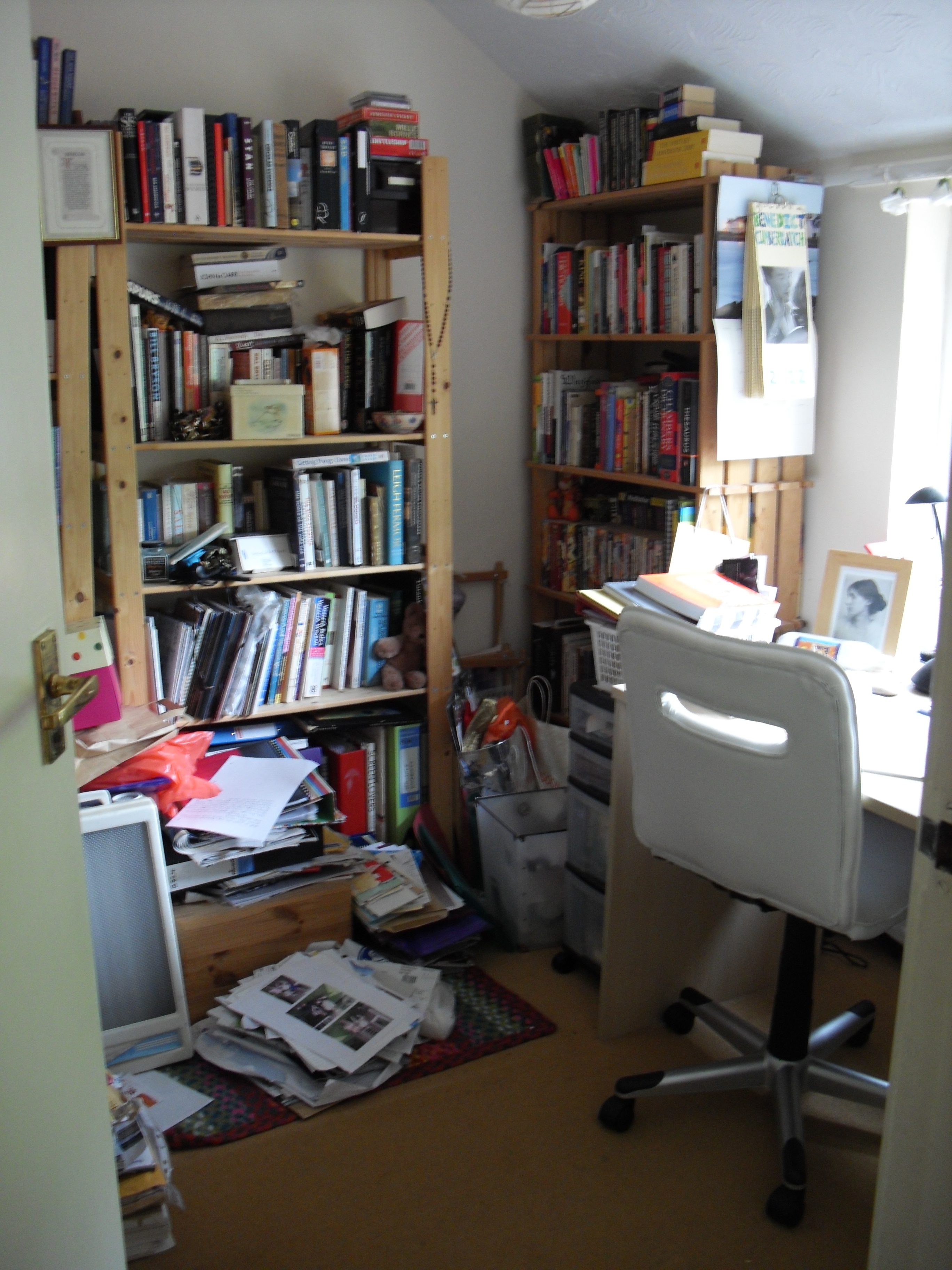
My study 1As you can see, its a mess.  Currently, it has a very nasty case of piles. (Piles of paper and junk, that is.)  The fact that it has become such a dumping ground, to the extent that I am now doing most of my writing sitting downstairs on the sofa, and I’m not doing any painting at all, is an important barometer for how much value I am attaching to my own art and writing practise.  In other words, not much.

One of my goals is to revamp my study.  This is because I need a Room of My Own.  Psychologically, I need to recognise my right to my own creative independence, and that is what my study signifies to me.  I need to make a gift to my creative self of a loving and beautiful space in which to make my dreams happen.  Its hard to claim that right, but I’m working on it.

You may not have the luxury of your own space, in which case, I sympathise because I spent many years in the same position, sharing a desk in the corner of our dining room with my husband.  (Even though he had his own office at work – not that I’m bitter, you understand!)  Still, there are ways to mark out some territory that you can call your own, a space where you feel totally free to create as you want.  That may be a corner of a shared room, the luxury of an actual studio, garden shed or study, or if you are not so territorial as I am, maybe a favourite table at a local cafe where you go to write, think or journal.

Where ever you choose, consider this space as not only a private area, safe from others, but also as sacred to your art – whatever form that takes.  When you go there, it should signal to your Artist Brain  that it is time to create.

Light candles, perhaps, and if you are so inclined, make a little altar to attract creative energy.  Surround yourself with pretty, evocative things.  Get some nice stationary and writing instruments.  A few pebbles can be delicious to handle and look at.  Make some inspiring signs to stick up, to remind yourself that you are entitled to this, that your voice is unique and deserves to be heard.  A painting that you like, objects that have emotional value for you, some nice furniture if you can afford it (I would love a comfy armchair to read in for my study), a noticeboard with inspiring images on it, wll all help to make even a small corner your own.

My Study 2In this picture of my study, you can see some of the things I cherish as part of my creative process.  (Sorry for the small lettering, I haven’t quite got the hang of Paint yet!)

I got the lovely chair for my birthday last year.  I’d never had a special, proper chair for my home office before. It still feels like an outrageous luxury!  There are fairy lights in the shape of roses around the window, which are nice when I am writing at night, as I usually prefer to.  There is my collection of books about writing, and books for reference, my Image Box for inspiration, and of course, my much cherished Benedict Cumberbatch calendar, which my adored niece made by hand for me last year.  On my desk, I keep a framed photograph of Virginia Woolf herself, because she is such an inspiration to me, both as a writer and as a person.

Try to carve out some personal space within your home environment to dedicate to your creativity.  Even if you are only able to keep your journals in a favourite tote bag down the side of the sofa to use when you can, it still counts.  It will help to enhance your creative process, and enable you to battle those critical voices that tell you your work isn’t good enough.

I’ll keep you updated on my efforts to reclaim my study from the mess and make it a place to snuggle down in to create.

Journal Friday: Motivations

Grandmas 80th

Family memories: Who are you leaving a legacy for? (That isn’t me, incidentally, its my own Grandma, and my nephew and two nieces, all grown up now.)

I became a Great Auntie for the third time yesterday.  Actually, saying that makes me sound old, and I’m not, really I’m not.  I became an aunt for the first time when I was 14, and since then my siblings have surrounded me with a reasonably sized and very rewarding family.  A big family event like this, or even just a friend having a baby, always raises a question for me, since I don’t have children of my own.

When I am gone, who will remember I was here?

I think that is one of the reasons I have stuck so dilligently to the diary-keeping habit.  The need to leave a mark,  To leave something of myself for posterity.  My diary is a record of my brain as much as anything, its change and development;  the ideas and interests I have had; the things I believe in; the problems i have struggled with and the solutions I have found.  And yes, it records my loves and losses too.

Every time I write, there is a part of me, something in the back of my mind, that is aware that one day, some beloved relative will find these notebooks and start to read them.  I don’t censor myself because of that.  Far from it, because I want them to know, fifty years down the line, who I really was, and what my daily struggles and joys actually were.

Some women keep a diary throughout their pregnancies, talking to their unborn child through the pages.  Others record their terminal illnesses so as to leave a message for their children to remember them by in later years.

Writing a diary can also be a more direct conversation with another person.  Anne Frank wrote her famous diary to her imaginary friend Kitty, perhaps so that she would not feel so alone in her wretched circumstances.  I doubt she ever thought she was leaving a legacy that would inspire people all over the world for decades to come.  For Frank, Kitty was a friend and confidante, a person to whom she could confide things she would never be able to say to anyone else.

For the most part, people write diaries and journals for and to themselves.  They may have little thought of recording ‘interesting times’, unless they are self-seeking politicians such as Alan Clark.  They write because they need to, because it helps them work things out, or simply because they enjoy it.

None of these reasons is wrong.  There are no wrong reasons.  You might think it self-important to want to leave a mark on the world, but it doesn’t make it a reprehensible motivation.   We all have our motivations for doing what may seem an apparently narcissistic activity, at least on the surface.

What are yours?

Journal Exercise:

Take out your journal and spend a few pages musing on why you write it, and whether you write to or for someone.  Journals are not meant to be read by anyone except their writer, at least not without permission, but sometimes we write with someone specific in mind.  Do you write for someone else, to someone else, or just to yourself?  Do you mean to use your writing as a prompt for other forms of creativity, painting for instance?  Or do you want to record a difficult stage in your life so that you can learn from it?  Do you want to write things down so you will remember them in years to come, or do you want to leave a record for posterity and your great-grandchildren?

If you have something to say to a specific person that you cannot say to their face, write them a letter in your diary, letting it all out.  You never have to send it, but it can help to say those things in some private, safe way.  That is what your diary is for.

If you are interested in historical diaries, you might look at The Great Diary Project for inspiration.  Other people’s published diaries can be an endless source of inspiration, and I will be writing about notable ones in future posts.  In the meantime, why not pop out to your local library or bookshop and see what you can pick up.

Happy journalling!

Flow, or How To get Out Of Your Readers’ Way

flow at Ardnave

Ardnave Beach, Islay – I didn’t have an illuminating photo of a stream, so rocks will have to do!

You’ve probably heard of Flow.  It is that psychological state of perfect concentration that we fall into when our attention is completely absorbed in something, whether it is running, painting, reading, crafting or anything else that involves us completely.

As a writer, Flow is what you are after in your reader.  You have probably felt it yourself.  Remember those books that were so engrossing that you could lose hours at a time between the pages, and not notice?

The trouble is that when you are reading, the tiniest thing can jolt you out of it – from the cat meowing for its tea, to your baby crying to be picked up, or even something as small as the rain tapping against the window.  As a writer you are up against this too-human tendency, and your job is to make sure that you do not add to the distractions.

This is why getting the nuts and bolts right is so important.

For example, have you ever come across a typographical error in a printed novel?  It seems to be happening more and more these days, and I find I notice at least one in every novel I read.  It is irksome.  It makes you suddenly aware that you are in the act of reading a book, rather being so caught up in the action that you are in it with the characters, a part of the crowd.

I have judged a number of short story competitions in my time, and I never fail to be amazed at how writers fail to take account of this. Being aware of your readers’ flow can improve your writing immeasurably, and can make the difference between a prize and publication, or languishing at the bottom of the reject pile.

Its not just about presentation – lets face it, in this digital age, your work could be presented in any number of ways, so even if you make sure you conform to the industry standard of 12 point, double spaced text, (which I would always advise) your reader may not ultimately be consuming it that way.  You can make the difference, and keep your reader in the moment, by observing a few simple rules:

1. Pay attention to punctuation.  It’s a small thing, but it makes a big difference.  Read your work aloud, and notice where you take a breath, or pause.  That’s where a comma should go.  Read a good book about it.  You can’t do better than this one.

2.  Don’t trust the spell checker.  It can’t tell the difference between ‘passed’ and ‘past’, and that little difference could be enough to annoy your reader out of their flow, and maybe give up completely.

3. Get to grips with language.  Knowing the meaning of words is really important, so don’t just take it for granted – Fanfiction writers, I am looking at you!  Just because someone else uses the word ‘ravage’ instead of ‘ravish’, doesn’t mean you have to make the same mistake! (And ‘leisurely’ is not an adverb. Grrr!)  When in doubt, look it up!

4.  Don’t use overlong sentences.  You aren’t Henry James.  Thank God.  Keep it to one or two clauses at most.  Don’t ramble.  Short sentences may increase the pace of your scene, but you can slow things down in other ways if thats what you want, through description and reflection.

5.  Don’t repeat yourself.  This is a private bugbear of mine, I have to confess.  You don’t need to use the same word three times in a three line paragraph.  You’ve got vocabulary – use it!  If you want to understand how the breadth of language can be used to write a whole book about just one thing, avoiding  repetition, read Patrick Süskind’s dazzling novel,  ‘Perfume’.  It proves you really don’t have to repeat yourself.

6. Proof read.  And then do it again.  And then get someone else to proof read for you.  Seriously.  There are so many typos and spelling mistakes (commonly referred to as ‘smelling mistakes’ in our house) that you often can’t see without help.  (And now I am having a mini-nervous breakdown that there will be typos in this article that I haven’t seen – you see, we all do it, so beware!)

These are just a few simple things you can do to give your reader a smooth ride.  If you do that, not only will they keep reading to the end, but they are far more likely to come back for more.  And thats what you want!

Happy writing!

Inspiration Monday: Images

DSCI3431

My Image Box

Writing exercises are a great way to get yourself going with new writing ideas.  Sometimes it is hard to think up something to write about, and this is where images can be really useful.  If you don’t have time to go out into the world and absorb the landscape, or you don’t feel like listening to music or doing something else that feeds your imagination, images of all kinds can be evocative prompts to get you going.

I keep an ‘Image Box’.  I buy odd postcards when I am visiting shops, art galleries, National Trust properties.  (I even drop leaflets into my image box, knowing the colours used in them can get my juices flowing, and I scour magazines and newspapers for pictures that catch my eye.)

Postcards don’t have to be of anything particular, the places and objects depicted don’t have to be of things you have seen or visited.  They just have to get you started.

When I am stuck, and need to write something fresh, something that comes clean out of the blue, I pull a random image out of my box.  Then I set the timer, and write for fifteen minutes on what the image suggests to me.

Here are a few pictures out of my box:

postcards

Postcards from my Image Box

(clockwise from top left) Sylvia Plath 1959, photographed by Rollie McKenna;   The Forest of Bowland from ‘Our forbidden land’ by Fay Godwin 1989;   ‘Silver Moonlight‘ by John Aitkinson Grimshaw (Harrogate Museums and Arts);    ‘A Norfolk Village’ by Edward Seago (Norwich Castle Museum and Art Gallery);    Sound II sculpture by Anthony Gormley, Permanent Installation in the Crypt at Winchester Cathedral, photograph by Roger Twigg.

These are all striking images, but what stories do they tell?  What do they suggest to you?

Writing Exercises:

1) Start collecting images for an Image Box of your own.  You might like to do it the old fashioned way, as I do, with postcards and pictures cut from newspapers, magazines and Sunday supplements.  Or you might like to use a digital version like Pinterest.  Whichever suits you.

(These days I also keep a private folder of images that I download from Tumblr on my laptop, which also feeds my imagination – I don’t use them for anything other than my own private use, so I hope I’m not infringing any copyright by doing so.)

Keep an eye out for anything really striking – a black and white, chiaroscuro portrait perhaps, or an arresting street image.  Whatever catches your eye.

2) When you have time for a writing exercise, get out your timer and your writing notebook.   Fish out a random image that appeals to you, set the timer for fifteen minutes, and write!

It doesn’t have to be a complete story, remember.  It can just be a sliver of description, a bit of character study, a list of traits or adjectives, or a bit of backstory.  What is going on in the image?  What is the place like? Are there people?  What are they doing, and why?  Is it a portrait like the one of Sylvia Plath above – forget who she is for a moment, and look at the image.  Why might this girl be wistful, a bit sad or worried?  Who could the person in your portrait be?  Why do they look the way they do? Or who is the person doing the looking, taking the picture?  What is their story?

Use your Image Box whenever you are stuck for something to write about.  I have got whole stories out of a single image, like this one, which I wrote from a fanart masterpiece by Marielikestodraw, the doyenne of gorgeous fanart.  You never know what might be sparked off.

Happy notebooking!