Category Archives: core practices

Help will come

Life Org kit I was working on my Life Organiser last night for the first time in a couple weeks (it’s been a hell of a couple of weeks), and the quote at the top of the page for Week 43 in Jennifer Louden’s book just jumped right out at me:

A thunderbolt illuminates your heart: it isn’t your job alone to fulfil your dreams and give birth to your yearnings. You can relax and ask for help, and help will come.

It was that last sentence that jumped off the page at me.

Help will come.

Help will come.

All you have to do is ask.

Lately, I haven’t been asking. Actually, let’s be honest here, I have the greatest difficulty in asking for anything, ever. It’s one of the hardest lessons I have had to face with chronic illness. Sometimes, you just can’t be perfect and do it all. Or maybe, do any of it. You have to ask for help.

Whether I need to ask for help cleaning the house because I’m too exhausted to push the vacuum cleaner, or I need help from my Muse because frankly, ain’t nothin’ goin’ on in my storyworld, it is really, really hard to admit I need help.

Usually, I do the passive-aggressive woman thing of wearing myself out, reducing myself to a stressy heap of tears and vitriol, and then Husband put his hands on his hips and says in a despairing tone: ‘well, you only had to ask.’

I’ve been feeling really stressed for the last few days, and not very well at all, and if I was one of those organised bloggers who writes their posts weeks in advance, I would have had a bunch of spare posts backed up to cover me for the times where my brain goes blank. But I‘m not. I’m a ‘fly by the seat of my pants’ kinda gal, and I really like being able to write what I need to write when I need to write it. I need my posts to feel current for me, otherwise they come out creaky and preachy. Or at least, I think so.

So I didn’t write on Monday. I just couldn’t.

Instead, I had a bit of a meltdown.

On Tuesday, I decided to trust to the Muse. You could say that I asked for help. I trusted that some inspiration would come along. I listened. And while I was listening, I got down to a few other things, including my Life Organiser.

Bingo!

The action became the lesson. Trust. Ask. (Keep busy while you are waiting.) Help will come.

And it did.

If you are struggling with your creativity right now, ask for help.

Maybe you just need Grandma to come and look after your baby for an hour so you can write or read a book by yourself. Maybe you need someone to hoover the carpet, which will give you enough time to do something for yourself, something creative.

Or maybe you need to ask the Universe for help, to look up to the sky and say ‘Please could you send me some inspiration, because right now, I’m a bit blank.’

Then listen.

(The listening part is the important bit.)

As I mentioned in a recent post, silence helps.

If you can’t find silence, do something that will allow your Muse to speak. Morning pages; perhaps, a walk around your neighbourhood with your camera; a few writing exercises. Do your Life organiser, or read a book. Allow yourself to be open. Make peace with your temporary stuckness, but act in a way that will allow whatever message your Muse has for you to come through.

Help will come.

Your job is to be gently open to it.

Happy Creating,

EF

Inspiration Monday: Silence

pat oxburgh b&w

Husband sitting in the partially ruined church at Oxburgh, Norfolk

I was reading the chapter on silence in Christina Baldwin’s book ‘Life’s Companion: Journal Writing as Spiritual Practise’, and it immediately rang bells for me. I have a particular reason for this. Let me explain:

One of the symptoms of the chronic illness with which I live, ME/CFS, is sensitivity to noise. Some days are better than others, but there are everyday sounds in modern life that can create physical agony for me. And no, I’m not kidding.  I mean, I get actual pain. A cold electric current feeling up and down my spine and a nauseating icy pain in the back of my skull. Unpleasant to say the least.

For the first three years of my illness, I couldn’t listen to any music with a beat at all. Every thud of bass was like a knitting needle jabbed into my neck. No pop radio, no rock, no hand jiving in the car to the Stone Roses or the Pet Shop Boys. No Elvis.  No Beatles.  Nothing.

I couldn’t listen to anything much. Mozart and Bach worked, a little Handel mixed in. Beethoven proved too noisy, as did anything after him, although I did find I could handle some Vaughan Williams. Opera was right out, so goodbye to my favourite tenor, Placido Domingo. I just couldn’t bear to listen to him anymore.

Most of the time, though, any kind of noise was painful.

So for three years I avoided places where the music was piped, and had to ask friends who listened to music perpetually to turn down their stereos, which was mortifying because they just didn’t understand.

I adjusted to a world without music.

I learnt a different way of listening.

I listened to the birds, the ones that make pretty sounds, and the ones that don’t. I learnt I could set my watch by the rooks in the tree opposite the house. (They all get together and start shouting at one another at 3.30pm, no matter what time of year it is.) They’re funny, like one of those noisy markets where everyone is shouting about their wares.  I’m rather fond of rooks now.

I learnt to hear the vegetation around me too, the creaking trees and rustling shrubs, the fresh new spring leaves and the rattle of the dried autumn ones.

And the animals. The scuttle of mice in the undergrowth, the mewling squeaks the rabbits make, the scrabble of the squirrels on the roof tiles. The buzz of the mason bees under the window in the summer, the drone and thump of the hornets throwing themselves against the window, attracted by the light, in autumn.

I came to realise how much noise pollution we endure, day after day, the constant onslaught of a life lived with continual racket, the radio, the TV, the iPod, the piped music, the slot machines, even the roar of conversation echoing in the cavernous, sound-reflecting spaces of shopping malls. And how much we use recorded sound to blot out our minds, to stop us thinking too much.

The Christian mystics said that prayer is talking to God, but it isn’t much use if you don’t listen for when He speaks back. To hear the Divine, we have to be in silence. This is just as important when the voice that speaks inside us is the big, blousy, shriek as when it is the almost inaudible whisper. The practise of creativity demands that we listen. Sometimes, we have to listen hard, and without distractions.

When did you last spend time in silence? Do you make space for a little quiet time daily? Do you relish that moment when the kids are in bed, and you can sit down at the kitchen table with a glass of wine, take a deep breath, and just listen to the noises the house makes around you as it settles for the night? Or do you fill every waking hour with a constant cacophony to drown out the voices inside your head that are telling you the life you are living is not fulfilling you?

Out of the quiet comes not only spiritual fulfilment, spoken of in all religions, but human creativity. Out of silence come the stories we tell, the fantasies and day dreams that grow into novels, plays, paintings, films, concertos and ballets.

When we cultivate stillness, when we listen, we give our brains space to breathe. And yes, sometimes we then have to face up to the uncomfortable truths of our lives. But often, we have the opportunity to tap into wells of creative inspiration previously unknown to us. Our Muse’s voice can be heard.

You don’t have to take a vow of silence to benefit from stillness, and I’m not saying you should give up the joy of music. (I’m back on it now, and believe me, its one of my greatest inspirations.)

Listen to yourself.

What I am suggesting is that you take time daily to be in stillness. To listen to the sounds of the world around you instead of filling the void with canned synthetic noise. To listen to yourself. It may only be ten minutes, or the time you spend in the bathroom every morning, or half an hour before bed without the telly on. You don’t have to meditate, although that is good too. No, this is a different idea, a way of being quiet with ourselves, a way of listening for the inspiration to come. I know you lead a busy life, no doubt, and that quiet in a city is hard to find. But I assure you, it is there. You can find it. And when you do, immerse yourself in its balm, as often as you can, and allow it to feed your creative life.

Happy Creating,

EF

Journal Friday: Returning to the Journal

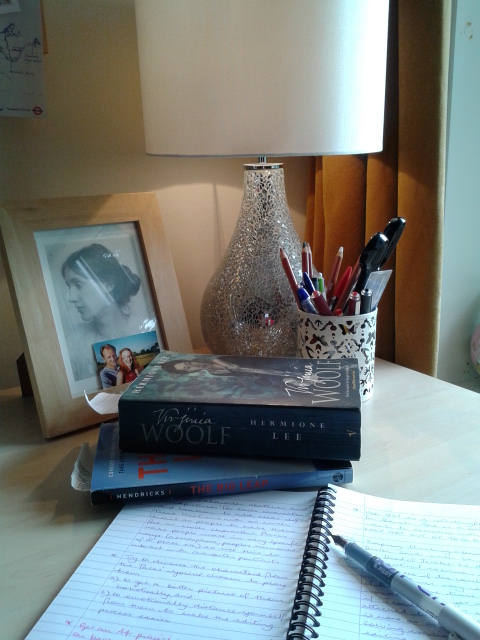
VW desktop

This time of year (autumn) is always a time of new starts for me. Husband is a University lecturer, which establishes a certain kind of seasonality in our house – we live according to the academic year, just as we have since we were kids. And on top of the usual stationery-buying frenzy I get at this time of year, I find myself stopping to reassess where I am too.

In truth, its always good to stop off on the seasonal journey to think about where you are in your life, and where you want to go. Life coaches encourage us to do this on a quarterly basis, and to be quite frank, I think it’s a good wheeze. It is hard enough to find time in a busy life to stop and think, but like the prayer bell in the monastery that reminds the inmates to focus on God at regular intervals, the seasons are an automatic prompt to stop and take stock.

This year has been a time of huge shifts for me, changes in my role as wife, care-taker, aunt, friend and woman. I have felt new currents in my creative life starting up, the drive to take my photography more seriously, the sense of a new mission, a new message in my work. It is a time of change, of departures.

Pagan theology tells us that autumn is the time to reap the harvest of what we have sown during the productive seasons of the year – not only of Spring and Summer, the active months, but also of the deep, dark percolation of the Winter that preceded them, before we go down into the dark once more, into that time of thinking, rest and meditation. We need to think about what we have achieved, assess the fruits of our labours, celebrate them, and prepare to settle into a time of productive hibernation during which we can incubate our hopes and dreams for the future.

Well, hooray for the journal, then!

I have been taking time to settle back into my journal-keeping, and to use it in a more constructed way. I have never really used the technique of guided journaling before, by which I mean writing from prompts designed to explore the psyche.   I’ve always been more of a ‘stream of consciousness problem solver’ kind of diarist. In the midst of upheaval, especially during the summer months, I find it hard, therefore, to keep up such a regular journal commitment, because it often takes time to write and write until you’ve found the answer.

Recently, though, I have decided to be more conscious about what I am doing with my diary. I have set out to explore myself and different aspects of my life in a structured way, in the hope that it will guide me to new paths, and help anchor me through the current storms. I’m using visual means too. Nothing fancy. (I’m still pretty blocked about my drawing.) I’ve been collaging instead. Gala Darling’s ‘Radical Self-Love Bible’ Programme has been invaluable with this, a plethora of prompts and eye-candy to help you explore yourself on paper, through collage and writing. I’m not much good at discipline, of course, and though I am half way through the programme now, my ‘bible’ is pretty lightweight. I tend to fall back on my familiar old notebook on a day to day basis, but Gala’s approach is challenging me just enough to make me think about where I am going with my diary, and that’s enough right now.

Journal Exercise:

This weekend, I am planning to retreat to my journaling practise and do some conscious assessment. I’m going to take time to recognise the enormous changes I have gone through, and the achievements I have made so far this year. I am going to consider my intentions for the coming dark months, and work on an emotional strategy for handling Christmas, which is always a difficult time for me. I mean to use my journal to ground myself in who I am, and who I want to be. And to think about where I am going.

If it proves a productive, positive exercise, I ‘m going to repeat it on a seasonal basis.

Would you like to join me?

Why not take this weekend, or some time during it, to sit down in a quiet place with your journal, and think about where you are in your life, and where you want to go.

  • What have you achieved in the last nine months?
  • What ‘babies’ have you birthed, literal, creative, emotional or otherwise?
  • What are you most proud of?
  • How are you feeling right now, physically and emotionally?
  • How would you like to feel?
  • What small, achievable steps can you take to move towards these intentions?
  • What flashpoints can you identify in the coming three or four months? Can you explore why they affect you? What could you do to ease your path through them?
  • How can you celebrate yourself at this point in your life?
  • What creative voices are calling you right now?

If you find the idea of a more conscious journaling practise interesting, you might like to explore Tristine Rainer’s seminal book, The New Diary.

If you want more guidance about deciding where you want to go in life, take a look at Danielle LaPorte’s The Firestarter Sessions, and The Desire Map.

Kate Courageous’s wonderful website is full of rich wisdom and worth exploring.

Happy Journaling,

EF


The Book List

Some books here are waiting to be read.

Some books here are waiting to be read.

The other day, a friend challenged me on Facebook to name the top ten books that had most influenced me in life. It was one of those things where you give your list, and then challenge your other friends.

So far so good.

But how the hell do you choose, especially as the challenge specifies you do it off the top of the head, without thinking too hard, as fast as possible. How do you choose only ten books out of all the great novels and stories you have read over a lifetime?

My list was visceral, and based largely on what I read when I was younger. I thought about the books that had made me happiest, that I have gone back to over and over again in the course of my life. And it was interesting just to reflect on my criteria for choosing, as much as anything.

So here is my list (verbatim):

“1. Finn Family Moomintroll by Tove Jansson
2. Jane Eyre by Charlotte Bronte
3. Good Omens by Terry Pratchett and Neil Gaiman
4. Lake Wobegon Days by Garrison Keillor
5. Virginia Woolf by Hermione Lee
(gosh this is hard)
5. The Count of Monte Cristo by Alexandre Dumas (kept me sane in the run-up to my wedding)
7. Antrobus Complete by Laurence Durrell
8. Persuasion by Jane Austen
9. Practical Magic by Alice Hoffman
10. Rebecca by Daphne du Maurier (obvious)”

I ended up with about 15 that didn’t quite make the grade, and if I think too hard about it, I would definitely shift a few from one list to the other.  I mean, how do you choose which Terry Pratchett?  The above was my original choice, and I think I’ll stand by it.

And then I challenged other friends. And like Japanese knotweed, lists of novels and non-fiction books blossomed out all over. Everyone had a fascinating new combination of books they raved about. Many, like Sebastian Faulkes’ ‘Birdsong’ and Camus’s ‘The Plague’, were held in common. Lots of lists were biased towards ‘we did that one at school’ books. I marvelled at the wide range of stories that had influenced my friends.

And I felt like I had barely read anything worth reading since I left college.

I suppose this is understandable. When you see a list of books, you always look for the familiar ones. And if the ones you have read are in the minority, you feel like a fool for not having read the others. Especially the significant ones. On the other hand, who the hell has read the whole of Proust’s ‘Remembrance of Things Past’, or ‘War and Peace’? (I have to say I was impressed by the number of people who had read Dostoyevsky’s ‘Crime and Punishment’. Kudos!

There are woeful gaps in my reading, despite what friends who always see me with a book might think. This is especially true these days, when I am so addicted to the quick highs offered by every morning’s new crop of fanfics. I have not read many European novels, or the Russians. I don’t know Kazuo Ishiguro or Graham Greene, Iris Murdoch or GK Chesterton. Or Kerouac, despite having a degree in American Studies. I read one book from last year’s Man Booker shortlist (Ruth Ozeki, ‘A Tale for the Time Being’), and that was because it looked like the easiest. (It was fantastic.)

Writers must read.

It is one of the basic pillars of the Craft. And you have to read the good stuff as well as the commercial, otherwise you never improve. Making this list made me realise how little decent fiction I have read in recent months. Time to get back to it.

“I mean to read myself blue in the nose.”

Virginia Woolf.

When I began my Diploma in Creative writing, we were given a list of novels and volumes of short stories to plough through as precedents, much as art students must analyse the works of the Masters, sitting in galleries for hours on end, studying Goya or Rembrandt. I found an old bookmark from those days, a list of novels scrawled on it, each title with a line scored through it as I completed it. (A couple of loose ones at the end remained unread.)

I need to do the same again.

This morning I found myself in a bookshop, gazing longingly at table after table of lovely crisp new novels. (It’s the time of year that provokes me – September draws me into bookshops still, an echo of student days of joyful bookbuying with a free conscience!) But I was good. I left the books uncaressed. I have piles of unread novels at home, you see, amongst them ‘Birdsong’, along with Tim O’Brien’s ‘The Things They Carried’, Jonothan Franzen’s ‘The Corrections’, and dozens of others, all highly recommended as quality fiction for the budding writer, and all gathering dust on the shelf. No point in buying new ones until I have ploughed through the old ones.

So I will cut a strip of paper and write a list of the books in my pile on it. And then I will begin. And each time I close the back cover a book and sigh with completion, I shall draw a careful line through the title and pick up the next.

Happy Creating,

EF


Creativity Tip of the Day – Positive People

Supportive Friends

Supportive Friends

One of the best ways to enhance my creativity that I have found over the years is to surround myself with positive people who support my work.

Sounds like a no-brainer, right?

When it comes to actually doing it, though, we often struggle.  Sometimes it is hard to let go of friendships with people who are unsupportive of our creative dreams.  So often, I have heard people say to me:

‘Oh, its so hard to get published, and there are so many people out there trying to do it.  Why bother?’

‘There’s no money in the arts.  You have to get a proper job.’

‘You need to get serious and grow up.’

‘Are you still writing your little stories?’ (This one is the most patronising I’ve had!)

None of these remarks have anything to do with your creativity, or mine.  They are all excuses from people who are afraid to take the plunge and do something creative for its own sake.

Truly supportive friends are enthusiastic.  They want to hear about your work.  They offer helpful and supportive comments.  They will offer to read your writing in a loving and constructive manner (rather than just telling you how they would have done it).  They will take your efforts seriously, and understand that you are doing what you love because you love doing it.  They will never point out how there is no money in it (not true) because they know thats not why you do it.  They will joyfully share your dreams.

Keeping positive is difficult enough in these dangerous and depleting times.  Keeping positive in the midst of a gruelling creative project is even harder.

Yes, we need to be part of a creative community of fellow practitioners of our chosen arts.

We also need to surround ourselves with friends who are willing to cheer us on.  They don’t necessarily have to be people who pursue the same creative arts as we do.  Their creativity may lie in the sciences, applied crafts or in the natural world, or in any other area.

What supportive friends do is share our enthusiasm.

Take the time to cultivate the people in your life who make you feel good about your creativity and yourself.  Find friends who are willing to get out there and cheer you on.  Cheer them on in your turn.  You will find so much creative energy in this simple lifestyle change, and I guarantee that it will enhance your world and your creative practise.

Happy Creating,

EF


Journal Friday: Smorgesbord

Diary Pile 2I’m feeling a bit rough at the moment, so I’ve been spending a lot of time surfing the internet.  Its a good thing to do when my brain is mushy like this.  I have trouble parsing long  blocks of text, so little blog posts and internet sites are just the thing to keep my mind occupied and spark new ideas.

So I thought I’d share some of my journalling current faves with you:

I just bought this book.  Its written for teenagers, but its a brilliant introduction, and I am really enjoying dipping into it.

Loving this artjournal site.  So much eyecandy!

I love Bronwen’s Artful Life blog, and I really fancy trying her method of creating an art journal from a vintage book.

Have you come across creativebug.com yet?

I recently came across the idea of the Bullet journal, which was new to me.   Its a kind of cross between a to do list, a project planner and a journal.  Might be a great solution if you are pushed for time and looking for a way of combining recording your life with planning it!

On a similar theme, you might be interested in the whole idea of sketchnoting.  Check out the website of the Sketchnote Army, a pretty breath-taking archive of how to record information graphically.  You could combine Sketchnotes and Bullet journals, and you don’t have to be able to draw…

Lorraine Bell’s planner is delicious!

My Pinterest pinboard on organisers is continually growing.

If you love Moleskines, their myMoleskine site will bend your mind!

I love Plannerisms!

Well, that should keep you going for a while!  Hope you have a happy and creative weekend,

EF


Which Notebook?

My old writers notebook

My old writers notebook

I’ve been trying to find the best way to keep a writing notebook for the last year. And by ‘right’, I don’t mean correct, I mean the system that works best for me.

I always used to keep all my notes in an A4 ringbound PukkaPad notebook, the hardback kind. I loved it. There was plenty of room on the big pages, and PukkaPad’s paper is beautifully smooth and takes ink perfectly. Their products are especially good for Morning Pages, because you can write quickly and smoothly on them.

This was fine as far as it went, but the book was too big to carry around with me easily, which meant that I tended only used it at my desk. And that meant I wasn’t noting down all the ideas I had, just the few I had when I was thinking about it. Which meant I was always trying to remember what I had thought about. And that meant, of course, that 75% of the ideas I had went AWOL. What a waste.

(I did have a baby moleskine at one point. It just felt like clutter in my handbag and I rarely used it.)

Last September, I decided I was going to get serious about my writing practise, and that meant reflecting on my notebooking habits. This was not a flattering experience.

I restarted with a cheap hardback A5 notebook, because it had to be sturdy to withstand being knocked about in my handbag. I just bought the cheapest I could find because I figured it was an experiment, and it didn’t have to be perfect. Plus, if it was too nice, I wouldn’t use it.

(That’s a trap I’ve fallen into before. Its easy to feel intimidated by a fancy notebook to the point where you can’t bring yourself to write in it, because you feel anything you do write has to be perfect. It’s a creative disaster.)

So decorated the cover so it looked like a more expensive one I was coveting at the time, and away I went.

It was really hard at first, making sure I scribbled down the thoughts I had when I had them, not trying to save them up. I added quotes I came across, stories I heard on the bus or on the radio, and took notes in book talks I went to. And I quickly filled up my scrappy little book.

And once it was full, I forgot about it.

So when I got the bug again, deciding to renew my commitment to my work, I made the mistake of going off to gorge myself on the goodies at Staples. Gods, I love Staples!


The ARC discbound notebook system from Staples.  The one on the left is a cover I made myself.

The ARC discbound notebook system from Staples. The one on the left is a cover I made myself.

And there I fell in love with the ARC discbound system. I came home with a beautiful leatherbound A5 notebook. And it is gorgeous. You have no idea. And because its discbound, I decided I would combine my notebooking with a blog planner. I printed out pages and punched then and fitted them in and moved them about. And my lovely ARC planner became so big and heavy that I couldn’t get it in my handbag. Which rather defeated the object. And the thing with the lovely leather binding is that you can’t just throw the book in the back of the drawer to await later pillaging for ideas. You feel duty-bound to keep using it. So you have to take the contents out, and then what do you do with them?

So the ARC notebook, no matter how delectable, was a notebooking disaster.

But I learnt from my failure. I now knew I needed the following:

  • An A5 notebook to fit in my handbag.
  • A pen loop would be useful.
  • Nothing too fancy, or I won’t write in it.
  • Nice paper is an incentive.
  • A sturdy binding to withstand handbag battery

So back to Staples I went.

And this time I came home with the A5 version of the Oxford notebook. It has a stiff plastic cover and is spiral bound, which means I can fold it flat over easily. Its got lovely paper. I can tuck a biro into the spiral binding and it acts as a pen loop. It is satisfyingly thick but the smallish size means I can fill it quickly, which pleases me and makes me feel like I’m making progress.

And I am using it. Every day. Filling it with thoughts and ideas and potential stories and snippets and all kinds of goodies that I know I can rummage through in future. I’m even using it to write bits of stories and dialogue for my fanfics, and bits of diary-like reflection on the writing process for my novel.

People, its working!

It goes with me everywhere, my little friend. And it is still evolving. I could probably write another post along the same lines as this one in six months’ time, and I’ll probably tell you something completely different. I think the notebooking requirements you have change with you as you go on in the craft. But for me, this is where I am now, and I think I have finally found a way to record my brain on paper in a meaningful and useful way.

I encourage you to explore using a writers notebook if you write, but to do it, too if you pursue any other kind of creative art. A sketchbook for an artist fulfils the same function. It allows you to explore your creative interior, push the boundaries of your ideas. Its useful to keep a little notebook in your pocket or bag just to scribble down random ideas and thoughts you have, regardless of what art you do.

Be gentle with yourself as you find out what works best for you. From little cardboard-bound exercise books to luxurious Paperblanks, there will be something that fits your life. Think about your lifestyle and what your requirements are. I recommend that you start cheap so you feel like you can make mistakes. There is no wrong or right. Its just what works best for you. You just have to find it.

If you want a beginners guide to keeping a writers notebook, click here.

I’ll no doubt have lots more to say on the subject in coming posts.

Happy creating, EF

Journal Friday: Solitude

Shadow Selfie

Shadow Selfie

I’ve been making huge leaps this week, but one of the results has been a deep gloom opening up inside me.  The exact opposite of the feeling of exhilaration I SHOULD been feeling when I make massive learning gains with my creativity.

(Did you notice the Bingo! word there – give yourself a pat on the back if you picked out the poisonous SHOULD in that sentence!)

Instead of bouncing around like Tigger on a coke spree, I feel like a sodden blanket.

Why?

Because writing is a solitary art.  And human beings are social animals.

Now don’t get me wrong, I’m the first to admit that I need to be on my own a lot.  I like my own company.  But there are also limits.  If I get left on my own for long periods, I get mournful, bad-tempered, sick of myself, sick of everybody else.  I start feeling like I want to stab myself in the forearms with a compass point.  This is obviously not a good place to be.

Husband has been out pretty much every night this week, playing sports and meeting up with business colleagues.  He has commitments that sometimes pan out like this, and I’m fine with that.  But occasionally it means I get a week like this one.   I’ve been on my own from eight in the morning till eleven at night for four days on the trot.  Thats enough time on my own for me to go slightly round the twist, to over-react to everything, and end up in a grumpy hole.  From whence no writing, or anything positive, emerges.

I’ve spent a lot of time struggling to get out of my grumpy hole.  “I ought to be able to get over this, I SHOULD have worked out strategies by now to combat this,”  I told myself.  (There are two Bingo! words in that sentence, can you spot them?.

But then I thought maybe the thing to do was to allow myself to feel the feeling of misery, and then perhaps it would leave.  In other words, not to fight against it, but to be with it, and see where it took me.  Because lets face it, after 44 years of living with depression, I can safely say that a) the odd blue day is a doddle compared with the major depressions I’ve experienced, and b)  I know I get this when I’ve been on my own too much, so maybe I can work out what its trying to tell me.

It turns out that its trying to tell me that I need to get out more.

I get exhausted.  That is part of my ongoing health problems, and I need to take account of that, but I also need to accept that one of the basic needs I have is for a change of scene, and seeing people.  It doesn’t necessarily have to be conscious socialising.  It can be just getting out into town, seeing other human beings in the street in their infinite variety.  Maybe two days a week would be good maintenance treatment for me.  To get out, to see the world, interract with it.  And rest at home the remainer of the time.

(I should probably point out that I live in the middle of nowhere, literally, and I can go days without seeing anybody, which can be very isolating.  We are two miles from the nearest village, not a distance I can walk, so it is not like I can just pop out to the corner shop for a natter and some social contact.  Given that we can only afford one car, and that Husband’s access to work has to take priority, getting about has to be carefully planned.)

I need to take this awareness of my own needs forward.  I’m enjoying my writing so much, but I need to take care of myself too.  And that means going in to work maybe a day or two a week with Husband, settling down at the library or the cafe, and writing there instead of at home.  So that I see people.  So that I have the stimualtion I need.

Journal Exercise:

You may not have the same ‘shut-in’ issues that I have, but I invite you today to examine the ordinary activities and lifestyle factors that help you to be creative in a regular way.  Do you need to drink more water, take regular walks, get a new chair because the one you have gives you back ache, and makes you reticient to sit in it to draw or write?  Does eating dairy give you sinus headaches so that you feel all fuzzy, and you can’t think straight?  Do you need a holiday, a long bath, a place to work where next door’s dog isn’t barking?  Maybe your partner could look after the baby an hour a week so you can have time on your own, or perhaps you need to get up an hour earlier so you can be peaceful with yourself before the rest of the family rises.

Spend some time exploring in your journal the basic things you need to operate at your best: good food, 8 glasses of water a day, cuddles, exercise, Whatever your core requirements are.

Now write about the little things that you could do for yourself that would help you to function above just the basic level of proficiency that you explored above.  Think about the times when you have been really crackling creatively.  What made those times special?  Are there factors you could replicate, to recapture that sense of being in the flow?  What really makes your motor run?  It could be listening to rock music while you work, hanging out at the cafe, carrot cake, more cuddles, or anything else.

A note of caution:  The whole myth about artists having to be self-destructive is exactly that –  a myth.  Try copying F Scott Fitzgerald or Jack Kerouac, and drinking to promote creativity, and I can guarantee what you will end up with is not increased creativity.  You will just end up being dead.

All the actions you take should be self-caring and self-nurturing.

I hope that you can uncover some new ways to nurture your creative flow, or maybe just work out how you sabotage yourself with having too much of one thing, and not enough of another, as I do.  Writing is a solitary act, but you don’t have to be on your own to do it, as I have been reminded this week.

Take care of yourselves, and happy creating,

EF

Finding the Right Place to Write

Roald Dahl in his writing hut.  From the CBBC website.

Roald Dahl in his writing hut. From the CBBC website.

As regular readers will know, me and my study have a kinda love-hate relationship. In recent months, I’ve been trying to do it up a bit, make it a nice place for me to work, somewhere that reflects who I am and what I want. Somewhere I want to inhabit. Because I really do think that it is important to have ‘A Room of One’s Own’.

The problem is that it doesn’t seem to work for me in practise.

I do most of my writing sitting in my comfy armchair in the living room, with my laptop in my lap (strangely enough!), or writing in notebooks resting on a brilliant drawingboard that I bought from The Art Trading Company. And seriously peeps, this drawingboard is brilliant, and I’m going to get another one for my bedroom so I can be comfortable when I write in bed, because I also write there a lot, especially in my journal.

Now, it has lately occurred to me that this habit was set in stone when I was just a little kid. When I was small, I had a tiny bedroom only just big enough for a not-quite-full-size single bed, and certainly not large enough to include something as luxurious as a table. As I got older, and siblings moved out, I moved into their (larger) bedrooms, but there was never really enough room for a table or desk.

Aha! But I had my trusty piece of board!

Yes, I said ‘board’. It was a thin bit of old chip board, about A3 size, and I used it for hours, sitting on my bed, for drawing and writing, as a working surface for sewing and painting and plasticine and homework, as a play area, and for all kinds of other activities. That board was a miracle. I could have it on my lap when I was snuggled up amidst the sheets, and it kept the ink from getting on the cotton as well as giving me a firm surface to work on. I loved it, and I was never without it until I left home. After that, I think my mother threw it away. But who knows, it might still be in her house, under the spare bed, along with my ‘A’ level art portfolio!

The other day, I was thinking about my lovely old piece of board as I sat in my armchair with my lovely new drawingboard on my lap, and I remembered seeing photographs of Roald Dahl’s writing hut, where he sat in an old armchair with a board on his lap, and wrote the great classic of my childhood, Charlie and the Chocolate Factory. (My husband actually knew the Dahl family and played in that hut at one time, the lucky hound!)

Nicole Kidson as Virginia Woolf inthe film 'The Hours'.

Nicole Kidson as Virginia Woolf inthe film ‘The Hours’.

Then I remembered a scene from the film, ‘The Hours’, in which my heroine, Virginia Woolf, played by Nicole Kidman, sits in an armchair by the window at Hogarth House, with a baize-covered board on her lap, and scratches out the first few lines of ‘Mrs Dalloway’ with her new pen nib. Woolf was actually more inclined to write at a high table, standing up, but the image is potent for me.

It is very nice to have a desk and a study, and sometimes, that is exactly what I need. But I am also fortunate in that I spend a great deal of time having the run of the house to myself, which means that I can write pretty much anywhere I have a suitable work surface, enough light, and where I can get comfortable. I’m not ungrateful to finally have the luxury of my own study, believe me, but having it as made me realise that really, it wasn’t necessary. I was always saying I couldn’t be a proper writer until I had a study of my own, but that just wasn’t true. I have written far more words in my armchair or my bed.

The lesson I have come upon, and the one I wish to communicate to you, Dear Reader, is that actually, once you find the place that suits you, you can write anywhere. You don’t need a study. And if you have one, as I am lucky enough to, you may not end up using it. Don’t beat yourself up about not doing so. Take Woolf’s exhortation to find ‘A Room of One’s Own’ as a wider license to find space of your own. The local Costa Coffee may be your perfect place to write. Or, as for my husband, the comfy chair by the roaring fire of your favourite pub may be just the place. Or you may indeed have your own study and revel in it. The important thing is to get comfortable and have a firm surface to write or type on, so that you are not distracted. It doesn’t matter if its in a caravan or a lorry cab, so long as your imagination can take flight. Because once it flies away to your story world, it doesn’t matter where you are.

Happy Creating,

EF

Inspiration Monday: Whats Inspiring Me Right Now

VW desktopFor today’s post, I thought I would bring you a little window into my creative mind.  Here are some of the things that are really getting my brain going at the moment.

This post from Kate Courageous really is causing a revolution inside my skull.  Imagine – learning to accept Nigel instead of kicking him?

Not practising enough?  Susan Piver has some interesting things to say about beating yourself up that are relevant whether you are talking about your meditation or your creative practise.

Found this lovely old post by Holly Becker on Decor8 about visual journals.  I really like this one about creating a lookbook too.

The New York Times on why handwriting matters.  Don’t say I didn’t tell you so.

The Handmade Home geniuses have their new 2015 planner out!  And yes, I am a total planner geek.  See also the fact that I have just discovered how Pinterest can feed my addiction!

I love Brainpickings.

I love iHanna’s blog, but I especially like this post – ‘Glue book where I collect happiness.’  Isn’t that a brilliant idea?  Collecting happiness between the pages of a journal.  Count me in.

This book.  I’ve lost count of how many times I have read this biography of Virginia Woolf, but right now, every time I pick it up, I am filled with a new rush of ideas, inspiration, and fixes for my novel.

I’m loving this book as well.

Well, that should keep us all going for a while.  Hope you have an inspired and creative week,

EF