Category Archives: Freedom to be yourself

Planning the Perfect Home Office – Progress Report

So, as I mentioned before, Husband, in his wisdom, decided that the best idea he had ever had would be for us to swap studies.  He gets the box room at the back of the house, north facing, looking over the boiler house roof and into the woods beyond.  And I get the room at the front of the house, south-facing and a little more than twice the size, with accompanying futon and a big space to lay out my yoga mat, should I be so inclined.  Yes, I will have to share this space when friends come to stay, but frankly that doesn’t happen very often because we live so bloody far from everyone else we know on the planet!  On the other hand, my new desk overlooks the front garden, with a view down the lane and across the fields to the poplar plantation, about half a mile away.  Not only is it a great view, but I can see people coming!

So far so good.

What I was not bargaining for is the sheer accretion of junk that has built up over five years of occupancy.  There are mountains of magazines to sort through, clippings to find a home for, bills to file, and then there are the hundreds of other bits I never knew had.  A bellpull made of six gaudily decorated velour camels, given by a distant-travelling cousin.  A mug from an old work project with a cartoon on it of my own design.  Sufficient packs of playing cards to run a sizeable poker tournament – we never play cards.  Tiny audio tapes from an old Dictaphone machine, now long lost.  A bag of marbles – blamed on Husband.  A slightly used Barbie doll with complete wedding trousseau.  Empty A4 clip files and notebooks galore.  And how many packets of staples does one person really need?

(I’m not even going to mention the host of dead biros, fluff and ancient receipts for distantly deceased electronic equipment.)

It turns out that Number One on the list of activities when planning your home office is:

CONDUCT THE MOTHER OF ALL DECLUTTERINGS!

Having spent long hours toiling over heaps of useless junk, diligently throwing out anything I hadn’t looked at in six months, I then went through the following process.

Start by being proactive:  Being me, I went out and got a book from the Library on how to plan your home study.  It has lots of pretty pictures.  What it does not have is a list of things you will need.  It says you must work it out yourself.

Thanks.

Question 1 in the book:  How much storage will you require?

Answer:  How the fuck do I know?  I’m a writer!  By definition, I generate vast quantities of paper! And I draw too, so double that!

Cunning Strategy:  Make sure the Husband takes on responsibility for household filing so at least I don’t have to think about that.  I hate it anyway.  He can have it in his office so I never have to think about it again.  Plus, its one less filing cabinet to fit in.

Concern:  I have all these writing notebooks that I may need to refer to as a part of my work, so they will need to be handy.  But what do I do with all the Morning Pages notebooks and diaries?  I need to keep them because they record my life, but I doubt I shall need to drag them off the shelf on a regular basis.

Hesitant solution:  Bung them in big plastic crates with mouse-proof lids and store them in the boilerhouse?  Discard on the basis that its too risky because mice are fiendishly devious little bastards.

Sneaking suspicion:  I would rather go out and spend a fortune on funky stationery than plan any of this stuff.

Probable outcome:  I will be cheap and impulsive, go out to The Range and buy a bunch of ugly stuff I don’t like instead of working out how much I need and saving for the really nice stuff I do like, and none of it will do what I want/need it to, and then I shall not want to use my new office as a result, i.e. back to square one.

Sudden flash of determination:  I am not going to ‘cheap out’ again.  I’m going to do it right this time.  Because I deserve a nice place to create.

(Sneaking suspicion and Probable outcome persist in the back of my mind.)

Intermediate action:  Go on fact-finding mission.  In other words, hang out in posh shops looking at all the kit I can’t afford but would dearly love.  Come home feeling resentful, poor and even less determined to plan sensibly than I was before.

Current state of affairs: sulking.

Yes, I would love to be able to say I went out and bought a label maker and some washi tape and now my life is complete, but it hasn’t happened yet.  I have a desk and a chair, and three bookshelves double stacked with books, and a slightly denuded pile of Sherlock clippings, but my magnificent new working space has yet to materialise.

I’ll keep you posted.

(And if you have any tips, let me know.  Please?)

EF

On Perfectionism (and Timing)

Carpet makers in Turkey weave a mistake into every carpet they produce - because, they say, only what God makes is perfect.

Carpet makers in Turkey weave a mistake into every carpet they produce because, they say, only what God makes is perfect.

A friend was trying to finish his novel.

‘So many grammatical errors,’ he moaned.  ‘So many mistakes.’

He worked so hard that he wept.  It would never be perfect.  It would never be good enough.

All this effort, two days before he was due to be married.

There is perfectionism, and there is timing.

Perfectionism is a disease I suffer from myself.  It has blocked me for years.  Nothing can ever be good enough.

I set my standards so high, I never fail to fail.  And then I look at what I have failed to do, and tell myself I am useless, and that I will never finish anything.  Without noticing (conveniently) that I have set myself up for the perfect fall.

I am perfect at this.

So it is with this blog.  It had to be perfect.  It had to be faultless.

Never mind that I have a serious chronic illness that regularly prevents me from leaving the house, which affects my cognitive function to the extent that at times I can neither read nor write, nor understand what is said to me.

The blog still had to be perfect.  And I had to post three times a week.  Regardless.

Regardless of my health, or looking after elderly, sick parents, or my husband’s workload, or my marriage, or the weather, or having to attend friends’ weddings, or making time for much-needed holidays, or anything else that comprises having a life.

Add in the blog and perfectionism and you have a recipe for disaster.  Or at least a very poorly blogger.

This is as insane as my friend trying to perfect his novel two days before one of the most important and stressful days of his life.  (And happiest, lest we forget.)

Sometimes, you have to sit down and recognise that perfectionism is a disease created by Nigel.  Sometimes you have to stop, and realise you haven’t been very realistic about what you can achieve.

And you have to move the bar.

Perfectionism and timing have combined to create the perfect storm in my life right now.  I have been going through a bout of severe illness, and just at the start of August, the busiest month of my year so far.  My mother is coming to stay for a week.  Friends are getting married, and babies are being welcomed into the clan.  The garden needs watering, and I have a craving to write original fiction that I have not felt in many months.  With limited energy, and limited time, I can only do so much.

Conclusion:  this blog cannot be perfect.  It only has to be good enough.

It only has to be here to encourage you, dear reader, on your own journey of writing and creative discovery.  It only has to be witness to my own creative process, as I try to navigate a way through illness and into producing a novel that will make my soul sing, and make you turn the page with delight.  It doesn’t need to be the be-all and end-all of teaching writing – there are plenty of other people who can do that so much better than me.

Here are my good enough dreams:

I want to write that novel.  I want to write an ebook on journaling for you, too.

WARNING: RIDICULOUS DREAM SHARE ALERT

I want to make a collectors’ edition of my novel, illustrated with my own art, for you to buy.  Yes, I know, it’s crazy, but it’s something that is calling me, and somehow I know I have to follow its siren song.  And you are supposed to share your creative dreams, aren’t you, to help make them happen?  So I am sharing my dream with you to give it some karmic weight.  (Yeah, I believe in this stuff.  Bear with me.)

I also want to be well, have a holiday, enjoy some quality time with my mum, have a happy marriage (i.e. see my husband occasionally), water the garden and, well, have a life, really.

And I don’t want either perfectionism or bad timing to get in the way.

So I’ll make a deal with you:

I’m going to blog twice a week, instead of three times.

Sometimes I might only manage once, but if I do, I want you to know that the time I haven’t spent writing a blog post for you has been spent either a) getting well or, b) working on a creative project like my novel.  Because the blog can’t take up all my creative energy.  That just doesn’t make sense.  The blog is not the purpose, it is secondary to the purpose.  The purpose is the writing.

There was a time, this time last year, when I thought I would never have the courage to set up this blog.  Right now, I am scared that I will never have either an ebook or a novel to offer through it.  This time next year, I hope I’ll have proved at least one of those fears wrong.  In the meantime, I am moving the goalposts, lowering the bar, and whatever other clichés you care to insert.

I hope that you will stick with me.  I hope that you will share my journey, and tell me about yours too.  I hope that we can learn this together, that we can kick Nigel into touch and fill our lives with creative joy.

Happy creating,

EF

Journal Friday: The Structuring Absence

elephantWhen I did my English degree, way back in the late ‘80s, Literary Theory was all the rage.  I don’t know if they even study it now, but it was the thing then.  Literary theory is the place where literary criticism, philosophy and linguistics meet.  Throw in a good handful of politics, sexual politics and psychology and you have a seething mass of academic pretentiousness that no one with a reasonable sense of humour should be subjected to.  Literary Theory goes in fashions like everything else, and the Next Big Thing then was Postmodernism, which leant heavily on Poststructuralism and the work of theorists like Jacques Derrida and Roland Barthes. We read Thomas Pynchon and Paul Auster and pretended to know what they were on about.  We were encouraged to use words like signifier (word), signified (meaning), and problematize (make something difficult).  I find it deeply satisfying that Roland Barthes’s death resulted from being run over by a milk float.  It couldn’t be more pedestrian (sorry for the pun), or ironic, could it?

Now why am I ranting on about all this pretentious bollocks when I should be talking about journaling?  Well, let me explain the one phrase that poststructuralism gave me which I still cherish today:

The Structuring or Signifying Absence

This is actually another way of saying ‘The Elephant in the Room’.  It is the thing that is never spoken of, yet which underlies and give shape to everything that happens around it.  It is the empty space which is significant, which speaks of something profound.

It is ‘that which is left unsaid.’

Take a very simple example.  In Daphne du Maurier’s novel ‘Rebecca’, the character of Rebecca de Winter and her untimely death are the signifying absence.  Rebecca structures the whole novel, and the behaviour of all the characters revolves around her, even to the extent that we never learn the heroine’s name, because Rebecca is more important in everyone’s mind, including her own.  Rebecca is a tangible presence, even though she no longer exists.

Actually, this isn’t strictly a good example because its too overt.  Take the Wooster novels of P G Wodehouse.  Set in the 1920’s and ‘30’s England, they almost never mention the Great Depression or the First or Second World Wars, and yet the fact that as readers we know that the ridiculous events are going on against this backdrop makes them all the more ludicrous.  Wodehouse does lampoon the figure of fascist leader Oswald Moseley at one point, but basically, his choice is to exclude politics.

The point of the structuring absence is this:  that what the writer chooses to exclude is just, if not more, significant than what is left in.

How does this relate to writing a diary?

I am thinking right now of gaps.  I have been keeping a journal for nearly 40 years now (ouch!), but there are plenty of gaps.  And I am sure those gaps say as much about my life as the parts where I was writing.  They usually happened for two reasons:

  1. I was having a brilliant time and was too busy living life to bother writing everything, or anything, down.  My honeymoon is a great example of this.  I was determined I was going to record every detail of our tour across the south of England, but when it came to it, I was having too much fun!  So all I have is the photos we took.  And I think that is very significant.
  2. I was in a state of such terrible depression that I was incapable of writing.  This is far more common.  There are several gaps of months in my diary during my early 20s, when I was struggling with clinical depression so profound that it threatened my life, and it was impossible for me to write at that time.  So I didn’t.

What we don’t write about in our diaries is just as significant as what we do.  Every diary entry is an act of self-censorship, whether we know it or not.  By choosing what we write about, even if the choice is unconscious, we are in fact editing, fashioning a narrative of our lives structured by our choices and the responses we have to our life events.  Just as Wodehouse chose, out of what I believe was sheer political naiveté, not to write about politics (to his great cost as it turned out), we may choose not to write about our cancer, our son coming out as gay, our struggles with debt, even though these are massive issues which shape our lives in profound ways.  We may even choose at times simply not to write at all.

When I don’t write in my diary, I am always aware that something is going on for me.  I may be in denial about some issue that is obsessing me, or I am too sick to write, which is an issue in itself.  Either way, the gaps between dates in my journal are a red flag.

But they are not a reason for self-flagellation.

When I was a kid, I thought that you had to write a diary every single day.  A lot of people believe this, but very few manage it, and most give up because of this misconception.  Don’t beat yourself up when you have non-writing periods.  Accept these empty spaces as significant, as structuring absences, and consider what they might mean for you.  Above all:

Write when you need to write.

Journal Exercise:

At the moment a big gap is developing between today’s date, and the last one I wrote in my journal.  I know why this is.  I am ill.  Staring into space or lying on the sofa watching Harry Potter yet again is about as profound as I can manage right now, and I’m okay with that.  I will go back to it when I am ready, and because I don’t make a big deal about it, I won’t be creating any blocks, so the gap will be much smaller than it would have been otherwise.

Are you creating a journal gap, a structuring absence, consciously or not?  Take some time to contemplate why this might be happening for you – you don’t have to write about it in your journal, just allow it some kind and accepting thought.  It may because you are hung up on ‘doing it right’.  It may be because there is a HUGE elephant in your life that you are simply not ready to address yet.  It may just be because you are present in your life, too busy or, what a delight, having too much fun!

Whatever is going on for you with this, make peace with it.  Be accepting of yourself.  You might even want to write something in your journal to that effect:

‘I am not writing much here at the moment and I’m okay with that.  I’ll get to it when I need to.’

You may not want to write in the ‘why’.  Perhaps that is better left until you are ready to write again.

And if you are writing regularly, and getting lots out of it, make sure you relax into it and don’t make it an OUGHT.

Happy journaling,

EF

The Writing Life: Go On Retreat

DSCI2692It’s getting to that time of year.  The sun is out, schools are breaking up, and the beach is calling.  You may have already enjoyed a holiday, or you are preparing to join friends, your significant other and/or family for a week or fortnight chilling out.

I love annual holidays, believe me.  These days, though, my system won’t handle hot weather anymore, and money is thin on the ground, so we don’t do the foreign holidays like we used to.  A week in the Inner Hebrides, surrounded by fantastic scenery (and enough whisky to entertain the husband) is the most we occasionally manage.

Holidays are great, especially if they include sun (we don’t have unreasonable expectations when we go to Scotland, put it that way!).  You can spend a week by the pool reading and relaxing, visit a few local sites, enjoy slow evening meals in a tavern while you watch the sun sunk into the azure sea.  Bliss.

But have you ever thought of taking a holiday with your creative passion?

And no, I am not talking about one of those great holidays where you go painting with a tutor in the South of France, or take tutorials with a famous poet at Arvon, although I have no doubt they are fantastic!.

I’m talking about just you and your muse.  One on one.  Taking time out for what may be the most important romance of your life.  Your relationship with yourself.

Once a year, our writers group gathers at a local conference centre in the South Norfolk countryside.  We arrive on Friday afternoon and leave on Sunday afternoon.  Three hot, delicious meals a day are provided, together with morning coffee and afternoon tea.  We each have an en suite study bedroom with bed and desk, and views across the fields.  The welcome is friendly, and you can practically hear the collective sigh of relief as we all turn inward, away from our busy lives, to concentrate on our writing.

Imagine that.  An entire weekend, just you, and your stories.

No having to food shop, cook meals, prize your angry children from each other’s throats or soothe your spouse’s ego when their team lost at whatever sport they are obsessed with.  A whole weekend where you can sleep, soak in the bath, so some yoga, walk through the countryside, listen to the birds, and pick up your pen when the muse strikes you.  There are familiar friends from the writers group to discuss your work with, to talk about writing and reading and the ideas that fill your head.  But there are no everyday worries to distract you from your work.

It doesn’t have to be expensive.  Our retreat costs around £140, which I think is pretty impressive for full board for two and a half days.  We don’t have luxury, but we don’t need it.  The luxury is being able to spend time with our stories.

Each evening, we gather together after supper.  On the Friday night, we are still settling down, orienting ourselves within the space we have set aside to be with our work.  We bring bottles of wine and soft drinks, and snacks to share.  We also bring pieces of writing by other writers from books and poetry collections that we have recently enjoyed, and take turns to read to one another.  This provides a cross-fertilisation, and a chance to reconnect.  During the weekend, we meet for meals and coffee breaks, but mostly we spend time alone, working or moodling, feeding our souls, communing with our creativity.  On Saturday evenings, we gather again, to read and workshop what we have written through the day.  And we always gather for afternoon tea on Sunday, about 4pm, to finish off and say goodbye.

Sometimes, when someone is going through a difficult time in their lives, this retreat is simply time spent with themselves, refilling the creative well.  It doesn’t have to produce anything in particular apart from a chance to ground in one’s own needs and interests, to find a bit of peace.  At other times, we come with a sense of what we specifically want to achieve, meaning to address some particular aspect of a current work, or a precise task, such as preparing a synopsis for an agent.  Having a plan is good, but its better to go with your creative season.  If you just need to down tools from a busy life and immerse yourself in creativity, that’s the thing to do.  Each of us seems to find her own need for every retreat, and we look forward to each new one from the moment we leave the last!

Even if you can’t find a group to go with, you might have a friend who could join you.  This weekend, I had the pleasure of greeting two of my fanfiction writing friends who came up to Norwich for a weekend, shared a cheap hotel room, and enjoyed a break for writing, creativity and fun.  We got together, had a meal, and shared our interests.  It was so refreshing!  Making time to go somewhere different allows you to depart from your everyday cares, and concentrate on the art form that you love.  This more informal approach might be a good way of managing a retreat for you.

I heartily encourage you to find a way to take time out for a writing or creativity retreat.  It is a practise that I think every creative person should incorporate into their process and their life.  It revives and stimulates.  It also reminds me that I am part of a tribe, however hidden we are.  It stimulates new ideas and new interests, and above all, it gives peace of mind.

So if you are planning a hectic family break right now, why not take the time to dream up a way of escaping on your own, however you do it, just you and your muse, as part of a group, or alone, to feed your soul.

Happy retreating,

EF

Journal Friday: Reflecting on Creative Blocks

paintbox

So, if you read my last post, you will know that I am increasingly drawn towards drawing and painting at the moment.  This is my current creative season and I want to honour it.  So today, no doubt, you will be expecting me to deluge you with jpegs of the beautiful pictures I have been creating.

Yeah, Right.

Nigel has been hard at work again.  I have produced the sum total of zero drawings in the last two days.  Yesterday I couldn’t even bring myself to go into the study to get out my sketchbook and paints.  The blank page suddenly seems terrifying.  I can’t even doodle.  How the hell have I lost the ability to doodle, for Gods’ sakes?

Bit not good.

This, my friends, is where the journal really comes into play.  I sat down with my trusty moleskine and pen, and thought about my childhood memories of drawing.

I used to draw all the time.  It was what I was known for, amongst family and friends.  I was never without a piece of paper and a pencil.  I made little books and illustrated them.  I wrote stories and illustrated them.  I wrote stories about my favourite TV programmes, like ‘Blakes 7’ (remember that one?  I had a terrible crush on Paul Darrow) and drew the characters all the time.  (If only I had known about fanfiction and fanart then!)  I was obsessed at one point with the Tudor monarchs, and copied their opulent portraits and clothes with fibre tipped colouring pens.  Then I got into the Ancient Egyptians, and copied their sideways style of representation.  I even copied the drawings of E.H Shepherd in the beautiful edition of Kenneth Graham’s ‘The Wind in the Willows’, which my father gave me – it was his favourite book.  And I painstakingly illustrated all my school work (except the Maths, of course, because that was too serious, which was probably why I was never any good at it.)  In other words, I spent hours absorbed in transferring images from my head onto the page.

What happened?  Senior school art classes.  Hours of drawing still lives of pots and pans. Teachers who made us draw boring subjects, and never gave us any information about technique.  I’ve learn everything I have ever learnt about art and how to use paint from copying, which my art teachers said was the worst possible sin.

(But I am getting ahead of myself, I’m supposed to be thinking about my childhood drawing.)

As a kid, art was my obsession, but it requires materials, and they were in short supply.  For paper, my dad bought home gash computer paper from work, the perforated kind that comes in a concertina, with holes along the edges, and with about the same handling quality as IZAL toilet paper.  I was occasionally bought coloured felt-tipped pens but in the 1970s they were rubbish, and the black ones were invariably dried out before they were even used.  At least 25% of the pens in the pack didn’t work within about two days of having them, and you had to conserve those that did with fiendish vigilance.  There were occasional gifts of watercolour pan boxes, but they were very low pigment, and anyway, painting in your bedroom is frowned upon by most mothers because it is messy.  And there wasn’t anywhere else to paint.  What I am trying to say is that I grew up yearning for those huge bottles of poster colour paint that stood on the trolley in school.  The thought of being able to just splash paint about willy-nilly was ridiculous.  My parents wanted to encourage my artistic side, but they didn’t have the disposable income or the mindset to invest in good raw materials for it.

The result is that the scarcity of my childhood has bloomed into a scarcity paranoia in adulthood.  As soon as I was earning, I went out and bought decent art materials, but then I couldn’t make myself use them.  I have drawers and boxes full of sketchbooks, pastels, inks and paint tubes that have never been opened because I still have the mindset that they have to be conserved.  I can’t waste a thing.  To the point where I can’t use a thing.

None of this would I know and understand, were it not for exploring it in my journal.  And in my journal have come the little glimmers of a solution, a plan to tackle my stuckness with baby steps so minute that I can fool Nigel into thinking I’m not even putting pen to paper at all!  Slowly and gently, I will con myself into the belief that making a tiny drawing is safe.  And then I will con myself into making a bigger one.  Until one day I will fulfil my dream of illustrating my own novels, and making huge abstract expressionist canvases like Rothko and Pollock.  But not yet.  To begin with, I will throw out everything I learnt in art class, scrunch up my eyes and begin again, as a child.  It will be hard, but I can do it.  I did it with the writing, after all…

Journal Exercise:

Are you also struggling with a creative block?  Is there something you used to do, and would like to do again, but are afraid to?  Perhaps you are just stuck and you can’t get out of your own way.  You probably don’t even know why.

Get out your journal and take a few deep breaths.  Close your eyes and let yourself fall backwards through time. Feel yourself become a child, doing that thing you loved do and don’t do anymore, whatever it is.  Immerse yourself in that memory.  How did it feel?  What was so satisfying, enticing, transcendently joyful or just effortless about it?  How did splashing paint on paper, sewing a doll’s dress or dancing to the radio help you express yourself?  Connect with the fun, the pleasure, the satisfaction.

Now write about it.  Take time to write out all you can remember about doing that creative activity, and take the memory from as early an age as possible.

Now take another deep breath and continue to write, this time about when you stopped pursuing that activity.  What happened?  What age where you?  Was there criticism from parents or responsible adults?  Or was it competition with other children who you regarded as being better at the skill than you?  Perhaps you reached puberty and decided that form of creativity was childish and no longer for you?  Or you felt you couldn’t go any further with it because you couldn’t make a living at it?  Whatever the reason, explore your memories of it.  Be as thorough as you can.

Give yourself some time to sit with these memories, to contemplate them.  Decide what aspects are still stopping you.  Are you, like me, fearful that your work won’t be ‘GOOD ENOUGH’ (thanks, Nigel), or still carrying that fear that there isn’t paper to waste?  Will doing this activity make you vulnerable in some way?  (If so, you don’t have to show it to anybody, just keep it for yourself.)

(If some major trauma is involved, it is wise to seek professional help.  A therapist is invaluable, and those who specialise in expressive arts or Gestalt might be just what you need.  Don’t suffer flashbacks alone as a result of this exercise.  Self care should always be the first rule of creative expression.)

Think about ways to ease yourself through these issues.  Maybe taking a beginners or taster course, where everyone will be fumbling about at the same starter level, could encourage you that what you make doesn’t have to be perfect.  Perhaps an online course that you can follow in private, and at your own pace (Alisa Burke has some brilliant art and sewing courses.)  Or you could buy some kids art materials and use them with your own kids (or borrow someone else’s for an afternoon).  Watch how kids are completely free of judgement when they make art.  They are just having fun.  You can, too.  (Actually, I think I may have to borrow some children and do this myself!)

Trust that what comes up in writing your journal is from deep within, an inner wisdom that will guide you back to your creative centre.  Above all, be gentle with yourself as your formulate your action plan, and give yourself as much time as you need.  You don’t have to become Picasso or Nijinsky overnight.

Happy Creating,

EF

Outflow: My Creativity Right Now

Picasso ceramicsWe are having a heatwave here in the UK, and I’m not very good in hot weather.  The result is that my brain has gone on strike, as has much of my body.  Which makes me think about ‘creative seasons’ and the Habit of Art.

My ongoing health problems taught me long ago to have peace with the days when I can’t do anything beyond lie on the sofa and practise my groaning. ( I’m getting quite good at groaning, I have to say.)  Chronic Illness is, however, a bit of an extreme way of forcing oneself to recognise one’s creative cycles, and not one I would recommend.

There are lots of creativity gurus who are adamant that turning up at the page, or the canvas, and making yourself do the work is the only way forward, and for the most part, I would agree.  But what do you do on the days, like today, when it just ain’t gonna happen?

Take note, that’s what.

I find my creativity goes in bursts, as I have mentioned before, and in recent years I have noticed that my writing seagues slowly into art in the summer months.  Writing is a great thing to be doing when the weather is cold and wet, and all you want to do is curl up in the warm.  In the summer, though, the urge to get out there into the landscape and experience the world is almost irresistible, as anyone who has ever worked through the summer in an office will agree.  Right now I am experiencing the difficult-to-ignore urge to paint rather than write.

And I am OK with that.

Yes, I am feeling a bit frustrated that I can’t settle to the writing projects I want to progress, but I can’t force it, or I will get resentful, and probably produce pages of complete drivel that I’ll hate later.  The urge to be creative is still with me, though.  It is just taking a different, more exterior form.  I want to draw, paint, decorate pottery, make cushion covers, garden, and bake cupcakes.  So that’s what I’m going to do – at least as soon as the weather cools down and my brain starts functioning again!

There is a tension between turning up to create and the creative seasons themselves, and the skill of a true creative is to be able to accept the difference between a) the resistance to sitting at the desk and working, which is procrastination and stopping oneself being all one can be, and b) the natural flow of creativity as it morphs from one season to the next.  There is much to be said for making yourself sit down to create every day, but using it as a stick to beat yourself with is not helpful.  We need to be aware of when our creativity transforms, and to trust it enough to go with the flow.  This doesn’t mean I am abandoning my writing for good, simply that I know that right now, that isn’t where my best work will come.

The image in my head to illustrate this is when Picasso discovered the provencale village of Vallauris and threw himself into the art of ceramics.  I have no doubt there were those who worried that his canvas days were over, but that was far from the truth.  Instead, he trusted his creative urges enough to know that ceramics was a road he had to walk at that point in his life.

So I am trying to emulate Picasso, and to be at peace with where my creative road is taking me.  It’s not easy, and Nigel has a lot to say about not having the gumption to get on with the novel, but frankly, STUFF NIGEL!  Lets get out in the sun, eat ice cream, and do creativity the way we need to right now!

Happy sun-bathing and creating,

EF

The Writing Life: Writers Groups

DSCI2689

I belong to a writers group.  And it’s great!

It all began years ago, when I started the Diploma in Creative Writing at the University of East Anglia.  It was the first writing course I ever went on.  I walked into the room and found myself surrounded by people like me.  It was the first time I ever felt like I wasn’t different and strange.  I had found my tribe.

Writing is a solitary occupation, so it is crucial for both your mental health and your work to socialise.  And what better way to do that than with other writers who are going through the same trials and tribulations as you are?

As part of our diploma course, we went on a weekend retreat, involving taught sessions, visiting speakers, workshopping and private writing time.  It was a huge success and we bonded.  Many of us went on to study for the Advanced Diploma in Prose Fiction, which was primarily a workshop-based course, and that further cemented the group.

Since then we have continued to meet, once a month, to share our work, our experiences, problems and interests.  And an awful lot of tea and flap-jacks!  Members have come and gone, buts okay.  There is a core group who have stuck together for over a decade now, sharing life experiences, supporting one another through MA courses and publication.  We go on annual retreats together, about which more in future.  We meet at each other’s houses, planning dates ahead and each offering to the host nights most convenient.  Hot and cold drinks, nibbles and cakes are provided to lubricate the conversation.

Based on the old course model, each member brings a piece of new writing that they have done, and we try to keep it to around 1,000 to 2,000 words in length – any longer and it takes up too much time.  You can read your own piece, or ask someone else to read it.  (It is sometimes really helpful to hear another person read it in order to pick out the parts where the writing is less fluid.)  Then people comment.  Helpful and empathic criticism is offered.  We always make sure we start by pointing out what we like about the piece.  Often, if it is part of a larger work, people will ask questions about plot or backstory.  Because we know one another’s work so well, we can refer back to earlier stories, or earlier parts of the work, and kick around ideas to find out what might be a useful improvement for any problems.  At the end of every participant’s session, they are asked how they feel about what was said, which gives them the chance to say anything that has been missed in the discussion.  We usually manage to workshop about three pieces of prose in a 2.5 hour meeting.

Not everyone may have something they want to read, or will have had time to write that month, and that’s okay too.  They contribute by commenting on and supporting the work of others.  We have prose writers and poets.  We share news of any courses or day schools that may have been attended, and often discuss what books everyone is reading too.

And of course, we do a lot of nattering and gossiping too.

Outside the regular meetings, we have been known to circulate work and meet informally for writing sessions.  We even do writing sessions over the phone.

I encourage you to find your own tribe.  You can do it online or in person.  Libraries and publications such as Mslexia and the Writers Digest often have small ads for writers groups.  Or start one yourself, as we did.  Make sure you are happy with the atmosphere and ethos of the group you join, however.  There is no point in sharing your work and then having it brutally cut to pieces.  Gaining confidence in dealing with confidence is one thing.  Bullying is quite another.  There are pitfalls with joining any group, but the advantages with a good one will outweigh any glitches.

My pals in the group have stuck by me through thick and thin and seven novels, and I am eternally grateful to them for their kind support and criticism.  And for banning me from using the word ‘massive’.  Sometimes you need that kind of pal.

Dear Bridget, Clare, Heidi, Nina, and Sally, I love you.

And now I had better get myself together and go and put some flap-jacks in the oven, because they’ll be round tonight and I haven’t written anything yet!

Happy creating,

EF

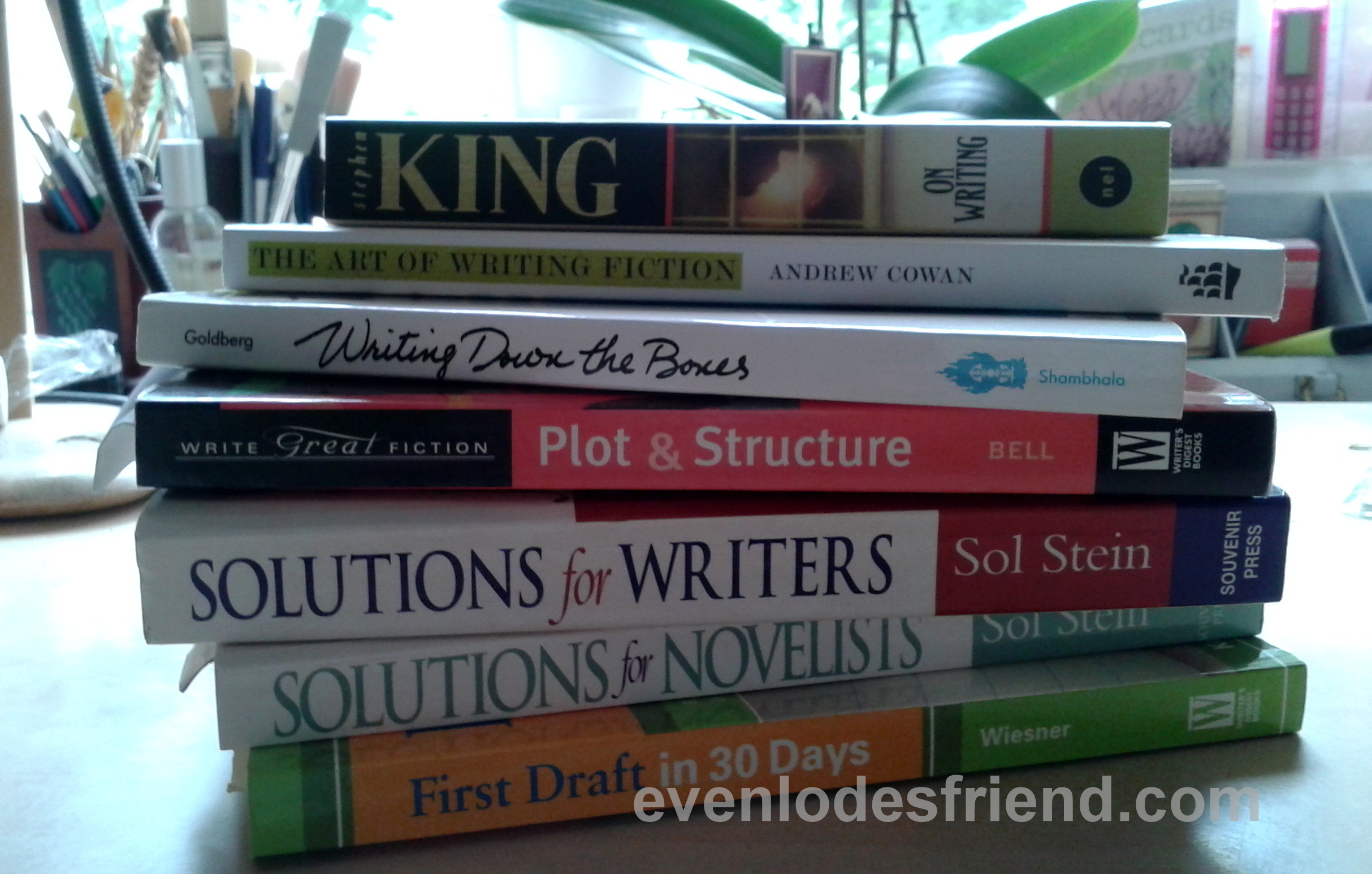
How to Write: Write what you know, or not…

writing books

Most books on how to write will tell you this:  write what you know.

If you have some major area of expertise, they say, you should use that as a background for your novels.  Dick Francis, a famous jockey, wrote crime novels set against the backdrop of the horse-racing world, with spectacular success.  John Grisham was a criminal lawyer and politician before publishing fabulously successful legal thrillers.  Agatha Christie drew on her war work as a hospital dispenser when writing her detective fiction.  All of these authors, and many more, have made huge successes of writing about what they know.

BUT –

(And the word BUT has a bit of fairy dust in it that magically negates everything that comes before it, have you noticed that?)

I once heard novelist Rachel Cusk at a reading on the subject.  She was stridently against the idea of writing about what you know.  She said words to the effect of:

‘You know, we write fiction, and the clue is in the name.  Fiction.  It means we make it up.’

Take a moment to think about this:  the genre of science fiction would never have been invented if we only wrote about what we know.  No one has travelled across the Universe of the star ship USSS Enterprise, after all.  Fancy a world without ‘Harry Potter’ or ‘Game of Thrones’?  That would be the logical conclusion.

And what about crime?  Yes, I agree there are a number of very talented writers producing procedural crime novels who have a background in criminal pathology or forensics, but how many truly great crime writers have actually personally killed someone? (None, we hope.)

‘Write what you know’ does not, therefore, take account of the most wonderful asset we have, the thing that makes human beings extraordinary amongst all the myriad of life on this planet:

Imagination

Imagination enables us to fly beyond the stars at warp speed, fight dragons with broadswords, fall in love with Benedict Cumberbatch and have him love us back.  And all in our lunch break.  Think about it –who really wants to write about their day job when they can write about this stuff?

There is, of course, a caveat.  Sometimes you need to do research.  And research is a double-edged sword on which you fall at your own peril:

I wrote a book set in London.  I have not lived in London.  I gave it to a friend to read, and he was a Londoner, born and bred.  He asked me about the car chase – Where are they?  Where are they going?  What road are they on?  He was frustrated because he knew the city well and he could not orient himself within the action.  I had not done my research and I did not know the setting well enough to wing it.  The novel collapsed for the reader as a result.

The opposite is true.  I wrote this story, set partly in Oxford, a city I know well and visit often.  I was able to undertake the depicted walk myself, just to be sure I had the details and the route right.  The result was a story that was adored by readers who knew the city too.  I had a personal email from one who was delighted that memories of her student days had been rekindled by my work.

So, getting the details right is important.  If you don’t, you can look like an idiot who doesn’t know what he is talking about, and the credibility of your story collapses.

BUT

(Fairy dust again.)

There is such a thing as having too much detail.  The first novel I wrote was set in the Iron Age, around 230BC, on the Newbury Downs.  It is not an area I know well, though I have driven through it.  And I have no background in archaeology or prehistory, so I had to research it all myself.  It took me seven years to finish it, and I gave up doing word counts after 250,000.  I knew too much.  I had too much detail – there are things I know about Iron Age saddles that normal human beings really shouldn’t know.  It’s doubtful that any reader would care.

And yes, you always get the odd accuracy fiend who emails you to say (puts on squeaky voice) ‘Er, the spoon your hero was using in scene 23?  Well, those kinds of spoons were not invented till three hundred years after the date you posit…’ etc etc.  But those are not your average readers.  Unless you write sci-fi, in which case you had damn well know your warp cores from your improbability drives.

“The best way to become acquainted with a subject is to write a book about it.”

-Benjamin Disraeli

The point I am trying to make here is this:  Ignore the advice.

Write what you want to write.

Write what you need to write.

(And if you have to, do the research.)

I promise to talk more about research in a future post, but in the meantime, do this:

Write the novel you want to read.

Happy creating,

EF

Journal Friday: Outflow – Making Lemonade

LemonsPart of being a writer is the dance of self-acceptance.

I have to deal with a chronic illness, which has radically altered my life for the last fifteen years, and shows no sign of waning.  This means I have to manage the delicate balance between self-care and doing too much.  When I overdo it, I end up exacerbating my symptoms and have to face extended periods of bed rest and being confined to the house.  Anf brain fog.

So sometimes I can’t write.  And its not that I don’t want to, its just that I literally can’t.

As I have said before, however, that doesn’t mean I’m not writing.  In my head, at least.

Sometimes life deals us lemons, and the lemonade is hard to make.  But even when I feel like I am buried under tonnes of lemons, the dream is still there.  The memory of how fantastic it feels when I am able to write, when the flow is happening and I am submerged in a scene.

This is where my diary comes in.  At times when I can process language, when I can hold my pen, I write in my journal.  It may only be a few lines, a sentence or two, but it is self-expression, getting the feelings out onto the page, and it feels fantastic.

At times when things are tough, my journal is my life raft.

At the moment, as I struggle with another period of sickness, I am working with this book.  When I have finished squeezing every drop of goodness from it, I will tell you how I got on, a little review of sorts.  In the meantime, I offer you this quote, from the marvellous SARK, patron saint of creative women, quoted by the author, Jackee Holder:

“I love journal keeping because it has helped me to discover and uncover myself, to encourage my own bravery, sort out difficulties with other people, to invent new ways of being.”

SARK, Juicy Pens, Thirsty Paper, 2008.

Happy Journalling,

EF

Journal Friday: How to write yourself out of a hole

Lighthouse at Dusk, Islay, Scotland

Lighthouse at Dusk, Islay, Scotland

(DISCLAIMER:  I am not a qualified counsellor, psychiatrist or doctor.  I am just describing what works for me.  If you are suffering with depression I urge you strongly to reach out and get help.  You do not need to suffer.)

I have suffered from bouts of depression since I was a child.  Depression is not having a bad day, or feeling blue, though both of those are unpleasant.  Depression is a soul-crushing, heart-lacerating misery that debilitates and destroys everything in its path.  Do not deny it or under-estimate it.

That said, over the years I have found ways to help myself, and believe me, helping yourself, feeling you have a little control over something that feels like it is controlling you, is a real relief.  Journaling is one of those ways.

So what to do if you find yourself at the bottom of the depression mine shaft?  Or even if you are just having a bit of a black dog kind of day?

How to:

Get out your journal.

Write down how you are feeling RIGHT NOW, in this moment.  As my counsellor often says, you can’t get to Edinburgh if you don’t know where you are now. (Think about trying to plan a journey that way – impossible!)

Be specific.

Stop and take the time to feel what is going on inside your body.  Do you have particular sensations associated with this low mood?  If so, where are they?  Write them down. They may be indicative of trapped emotions.

How are you feeling emotionally?  Write that down too – a list of adjectives if that is all you can face doing.

Does an image that describes how you feel come to mind?  Describe that.  For example, for me a real, deep depression feels as if my ribs have been ripped open, and my heart repeatedly slashed.  I feel it bleeding inside my chest.  Yes, it is a horrible image, but that is exactly how I feel, and describing it, in as much detail as possible, can be a huge relief.

Do not judge your feelings as you record them.  Do not judge yourself as selfish or unfeeling because you resent the fact that your husband is not doing much to help with your crying baby, or that you are angry because your boss does not recognise how hard you are working..  Have a good rant, safe in the knowledge that you don’t have to protect anyone’s feelings.  You are not being a martyr or a victim at this point.  You are just recognising how you feel.  Do not feel bad about what you write.  Admitting these feelings exist to yourself is the first step to healing, and no one else is going to see what you write.

If you don’t feel anything, write that too.  An absence is just as important.  Describe the void in as much detail as you can.  You may even find, as you progress, that you begin to pick up on little gimmers in the abyss, feelings you didn’t know were there.  Write those too.

As you write, you may find other feelings coming up from underneath the ones you are describing.  Get those down.  I often find that underneath my depression is anger, and underneath the anger lies a need not being met.  When I identify what it is I want that I am not getting, I am right in touch with the small child inside that feels unloved, whose needs went unmet.  Do not judge the need.  Simply recognise it.  Is there a way you can get what you need now, in a healthy way?  Now you know what it is, you can ask for it.

Whatever else you do, try to write daily, and get whatever miserable feelings you are having onto the page.  Once you have let them out, keep writing.  You may find more positive stuff coming through behind, and perhaps even ideas of things to do to help, comfort and console yourself.

Above all, be gentle with yourself. 

Show yourself the same compassion you would to a friend in need. (We often don’t do this, conditioned as we are to berate ourselves for the smallest failing.)

What next?

This is a process of continuing orientation and expression.  If you were on a cross-country walk, you would stop regularly to check your map and compass, to be sure where you were, to work out which was the next direction to take.

In the same way, depression is a long journey.  You need to be taking your own emotional temperature, checking your compass, as regularly as possible.  So make time to write often.

In my last spell of depression, I worked in my journal like this three or four times a day, for several days, then continued on a daily basis long after.  That probably sounds like quite a lot of effort.  On the other hand, you might take a pill three or four times a day if told by the doctor that it would make you feel better.  And this will make you feel better.

Why?  Because it gets the toxic feelings out of your body and mind, and puts them somewhere else – onto the page.

NOTE:  Do not reread what you write when you are still ill, or at all.  That would be ruminating on your feelings, and will encourage you to judge, feel guilty or ashamed.  Just get it down.  You are looking for TRUTH, not BEING GOOD.

You may find it helpful to write on loose sheets of paper, rather than in your journal proper.  This way, you could opt to burn the pages, ritually releasing the feelings, and freeing yourself.

Whether you are in the midst of a long bout of clinical depression, or just having a low spell, I encourage you to try this way of journaling.  I hope that it will help you to release your pain and move back into the sunshine.

With love,

EF