Category Archives: Self care

We NEED to Look After Ourselves

I was going to write some informative writery stuff this morning, but actually, after the week I have had, I feel like there is a pressing need to say something crucial:

We Need to Look After Ourselves

A dear friend of mine wrote in her blog yesterday about how she forgets to take preventative meds for her migraine when she doesn’t sleep well, and the result is, well, a migraine.  She rants in her post at herself because this miserable agony of a head storm is totally preventable.  And I really sympathise.

Because I am lying in bed right now, typing upside down on my laptop because my back is wrecked and my stomach is a painful disaster.  Both entirely preventable conditions.

1) I haven’t done any really consistent yoga since I had flu last Christmas.  I was so ill, and it took me so long to recover, that exercise didn’t seem possible.  Besides, writing has been my priority, so everything else took a back seat.  As a result, I have lost the muscle mass, flexibility and strength inside my torso that is really needed to hold me up and make my limbs work effectively.

2) My posture is just appalling, and it isn’t helped by hunching over in an inadequate office chair at my desk, or slouching on the sofa for hours on end, typing.

3)  I carry the majority of my stress in my spine, which means neck and shoulder pain unless I take time to release the tension by relaxing or stretching.

4) Its so easy to eat rubbish.  I have a delicate gut that is sensitive to all kinds of crud they put in food these days, and I have to be so careful.  But being careful is pretty much a full-time job, and I would rather be writing.  And I can’t be bothered much, either.  I mean, that chocolate ring donut?  Why not? Just one wouldn’t hurt, would it?  So I’m not careful, and then I develop terrible stomach pains, and then I can’t write. (Are you starting to see the pattern here?)

5)  Stress and anxiety play a big part in my ill health, and I know I am better when I meditate.  But I don’t.  Because it takes time, time when my brain isn’t in its dream world, playing with gorgeous men and exciting stories, and generally having more fun than in real life.  I don’t want to expend the energy on being away from my fantasies.  But when i don’t tackle my tension, I end up with debilitating headaches, back pain, anxiety attacks, insomnia and stomach flair-ups.

None of this is rocket science, as they say.  I know what does me good, but I compulsively and consistently fail to do it.  And judging by my friend’s blog post, and comments from others, I am not the only one.

Lying on my back on the bed this week, working my way through various ‘back care’ books gleaned from the library for research, it became clear to me that this back care thing is a lifelong commitment.  It requires me to be present at every moment in my body, to think about the way I stand, move, sit, lift, twist and bend.  It means getting up from my desk every 20 minutes to move around and release muscles.  It requires learning how to sit and stand correctly.

And my guts?  Well, me and my innards have been fighting a war of attrition for four decades, but I think I can say without doubt that these days, my innards are winning.  They need to get what they ask for, because if they don’t, they stop me doing what I want to do.  So I need to commit to making and eating clean, healthy, nondairy, gluten-free food AT ALL TIMES, not just when its convenient.

I know this.

What I didn’t realise is that these commitments are actually part of my commitment to being a writer.  It is as much my job to look after my body and keep it healthy and functioning as it is to back up my computer or buy ink cartridges for my fountain pen.  All that stuff about writers drinking themselves into cirrhosis and death to write great novels is frankly, and not to put too fine a point on it, bollocks.  I’ve been in pain for the last fortnight, and believe me, it isn’t fun and its not a life plan I want to pursue!

The body is not just transport, as dear Sherlock likes to point out.  It is the foundation stone of our beings, and foundations have to be strong and sure to support the growth,power and creativity of which we are all capable.

So here is my commitment:  I am writer.  That means writing.  And it means creating an environment in which writing can happen, both within my home and within my body.  It means my writing MUST be embodied.

I am making self-care part of my job.

(Because if I don’t, the rest of the job can’t happen.)

Happy Healthy Creating,

EF

Preparing for a Writing Retreat

I’m so excited.  I’m going on a writing retreat!

This weekend, my writers group is convening at a nearby conference centre for a weekend of writing and eating and talking about writing and eating some more, and maybe a little bit of dozing or walking, and then some more writing.

We normally do this once a year, but this year, we enjoyed ourselves so much we thought we’d do it again at the end of the year.  So here I am, thinking about a weekend spent solely with my friends and the Work.

Over years of doing this, I’ve found I need to do a few things to prepare myself so that I get the most out of the time:

Plan:

I usually like to sit down with my writers notebook or my journal, and think about two things:

  • where I am, and
  • where I want to be.

This year I am thinking about the goals or intentions I have set myself for this website, for my publications, and for moving my writing on to the next level.  Its one of the few truly extended, uninterrupted periods I get to just write, so I like to choose a project that I can get my teeth into, but also one that really needs to be tackled.   Something pressing.

This year, I am toying with the idea of doing NaNoWriMo, because I want to crank out a novel as fast as possible.  So I have decided to lay the groundwork on this new idea, and throw myself into it, immerse myself in it as much as I can.  In previous years, I have redrafted novels or short stories, polished specific sections of a novel, worked specifically on character, or redrawn a dodgey plot.

My goal this year is especially fuelled with the knowledge that I need to be writing something original, something other than fanfiction.  Nothing wrong with fanfiction.  Its given me marvellous confidence in my work, and I love writing it.  I just think I need push myself, to do something new.

Manage expectations: 

I’m not going to finish an entire novel in a weekend.  I may even get no further than writing 500 words.  And I am okay with that.

When I first started going on retreats, I had HUGE expectations of myself and what I could achieve.  I thought I could crank out 20,000 words in two days, a third of a novel.  I thought I could create publisher-ready prose.  The truth is that even on retreat, there is only a limited amount of time, and making really good prose takes time.  A lot of time.  I have only learnt this with experience.

There have been several retreats where I have slept badly on the first night, or felt ill, and as a result have really been unable to do anything much at all apart from eat, sleep, talk with my fellow writers, and be.  Sometimes that is what a retreat is for.  I have gained from those experiences.  These days I am ready to allow my retreat to be whatever it needs to be, and to trust that whatever happens is part of the process.

So I make plans, but I don’t get too attached to them.

Be present:

Being aware of my physical wellbeing is very important on retreat, and not simply because I suffer from chronic illness.  I need to be present in my body, so I do yoga and meditate, go for walks, stand in the shower and feel the water on my skin, and take naps.  (One friend uses the annual retreat to undulge in long, hot, scented baths because she doesn’t have a tub at home!)  This might all seem time away from writing, but it is crucial.  Self care is part of retreating.  Doing these things allows me time to think about the writing, to form scenes and sentences in my head.  But it also allows me to come to the laptop refreshed afterwards.  So it is an investment in my writing, as well as my body.

Packing: 

As a result, packing right is really important.  I always make sure I take warm, snuggly clothes, my yoga mat and yoga clothes, a hot water bottle, walking boots and, on occasion, even a teddy bear for cuddling purposes.  And because I have weird dietary issues, I make sure I take an extra supply of good, healthy foods and my favourite herbal teas too.  The centre staff are really great in catering for my diet, but there are those in-between-meals moments, when what you really need to fuel the Muse is your own favourite brand of chocolate!

Be absent: 

I get very anxious when I am away from home.  I need to be grounded in my safe environment in order for my imagination to work properly.  It helps that we have been going on retreat to the same place for years, and also that it really isn’t very far from my own home, so I feel like I am on home turf.  Other people find their imagination is stimulated by unfamiliar territory.  Mine just shuts down so that my emotional system can cope with the panic attacks.

To counter this, I take music and listen to it doggedly in order to transport me to safe psychic territory.  I put on my headphones, close my eyes and fly away.  And then I can write.

It is a major diffence to how I normally write, which is in silence.  So part of my preparation ritual is to gather music around me.  I make playlists for different characters, delve into iTunes and my CD collection,  choose music that evokes particular memories or landscapes for me, or none at all.

Allow it: 

Going on retreat is supposed to be calming, an activity to feed your soul.  Its supposed to be downtime from your usual life.  As a result it is easy to get really wound up about how good it is going to be, and then find yourself disappointed.  To feel like you just aren’t calm enough, or getting enough done, or maybe even that you are wasting time that should be spent looking after the kids, doing the washing or writing that sales report.  This harks back to managing expectations.  But it also has a deeper meaning.

you are allowed to have time to yourself

You aren’t being selfish.  Leave all your SHOULDS and OUGHTS at home.  You deserve to have this time spent solely with yourself, doing something you love.  I continue to struggle with this.  I tend to make retreat a time which is about productivity rather than identity – about being myself and giving myself what I need.  When you accept retreat as a gift to yourself, managing expectations becomes easier.  And that precious dimension of writing that no one seems to talk about – moodling – becomes possible.  Have a weekend’s moodle.  Because you are worth it.

I heartily recommend going on a retreat if you can manage it.  Maybe for a day, or even overnight.  Maybe just for an afternoon.  If you are looking for ideas and guidance, I also recommend Judy Reeves’ wonderful ‘A Writers Retreat Kit:  A Guide for Creative Exploration and Personal Expression’, which I ordered recently from Amazon in preparation for this weekend.

Now I had better get back to my packing!

Happy writing (and moodling)

EF

Outflow: Stand Still and Listen

Shadow Selfie

Shadow Selfie

You didn’t get a post this morning.  You got an empty space where your post should have been.

Sometimes, life gets in the way.

Best Laid Plans, and all that.

I am in The Red Tent.  My Moon Palace.  The Painters have arrived.  Auntie Flo is in town.  And all the other euphemisms you can think of. A weekend spent caring for my elderly and very frail in-laws followed a busy week, alongside a developing cold, has caught up with me, and now my period has arrived.  And there is no juice left.  Nothing spare.  All I can do is lie here and contemplate.  Try to withstand the OUGHTs and the SHOULDs that are crowding my brain right now, pointing their fingers in accusation because of all that is left undone.

Learning to stop is the hardest thing about my illness.

At primary school, our teachers utilised a very simple form of crowd control.  On the first day, we were instructed about the first rule of school.  If the teacher says ‘Stand Still and Listen,’ thats what you do.  You stand where you are, don’t move.  You open your ears and your mind, and wait for the next instuction.  This was ostensibly about the need for safety, but it also meant that we learnt to pay attention.

Over the years, I have forgotten the importance of ‘Stand Still and Listen’.

Today I’ve been wondering whether ‘Stand Still and Listen’ is what my ME is here to teach me.

To listen to my body.

To listen for the pain.

To listen to my life.

To listen to the world and the people around me.

To be still, and know that I Am.

I will be gone soon enough.  We all are, eventually.  Better make the most of it while we are here.  But that doesn’t mean a frenzied whirl of activity, filling every moment with busyness because we are afraid of death.  It means savouring the moment, being mindful of NOW.

I am sure I have spoken on this theme many times on this blog, and I will do so, no doubt, over and over again in future.  I struggle to learn this lesson every day.  And yet, as a writer, I need to Stand Still and Listen even more than most other people.  Because if I do not observe the world around me with quiet reverence, if I do not record it with compassion and objectivity in my mind and in my notebook, then how can I record it in my stories?  How can I make my story worlds into believable places?

Whether you are a writer, an artist, or any other sort of creative, or whether you are someone who does not see themselves as such, take the time over the next week to practise Stand Still and Listen.  Whether you actually physically stand still or not is up to you.  But take a moment to be still and aware, a moment or a day or a week, or however long you need.  Take stock.  Be in the moment.  I promise the world will grow and deepen for you when you do.

With love from the Red Tent,

EF

Journal Friday: The Emotional Swingometer

go away bagThe Creative Life is a carnival ride.  Don’t let anyone tell you otherwise.

Right now I am on the rollercoaster.

Thank goodness for my diary.  If it were not for that little Moleskine notebook, I would be a complete basketcase.  Actually, I’m probably still a complete basketcase, but I feel better about it, because I write it all down.

The days when I am completely sure I have squeezed every last drop of juice out of Johnlock.

They days when I can’t stop writing Johnlock.

The days when I have so many ideas for stories that I don’t know what to do with them all.

The days when my imagination is a barren wasteland.

The days when one comment has convinced me that my work is utter crap and I owe it to the world to never write again.

The days when a stroppy comment has filled me with so much anger and resentment and martyrdom that I am going to passive-aggressively hold the entire fandom to ransom by never publishing another Johnlock story again because frankly those bitches are all so ungrateful.  (as if they’d even notice.)

The days when that novel I am writing is the greatest thing ever written.

The days when that novel is so bad I am ashamed to even walk into the same room as my laptop.

The days when reviews flood in, and I am Queen of the World and Goddess of All Writing and my ego is the size of Jupiter.

The days when the reviews flood in, and they just aren’t praising me enough, they’ll never say enough good things about me because I am so bloody wonderful, which of course means that secretly I know without doubt that I am an absolute fraud and completely useless.

The days when the reviews flood in, and I am cowering under my desk in shame that anybody could think that story I wrote is readable.

The days when I am satisfied because I have written something that I think is good.  Good in the way that tapping on solid mahogany with your knuckles is good.  Something that is out of my own real, original voice.  Something that I am satisfied with.

The days when the fandom bores me to tears, or irritates the hell out of me, and so does my writing.

The days when I know my writing is completely stagnant, and I need to progress onto the next stage but I don’t know where to start.

And the days when I just sit down and write.

Before, or after I have written some fiction, I take a little time to reflect.  Sometimes I write in my journal to get my juices flowing, the way Morning Pages are supposed to.  Sometimes I write afterwards, to reflect on where I am going, on my emotional equilibrium (or lack of it).

Usually, when I have published a story, I watch the comments coming in, and try to write through my responses, the paranoid ones and the egotistical ones, the happy, the grateful and the furious.

My journal helps me keep my writing experience in perspective.  There isn’t a lot of perspective about our own creativity, lets face it.  We are all reared to be perfectionists, to rule ourselves out in the basis of not being Picasso, or to believe ourselves to be Dickens without needing to do the hard work.  It is so hard to be objective.

My journal helps me remember that the only life I am saving when I write is my own.  In the great scheme of things, this is not battlefield surgery.  Or, if it is, it is on my emotions alone.  That is why objectivity is important.

I need to remember that my writing is not about what other people think.  It’s about me.  At its very core, it is about healing my own wounds. 

Even if I never publish another word, I will still keep writing, partly because it’s a compulsion, and partly because it mends my soul.

That is why keeping a journal is crucial for every creative person, whether you are amateur or professional.  It reminds you of the WHY.

How do you use your journal in your creative process?

Happy journaling,

EF

Smorgesbord

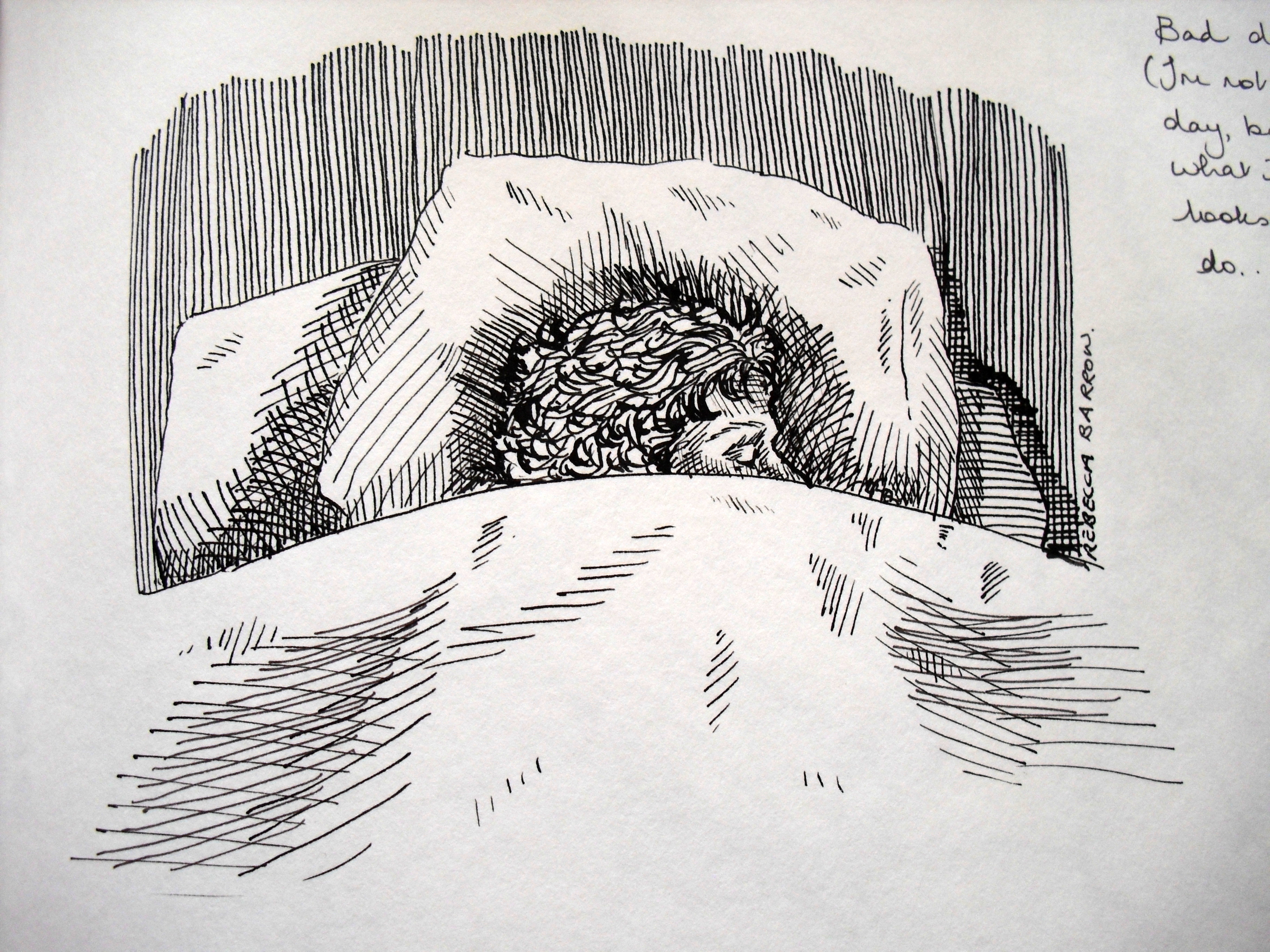
sleep sketchI usually try to post on a Monday, Wednesday and Friday, but this week’s Wednesday post got missed because I was ill.  I’m still ill, but my brain is slightly clearer today and I am giving myself to thinking time.

Thinking about future posts for this blog.  Thinking about writing and notebooking.  Thinking about art.  Thinking about clearing space in my life for more creativity.  Its a luxury I have to lie in bed and consider which direction I am going in creatively, and I recognise that.  Few people get that option.  I may be feeling terrible, but I’m enormously grateful I can use this time to be present with my work.

I thought I’d share a few things I have been mulling over with you.

Here are the thoughts of Elmore Leonard on writing, an enormous inspiration.

Here is Stephen King, saying illuminating things about both ‘The Shining’ and about the attitude of critics, something I really needed to hear this week.

Talking about critics, Jack Vettriano has been savaged by the art establishment over the years, but now he’s having a retrospective at the Kelvingrove.  Oh, the irony!  (And lets just remind ourselves that this man is self-taught, which may be why critics hate him so much.)

If you are interested in art, check out this site.  I love its brightness and enthusiasm.

I want to do this course next.

And to end, a little light reading.  I’m pursuing a new project of short stories and vignettes which explore life inside an established relationship through fanfiction.  The series is called ‘Geography of a Shared Life’.  You can read my latest piece here at A03, and here at FF.net.

Happy creating,

EF

The Wild Donkeys: A Strategy for Choosing a Creative Project

donkey

‘So, how’s the writing going?’

This from a man who is one of the Blessed Few.  A writer whose work was picked up by an agent straight from the much garlanded MA in Creative Writing at the Unversity of East Anglia.  Alumni include Ian McEwan, Rose Tremain, Hanif Kureshi, Tracey Chevalier and, well, you get the picture.  He is in glittering company.

He is also a really lovely man and a dear friend who takes a genuine interest in my work, so I rein in the envy monster and give him the polite and honest answer.

‘Fine.  Well, actually, I’m a bit stuck.’

‘Creative block?’

‘No, too many ideas.  I don’t know where to start.’

‘You should be writing a novel, you know.  I read some of your Sherlock stuff the other day.  It’s really good.’

‘Thank you.  I’ve written seven novels so far.  Writing a novel isn’t the hard part.  Its choosing which one to write that’s difficult.’

‘Well, just pick one and start.’

I love men.  Everything seems so easy to them.  And they are so good at handing out really practical advice.  (You’ll also notice that I don’t ask him how his novel is going.  That’s because I know.  I recognise that pained look.  I’ve seen it in the mirror too many times.)

OK, I know its good advice.  The right advice.

As Leonie Dawson puts it, I need to choose a wild donkey and ride the shit out of it till its done.

Every writer has a place where they habitually get stuck.  A psychological Marianas Trench on the road to getting their work into the readers’ hands, one that they tumble into every time.  For some it is grinding the words out, which for them is like sweating blood.  For others, it is coming up with the idea in the first place.  Some worry when they get to the middle because that’s always where they get bogged down, and some will spend ten years writing the first page.  We all have our Achilles’ heel.

For me, its choosing which idea to stick with.

So I have decided to take September off.  Not from writing; quite the opposite, in fact.  No, I’m taking the month off from worrying which novel to concentrate on.  I’m in a physically stuck place right now, and I need to concentrate on my health, on getting my body moving again after a summer of boom and bust energy.  I’m looking to create a smooth, even flow in my life, in my health, and my art.  I have faith that if I can manage to attain a relative level of consistency in my body, the answer will come to me.  Yes, maybe that sounds mad, but its just how my creative process works.

And in the meantime, I’m refreshing my theory knowledge, reading, working on my notebooking, and bashing out some major fanfiction.  I’m easily distracted, and having short stories and novellas on the go is a great way to handle that.  But sooner or later, I want to create something major.  Something big.  Something that shows both me and you, dear Reader, what I can really do.

Happy creating,

EF

On Perfectionism (and Timing)

Carpet makers in Turkey weave a mistake into every carpet they produce - because, they say, only what God makes is perfect.

Carpet makers in Turkey weave a mistake into every carpet they produce because, they say, only what God makes is perfect.

A friend was trying to finish his novel.

‘So many grammatical errors,’ he moaned.  ‘So many mistakes.’

He worked so hard that he wept.  It would never be perfect.  It would never be good enough.

All this effort, two days before he was due to be married.

There is perfectionism, and there is timing.

Perfectionism is a disease I suffer from myself.  It has blocked me for years.  Nothing can ever be good enough.

I set my standards so high, I never fail to fail.  And then I look at what I have failed to do, and tell myself I am useless, and that I will never finish anything.  Without noticing (conveniently) that I have set myself up for the perfect fall.

I am perfect at this.

So it is with this blog.  It had to be perfect.  It had to be faultless.

Never mind that I have a serious chronic illness that regularly prevents me from leaving the house, which affects my cognitive function to the extent that at times I can neither read nor write, nor understand what is said to me.

The blog still had to be perfect.  And I had to post three times a week.  Regardless.

Regardless of my health, or looking after elderly, sick parents, or my husband’s workload, or my marriage, or the weather, or having to attend friends’ weddings, or making time for much-needed holidays, or anything else that comprises having a life.

Add in the blog and perfectionism and you have a recipe for disaster.  Or at least a very poorly blogger.

This is as insane as my friend trying to perfect his novel two days before one of the most important and stressful days of his life.  (And happiest, lest we forget.)

Sometimes, you have to sit down and recognise that perfectionism is a disease created by Nigel.  Sometimes you have to stop, and realise you haven’t been very realistic about what you can achieve.

And you have to move the bar.

Perfectionism and timing have combined to create the perfect storm in my life right now.  I have been going through a bout of severe illness, and just at the start of August, the busiest month of my year so far.  My mother is coming to stay for a week.  Friends are getting married, and babies are being welcomed into the clan.  The garden needs watering, and I have a craving to write original fiction that I have not felt in many months.  With limited energy, and limited time, I can only do so much.

Conclusion:  this blog cannot be perfect.  It only has to be good enough.

It only has to be here to encourage you, dear reader, on your own journey of writing and creative discovery.  It only has to be witness to my own creative process, as I try to navigate a way through illness and into producing a novel that will make my soul sing, and make you turn the page with delight.  It doesn’t need to be the be-all and end-all of teaching writing – there are plenty of other people who can do that so much better than me.

Here are my good enough dreams:

I want to write that novel.  I want to write an ebook on journaling for you, too.

WARNING: RIDICULOUS DREAM SHARE ALERT

I want to make a collectors’ edition of my novel, illustrated with my own art, for you to buy.  Yes, I know, it’s crazy, but it’s something that is calling me, and somehow I know I have to follow its siren song.  And you are supposed to share your creative dreams, aren’t you, to help make them happen?  So I am sharing my dream with you to give it some karmic weight.  (Yeah, I believe in this stuff.  Bear with me.)

I also want to be well, have a holiday, enjoy some quality time with my mum, have a happy marriage (i.e. see my husband occasionally), water the garden and, well, have a life, really.

And I don’t want either perfectionism or bad timing to get in the way.

So I’ll make a deal with you:

I’m going to blog twice a week, instead of three times.

Sometimes I might only manage once, but if I do, I want you to know that the time I haven’t spent writing a blog post for you has been spent either a) getting well or, b) working on a creative project like my novel.  Because the blog can’t take up all my creative energy.  That just doesn’t make sense.  The blog is not the purpose, it is secondary to the purpose.  The purpose is the writing.

There was a time, this time last year, when I thought I would never have the courage to set up this blog.  Right now, I am scared that I will never have either an ebook or a novel to offer through it.  This time next year, I hope I’ll have proved at least one of those fears wrong.  In the meantime, I am moving the goalposts, lowering the bar, and whatever other clichés you care to insert.

I hope that you will stick with me.  I hope that you will share my journey, and tell me about yours too.  I hope that we can learn this together, that we can kick Nigel into touch and fill our lives with creative joy.

Happy creating,

EF

Outflow: What the **** am I doing?

new study deskYou may have noticed that yesterday was Wednesday and that it was eerily quiet here at Evenlode’s Friend.  Oops.

Its not that I wasn’t thinking of you, believe me.  Its just that, well, I won’t go into too much sordid detail here, but there are some stomach complaints that leave little room for writing blog posts.  Yes, I was ill. I still am.  I’ve been hit by a particularly nasty bout of IBS, and its going to take some time to settle things down again.

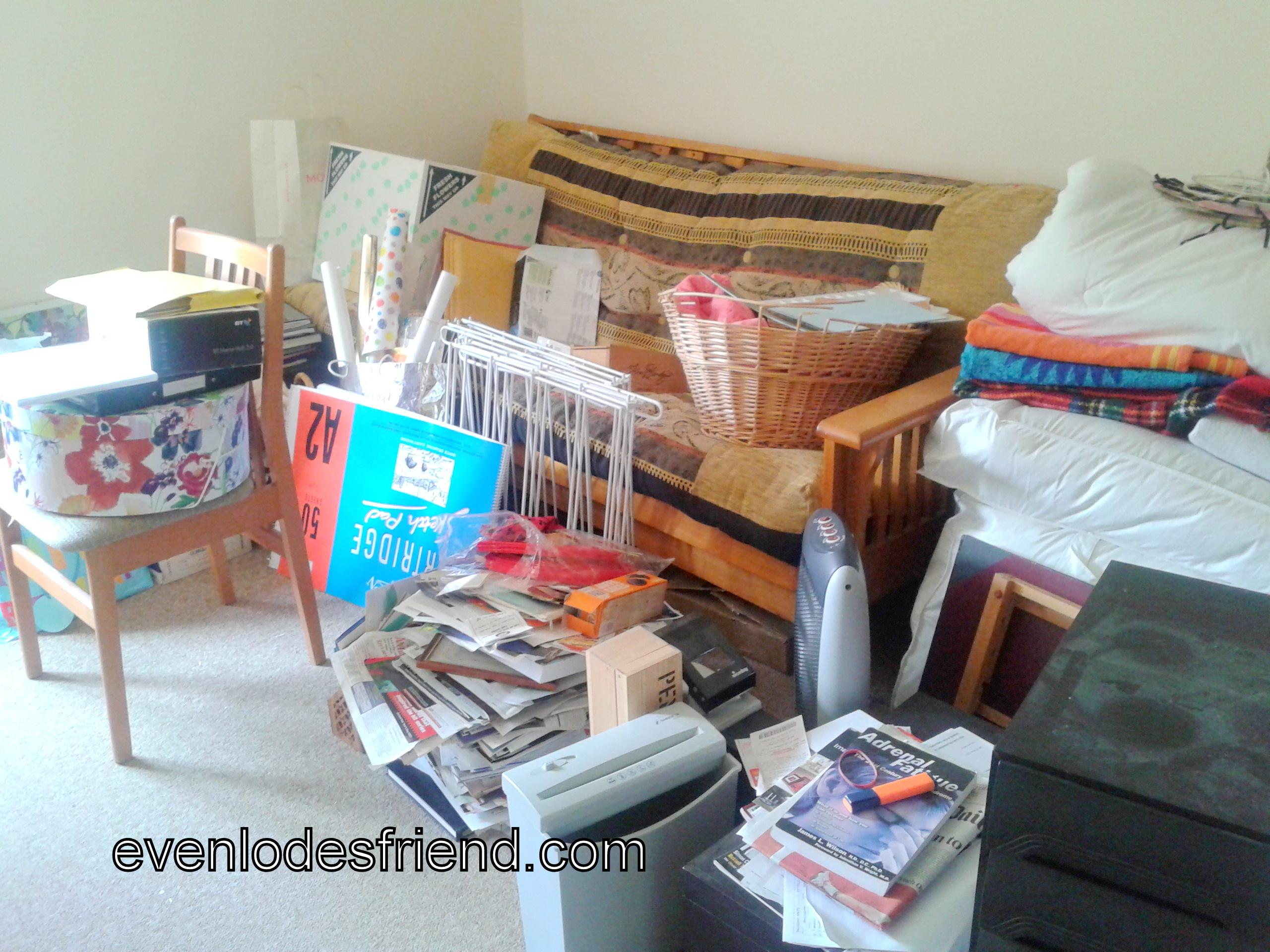
But of course, because I never do anything by halves, my darling husband is having a couple of days off right now and decided, for a whole bunch of really complicated reasons, that it would be a great idea for us to switch offices.  Yes, while I am ill.  No, he did not expect me to help move the furniture.  So now he has the north-facing back room, and I have the sunny, and much larger, front room with the sofabed-futon thingey to lounge on.  I suspect I may have got the best end of the deal, don’t you?

This brilliant wheeze unfortunately has its down side.  Evenlode OPs Centre now looks like a cross between a bad jumble sale and the aftermath of Chernobyl.  Major purge, rethink and planning are urgently required.  (Shame my brain is on illness-induced sabbatical, but there we are.)

new study messThis is not entirely a bad thing, however.  I need to be systematic about everything right now, and the study change is just the external materialisation of the internal mess I am in.  Because it turns out that this blogging thing is much harder than it looks, and I am going to have to be a lot more organised than I thought.  I can’t just fire off a post for this blog in half and hour from a standing start, as I do with my personal blog, because its not that kind of site.  I want my readers to be informed, and that means my research has to be spot on and my posts thorough and thoughtful.  I need to write ahead, and I haven’t worked out how I can do that and juggle my health issues and life at the same time.  I think its good, on the whole, to reassess what you are doing periodically, but I’ve never been one for planning systematically how to do something, as the state of my desk drawers unvariably show.

Yes, its cosmic learning time!

So, today’s Outflow is about two things, redesigning my work area, and planning my work method.  I must be mindful about what I’m going to need and the issues I am going to have to plan for, like not being well enough to write on a posting day.  I’m going to need a workspace that supports me, with all the tools for writing, painting, planning and running this little endeavour within easy reach.  And its got to be easy to keep tidy and organised because I am crap at being neat and perversely, as a Libran, I don’t like working in a messy, ugly space.  In this way, writing a blog isn’t any different from my other creative work, my writing and painting.  It just has to be more systematic and focussed.

If you keep a blog, I would love to know how you organise yourself ahead, and plan your posts.  And if, like me, you are lovingly embarking on making a new creative nest for yourself, I would love to hear about that too.  Please leave a reply (the tag appears at the top of each post for some reason, thats another design issue on my blog To Do list!) and maybe we can do a compendium post of all the shared ideas and wonderful ‘Rooms of Our Own’.

Happy Creating,

EF

Journal Friday: Reflecting on Creative Blocks

paintbox

So, if you read my last post, you will know that I am increasingly drawn towards drawing and painting at the moment.  This is my current creative season and I want to honour it.  So today, no doubt, you will be expecting me to deluge you with jpegs of the beautiful pictures I have been creating.

Yeah, Right.

Nigel has been hard at work again.  I have produced the sum total of zero drawings in the last two days.  Yesterday I couldn’t even bring myself to go into the study to get out my sketchbook and paints.  The blank page suddenly seems terrifying.  I can’t even doodle.  How the hell have I lost the ability to doodle, for Gods’ sakes?

Bit not good.

This, my friends, is where the journal really comes into play.  I sat down with my trusty moleskine and pen, and thought about my childhood memories of drawing.

I used to draw all the time.  It was what I was known for, amongst family and friends.  I was never without a piece of paper and a pencil.  I made little books and illustrated them.  I wrote stories and illustrated them.  I wrote stories about my favourite TV programmes, like ‘Blakes 7’ (remember that one?  I had a terrible crush on Paul Darrow) and drew the characters all the time.  (If only I had known about fanfiction and fanart then!)  I was obsessed at one point with the Tudor monarchs, and copied their opulent portraits and clothes with fibre tipped colouring pens.  Then I got into the Ancient Egyptians, and copied their sideways style of representation.  I even copied the drawings of E.H Shepherd in the beautiful edition of Kenneth Graham’s ‘The Wind in the Willows’, which my father gave me – it was his favourite book.  And I painstakingly illustrated all my school work (except the Maths, of course, because that was too serious, which was probably why I was never any good at it.)  In other words, I spent hours absorbed in transferring images from my head onto the page.

What happened?  Senior school art classes.  Hours of drawing still lives of pots and pans. Teachers who made us draw boring subjects, and never gave us any information about technique.  I’ve learn everything I have ever learnt about art and how to use paint from copying, which my art teachers said was the worst possible sin.

(But I am getting ahead of myself, I’m supposed to be thinking about my childhood drawing.)

As a kid, art was my obsession, but it requires materials, and they were in short supply.  For paper, my dad bought home gash computer paper from work, the perforated kind that comes in a concertina, with holes along the edges, and with about the same handling quality as IZAL toilet paper.  I was occasionally bought coloured felt-tipped pens but in the 1970s they were rubbish, and the black ones were invariably dried out before they were even used.  At least 25% of the pens in the pack didn’t work within about two days of having them, and you had to conserve those that did with fiendish vigilance.  There were occasional gifts of watercolour pan boxes, but they were very low pigment, and anyway, painting in your bedroom is frowned upon by most mothers because it is messy.  And there wasn’t anywhere else to paint.  What I am trying to say is that I grew up yearning for those huge bottles of poster colour paint that stood on the trolley in school.  The thought of being able to just splash paint about willy-nilly was ridiculous.  My parents wanted to encourage my artistic side, but they didn’t have the disposable income or the mindset to invest in good raw materials for it.

The result is that the scarcity of my childhood has bloomed into a scarcity paranoia in adulthood.  As soon as I was earning, I went out and bought decent art materials, but then I couldn’t make myself use them.  I have drawers and boxes full of sketchbooks, pastels, inks and paint tubes that have never been opened because I still have the mindset that they have to be conserved.  I can’t waste a thing.  To the point where I can’t use a thing.

None of this would I know and understand, were it not for exploring it in my journal.  And in my journal have come the little glimmers of a solution, a plan to tackle my stuckness with baby steps so minute that I can fool Nigel into thinking I’m not even putting pen to paper at all!  Slowly and gently, I will con myself into the belief that making a tiny drawing is safe.  And then I will con myself into making a bigger one.  Until one day I will fulfil my dream of illustrating my own novels, and making huge abstract expressionist canvases like Rothko and Pollock.  But not yet.  To begin with, I will throw out everything I learnt in art class, scrunch up my eyes and begin again, as a child.  It will be hard, but I can do it.  I did it with the writing, after all…

Journal Exercise:

Are you also struggling with a creative block?  Is there something you used to do, and would like to do again, but are afraid to?  Perhaps you are just stuck and you can’t get out of your own way.  You probably don’t even know why.

Get out your journal and take a few deep breaths.  Close your eyes and let yourself fall backwards through time. Feel yourself become a child, doing that thing you loved do and don’t do anymore, whatever it is.  Immerse yourself in that memory.  How did it feel?  What was so satisfying, enticing, transcendently joyful or just effortless about it?  How did splashing paint on paper, sewing a doll’s dress or dancing to the radio help you express yourself?  Connect with the fun, the pleasure, the satisfaction.

Now write about it.  Take time to write out all you can remember about doing that creative activity, and take the memory from as early an age as possible.

Now take another deep breath and continue to write, this time about when you stopped pursuing that activity.  What happened?  What age where you?  Was there criticism from parents or responsible adults?  Or was it competition with other children who you regarded as being better at the skill than you?  Perhaps you reached puberty and decided that form of creativity was childish and no longer for you?  Or you felt you couldn’t go any further with it because you couldn’t make a living at it?  Whatever the reason, explore your memories of it.  Be as thorough as you can.

Give yourself some time to sit with these memories, to contemplate them.  Decide what aspects are still stopping you.  Are you, like me, fearful that your work won’t be ‘GOOD ENOUGH’ (thanks, Nigel), or still carrying that fear that there isn’t paper to waste?  Will doing this activity make you vulnerable in some way?  (If so, you don’t have to show it to anybody, just keep it for yourself.)

(If some major trauma is involved, it is wise to seek professional help.  A therapist is invaluable, and those who specialise in expressive arts or Gestalt might be just what you need.  Don’t suffer flashbacks alone as a result of this exercise.  Self care should always be the first rule of creative expression.)

Think about ways to ease yourself through these issues.  Maybe taking a beginners or taster course, where everyone will be fumbling about at the same starter level, could encourage you that what you make doesn’t have to be perfect.  Perhaps an online course that you can follow in private, and at your own pace (Alisa Burke has some brilliant art and sewing courses.)  Or you could buy some kids art materials and use them with your own kids (or borrow someone else’s for an afternoon).  Watch how kids are completely free of judgement when they make art.  They are just having fun.  You can, too.  (Actually, I think I may have to borrow some children and do this myself!)

Trust that what comes up in writing your journal is from deep within, an inner wisdom that will guide you back to your creative centre.  Above all, be gentle with yourself as your formulate your action plan, and give yourself as much time as you need.  You don’t have to become Picasso or Nijinsky overnight.

Happy Creating,

EF

Outflow: My Creativity Right Now

Picasso ceramicsWe are having a heatwave here in the UK, and I’m not very good in hot weather.  The result is that my brain has gone on strike, as has much of my body.  Which makes me think about ‘creative seasons’ and the Habit of Art.

My ongoing health problems taught me long ago to have peace with the days when I can’t do anything beyond lie on the sofa and practise my groaning. ( I’m getting quite good at groaning, I have to say.)  Chronic Illness is, however, a bit of an extreme way of forcing oneself to recognise one’s creative cycles, and not one I would recommend.

There are lots of creativity gurus who are adamant that turning up at the page, or the canvas, and making yourself do the work is the only way forward, and for the most part, I would agree.  But what do you do on the days, like today, when it just ain’t gonna happen?

Take note, that’s what.

I find my creativity goes in bursts, as I have mentioned before, and in recent years I have noticed that my writing seagues slowly into art in the summer months.  Writing is a great thing to be doing when the weather is cold and wet, and all you want to do is curl up in the warm.  In the summer, though, the urge to get out there into the landscape and experience the world is almost irresistible, as anyone who has ever worked through the summer in an office will agree.  Right now I am experiencing the difficult-to-ignore urge to paint rather than write.

And I am OK with that.

Yes, I am feeling a bit frustrated that I can’t settle to the writing projects I want to progress, but I can’t force it, or I will get resentful, and probably produce pages of complete drivel that I’ll hate later.  The urge to be creative is still with me, though.  It is just taking a different, more exterior form.  I want to draw, paint, decorate pottery, make cushion covers, garden, and bake cupcakes.  So that’s what I’m going to do – at least as soon as the weather cools down and my brain starts functioning again!

There is a tension between turning up to create and the creative seasons themselves, and the skill of a true creative is to be able to accept the difference between a) the resistance to sitting at the desk and working, which is procrastination and stopping oneself being all one can be, and b) the natural flow of creativity as it morphs from one season to the next.  There is much to be said for making yourself sit down to create every day, but using it as a stick to beat yourself with is not helpful.  We need to be aware of when our creativity transforms, and to trust it enough to go with the flow.  This doesn’t mean I am abandoning my writing for good, simply that I know that right now, that isn’t where my best work will come.

The image in my head to illustrate this is when Picasso discovered the provencale village of Vallauris and threw himself into the art of ceramics.  I have no doubt there were those who worried that his canvas days were over, but that was far from the truth.  Instead, he trusted his creative urges enough to know that ceramics was a road he had to walk at that point in his life.

So I am trying to emulate Picasso, and to be at peace with where my creative road is taking me.  It’s not easy, and Nigel has a lot to say about not having the gumption to get on with the novel, but frankly, STUFF NIGEL!  Lets get out in the sun, eat ice cream, and do creativity the way we need to right now!

Happy sun-bathing and creating,

EF