Category Archives: Self Expression

Word of the Year 2014

So, we have thought about intentions, and we have begun to consider the words that identify how we want to feel.  Those (five) words are the place from whence our intentions arise.  Because every day we can choose to do things that make us feel that way.

Clever, eh?

But there’s more:

You may have bumped into the idea of having a Word of the Year.  You can find out more about this habit here.

A Word of the Year is a kind of overall intention.  It gives you a direction, a way of formulating how you want to be in the world. It also has an uncanny habit of bringing into your life exactly what it says.

My word for 2013 was

Revolutionary

And oh boy, was it?!

This year has fundamentally changed how I feel about myself.  I have undergone a revolution in my core beliefs and my way of approaching the world.  I have turned my attitudes about my place in the world and, most particularly, in the world of work, on their heads.  In some ways, I have also revolved (the other meaning of revolutionary), coming back full circle to revisit issues that I thought I had dealt with before.

I have revolutionised the way I write and the way I feel about my writing.  I have set up this website and begun to dream new dreams about the kind of things I want to create.  It is exhilarating.

Let me tell you, revolution doesn’t have to be a violent upheaval that ends with tyranny and blood.

I have to confess that when the word first came to me, in the form of just revolution, (while I was still in the malaise of a serious bout of influenza which brought me close to being hospitalised), I was a bit scared.  I knew it was the word I needed, but it sounded frightening, as if I could be inviting an earthquake into my life.  Was I really ready for that much change?  After all, with limited energy, poor health and a susceptibility to anxiety and stress, it didn’t really sound a good idea to invite those kinds of energies into my world.  So I fiddled with it until it felt more friendly, more manageable.  And more appropriate to what I could cope with.  It became:

I AM REVOLUTIONARY

And this year, I have been.

So the question then becomes, what do I want to be next?

I don’t have to stop being revolutionary, of course, but 2014 needs a new word, something that allows new energies into my life, allowing me to blossom and grow in new ways.

I have been sitting with my five words and my journal and calendar, contemplating what I want to be and do next year.  How I want to build on the intentions and lessons that revolutionary brought with it?  I thought about kind, lovingkindness, courage, and strength.  The first two felt too soft, and the last two, too tough.  I needed something flexible, something I can grow with, something I can work with whilst still treating myself with lovingkindess.  And this is what I came up with:

DARE

Dare feels good.  It popped into my head at 2am on the way back to bed after a loo break (TMI), and I knew it was the right word.

Dare is about having a go, putting yourself out there, but not in a way that is perfectionist.  Not in a Nigel way.  Dare means trying something out and seeing if it fits.  It means trying something, and knowing that it doesn’t matter if I fail or if I don’t get it exactly right the first time, or even if it turns out to be the wrong thing after all.  At least I will have tried.  At least I will be in the arena fighting, as Roosevelt would put it.

Journal Exercise:

So, I invite you to take time to sit with your feelings words, with your creative and life intentions, and to consider what word might truly describe and inspire how and who you want to be in 2014.  What feelings and new adventures do you want to manifest in your life?  What energies do you want to invoke?

When you consider this, do it in the spirit of lovingkindness towards yourself.  Look at your life with a gentle hope, not in the spirit of forcing yourself into new contortions.  This is not some New Agey wishing, some pseudo-psychobabble soppy thing.  This is a life affirming way of moving yourself to new levels, of becoming more yourself every day, and of being deeply, affirmatively and satisfyingly creative.

Everyday life is a continual act of creativity.

When I say ‘sit with it’, I mean: allow yourself time to consider.  Allow ideas to filter, percolate and bubble in your mind.  Don’t force it.  It will come to you.  Let it happen.  You know deep inside what you want for yourself as a creative being.  Allow it to emerge.  And then rejoice in it.  Allow it to inspire every corner of your life for the whole year.

I guarantee it will take you places you can’t even begin to imagine right now.

Happy Creating,

EF
Its Never Too Late…

Whenever I see an article in the paper about some young person who has won an important first novel award, or got a massive advance on their first book, I have a mini meltdown.  Its not that I would take their achievement away from them.  Its just that I am now 46, and still struggling to finish a book that I am happy enough with to publish.

But how old is too old?

I could probably quote a dozen examples of authors who didn’t publish their first book until they were in their 60s or 70s.  There are always the exceptions.  I keep telling myself that its never too late to fulfil the dream of that first novel I wrote at the age of 16.  But you have to really understand the fact in your heart, as well as in  head.

Let me tell you a little story about fulfilling your dreams at any age.

The other day I went to my first Masked Ball.  I’m not a dancer by any stretch of the imagination, but we had been invited to go by friends who are.  It was an event run by the dancing school our friends attend, and as part of the entertainment, several of the school’s students danced exhibition dances.  To uproarious applause, there were paso dobles and waltzes and tangos.  (And there were lots of sparkles too, and I just love sparkles!)

Marvellous.

And then a tiny little old lady in a lacy top and a bow in her hair got up, and danced the foxtrot with her lady teacher.  And it was lovely.  She got the biggest round of applause of the night.

Then the evening’s compere told us about her.  How she had fulfilled a lifetime’s ambition recently by dancing in the British Ballroom Championships at the legendary Tower Ballroom in Blackpool.

Turns out, this lady, who reminded me a great deal of Mrs Pepperpot (if you remember her), was 86.

Eighty-six years old and still ballroom dancing.  Competitively.  Eighty-six years old and still pursuing her creativity.  Eight-six years old and still fulfilling her dreams.

How old is too old?

Ask me when I get to 87.

Happy Creating,

EF


Journal Friday: Derek Jarman’s Sketchbooks

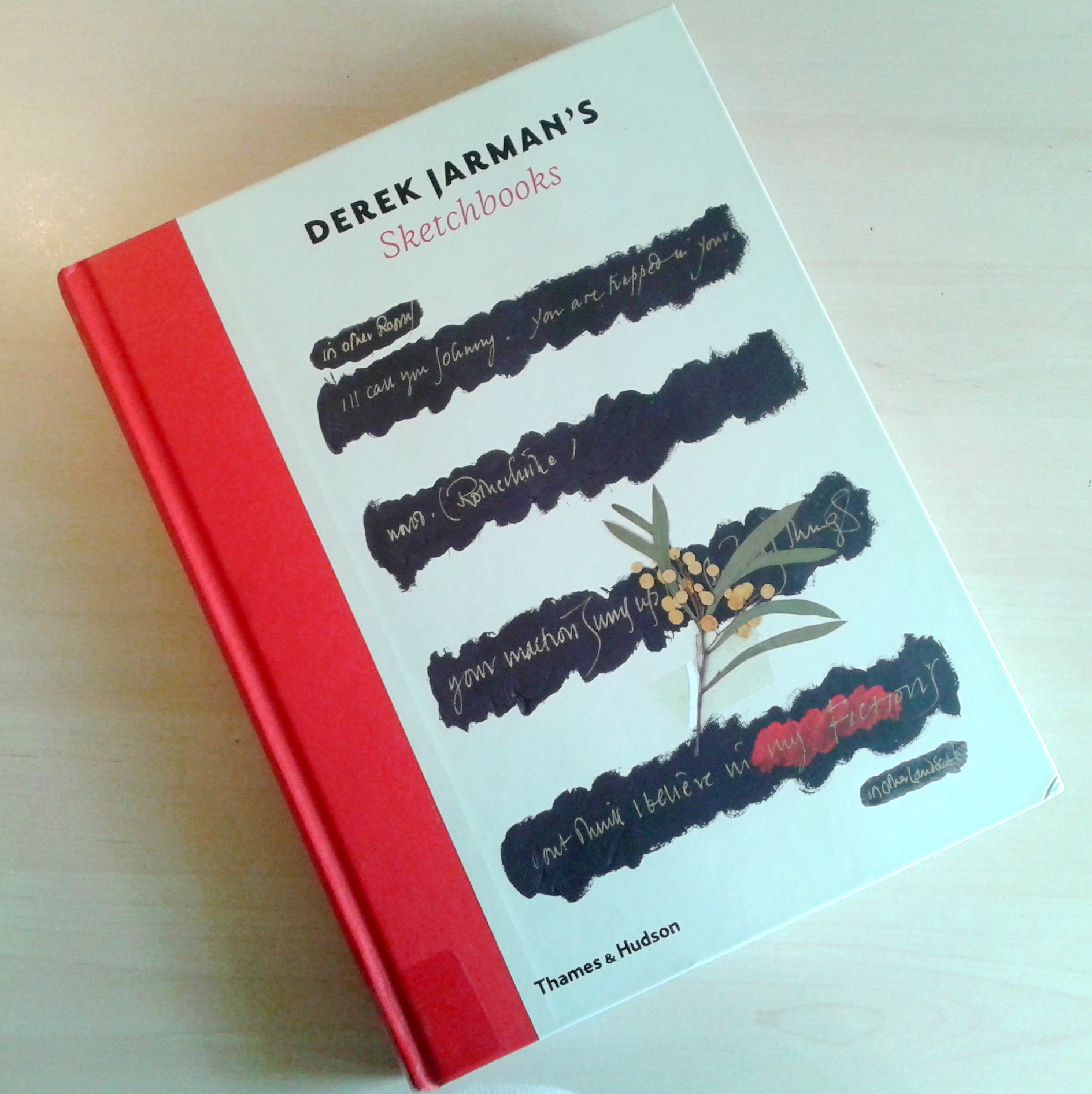
jarman diariesIt’s been a very busy week, and I’ve been diving into all kinds of exciting new and inspirational activities, including the UEA Literary Festival.  I’ve also been submerged in the magical world of Derek Jarman’s Sketchbooks, edited by Stephen Farthing and Ed Webb-Ingall, and I want to share the inspiration I’ve found in them with you.

derek_jarmanIn case you have never heard of Derek Jarman, he was a fabulously talented artist, film-maker, designer, writer, gardener and Gay Rights activist whose career was tragically cut short by AIDS in 1994, aged 52.  He directed music videos for the Pet Shop Boys and designed the sets for Ken Russell’s landmark 1971 film, ‘The Devils’.  At his home in Dungeness, he created one of the most haunting modern gardens in Britain, one that I am deeply in love with.

I first became aware of Jarman when I saw his film, Caravaggio (1986), starring Nigel Terry, Sean Bean, and Tilda Swinton in her first film role.  Later, in 1991, I wept my way through his heart-breaking ‘Edward II’, an adaptation of Marlowe’s play that spoke of Jarman’s outrage at homophobia in Thatcherite Britain.  These are not easy and accessible films.  They are, however, fabulous to look at, and very moving.

When I came across this edition of the sketchbooks in the library the other day, quite by chance, I had no idea that Jarman was a committed visual diarist.  The sketchbooks themselves are large – family photo album sized – and each cover is decorated in black and gold, making a slightly varied but pleasing continuity.  Inside them, Jarman uses ephemera, calligraphy, drawing and painting, poetry, pages of film scripts, actors’ head shots from casting sessions, clippings from newspapers, reviews, photographs of friends and colleagues, bits of feathers and pressed flowers to document his life and each of his projects.  The sketchbooks contain his thoughts on everything from his garden (there is a carefully drawn planting plan), to his illness, to sex, history and death.

Jarman made a series of paintings, the ‘GBH’ series, of black on gold abstracts, inspired by Goya’s Black paintings, and a film called ‘Imagining October’, which arose from finding Sergei Eisenstein’s own copy of ‘Ten Days that Shook the World’, the famous book on the Russian Revolition, and on which Eisenstein had based his ground-breaking film, ‘Battleship Potemkin’.  Jarman had been shocked to discover how much of the book had been redacted with blacked-out text by the Communist authorities.  Both of these concepts are reflected in the sketchbooks, where you can see Jarman working on the idea of black bars with gold writing, seen on the cover of the volume.  Jarman’s anger at the political situation for Gays in the UK shines through these blackened pages.

One of the things that particularly strikes me is the simplicity of the layouts he uses.  Even when he is writing pages of text, making notes or journalling, there is a sense of space.  Nothing is cramped.  He spreads out, not denying himself room to work, enjoying the clarity of white space around his words and images.  This is something I will definitely take away. My diaries always feel cramped.  I always feel that every inch of space must be used, because materials are scarce.  This denial of room to grow is cramping my creativity, something I need to break out of.

I want to draw inspiration from the sheer range of activities Jarman undertook, too.  For him, there is no line in his sketchbooks between diary, writer’s notebook, sketchbook, planner or scrapbook, anymore than there were boundaries between the creative areas he worked in.  Although he was primarily a film-maker, he was so many other things as well.  Jarman teaches me that I don’t just have to stick to writing.  I can follow where ever my Muse leads me.

There are no limits to what we can create, only the ones we impose on ourselves.

Things to try:

  • See if you can get hold of a copy of Jarman’s sketchbooks.  It isn’t cheap – £28 – so maybe you can order it from your library.  You may not like his style of modernist art, but you can appreciate how he puts every aspect of his life into these visual journals to make a record of his thinking.
  • Use your own sketchbook or diary as a kind of studio to record everything you do and think about a particular project.
  • Collect clips, postcards, photos, anything relevant to stick in – Jarman even stuck a ten pound note into his!
  • Luxuriate in space.  Allow each of your drawings, paragraphs, or collaged pieces to bask in a frame of white space, so that they can shine out, and be seen for what they are.  Don’t fall into my scarcity trap – there will always be more paper.
  • Decorate the covers of your sketchbooks or journals in a similar way, as Jarman did, each one slightly different, but using the same colours or materials.  Maybe you could do ‘series’ of notebooks, with matching covers, for different projects.  Don’t be precious about them, however.  Jarman once stuck a heavy bronze seal on the front of one of his books, but it was too heavy to carry and got in the way, so he ended up prizing it off.  The scarred gold cover is even more interesting as a result.

Happy journalling,

EF

Outflow: My Creativity Right Now

Picasso ceramicsWe are having a heatwave here in the UK, and I’m not very good in hot weather.  The result is that my brain has gone on strike, as has much of my body.  Which makes me think about ‘creative seasons’ and the Habit of Art.

My ongoing health problems taught me long ago to have peace with the days when I can’t do anything beyond lie on the sofa and practise my groaning. ( I’m getting quite good at groaning, I have to say.)  Chronic Illness is, however, a bit of an extreme way of forcing oneself to recognise one’s creative cycles, and not one I would recommend.

There are lots of creativity gurus who are adamant that turning up at the page, or the canvas, and making yourself do the work is the only way forward, and for the most part, I would agree.  But what do you do on the days, like today, when it just ain’t gonna happen?

Take note, that’s what.

I find my creativity goes in bursts, as I have mentioned before, and in recent years I have noticed that my writing seagues slowly into art in the summer months.  Writing is a great thing to be doing when the weather is cold and wet, and all you want to do is curl up in the warm.  In the summer, though, the urge to get out there into the landscape and experience the world is almost irresistible, as anyone who has ever worked through the summer in an office will agree.  Right now I am experiencing the difficult-to-ignore urge to paint rather than write.

And I am OK with that.

Yes, I am feeling a bit frustrated that I can’t settle to the writing projects I want to progress, but I can’t force it, or I will get resentful, and probably produce pages of complete drivel that I’ll hate later.  The urge to be creative is still with me, though.  It is just taking a different, more exterior form.  I want to draw, paint, decorate pottery, make cushion covers, garden, and bake cupcakes.  So that’s what I’m going to do – at least as soon as the weather cools down and my brain starts functioning again!

There is a tension between turning up to create and the creative seasons themselves, and the skill of a true creative is to be able to accept the difference between a) the resistance to sitting at the desk and working, which is procrastination and stopping oneself being all one can be, and b) the natural flow of creativity as it morphs from one season to the next.  There is much to be said for making yourself sit down to create every day, but using it as a stick to beat yourself with is not helpful.  We need to be aware of when our creativity transforms, and to trust it enough to go with the flow.  This doesn’t mean I am abandoning my writing for good, simply that I know that right now, that isn’t where my best work will come.

The image in my head to illustrate this is when Picasso discovered the provencale village of Vallauris and threw himself into the art of ceramics.  I have no doubt there were those who worried that his canvas days were over, but that was far from the truth.  Instead, he trusted his creative urges enough to know that ceramics was a road he had to walk at that point in his life.

So I am trying to emulate Picasso, and to be at peace with where my creative road is taking me.  It’s not easy, and Nigel has a lot to say about not having the gumption to get on with the novel, but frankly, STUFF NIGEL!  Lets get out in the sun, eat ice cream, and do creativity the way we need to right now!

Happy sun-bathing and creating,

EF

Journal Friday: Outflow – Making Lemonade

LemonsPart of being a writer is the dance of self-acceptance.

I have to deal with a chronic illness, which has radically altered my life for the last fifteen years, and shows no sign of waning.  This means I have to manage the delicate balance between self-care and doing too much.  When I overdo it, I end up exacerbating my symptoms and have to face extended periods of bed rest and being confined to the house.  Anf brain fog.

So sometimes I can’t write.  And its not that I don’t want to, its just that I literally can’t.

As I have said before, however, that doesn’t mean I’m not writing.  In my head, at least.

Sometimes life deals us lemons, and the lemonade is hard to make.  But even when I feel like I am buried under tonnes of lemons, the dream is still there.  The memory of how fantastic it feels when I am able to write, when the flow is happening and I am submerged in a scene.

This is where my diary comes in.  At times when I can process language, when I can hold my pen, I write in my journal.  It may only be a few lines, a sentence or two, but it is self-expression, getting the feelings out onto the page, and it feels fantastic.

At times when things are tough, my journal is my life raft.

At the moment, as I struggle with another period of sickness, I am working with this book.  When I have finished squeezing every drop of goodness from it, I will tell you how I got on, a little review of sorts.  In the meantime, I offer you this quote, from the marvellous SARK, patron saint of creative women, quoted by the author, Jackee Holder:

“I love journal keeping because it has helped me to discover and uncover myself, to encourage my own bravery, sort out difficulties with other people, to invent new ways of being.”

SARK, Juicy Pens, Thirsty Paper, 2008.

Happy Journalling,

EF

Journal Friday: How to write yourself out of a hole

Lighthouse at Dusk, Islay, Scotland

Lighthouse at Dusk, Islay, Scotland

(DISCLAIMER:  I am not a qualified counsellor, psychiatrist or doctor.  I am just describing what works for me.  If you are suffering with depression I urge you strongly to reach out and get help.  You do not need to suffer.)

I have suffered from bouts of depression since I was a child.  Depression is not having a bad day, or feeling blue, though both of those are unpleasant.  Depression is a soul-crushing, heart-lacerating misery that debilitates and destroys everything in its path.  Do not deny it or under-estimate it.

That said, over the years I have found ways to help myself, and believe me, helping yourself, feeling you have a little control over something that feels like it is controlling you, is a real relief.  Journaling is one of those ways.

So what to do if you find yourself at the bottom of the depression mine shaft?  Or even if you are just having a bit of a black dog kind of day?

How to:

Get out your journal.

Write down how you are feeling RIGHT NOW, in this moment.  As my counsellor often says, you can’t get to Edinburgh if you don’t know where you are now. (Think about trying to plan a journey that way – impossible!)

Be specific.

Stop and take the time to feel what is going on inside your body.  Do you have particular sensations associated with this low mood?  If so, where are they?  Write them down. They may be indicative of trapped emotions.

How are you feeling emotionally?  Write that down too – a list of adjectives if that is all you can face doing.

Does an image that describes how you feel come to mind?  Describe that.  For example, for me a real, deep depression feels as if my ribs have been ripped open, and my heart repeatedly slashed.  I feel it bleeding inside my chest.  Yes, it is a horrible image, but that is exactly how I feel, and describing it, in as much detail as possible, can be a huge relief.

Do not judge your feelings as you record them.  Do not judge yourself as selfish or unfeeling because you resent the fact that your husband is not doing much to help with your crying baby, or that you are angry because your boss does not recognise how hard you are working..  Have a good rant, safe in the knowledge that you don’t have to protect anyone’s feelings.  You are not being a martyr or a victim at this point.  You are just recognising how you feel.  Do not feel bad about what you write.  Admitting these feelings exist to yourself is the first step to healing, and no one else is going to see what you write.

If you don’t feel anything, write that too.  An absence is just as important.  Describe the void in as much detail as you can.  You may even find, as you progress, that you begin to pick up on little gimmers in the abyss, feelings you didn’t know were there.  Write those too.

As you write, you may find other feelings coming up from underneath the ones you are describing.  Get those down.  I often find that underneath my depression is anger, and underneath the anger lies a need not being met.  When I identify what it is I want that I am not getting, I am right in touch with the small child inside that feels unloved, whose needs went unmet.  Do not judge the need.  Simply recognise it.  Is there a way you can get what you need now, in a healthy way?  Now you know what it is, you can ask for it.

Whatever else you do, try to write daily, and get whatever miserable feelings you are having onto the page.  Once you have let them out, keep writing.  You may find more positive stuff coming through behind, and perhaps even ideas of things to do to help, comfort and console yourself.

Above all, be gentle with yourself. 

Show yourself the same compassion you would to a friend in need. (We often don’t do this, conditioned as we are to berate ourselves for the smallest failing.)

What next?

This is a process of continuing orientation and expression.  If you were on a cross-country walk, you would stop regularly to check your map and compass, to be sure where you were, to work out which was the next direction to take.

In the same way, depression is a long journey.  You need to be taking your own emotional temperature, checking your compass, as regularly as possible.  So make time to write often.

In my last spell of depression, I worked in my journal like this three or four times a day, for several days, then continued on a daily basis long after.  That probably sounds like quite a lot of effort.  On the other hand, you might take a pill three or four times a day if told by the doctor that it would make you feel better.  And this will make you feel better.

Why?  Because it gets the toxic feelings out of your body and mind, and puts them somewhere else – onto the page.

NOTE:  Do not reread what you write when you are still ill, or at all.  That would be ruminating on your feelings, and will encourage you to judge, feel guilty or ashamed.  Just get it down.  You are looking for TRUTH, not BEING GOOD.

You may find it helpful to write on loose sheets of paper, rather than in your journal proper.  This way, you could opt to burn the pages, ritually releasing the feelings, and freeing yourself.

Whether you are in the midst of a long bout of clinical depression, or just having a low spell, I encourage you to try this way of journaling.  I hope that it will help you to release your pain and move back into the sunshine.

With love,

EF

How to Take Criticism

The idea for this post came to me last week when I got a pretty starchy comment on one of my stories.  It happens sometimes.  Actually, I have to say I can think of only two previous occasions when comments have upset me in three years of online publishing, so I suppose I am doing pretty well.  My pals were very supportive, as was my husband.  No sweat, right?

Hmmm.

It got me thinking about how as artists we approach taking criticism.  Art of whatever form is a subjective thing.  Whether we like it or not is a personal matter.  You can’t please all of the people all of the time, as they say.  It is just a fact of artistic life, and we can learn a great deal from it.

The problem with art in general, and writing in particular, is that it is the product of our soul.  That makes it very close to us, an expression of our feelings, of everything we believe in.  And that, in turn, makes it hard not to take criticism personally.  Which is why a negative review can feel like being emotionally disembowelled.  It can be crippling.  It can block us completely, so that we never creatively express ourselves again.  That is why it is so important to know how to deal with it.

It strikes me that there are two types of criticism.

  1. Constructive Criticism.  This is the kind that comes from readers who support your work, who appreciate what an emotional risk it is to put your work out there, and who want to help you to improve.  They give honest, caring feedback.
  2. Rants.  You know this kind of comment.  It is usually about content, not plot, pace, language or technique.  It is usually angry, often vindictive, and actually has nothing to do with your work, and everything to do with the commenter’s personal ‘stuff’.

Constructive criticism comes from a place of empathy and support.  Its aim is to help you along the road to expressing yourself better.  It may seem niggly (you missed a comma out, for instance, or left a typo in) but it is there with positive intent.

Rants are to do with issues that the critic has in their own life.  The first nasty experience I had with this was with my story, ‘Property Of:’.  A reviewer wrote a vicious snarl about how I had depicted the armed forces as being shagging frantically in trenches at every opportunity, and that it was disgusting that I should suggest this, or that Dr Watson could have been involved with a married person.  My (possibly misguided) response was to email the person in question and ask her to expand on her comments.  What I got back was a three page diatribe on the fact that Watson should be whiter-than-white and how dare I criticise the army.

Clearly she had issues surrounding infidelity and the armed forces.

I don’t write for Disney.  I deal with the real shit. Real life.   Real people.  And real people make mistakes and get scared and do weird, unexpected things under pressure.  She had her own reasons for not liking my story.  Fine.  I triggered them.  Okay.  But I am not going to change the whole tenor of what I write to please one person, however hurt they have been.

Now don’t get me wrong.  I love criticsm.  When it is constructive.

In the course of publishing daily episodes of ‘The Case of the Cuddle’, for example, I realised from comments being made that I had left out a whole area of the story between Lestrade and Mycroft.  Without it, their responses to later events made no sense.  If it had not been for those reviewers who were unafraid to ask awkward questions in a supportive way, I would not have noticed the gaping hole in my narrative.  I hacked together an extra two chapters to insert into the story, and fixed the problem.  Bravo critics.  I learnt something.  Thank you.

That is the point of contructive critisicm.  You learn something.  The way to approach any kind of criticism is to ask this question:

What can I learn from this?

So, how do you deal with criticism, nasty or kind?  Here are a few tips:

  • Take a deep breath.  Walk away.  Give yourself some space.  DO NOT immediately fire back a stroppy reply that will only provoke further attack.
  • Work out which kind of criticism is being offered.  Calmly.
  • If this person has been triggered by some issue in your work, accept their right to their emotions, however wrong they are in venting them on you.  Something horrible has clearly happened to them to provoke such an outburst.
  • You don’t necessarily have to email them, or reply at all.  If you are really upset, do not engage.
  • If you write about difficult stuff, things that are likely to trigger strong reactions in your readers, them you should expect rants a bit more often than if you only write fluff.  Be prepared, but DO NOT back off from writing about the tough stuff.  It is only if we talk about these things that we can address them in society and heal the suffering they cause.  You are doing good work.  Keep doing it.
  • If you find yourself reacting strongly to a challenging, or ranting comment, it is worth thinking about why.  Perhaps this review has triggered something for you?  My commenter from last week challenged me about a prejudice I had been kidding myself I didn’t have.  On reflection, I realised not that she had a point, because I stand by the artistic decision I made, but that there was an element of truth in her accusation.  From now on, I will think more carefully about my responses to certain situations and where they come from.  I have learnt from her, and not just in terms of my writing.
  • You do not have to rewrite your work just because someone negatively criticises it, nor should anyone expect you to do so.
  • Think about the reasons why you made the artistic or aesthetic choice you did.  If your choice is rationally defensible, ie there is a better argument than ‘because thats the way I want to do it!’ (accompanied with a stamping of the foot), then let it stand.  If, on reflection, you decide that it could have been done better had you made a different choice, then you can take the criticism on board, and maybe do it different next time.  Make the decision to learn from it.
  • Don’t sweat the small stuff.  I find myself getting very gnarly when someone is kind enough to point out where I left a typo in.  Gggggrrrrrrr!  But actually, they are doing me a favour.  Not only are they acting as a free proof reader, they are also helping tackle my Perfectionism, and giving Nigel a good kick in the teeth at the same time!
  • Allow yourself to absorb the helpful comments at your own pace.  Sometimes it can be very challenging to be told your sentence structure is a bit dense, or that your character’s motivation is shaky.  Are you ready, at this point in your development as a writer, to accept this criticism?  If you are, take it on board.  If not, put it aside, and keep doing your best.
  • Don’t trust your first defensive denial.  If the comment is offered sympathetically, with the earnest desire to help, then examine it.
  • As with all criticism, take what feels truthful to you, and leave the rest.  Just let it go.
  • NO ONE has the right to browbeat you, attack you, abuse you, or verbally savage you to the point where you give up writing.  Constructive comments on the work are helpful, personal attacks are not.  Report vicious repeat flamers where necessary.  Bullying is NOT ACCEPTABLE.
  • The internet gives you the opportunity to get free comments on your work in a way that never would have been possible twenty years ago.  It is a huge resource.  People take a great deal of time and effort to read your work.  Thank them for the time they take to respond to it, and choose to learn from what they say, as far as you can.
  • Relax.  No, really.  This is not personal.  Rejoice in the feedback you get.  Why?  because it means you are OUT THERE, being seen, and that, my friend is a HUGE blessing.

No doubt there is a great deal more that I could add.  Taking criticism constructively is something you learn by doing.  It really helps to join a writers group, where you can trust your fellows to offer you helpful feedback on a regular basis, so that you get used to it, and build up your ‘resistance’. (More on writers groups in a future post) In the meantime, I return to the following, which is the best advice I can offer:

Take what feels truthful to you, and leave the rest.

Next Wednesday, I will be writing another article about how to give constructive criticism, so stay tuned!

Happy writing,

EF

Journal Friday: Art in your Journal, or Why I had to lock Nigel in the Garden Shed this Morning.

Diary Page mental energy groundedThe title for this post, “Using images in your journal”, has been in my editorial diary for weeks, swimming around, getting crossed out and rescheduled.  I knew I had to write about it, because Art Journaling is a huge movement, and one everyone can enjoy.

So why couldn’t I bring  myself to write about them?

In a word, Nigel.

Nigel, if you haven’t already come across him on this blog, is the name I have given to my inner critic.  At least its the one only one thats printable!  He is the psycho-demon-fuckwit-critic-from-Hell that sits inside my head, barking orders at me, making sure I keep being a Good Girl so that people will love me.

Yeah.  Right.

In the case of my art, I can identify exactly when my drawing became unacceptable.  Nigel began with the voice of my ‘A’ level art teacher, Bob Taylor.  I had always been a passionate artist, and while I always knew I wanted to be a writer, I felt that earning a living might enable me to use my art skills.  So I took Graphics at ‘A’ level, intending to apply to Art College.  When I told Bob Taylor this, he said the following:

You’re a good draughtsman but you don’t have originality.

Yeah, right.

Looking back on it as a much wiser adult, I can see what he was saying.  My art at that time was very constrained.  I was too busy producing what I thought other people wanted, and not following what I wanted to do, or breaking out and breaking rules.  My art was, frankly, pretty boring.  But being a Good Girl makes for boring.  Regardless of that, its a pretty cruel thing to say to a 17-year-old who has always dreamt of a sunny studio in St ives.  I suppose he was trying to save me many years of misery and disappointment. I just was not ready for Art School.  Or perhaps he had picked up on the vicious Nigel voice inside my head that kept me in check.  Whatever the reason, I quickly lost my passion, and ultimately abandoned my art.

Now I am pretty blocked.  Nigel says I shouldn’t draw unless I can make something perfect and professional, something of the kind I admire in other artists.  Only the best is good enough for me and you, he says.  And if you can’t make it perfect, why do it at all?

This morning, I locked Nigel in the garden shed with a ball gag in his mouth, and got out my diaries.  Because, you see I do draw.  Sometimes.  Where no one can see.  Where no one can judge.  And because a picture, as I learnt so long in Graphics class, can say so much more than words in describing a feeling.  I draw how I am feeling.  Sometimes.  If I am feeling daring, or desperate enough.  In my diary, it doesn’t have to be perfect.  It just has to be got out on paper.

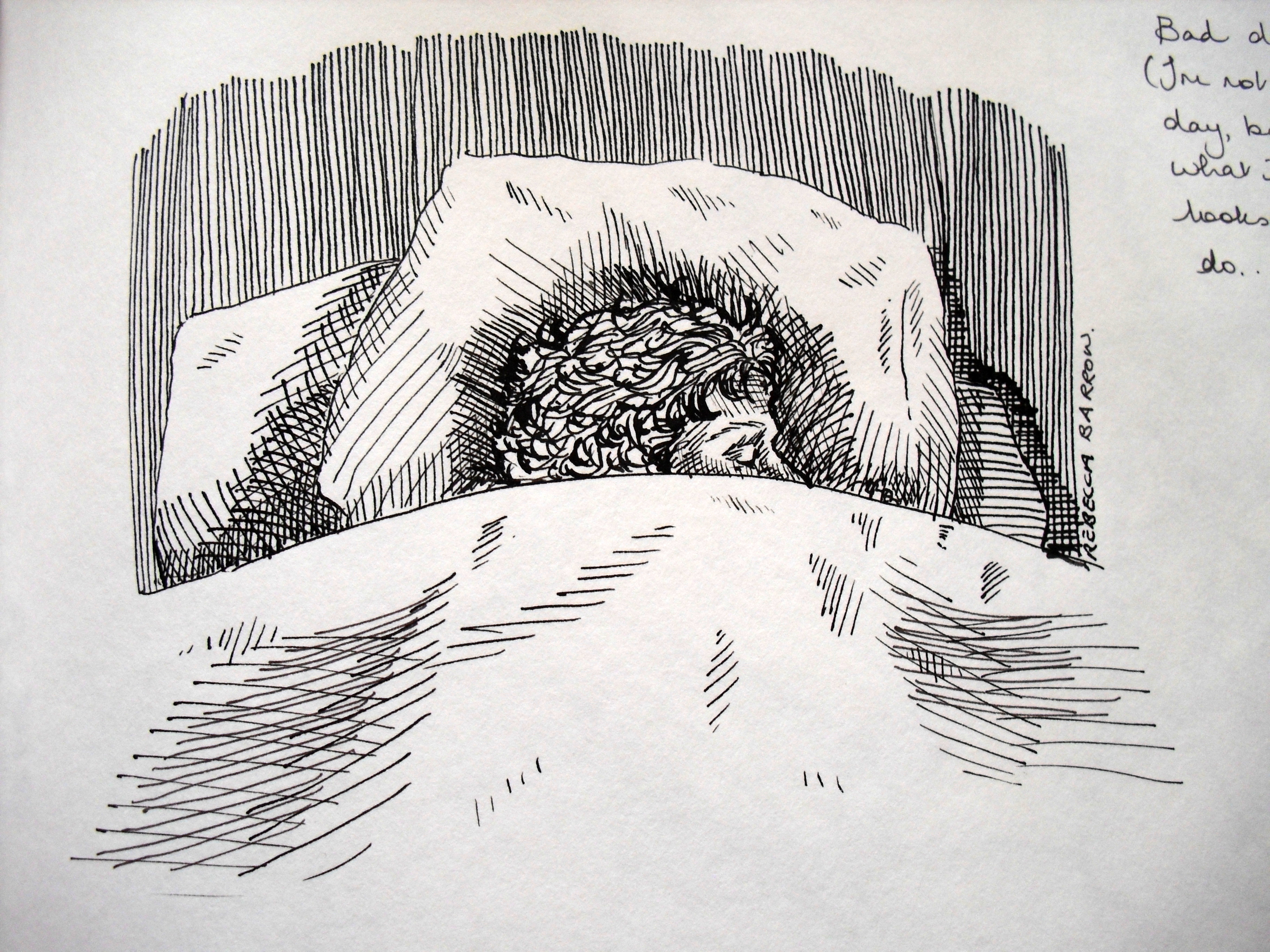
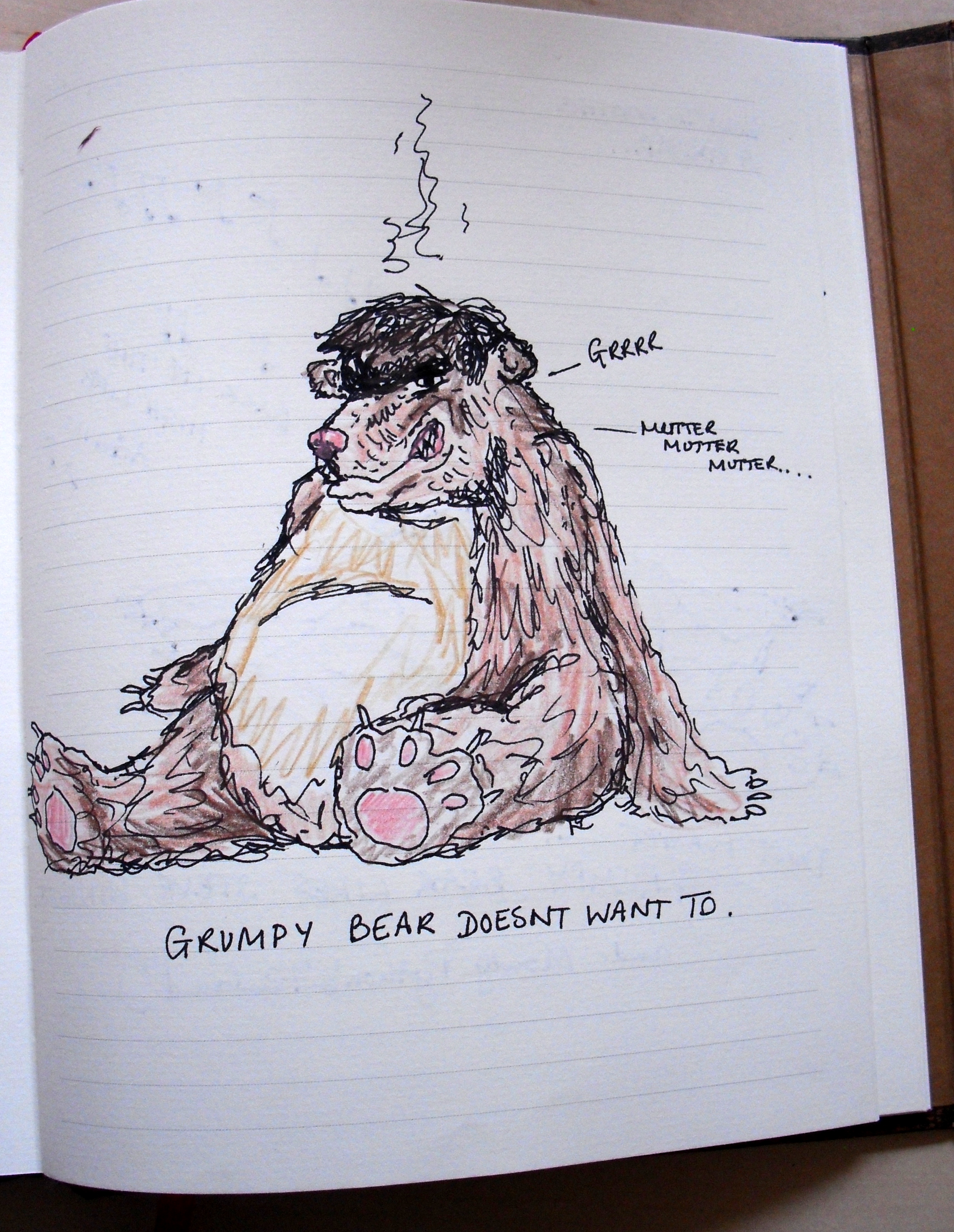
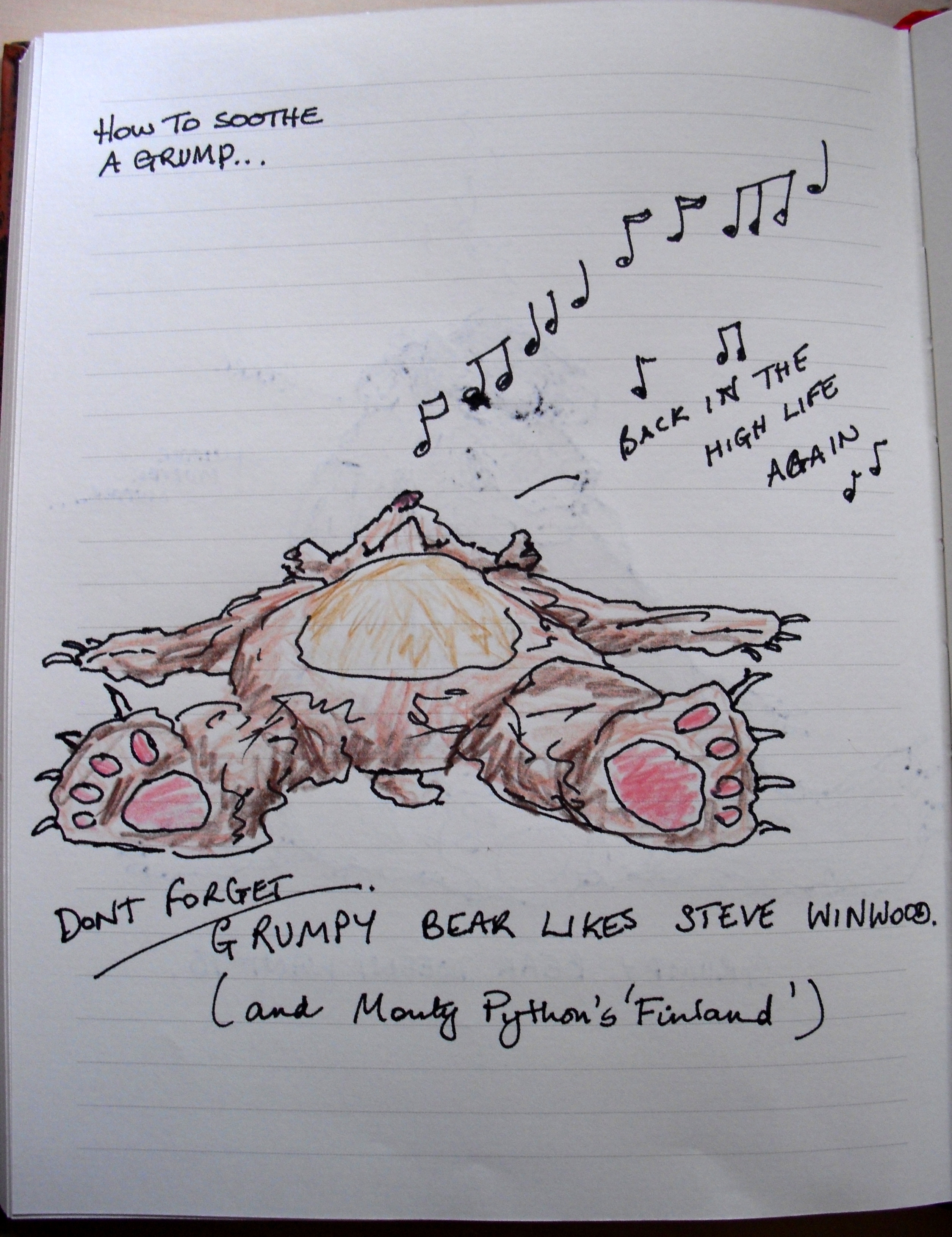
Here are a few of my drawings.  Nigel is very unhappy about my publishing them here, and he wishes me to point out that they are not up to my usual artistic standard.  I would like to point out that you don’t have to be able to draw, let alone draw like Rembrandt, if no one but you will ever see the images!

sleep sketchThis one is about my illness and the days I spend unable to get out of bed, which are frequent.

grumpy bear 1 grumpy bear 2

This is a feeling I had one day that I wanted to personify, in the hope of recording how to get rid of it.

hound sketchThis was the product of a night of insomnia.  Once I had drawn this rabid dog, something I felt compelled to do in a literally physical way, the feelings I was struggling with literally dissolved, and I went back to bed and slept for seven hours straight.

The point I want to make is not whether I can draw or not, but that you can use images to express your feelings in your journal without fear of judgement from others.  If you can’t draw, or can’t bring yourself to draw, paste in images cut from magazines, or postcards.  Collage is a great art form you can try without fear of criticism.  There are lots of ways to express what is pent up inside that are nothing to do with words.

Don’t let Nigel limit you.

Journal Exercise:

I am going to talk more about this, as I feel like I have opened up a rich seam, now that I have got over my block about it.  But in the meantime, you get to do some more shopping!  Go and buy yourself some nice coloured pens or pencils.  Sharpie ones are good and bright, but I like Staedtler Triplus fineliners and Berol Colour Brushes.

Reread my previous post about colour, and play with your pens or pencils inside your journal. Makes some marks.  Doodle.  If you fancy drawing, do, but don’t be critical of what you produce.  This is not about getting a grade A.  Just have a play.

What colours and shapes express particular feelings for you?  How do you feel when you use a particular colour?  What do certain shapes mean?

During the week, keep your eyes peeled when browsing newspapers and magazines, or even junk mail.  Pick out images that speak to you.  Pull them or snip them out and stash them in a box for future use, or stick them into the pages of your journal and write about how they speak to you.

Happy Journalling,

EF

Inspiration Monday: Colour

colorful-paints-WallpaperThe fact that human beings can perceive colour has been a huge influence on our development and our cultures. Colour has helped to protect us from danger, and find good things to eat.  It has helped us to define who we are in relation to others, as well as what we believe.  These days, it is as widely used in marketing and medicine as it always has been in art and fashion.  Colour blindness can prove a significant disability.

Thinking about how we respond to colour can be a rich seam to plunder for creative purposes.  The artists of the Fauvist movement, such as Matisse, and later Abstract Expressionists such like Mark Rothko, used intense shades of colour to convey and provoke emotion.  Both Matisse and Picasso made blue nudes, but look at the images they produced:

blue-nude picasso

Picasso Blue Nude 1902

blue nude Matisse 1952

Matisse Blue Nude 1952

Matisse’s vibrant cutout provokes a very different response to Picasso’s sombre meditation on grief.

Blue is the perfect colour to think about as an example.  It is culturally significant in many ways.  For example, the pigment lapis lazuli, a vibrant blue, was the most expensive pigment available to Medieval and  Renaissance artists, so was reserved for only the most important figures. Thus, the Virgin Mary is always pictured wearing a blue robe.  In Medieval England, blue was worn as an amulet to ward off ill-health, probably because of its Marian associations.  (This is why brides still wear ‘something blue’.)  In contrast, in some cultures, blue is shunned as the token of death, ghosts and bad luck.

We identify blue with calm and peace, and blue light has been used in urban areas with some success to reduce violence.  Blue can also be associated with depression – we talk of ‘having the blues’.

Conversely, red is seen as a vivid, energetic colour, associated with lust and sex.  We speak of the ‘scarlet woman’ for example.  It can also be interpreted as a warning of danger, as in ‘Stop’ signs and traffic lights.  Rooms painted red look smaller to our perception, but also warmer and cosier.  A blue room looks airy and spacious, but can seem rather cold.

Our emotional response to colour is also of interest.  We speak of ‘warm’ and ‘cool’ colours, and choose the clothes we wear by colour according to our mood.  I wear bright red all the time, but my mother accuses me of looking ‘too bright’ when I do!  My sister has such a visceral response to the colour lilac that it actually makes her nauseous.

I never really appreciated the importance of colour in the landscape around me until I moved to East Anglia.  I grew up on the south coast of England, by the sea.  There, the beaches are formed of toffee-coloured flints and broken, bleached shells.  The sea is often edged with emerald green seaweed, and is invariably the colour of cold coffee.  The crumbling sandy cliffs are the colour of ginger, and are held together by clumps of dark green gorse which turns acid yellow in spring.

The colours of the Norfolk coast are much more muted.  The beaches are pale sand, bound with dunes of khaki marram grass.  The sea is often indigo or petrol blue, and the skies are milky even in the most brilliant of summer weather.  Here, the prevailing colours are buff, dun, woad, grey.  They make the south coast seem gaudy by comparison.

As an artist or writer, you can use all this to your advantage.  The psychology and culture of colour can set the scenes for your images and stories.  Imagine a woman walking into a grey room in a scarlet dress?  (Artist Jack Vettriano uses this kind of contrast to huge effect!)  Imagine what people would be whispering behind her back.  Imagine what the response of the man she is meeting for dinner might be.

Creative Exercises:

Spend some time thinking about your own responses to colour.  What colours do you have in your home, and why?  Do they remind you of happy memories, or are they just there?

What are the colours you predominently wear?  How do you feel in them?  Go to the shops and try on garments in colours you would never normally wear.  How do they feel?  Why would you normally shy away from them?  What do you think the colours would say about you if you appeared in public in them?

Spend some time sitting on a bench in the high street, watching passers-by.  Note what colours they are wearing.  Are you drawn to them because of their colour choices, or repelled?  What do you think their colour choices say about them?  And what do you think they are trying to say with colour?

Keep your eyes peeled for colour around you.  What colour is your front door, the doctors’ waiting room, the toilet in your favourite restaurant, the plaster of the building across the road?  What shades are the trees, the earth, the sky?  What do these colours mean to you personally?  How do they make you feel?

You might like to spend some time with your writing notebook.  Choose a colour and write a word association exercise, scribbling all the words that come into your mind in connection with that colour, no matter how outlandish they might seem.  Now go back and examine what you have written.  Does your list suggest an atmosphere, a story, an image?  Play with whatever comes up as a response and see where it takes you.

There are a host of books you might like to read in connection with this subject.  Here are a few:

The Virgin Blue by Tracy Chevalier

The Colour by Rose Tremain

Colour: Travels through the Paintbox by Victoria Finlay

Happy Colouring,

EF

On Process: The Myth of the Suffering Artist

Chatterton 1856 by Henry Wallis 1830-1916(Henry Wallis’s painting of  Thomas Chatterton (20 November 1752 – 24 August 1770), who was an English poet and forger of pseudo-medieval poetry. He died of arsenic poisoning, either from a suicide attempt or self-medication for a venereal disease.)

I was going to start this post with a list of all the Creatives who have damaged themselves for the sake of their art.  I lay in bed the other night, trying to compile a list of them.  There were a lot, and those were just the ones I could come up with at 3am!

And why bother?  We know who they were.  We know the names of Rothko, Hemingway, Woolf, Pollock, Kerouac, Kinski, Dylan Thomas, and so very many others.

We conveniently don’t notice the ones like Grayson Perry, and Tracey Emin, who credit their art with saving them. (I’ve made links to autobiographies here, and I encourage you to read them, as they are enormously inspiring.)

We certainly don’t remember the millions of artists who, over the course of the last two millennia, have lived happy, healthy and fulfilling lives as well as making art of all kinds.

You don’t have to suffer in a garrett to be an artist.  You don’t have to drink yourself to death, take drugs, cut yourself, starve yourself, tolerate life in abusive relationships, live in squallor or destroy your health.  That is not what an artist is.

An artist is someone who makes art.

(Whatever kind of art that is, from writing to painting to dance.)

Just that.  Nothing else.  Just that.

Creativity is the greatest healing force in the Universe.  I know this because I have seen it and felt it for myself.  When you begin to create, you end suffering.  You will feel better.  I promise.

And yes, it will be frustrating at times, and maybe you will cry your way through every chapter, every linocut, every sculpture, every pas de deux, as you work through all the difficult feelings that come up.  Because lets not kid ourselves, people who create great art of all kinds are often driven to do so because of their own difficult pasts.

So maybe writing 500 words a day is like getting blood out of a stone for you?  There are ways to deal with that, but remember that struggle often comes from deep hurts from long ago, from entrenched behaviours that stop you being your most luminous self.  And if you write those words, every day, you will get through those barriers, and you will feel wonderful.

I promise.

I know because it happened to me.  And continues to happen.  Every day.

If you think that you cannot communicate accurately to your readers the misery and suffering of your characters without having lived it yourself, I will tell you the secret of how you can do without nailing yourself to a cross.

Three little words:

Imagination, empathy and research.  And the most important of these is IMAGINATION.

Imagine yourself in their place.  How would you feel?  What would distress you the most about their position.  Read up.  Find out how other people felt who went through similar traumas.

DO NOT TRAUMATISE YOURSELF.

Eat well.  Get enough sleep.  Value yourself.  Work at having loving and fulfilling relationships with others. Exercise.  Meditate.   See the doctor and the dentist if you need to.  Use your art to heal whatever wounds you have.  Care for yourself, and your art will be the better for it.  As will you.

Happy Creating,

EF