Category Archives: The Creative Process

Life – A Work in Progress

Saxlingham Summer Blues:  Partially finished, hand stitched quilt made by me.  Each square is 4x4cm.

Saxlingham Summer Blues: Partially finished, hand stitched quilt made by me. Each square is 4x4cm.

One weekend, I found myself doing some major revisiting.  Old issues, old passions.  Let me explain:

I was having a clear out, and I opened a box to find a large stash of fat quarters.  Patchwork and quilting enthusiasts amongst you will know what I’m talking about.  Fabric shops sell specialist, high quality cotton patchwork fabrics in small amounts, as well as by the metre – by the quarter yard or metre, in fact, or, in the trade, ‘fat quarters’. (Don’t ask me why ‘fat’ ones, I have no idea.)  They are much cheaper and allow you to build up a big selection of colours and designs for patchwork projects with a lower investment, because you usually need fairly small quantities for such projects.  Every quilter will have such a treasured stash.

I haven’t done any patchwork in quite a large number of years, and I don’t see myself doing any again for a while, if at all, so I decided to hand my stash on to someone who would use it.  Going through the wads of cloth reminded me of the time in my life when quilting was my main creative outlet, of the colours and patterns I was into then, of William Morris, the Pre-Raphaelites, of earthy reds and browns, and sage greens.

I’m a different person now.

I’m all grey and blue and white and Modernism these days.

It is not that these old perferences have dated.  Its just that I have moved on.

Later that same weekend, I found myself discussing an old trauma with dear friends, something that happened long ago, but that is an underlying influence on my life even now.  I have processed so much of the pain and damage of it that it has become part of the landscape of my life, as much as the tree outside my gate, and like that tree, I acknowledge its structuring presence, but I rather take it for granted, and essentially ignore it unless it specifically comes up.

And when it came up, it raised with it new issues.  I realised I would have to revisit my past, and look at old hurts with new eyes.  As I do so, I realise that I am a different person now, that I have come a long way.  On our journey through life, we bump up against some issues repeatedly, and its easy to get frustrated when this happens over and over again.

Life is not a circle

Bad, hand drawn graphic of how I’m trying to explain this…

Our lives are not circles in which we come up against the same old stuff every time.  Each time we encounter them, we are further along in our healing process.  Life is like a spiral.  Each time we encounter our pain, we can see it through a new perspective.  It re-emerges for a reason, because more healing is needed, more work must be done.

Another bad, hand drawn graphic to illustrate how we encounter triggers as a spiral on our life journey

Another bad, hand drawn graphic to illustrate how we encounter triggers as a spiral on our life journey

It took me a long time to understand that I was not a bad person because my tastes changed over time.  There is nothing wrong with leaving old interests behind and developing new ones.

Going back over old hurts doesn’t make me a bad person either.  When there are new things I need to explore about them, it is okay to do that.  Writing helps.  I am now able to engage with my old wounds through my writing.  Last time I did so, the result was one of my most popular stories, ‘The Case of the Cuddle’.  Now I find myself finally working with commitment on its long-anticipated sequel.

I wasn’t ready to do it before.  I did not have the impetus.  Now I need to speak the truth that its plot entails.  If I cannot do it in my own life, then I can do it through my story worlds.  I thought I had left the ‘CuddleVerse’ irrevocably behind.  I thought I was healed.  Now I understand, that healing, just like creativity, is a process.

I can’t tell you when the final installment will be ready to read.  I can’t even tell you if it is the final installment.  I may still have more healing to do.  Like the half-finished patchwork in the picture above, it has sat in a digital drawer for two years, waiting for me to be ready to handle it.

Some things we leave behind, and some things we need to come back to, time and again.

And that is part of Life – The Process.

Happy Creating,

EF


Are You Enjoying The Journey?

Are you enjoying the journey?

Are you enjoying the journey?

My niece has just got into drama school. After a long spell when she was not acting, she turned up at the audition feeling rusty and nervous. Afterwards she told me that doing the audition reminded her of just how much she enjoys acting.

She always laughs about how she will buy me a car ‘when she is rich and famous’, and its true, she does want to be famous, but only because it will allow her to get better roles. Her heroines are not the Hollywood starlets who are famous for being pretty (not that she isn’t pretty), but actresses who are famous for excellence – Emma Thompson, Harriet Walter, Fiona Shaw.

This made me think about the chapter in Ann Lammott’s seminal book about writing, ‘Bird by Bird’, in which she talks about those students in her writing classes who are only interested in learning how to get published. Getting published is only a minute fraction of a writer’s life. If you are only interested in that, why go through the long, hard slog of writing a novel in the first place?

You have to like writing. You have to like the process.

There is no point in setting out to be a great painter if you hate getting your hands mucky with paint.

There is no point in applying to drama school because you want to get famous, not because you want to act.

If you do either, you are surely going to spend a great deal of time being very miserable indeed.

When you decide to dedicate yourself to an art form, – or any activity, for that matter – be sure why you are doing it. There are a damn site easier and more reliable ways of getting rich and famous than writing a novel. You’d be much better off buying a lottery ticket or robbing a bank (not that I would condone the latter of course!).

Be creative through a medium that you love, because you love doing it.

Fame and riches may or may not follow, but one thing you can be sure of is that you won’t be miserable while you are waiting for it. You’ll be having a nice life. And lots of fun. Which is really the whole point, isn’t it?

Happy Creating,

EF

Permission

On Ardnave Beach, Islay, which I am yearning for dreadfully at the moment.

On Ardnave Beach, Islay, which I am yearning for dreadfully at the moment.

You know what they say about what you should do if you fall into quicksand:

Don’t struggle.

I wrote the other day about my fear of writers block, and it definitely struck a chord.  It seems so many of us are struggling to keep going, as if we are still trying to run even though we have one foot nailed to the floor.  Trying, trying, trying.  We give ourselves such a hard time.  We beat ourselves up because we aren’t good enough.

My dear friend Michelle, who can always see what I need better than I can, said to me:  ‘I know you are frustrated because you aren’t getting better as fast as you want to, or expected to.  But maybe you aren’t better because you haven’t waited long enough.

In other words, give yourself a break!

The thing that keeps coming up for me when I think about this issue is:

COMPASSION

We need to have compassion for ourselves.  We need to give ourselves time.  One thing I know:  if you stop struggling, you stop sinking.  If you stop trying so hard, things come so much more easily.

Michelle gave me permission to stop trying to be well.  She sent me home to bed.  I slept better that afternoon than I had in months.  Just because I wasn’t trying to feel better.  I was simply letting my body have what it needed. No striving.  No struggling.

I think we get writers block because  we are so busy striving.  We don’t give ourselves compassion.  Or permission.

Permission to write crappy first drafts.

Or crappy sentences.

Or nothing at all.

Everything has to be perfect first time.  And it isn’t.  Because we are human.

Of course, what I said in my last post still stands.  Write anything, if its only a shopping list.  It will help.  But also, give yourself a break.  Be gentle and tender with your inner creative.  Release the stress, let go of the striving.  Remember you are doing this because you enjoy it.  And if you aren’t enjoying it, why are you doing it?

As if by magic, two blog posts I saw this morning chimed with what I have been thinking about this.

Jamie Ridler talks about bringing the tenderness and vulnerability of where you are to your creative work, and also about ways to help yourself fit creative activities in to your busy life.

Jennifer Louden, who is such a wise soul when it comes to compassion for oneself, talks to my soul and yours about letting go of perfection.

I hope that if you are struggling with a creative block of any kind, that you will be able to show yourself compassion.  Be kind.  You are doing the best you can.  And if you stop trying to write the greatest novel of the 21st century, and start writing a paragraph about your dog’s snoring, maybe it will come more easily.

Remember, baby steps.

Happy Creating,

EF


Which Notebook?

My old writers notebook

My old writers notebook

I’ve been trying to find the best way to keep a writing notebook for the last year. And by ‘right’, I don’t mean correct, I mean the system that works best for me.

I always used to keep all my notes in an A4 ringbound PukkaPad notebook, the hardback kind. I loved it. There was plenty of room on the big pages, and PukkaPad’s paper is beautifully smooth and takes ink perfectly. Their products are especially good for Morning Pages, because you can write quickly and smoothly on them.

This was fine as far as it went, but the book was too big to carry around with me easily, which meant that I tended only used it at my desk. And that meant I wasn’t noting down all the ideas I had, just the few I had when I was thinking about it. Which meant I was always trying to remember what I had thought about. And that meant, of course, that 75% of the ideas I had went AWOL. What a waste.

(I did have a baby moleskine at one point. It just felt like clutter in my handbag and I rarely used it.)

Last September, I decided I was going to get serious about my writing practise, and that meant reflecting on my notebooking habits. This was not a flattering experience.

I restarted with a cheap hardback A5 notebook, because it had to be sturdy to withstand being knocked about in my handbag. I just bought the cheapest I could find because I figured it was an experiment, and it didn’t have to be perfect. Plus, if it was too nice, I wouldn’t use it.

(That’s a trap I’ve fallen into before. Its easy to feel intimidated by a fancy notebook to the point where you can’t bring yourself to write in it, because you feel anything you do write has to be perfect. It’s a creative disaster.)

So decorated the cover so it looked like a more expensive one I was coveting at the time, and away I went.

It was really hard at first, making sure I scribbled down the thoughts I had when I had them, not trying to save them up. I added quotes I came across, stories I heard on the bus or on the radio, and took notes in book talks I went to. And I quickly filled up my scrappy little book.

And once it was full, I forgot about it.

So when I got the bug again, deciding to renew my commitment to my work, I made the mistake of going off to gorge myself on the goodies at Staples. Gods, I love Staples!


The ARC discbound notebook system from Staples.  The one on the left is a cover I made myself.

The ARC discbound notebook system from Staples. The one on the left is a cover I made myself.

And there I fell in love with the ARC discbound system. I came home with a beautiful leatherbound A5 notebook. And it is gorgeous. You have no idea. And because its discbound, I decided I would combine my notebooking with a blog planner. I printed out pages and punched then and fitted them in and moved them about. And my lovely ARC planner became so big and heavy that I couldn’t get it in my handbag. Which rather defeated the object. And the thing with the lovely leather binding is that you can’t just throw the book in the back of the drawer to await later pillaging for ideas. You feel duty-bound to keep using it. So you have to take the contents out, and then what do you do with them?

So the ARC notebook, no matter how delectable, was a notebooking disaster.

But I learnt from my failure. I now knew I needed the following:

  • An A5 notebook to fit in my handbag.
  • A pen loop would be useful.
  • Nothing too fancy, or I won’t write in it.
  • Nice paper is an incentive.
  • A sturdy binding to withstand handbag battery

So back to Staples I went.

And this time I came home with the A5 version of the Oxford notebook. It has a stiff plastic cover and is spiral bound, which means I can fold it flat over easily. Its got lovely paper. I can tuck a biro into the spiral binding and it acts as a pen loop. It is satisfyingly thick but the smallish size means I can fill it quickly, which pleases me and makes me feel like I’m making progress.

And I am using it. Every day. Filling it with thoughts and ideas and potential stories and snippets and all kinds of goodies that I know I can rummage through in future. I’m even using it to write bits of stories and dialogue for my fanfics, and bits of diary-like reflection on the writing process for my novel.

People, its working!

It goes with me everywhere, my little friend. And it is still evolving. I could probably write another post along the same lines as this one in six months’ time, and I’ll probably tell you something completely different. I think the notebooking requirements you have change with you as you go on in the craft. But for me, this is where I am now, and I think I have finally found a way to record my brain on paper in a meaningful and useful way.

I encourage you to explore using a writers notebook if you write, but to do it, too if you pursue any other kind of creative art. A sketchbook for an artist fulfils the same function. It allows you to explore your creative interior, push the boundaries of your ideas. Its useful to keep a little notebook in your pocket or bag just to scribble down random ideas and thoughts you have, regardless of what art you do.

Be gentle with yourself as you find out what works best for you. From little cardboard-bound exercise books to luxurious Paperblanks, there will be something that fits your life. Think about your lifestyle and what your requirements are. I recommend that you start cheap so you feel like you can make mistakes. There is no wrong or right. Its just what works best for you. You just have to find it.

If you want a beginners guide to keeping a writers notebook, click here.

I’ll no doubt have lots more to say on the subject in coming posts.

Happy creating, EF

Journal Friday: Solitude

Shadow Selfie

Shadow Selfie

I’ve been making huge leaps this week, but one of the results has been a deep gloom opening up inside me.  The exact opposite of the feeling of exhilaration I SHOULD been feeling when I make massive learning gains with my creativity.

(Did you notice the Bingo! word there – give yourself a pat on the back if you picked out the poisonous SHOULD in that sentence!)

Instead of bouncing around like Tigger on a coke spree, I feel like a sodden blanket.

Why?

Because writing is a solitary art.  And human beings are social animals.

Now don’t get me wrong, I’m the first to admit that I need to be on my own a lot.  I like my own company.  But there are also limits.  If I get left on my own for long periods, I get mournful, bad-tempered, sick of myself, sick of everybody else.  I start feeling like I want to stab myself in the forearms with a compass point.  This is obviously not a good place to be.

Husband has been out pretty much every night this week, playing sports and meeting up with business colleagues.  He has commitments that sometimes pan out like this, and I’m fine with that.  But occasionally it means I get a week like this one.   I’ve been on my own from eight in the morning till eleven at night for four days on the trot.  Thats enough time on my own for me to go slightly round the twist, to over-react to everything, and end up in a grumpy hole.  From whence no writing, or anything positive, emerges.

I’ve spent a lot of time struggling to get out of my grumpy hole.  “I ought to be able to get over this, I SHOULD have worked out strategies by now to combat this,”  I told myself.  (There are two Bingo! words in that sentence, can you spot them?.

But then I thought maybe the thing to do was to allow myself to feel the feeling of misery, and then perhaps it would leave.  In other words, not to fight against it, but to be with it, and see where it took me.  Because lets face it, after 44 years of living with depression, I can safely say that a) the odd blue day is a doddle compared with the major depressions I’ve experienced, and b)  I know I get this when I’ve been on my own too much, so maybe I can work out what its trying to tell me.

It turns out that its trying to tell me that I need to get out more.

I get exhausted.  That is part of my ongoing health problems, and I need to take account of that, but I also need to accept that one of the basic needs I have is for a change of scene, and seeing people.  It doesn’t necessarily have to be conscious socialising.  It can be just getting out into town, seeing other human beings in the street in their infinite variety.  Maybe two days a week would be good maintenance treatment for me.  To get out, to see the world, interract with it.  And rest at home the remainer of the time.

(I should probably point out that I live in the middle of nowhere, literally, and I can go days without seeing anybody, which can be very isolating.  We are two miles from the nearest village, not a distance I can walk, so it is not like I can just pop out to the corner shop for a natter and some social contact.  Given that we can only afford one car, and that Husband’s access to work has to take priority, getting about has to be carefully planned.)

I need to take this awareness of my own needs forward.  I’m enjoying my writing so much, but I need to take care of myself too.  And that means going in to work maybe a day or two a week with Husband, settling down at the library or the cafe, and writing there instead of at home.  So that I see people.  So that I have the stimualtion I need.

Journal Exercise:

You may not have the same ‘shut-in’ issues that I have, but I invite you today to examine the ordinary activities and lifestyle factors that help you to be creative in a regular way.  Do you need to drink more water, take regular walks, get a new chair because the one you have gives you back ache, and makes you reticient to sit in it to draw or write?  Does eating dairy give you sinus headaches so that you feel all fuzzy, and you can’t think straight?  Do you need a holiday, a long bath, a place to work where next door’s dog isn’t barking?  Maybe your partner could look after the baby an hour a week so you can have time on your own, or perhaps you need to get up an hour earlier so you can be peaceful with yourself before the rest of the family rises.

Spend some time exploring in your journal the basic things you need to operate at your best: good food, 8 glasses of water a day, cuddles, exercise, Whatever your core requirements are.

Now write about the little things that you could do for yourself that would help you to function above just the basic level of proficiency that you explored above.  Think about the times when you have been really crackling creatively.  What made those times special?  Are there factors you could replicate, to recapture that sense of being in the flow?  What really makes your motor run?  It could be listening to rock music while you work, hanging out at the cafe, carrot cake, more cuddles, or anything else.

A note of caution:  The whole myth about artists having to be self-destructive is exactly that –  a myth.  Try copying F Scott Fitzgerald or Jack Kerouac, and drinking to promote creativity, and I can guarantee what you will end up with is not increased creativity.  You will just end up being dead.

All the actions you take should be self-caring and self-nurturing.

I hope that you can uncover some new ways to nurture your creative flow, or maybe just work out how you sabotage yourself with having too much of one thing, and not enough of another, as I do.  Writing is a solitary act, but you don’t have to be on your own to do it, as I have been reminded this week.

Take care of yourselves, and happy creating,

EF

The White Princess Problem

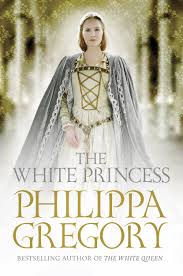
the white princessI’m undergoing quite a lot of shifts in my creative work these days, and as a result, I’ve been reflecting on my reading habits.
Bit not good, as Sherlock would say.

I read woefully little fiction. My bad.

If you want to be writer, you need to read. And read lots. And I do read lots. Its just that most of what I read could be loosely classed as ‘self help’ and history. Let me explain:

A little while back, everyone was raving about Philippa Gregory’s Cousins War novels, which tells the stories of the women involved in the Wars of the Roses, during the late Medieval period. I’d read Gregory’s ‘The Other Boleyn Girl’ when it first came out, because I’d read something similar by Jean Plaidy as a girl, and liked it well enough. I tried the first book in the series, The White Queen, but couldn’t get on with it. So, on the basis (again) that I had read something similar by Jean Plaidy, I decided when The White Princess came out, with its plot about Elizabeth of York, mother of Henry VIII and wife of Henry VII, that it was for me. I bought the book and settled down for a good read.

What a miserable book.

I have clawed my way wretchedly through it. I’ve only got a few chapters left, but every time I pick it up, I am seized with a bout of miserable gloom and depression that can go on for days. I just can’t stand it. I’m determined to finish the beastly thing, just on the basis that I refuse to let it beat me, but dammit if it isn’t the most spirit-crushing book I have ever read. And I’ve read ‘Middlemarch’! Now everyone is telling me that I must read Hilary Mantel’s ‘Wolf Hall’, and I just know that’s going to have the same effect on me.

Is it any wonder that I return repeatedly to Terry Pratchett’s Discworld books?

I want a book to entertain me, and leave me panting for more. I want to be riveted by every turn of the page. Its not that I don’t want conflict. I love conflict. Conflict is what makes a plot irresistible. Without it, fiction is just a mushy mess.

But why does every book that gains acclaim have to be so bloody depressing?

Is it so much to ask for something to be a bit witty? Is it so hard to make a book hopeful in some way?

Maybe it is that I read mostly first thing in the morning, to help me wake up and while I wait for the day’s medication to kick in, and last thing at night before I sleep. What you read first thing can set the tone for your day, which is why I try to choose something uplifting. And late at night, you want to read something that will help you sleep, not leave you lying awake worrying about death and betrayal and being hung, drawn and quartered.

I have a heap of novels that friends have lent me. They seem to be mostly about the Second World War and the Holocaust, which doesn’t bode well. I tried reading Kate Mosse’s ‘Labyrinth’, but it felt too cheesy, and worryingly like Dan Brown’s ‘Da Vinci Code’, which is the only book I’ve ever actually physically thrown at the wall in disgust because it was so badly written. (How that man has the gall to teach creative writing beats me!) I love historical fiction, but I want to read good work that is recently published. And I’m fine reading contemporary set books. Why is it so hard to find something that isn’t going to make me want to slash my wrists?

Maybe I’ll just see if I can get the latest Alice Hoffman from the library. I used to read her. She was good. But if you have any recommendations that fit the ‘positive’ bill, please leave a comment below. I’d love to hear about your favourites.

In desperation,

EF

UPDATE: went to the library and found Andrew Miller’s ‘Pure’. First few chapters are beautifully written, even if it’s a dark story. I’ll let you know if I’m inclined to slash my wrists at any point.

Inspiration Monday: Whats Inspiring Me Right Now

VW desktopFor today’s post, I thought I would bring you a little window into my creative mind.  Here are some of the things that are really getting my brain going at the moment.

This post from Kate Courageous really is causing a revolution inside my skull.  Imagine – learning to accept Nigel instead of kicking him?

Not practising enough?  Susan Piver has some interesting things to say about beating yourself up that are relevant whether you are talking about your meditation or your creative practise.

Found this lovely old post by Holly Becker on Decor8 about visual journals.  I really like this one about creating a lookbook too.

The New York Times on why handwriting matters.  Don’t say I didn’t tell you so.

The Handmade Home geniuses have their new 2015 planner out!  And yes, I am a total planner geek.  See also the fact that I have just discovered how Pinterest can feed my addiction!

I love Brainpickings.

I love iHanna’s blog, but I especially like this post – ‘Glue book where I collect happiness.’  Isn’t that a brilliant idea?  Collecting happiness between the pages of a journal.  Count me in.

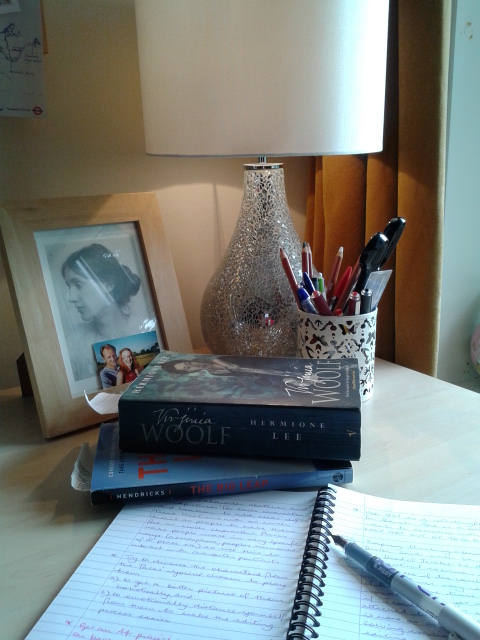
This book.  I’ve lost count of how many times I have read this biography of Virginia Woolf, but right now, every time I pick it up, I am filled with a new rush of ideas, inspiration, and fixes for my novel.

I’m loving this book as well.

Well, that should keep us all going for a while.  Hope you have an inspired and creative week,

EF


Books about Writing


Bookshelf

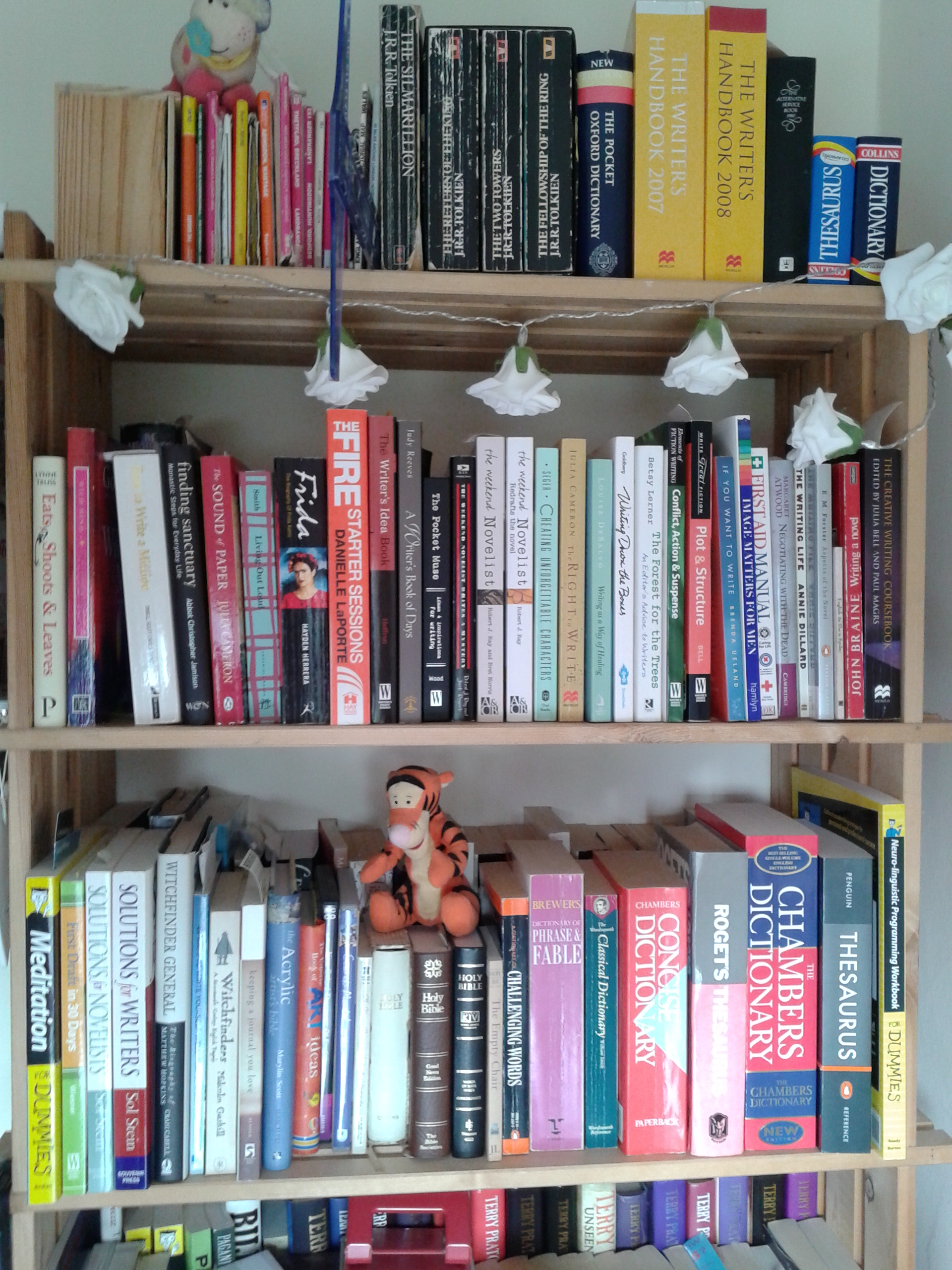
My shelves of books about writing.

I’ve made a big decision.

No, not that one.

I’ve decided not to buy any more books about how to write for two months.

Now you may not think that’s such a hard task, but I am the sort of person who likes to buy a book about a subject in lieu of actually doing it. I’m a big one for research. If I’m going to take up some activity, say, crochet for instance, then I am the one who will chug down to the library and take out all known books on crochet, in order to find out everything I need to know about the subject. For two days I read avidly and become an armchair expert, without even touching a ball of wool. And then I lose interest and the books gather dust on the coffee table until they have to be taken back to the library before I get fined, no crochet having ever been done.

I’m the same with books about writing.

Once every three or four months, or so, I resolve ‘to take my work more seriously’. This usually involves going in to work with my husband, who is a University lecturer, and settling down in the campus library to tap away on laptop undisturbed. (Never mind the fact that I really struggle to visualise and write in that library, but there you are!)

To get to the library, I have to walk past a bookshop.

(If you love books, you just know where this is going to end, don’t you?)

Add to this the fact that this University runs one of the first, and still best, courses in Creative Writing in the world, whose alumni include the likes of Dame Hilary Mantel, Kazuo Ishiguro and Ian McEwan. You can imagine how good the bookshop’s section of writing is.

Let me tell you, it is hell to walk past.

This is the reason why the bookshelf beside my desk is so crammed with ‘How to Write’ books. I buy a book every time I decide to ‘get serious’, because of course, buying a book is a prerequisite of ‘getting serious’. I’ll read a few chapters. And then I get bored/move on/get ill/realise its shortcomings/decide I want to take up crochet instead etc. So now I have a bookshelf full of books about writing and how to write, many of which are very, very good, dozens of which come highly recommended by friends and in other books about writing, and almost none of which I have ever read cover to cover.

Just call me a butterfly.

Today is another of those ‘I’m going to get serious’ days. Today I am not going to buy a book.

This is partly because I am completely broke, and saving up for a new pair of spectacles because the ones I have got are close to useless and I’m fed up of having to take my glasses off in order to read.

But mostly because its because I need not to read about writing and how to write, but to actually DO it.

You can’t be a writer unless you actually write. And when you write, you learn far more about writing than you ever could from a book.

Books about writing are great. Don’t get me wrong. I’ve got a lot out of them. But there comes a time when you have to leave them alone and learn by doing.

I’ll let you know whether I stick to my guns or not, though I have to say I don’t think my groaning bookcase can survive even one more purchase!

Happy Creating,

EF

Choosing the Next Thing

go away bagI came back from Scotland with a marked desire to embark on a big project.  I suppose this isn’t something new, but is a desire I have been nurturing for a while.  It represents the need to get away from writing what are essentially someone else’s characters, and write my own.

I need something to get my teeth into, a full length novel to help me get my confidence in my ability to actually write something BIG back.  Its been a long time since I finished anything substantial in terms of original work, and I need this.

I was reading this article by justine Musk, in which she talks about some writing advice she was given by a teacher:

“Will writing this book change your life?” the teacher asked me. “If the answer is no, then that’s not your real baby.”

If we write our own psychodramas, if we write our way to self=knowledge, then I need something that reflects the place where I am in my life at the moment.  A novel that parallels my own journey.

I sat down with my notebook and wrote about the four projects I could choose from:  two Victorian novels, one Evenlode book, and one fantasy story.  Then I picked one of the Victorian novels and tried to write a little bit in the voice of the protagonist, mainly because I am struggling with making her a three-dimensional character, which is what has stymied progress so far.  And suddenly, everything made sense.

This novel is about being who you truly, authentically are.

And that is exactly where I am in life.  I am trying to own and be who I really am.

So in order to make the protagonist realistic, all I have to do is write her as me.  My voice, my problem, my reactions and interests.  Its not the way you are supposed to write a character, but it is a way into creating her in a believable way.  This way I can explore her voice and see the story from her point of view.  This pretty much buggers up everything I’ve previously written for this project, because its all third person, and varies the voices through each of the three main characters.  But that approach didn’t gel, which is why it didn’t get any further.  Now maybe I can find a way in.

And then all I have to do is to stick with it until its done.

I have no idea whether this will work.  Maybe this time next year I will have completed another Evenlode novel instead.  You never know.  What I don’t want is to still have four unfinished works in the pipeline by then.  I need to finish something.  So I’m going to ride this wild donkey side saddle, and see where it takes me.

Wish me luck,

Happy Creating,

EF.


Inspiration Monday: In Utero

(And just in case you are wondering, I am not pregnant.)

“I’ve got a story coming on.”

This is what I generally say when Husband asks me why I’m being so grumpy and uncommunicative.  Its the time when I am lost in ideas, fermenting, cogitating, incubating.

This is sometimes not an easy time for the person or people who share your life.  They may feel like you are being deliberately distant.  Its always worth explaining that you still love them and want to be with them.  If you have to go away inside your head, it is because your Muse is kidnapping your brain.  Reassure those you love that you will be back with them soon, and its nothing personal.

This is also a time to be compassionate towards yourself.  If you are absorbed in your new project, you may have new ideas flooding your skull every which way.  It can be exhilarating, but it can also be exhausting.  Remember to take a breather if you can.  It will help the details to accumulate in your head in the meantime.

If you are suffering from the ideas overload that sometimes comes with a new project, when you are overwhelmed with all the brilliant concepts for other things you could be doing as well, write them down.  Write everything down.  You can always come back to them, but at least you will have a record of them when the deluge ends and the drought sets in.

You might be so excited by your new idea that you want to get started right away, like, yesterday.  Well, maybe.  But don’t jump the gun.  Give yourself some time to think things through.  Make lots of notes – this is what your writing notebook (or journal or sketchbook) is for.

Be thorough.  Take notes verbatim from  your Muse.  Don’t rest on your laurels at 3am and convince yourself that you are going to remember that brilliant flash of inspiration, because chances are, come breakfast time, the little sucker will have sneaked off into infinity, and you will spend the next week banging your head against the wall, trying to remember exactly what it was that was so bloody good that you thought you’d undoubtedly remember it.  (This is especially important as you get older, believe me, so its a good habit to start NOW.)

It can be worth exploring around your idea too, digging around in the associated issues, examining messages linked to what your story or painting will say.  But don’t get side-tracked by research at this stage.  This is a pit with spikes at the bottom, and I for one always seem to end up falling into it.  The problem with the pit of spikes (research) is that:

a) You can lose touch with the original idea and its uniqueness to you.  I was once on a writing course with a man who was fascinated by the concept of how ‘shell shock’ was dealt with in the First World War.  He had done so much research into it that there wasn’t a thing he didn’t know.  The trouble was that all the research had led him to the conclusion that the novel he had to write was pretty much a re-run of Pat Barker’s peerless ‘Restoration’, and why rewrite a novel that has already been written far better than you ever could?

b) You can get side-tracked BIG TIME.  I got so lost in researching my first novel, which was set in the Iron Age, that it took me seven years to write the first draft.  By the end, I was so exhausted, I couldn’t face editing it, so I gave up, and it now sits in a folder on the shelf, seven years of work gathering dust.

Allow your idea to emerge without influence, or at least without any influence that isn’t already within you.

One final tip I would add is: don’t share yet.  Not even with your Significant Other.  Give yourself time to polish the corners off and get things into some semblance of order.  Honour yourself and your project with private time, in utero, so to speak.  No one else can share the link between a mother and her baby while it is in the womb, no matter how much tummy rubbing and singing to the bump takes place.  You are feeding your project baby through an umbilical cord that runs solely between you and it.  Take as much time as you need to nourish and birth it.   You will know when is the right time to bring your baby out into the light.

Happy Creating,

EF