Category Archives: Writing

Losing myself amongst the ‘Woolves’

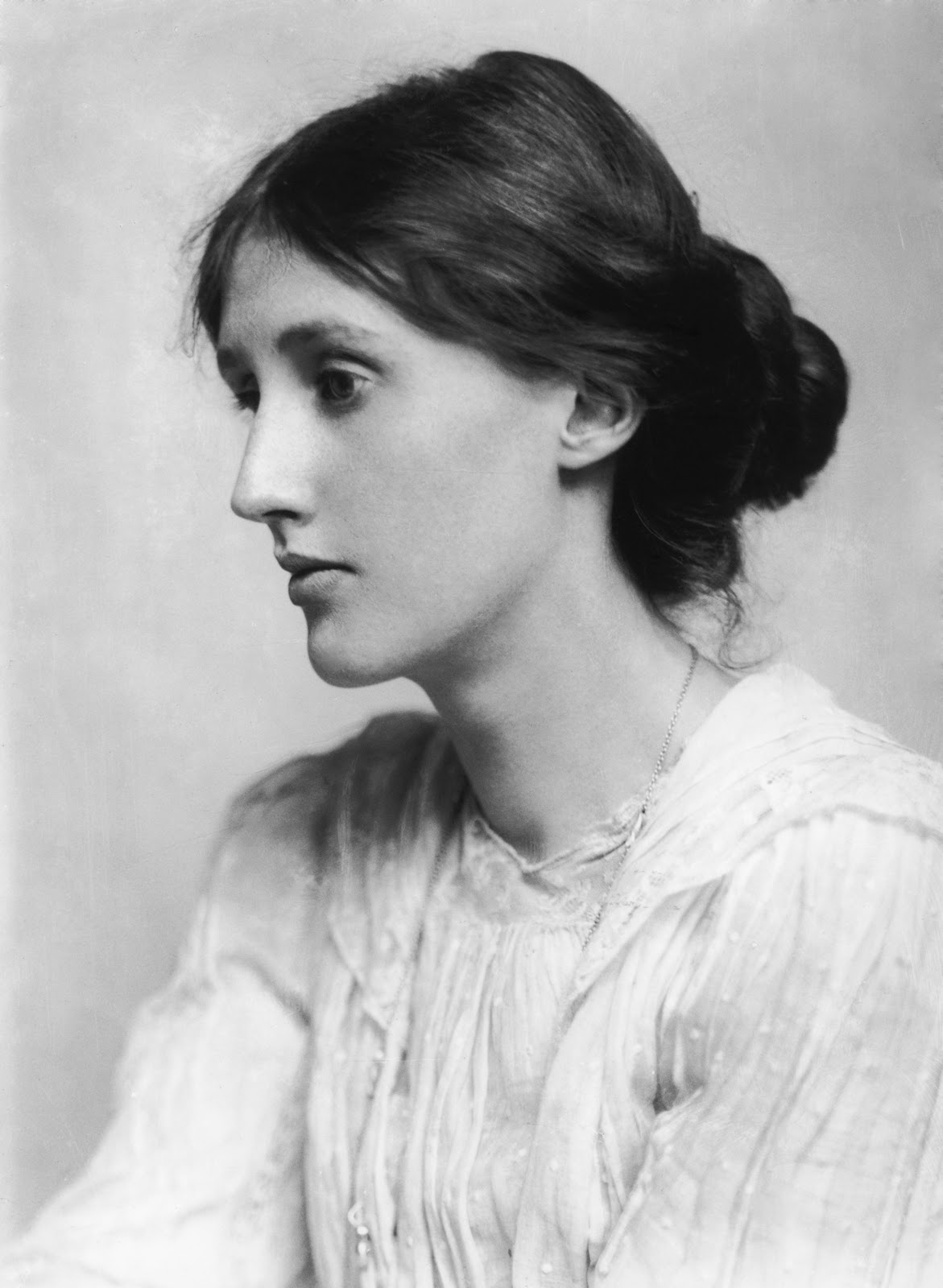
Virginia Woolf as a young woman.  I keep a copy of this portrait on my desk.

Virginia Woolf as a young woman. I keep a copy of this portrait on my desk.

So I spent Monday in London, escorted by my wonderful fangrrrl niece Amelia, at the ‘Virginia Woolf: Art, Life and Vision’ exhibition at the National Portrait Gallery.  And it was wonderful.

We saw innumerable portraits and photographs, but I think the personal papers were the most moving.  There were pages from her diary describing the bombing of Leonard and Virginia Woolf’s Tavistock Square home in October 1940, the original manuscript of ‘A Room of One’s Own’, love letters from Leonard written before their marriage,  and most moving of all, the little note she left for him when she set out to drown herself in the River Ouse in 1941.

One of the things that particularly struck me was that Woolf bound all her own notebooks and manuscripts, having taken bookbinding lessons in her teenage years as some kind of therapy for her mental illness.  The result was that she could make the perfect notebook for her own needs – which is, for a stationery addict like me, absolute nirvana.  Her books are big, too, slightly larger than A4, leaving plenty of space for her to explore her ideas.

Another interesting detail for me was that the page from her diary about the bombing had no crossings out on it at all.  My diary is a veritable Somme of scribblings-out, but she wrote a stream of consciousness with a self-assurance that seems absolute.  She had no doubts about what she was trying to convey.

The original copies of her books, published by the Hogarth Press, which she ran with her husband, still with their book jackets designed by her sister Vanessa Bell, look crisp and radical even now.  Amelia (a bookseller) and I both commented on the fact that the many editions of the novels for sale in the gallery shop had an assortment of different covers, none of which were so attractive, expressive, and frankly Modern-looking, as the originals.

Woolf is my writing hero for so many reasons.  She battled mental and physical illness, misogyny, and childhood sexual abuse to become one of the greatest novelists of the 20th century, reinventing the novel form in a way that would be emulated and built upon in succeeding decades.  She was self-educated, too, and could read Greek and Latin, despite the fact that her parents refused to send her to school as they did her brothers, a fact she railed against.

She is often criticised for being classist and racist, but I would argue that she was a product of her time, and it is to her credit that she did so much to counteract the snobbery and distrust of the working classes, which she inherited from her social millieu, through her political work.

Virginia Woolf was a great writer and feminist, a patron of the visual and applied arts, and a creative giant,  as well as a truly great human being who overcame enormous adversity to achieve what she did.  If you cannot get on with her novels, I wouldn’t judge you, but I urge you to dip into her enlightening and often witty diaries for inspiration on how to live a creative life despite so many difficulties.

Happy Creating,

EF
Unexpected Attack of the Killer Critics

“Well, it smacks of arrogance to me,” she said, when I explained to her what a blog was.  “To assume you have something to say that anyone would want to read.”

After that, I admit I lost track a bit of what she was saying, distracted by the fact that the word ‘ARROGANT’ seemed to be written above our heads in flashing red neon capitals.

And then was somehow branded on my forehead.

This, from a long-time friend, someone I have known for many years through both ups and downs, hers and mine.  I thought she knew how much my writing meant to me,  I thought she understood,

Of course, it all comes from fear.

Fear that the world is changing, and she doesn’t understand it.

It is fear that makes a person, however intelligent, assume that because they don’t understand something, it has no value.  The irony of this position is that it puts the fearful person in the centre of their universe, which is as good a definition of arrogance and egotism as I have seen.

Driving home, I realised my heart was hurting.  I looked up at the sun piercing shafts of silvery light through the evening rainclouds (“God speaking”, as my mother says whenever she sees such a sky) but I couldn’t see the beauty of it.  I was hurting too much.  But it won’t stop me, her criticism.  I will make lemonade.

Why?

Because I can’t not write.

Regardless of whether anyone thinks that what I have to say has merit (and I know some of you do because you kindly subscribe, favourite, like and comment, for which I am eternally grateful), I will go on writing because I am compelled to write.

Because its my job.

It’s my life’s work.

Its what I do.

I don’t get paid for it – not yet anyway, though I have hopes.  Some friends still don’t get that, either.  Their measure of success comes in pound notes.  They can’t understand my ‘failure to monetize’.  They don’t understand that to me, success means averaging 400 readers a day of my fanfiction, over 400 subscribers to this blog, or on some days, just managing to write two or three coherent sentences.

My critical friend doesn’t understand the compulsion to be creative, to have a voice.  She doesn’t get that if I don’t write every day, I turn into the Evil Twisted Passive-Aggressive Psycho-Bitch from Hell.  And she doesn’t understand that:

EVERYBODY HAS THE RIGHT TO SPEAK THEIR OWN TRUTH.

So if you take nothing else away from my work, and from my complaining about my thoughtless friend, or why money-oriented people don’t understand creativity as an end in itself, please take this:

SPEAK YOUR OWN TRUTH.

IT IS YOUR RIGHT.

This is my message to you, and whether it has merit or not, it is my life’s work to say it, over and over again.

Happy Creating,

EF

Inspiration: Sucking up History

20140927_135032As a special treat last weekend, Husband took me to visit a local National Trust property, Oxburgh Hall.

Built about 1482, Oxburgh was the home of a well-connected family who hung onto their Catholic faith throughout a period in English history when it was dangerous to dissent from the religious line the Crown laid down.  Oxburgh’s inhabitants  suffered as a result, passed over for lucrative posts at Court, closely watched for sedition and treason, and restricted from certain occupations as well as from celebrating their religion openly.

The result of this (relative) penury is that the building escaped the zealous passion for updating property that characterised the aristocracy, and many of its original features remain intact, including the King’s Room and the Queen’s Room, authentic Tudor bedchambers in the tower house that spent many years used only as storage spaces!

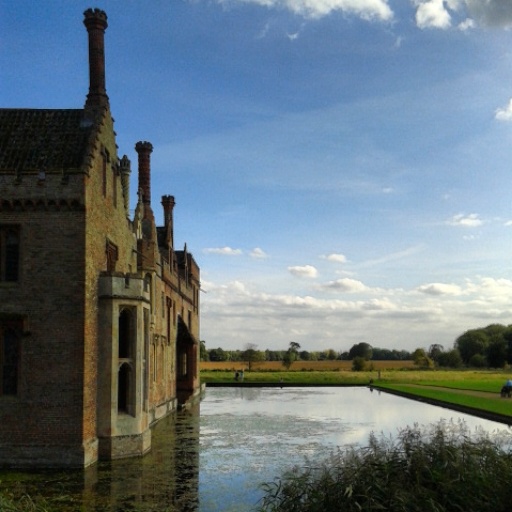
Oxburgh Hall:  The Moat

Oxburgh Hall: The Moat

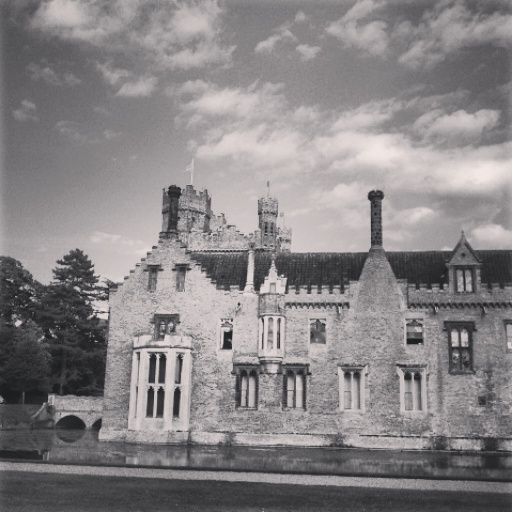
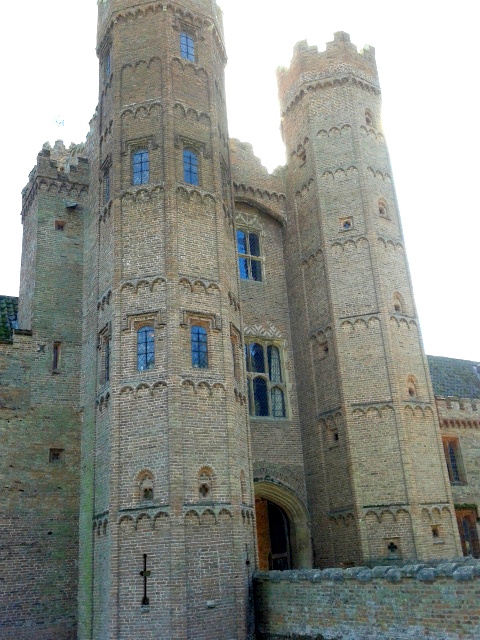
Oxburgh appears to float on its moat, which cannot be drained as the 500-year-old elm wood posts which support the foundations would crumble were they to dry out.  It still has the barleysugar chimneys and characteristic towered gatehouse that recalls the Wars of the Roses.  Inside the sombre portraits of nuns, the needlework sewn by Mary, Queen of Scots in her years of captivity, and the Priest Hole, where illegal Catholic priests had to hide from government troops, speak of a dark history of dissent and risk, of members of the family living in fear for their lives, simply because of their religious beliefs.  Oxburgh was a particular target during both the Reformation and the Civil War.  And yet, despite this, the little rowing boat that floats beside the steps on the moat is  named ‘Le Boat sur le Moat’, so the family still kept their sense of humour!

I started wondering what it would be like to live through that?  Never to be able to trust your neighbours, your servants, even your family?  To live constantly in the shadow of the block?  To live in fear of the next knock on the door?  To question your beliefs every day because they challenge your personal safety and that of those you love?  To always be regarded as ‘Other’?

Oxburgh Hall

Oxburgh Hall

The history around us gives us an opportunity to look at our own lives through a different lens.  What happened in England in the 15- and 1600s is not really much different to what is happening in parts of the world now.  Being inside a building where these things happened, seeing and touching the belongings of people who lives through such terrifying times, brings the realities home in a much more deeply felt way.  If we do not live under such stresses ourselves, we can never truly understand what they mean, but we can imagine.

I live in a house that was built in the 1880s.  Its just a little country cottage, the middle one of a row, the kind that are common in the UK.  It was originally built as two houses, one up-one down dwellings with an outside wash house, coal hole and privy each.  The men who lived here worked for the local Lord as farm workers or gamekeepers, and got the house as part of the deal.  Their women kept the house, cooked the meals, raised the children, and spread their washing out on the pasture behind the houses to dry on wash day every week.  The children would have walked across the fields to school each weekday, and worked alongside their parents when they got home.  They would have worshipped at the medieval parish church whose tower can be seen from our livingroom.  How different the lives of those souls would have been from mine.

Inspiration:

Think about historic buildings and places near where you live.  try to visit one or two if you can.  They don’t have to be as old as Oxburgh to count.  What about a coffee shop built in the 1930s, during the Depression, or a 1950s diner?

Take some time to soak up the place.  Think about the people who have lived and worked there.  How would the community have reacted or been affected when the building was put up?  They might have had to sacrifice their own land or homes, for instance, or they might have objected on moral or economic grounds.  How would it have felt to visit this place in those days?  What kind of day to day issues would have been on the minds of those who lived here?  What stories are concealed in their lives?

Take some time to write a few pages, answering these questions.  It doesn’t have to be historically accurate, but it helps.  Use the building or place as an entrance into someone else’s life and see where it takes you.

Happy Creating,

EF


The Book List

Some books here are waiting to be read.

Some books here are waiting to be read.

The other day, a friend challenged me on Facebook to name the top ten books that had most influenced me in life. It was one of those things where you give your list, and then challenge your other friends.

So far so good.

But how the hell do you choose, especially as the challenge specifies you do it off the top of the head, without thinking too hard, as fast as possible. How do you choose only ten books out of all the great novels and stories you have read over a lifetime?

My list was visceral, and based largely on what I read when I was younger. I thought about the books that had made me happiest, that I have gone back to over and over again in the course of my life. And it was interesting just to reflect on my criteria for choosing, as much as anything.

So here is my list (verbatim):

“1. Finn Family Moomintroll by Tove Jansson
2. Jane Eyre by Charlotte Bronte
3. Good Omens by Terry Pratchett and Neil Gaiman
4. Lake Wobegon Days by Garrison Keillor
5. Virginia Woolf by Hermione Lee
(gosh this is hard)
5. The Count of Monte Cristo by Alexandre Dumas (kept me sane in the run-up to my wedding)
7. Antrobus Complete by Laurence Durrell
8. Persuasion by Jane Austen
9. Practical Magic by Alice Hoffman
10. Rebecca by Daphne du Maurier (obvious)”

I ended up with about 15 that didn’t quite make the grade, and if I think too hard about it, I would definitely shift a few from one list to the other.  I mean, how do you choose which Terry Pratchett?  The above was my original choice, and I think I’ll stand by it.

And then I challenged other friends. And like Japanese knotweed, lists of novels and non-fiction books blossomed out all over. Everyone had a fascinating new combination of books they raved about. Many, like Sebastian Faulkes’ ‘Birdsong’ and Camus’s ‘The Plague’, were held in common. Lots of lists were biased towards ‘we did that one at school’ books. I marvelled at the wide range of stories that had influenced my friends.

And I felt like I had barely read anything worth reading since I left college.

I suppose this is understandable. When you see a list of books, you always look for the familiar ones. And if the ones you have read are in the minority, you feel like a fool for not having read the others. Especially the significant ones. On the other hand, who the hell has read the whole of Proust’s ‘Remembrance of Things Past’, or ‘War and Peace’? (I have to say I was impressed by the number of people who had read Dostoyevsky’s ‘Crime and Punishment’. Kudos!

There are woeful gaps in my reading, despite what friends who always see me with a book might think. This is especially true these days, when I am so addicted to the quick highs offered by every morning’s new crop of fanfics. I have not read many European novels, or the Russians. I don’t know Kazuo Ishiguro or Graham Greene, Iris Murdoch or GK Chesterton. Or Kerouac, despite having a degree in American Studies. I read one book from last year’s Man Booker shortlist (Ruth Ozeki, ‘A Tale for the Time Being’), and that was because it looked like the easiest. (It was fantastic.)

Writers must read.

It is one of the basic pillars of the Craft. And you have to read the good stuff as well as the commercial, otherwise you never improve. Making this list made me realise how little decent fiction I have read in recent months. Time to get back to it.

“I mean to read myself blue in the nose.”

Virginia Woolf.

When I began my Diploma in Creative writing, we were given a list of novels and volumes of short stories to plough through as precedents, much as art students must analyse the works of the Masters, sitting in galleries for hours on end, studying Goya or Rembrandt. I found an old bookmark from those days, a list of novels scrawled on it, each title with a line scored through it as I completed it. (A couple of loose ones at the end remained unread.)

I need to do the same again.

This morning I found myself in a bookshop, gazing longingly at table after table of lovely crisp new novels. (It’s the time of year that provokes me – September draws me into bookshops still, an echo of student days of joyful bookbuying with a free conscience!) But I was good. I left the books uncaressed. I have piles of unread novels at home, you see, amongst them ‘Birdsong’, along with Tim O’Brien’s ‘The Things They Carried’, Jonothan Franzen’s ‘The Corrections’, and dozens of others, all highly recommended as quality fiction for the budding writer, and all gathering dust on the shelf. No point in buying new ones until I have ploughed through the old ones.

So I will cut a strip of paper and write a list of the books in my pile on it. And then I will begin. And each time I close the back cover a book and sigh with completion, I shall draw a careful line through the title and pick up the next.

Happy Creating,

EF


The Benefits of Giving Up

The Cumberbatch

Gratuitous Cumberbatch photo. Just because I felt like it!

Dear Reader,

I want to tell you about why its sometimes a really good idea to give up.

You weren’t expecting that, were you?

In my last post, I wrote about the folly of trying.  Of pushing ourselves beyond endurance, and as a result, being unable to achieve the things we want.

That post was an example of me writing my own permission slip.  That day, I took my own advice.  I gave up trying.  I spent a lot of time just lying around.  I felt terrible, so why do anything else? I simply surrendered to what my body was trying to tell me.  Which was, in essence, ‘STOP’.

So far, so good.

The next day, I woke up at 8.30am, earlier than I am normally able to do, and in addition, woke with a clear head.

I grabbed my laptop and opened it up.

And I wrote.

I wrote all day.

In between spells of writing, I stripped the bed, put clean sheets on, did three loads of washing, tidied the kitchen, ironed some fresh pillowcases, made some long overdue phonecalls, and cooked a lovely supper for Husband and myself. I got so much done!

By close of play, i.e.11pm, I had written (get this) 6470 words.  Thats 27 pages.

The most I have ever written in one day.

(Round of applause, please.)

And all because I had given myself some much-needed space.

This is why you must learn to stop.  Yes, it is important to write every day.  Little and often is imperative.  Regular practise for any art form is necessary.

And there will be days when you sit down at your desk or in your studio and think:  ‘I really don’t want to do this today.’  And when you start, the brush strokes will be ugly or the words will come out like lumps of lead.  And then you will get going and things will flow and it will be alright.  (In fact it will be better than alright.  Because all the pain and depression you may have been struggling with will fly away, and creating will heal you.)  That is the point of any practise.

I am not saying you should only write when you feel like it.

What I am saying is that you must recognise that there are some days when your body is leeched to a husk, when your brain is too full or too empty to do anything but be.  Those are the days when you need to be gentle with yourself.  To put away the expectations.  And you will know those days.  The days of crisis.  The days when Life just steps in and pulls the carpet from under you.

If, like me, you live with chronic illness, working out which those days are becomes a little harder.  After 17 years, I am getting better at it, but I’m still not great.

The important thing to remember is that when you release the pressure on yourself, the result is often magic.

Its very Zen to say: let go of perfectionism, let go of expectations, but its easier said than done.  We all carry expectations from society, our upbringing, our peers and ourselves.  Letting them go is a daily practise in itself.  I am reminded however of an old saying I once heard:

“Let go, and Let God.”

Once we stop trying, once we stop tensing up and forcing things, the creativity flows through us freely onto the page or the canvas or the keyboard.  When we are free to make crap art, we learn.  And invariably, in my experience at least, when we give ourselves permission to make crap, what comes out is pure gold.

So here I am, in the aftermath of this great day of writing, assessing what I have learnt, what I can take with me from this experience.  I don’t know if what I wrote yesterday was gold or dross.  Chances are it will be about 50/50.  I don’t really care.  To be frank, it was fun.  It was an enormous relief just to spread my wings and fly without judging myself at all.

And I’m looking forward to doing it again just as soon as I can.

Happy creating,

EF


The Folly of Trying

My counsellor told me a story:

A man was asked at a conference to come up onto the stage, where the speaker had set a single chair in the centre.

‘Try to pick up the chair ,’ the speaker said.

The man picked up the chair.

‘No, you’re not getting it,’ the speaker said.  ‘Try to pick up the chair.’

The man picked up the chair again.

‘No, you’re still not getting it.  TRY to pick up the chair.’

The man put his hands on the chair and then, in a flash of inspiration, he understood.

Because TRYING to pick up the chair is not the same as picking up the chair.

If you TRY, you never actually achieve the action.  You just TRY.

Or, as the venerable Yoda said, in ‘The Empire Strikes Back’:

Try not.  Do.  Do or do not.  There is no try.

(I had that on my door at college.  I don’t think I understood it then.  Now I do, I really, really do.)

This wisdom has really been banging on my door today, as I struggle with a cold, coming on the back of a bad spell of IBS and ME/CFS.  I am busy TRYING.  Trying to get better.  Trying to feel well. Trying to cope with the housework. Trying to write.

Sometimes you have to recognise the wisdom of ‘Do or Do Not.’

Lately, I worry that this blog has become more about illness and less about creativity.  More about my TRYING experience.  But I think it really is an important lesson to learn for creative people.  We push ourselves and push ourselves, driven by expectations and perfectionism and Gods-know what demons we have inside us, deftly planted there, no doubt, by our loving parents. We dance the dance of the OUGHT-hogs.  The SHOULDS.  We are so busy forcing meaning into our lives as creatives, as Eric Maisel ill-advised (IMHO), that we pulverise our souls and our bodies into gibbering wrecks, terrorised by all the goals we fail to achieve and the standards we are incapable to meeting.  Books about how to write invariably advise the student that they have to write every day, no matter what.  I don’t think thats healthy or, frankly, practical.  Of course, it helps if you can.  A lot.  But seriously, who can write when their child has been up all night vomiting, or they have just received a redundancy notice?

Sometimes you have to treat yourself with loving kindness.  Sometimes you have to lower your expectations, and maybe even give in to the avalanche that Life has dumped on your head.  I have been talking to several friends who are all struggling with ill health this week, recovering from cancer treatment or at the end of a difficult pregnancy, or even in bereavement, and I truly believe that this is something all of us needed to hear.

Sometimes you are allowed to stop trying.

Sometimes its good to stop trying.

And then, when you have given yourself a break, a rest, a time of wound-licking, you can get up and go and do what it is you need to do.

MInd you, I have probably just proved myself wrong by writing this blog post, because I’ve spent the last six hours lying in bed groaning, absolutely convinced that I couldn’t write anything today.  So there you go.  Take from that what you will.  Just promise me something?

BE KIND TO YOURSELF

Happy Creating,

EF


Life – A Work in Progress

Saxlingham Summer Blues:  Partially finished, hand stitched quilt made by me.  Each square is 4x4cm.

Saxlingham Summer Blues: Partially finished, hand stitched quilt made by me. Each square is 4x4cm.

One weekend, I found myself doing some major revisiting.  Old issues, old passions.  Let me explain:

I was having a clear out, and I opened a box to find a large stash of fat quarters.  Patchwork and quilting enthusiasts amongst you will know what I’m talking about.  Fabric shops sell specialist, high quality cotton patchwork fabrics in small amounts, as well as by the metre – by the quarter yard or metre, in fact, or, in the trade, ‘fat quarters’. (Don’t ask me why ‘fat’ ones, I have no idea.)  They are much cheaper and allow you to build up a big selection of colours and designs for patchwork projects with a lower investment, because you usually need fairly small quantities for such projects.  Every quilter will have such a treasured stash.

I haven’t done any patchwork in quite a large number of years, and I don’t see myself doing any again for a while, if at all, so I decided to hand my stash on to someone who would use it.  Going through the wads of cloth reminded me of the time in my life when quilting was my main creative outlet, of the colours and patterns I was into then, of William Morris, the Pre-Raphaelites, of earthy reds and browns, and sage greens.

I’m a different person now.

I’m all grey and blue and white and Modernism these days.

It is not that these old perferences have dated.  Its just that I have moved on.

Later that same weekend, I found myself discussing an old trauma with dear friends, something that happened long ago, but that is an underlying influence on my life even now.  I have processed so much of the pain and damage of it that it has become part of the landscape of my life, as much as the tree outside my gate, and like that tree, I acknowledge its structuring presence, but I rather take it for granted, and essentially ignore it unless it specifically comes up.

And when it came up, it raised with it new issues.  I realised I would have to revisit my past, and look at old hurts with new eyes.  As I do so, I realise that I am a different person now, that I have come a long way.  On our journey through life, we bump up against some issues repeatedly, and its easy to get frustrated when this happens over and over again.

Life is not a circle

Bad, hand drawn graphic of how I’m trying to explain this…

Our lives are not circles in which we come up against the same old stuff every time.  Each time we encounter them, we are further along in our healing process.  Life is like a spiral.  Each time we encounter our pain, we can see it through a new perspective.  It re-emerges for a reason, because more healing is needed, more work must be done.

Another bad, hand drawn graphic to illustrate how we encounter triggers as a spiral on our life journey

Another bad, hand drawn graphic to illustrate how we encounter triggers as a spiral on our life journey

It took me a long time to understand that I was not a bad person because my tastes changed over time.  There is nothing wrong with leaving old interests behind and developing new ones.

Going back over old hurts doesn’t make me a bad person either.  When there are new things I need to explore about them, it is okay to do that.  Writing helps.  I am now able to engage with my old wounds through my writing.  Last time I did so, the result was one of my most popular stories, ‘The Case of the Cuddle’.  Now I find myself finally working with commitment on its long-anticipated sequel.

I wasn’t ready to do it before.  I did not have the impetus.  Now I need to speak the truth that its plot entails.  If I cannot do it in my own life, then I can do it through my story worlds.  I thought I had left the ‘CuddleVerse’ irrevocably behind.  I thought I was healed.  Now I understand, that healing, just like creativity, is a process.

I can’t tell you when the final installment will be ready to read.  I can’t even tell you if it is the final installment.  I may still have more healing to do.  Like the half-finished patchwork in the picture above, it has sat in a digital drawer for two years, waiting for me to be ready to handle it.

Some things we leave behind, and some things we need to come back to, time and again.

And that is part of Life – The Process.

Happy Creating,

EF


Fanfiction: Opal

Old fishing boat on the shingle in the mist.

Old fishing boat on the shingle in the mist, Aldeburgh, Suffolk.

I wish I had something fresh to offer you today, but I’m in the middle of a ‘perfect storm’ of illness, and I’m impressed I’m actually able to be this coherent!  Still, thank goodness for the back catalogue, eh?

Today you can read the last part of The Plato Series, freshly transferred to AO3, and slightly rewritten for clarity.

A little taste:

“John twisted to look at the bedside clock. ‘Oh, fuck.’

           It was half past six on Sunday morning and they were supposed to be having a lie-in. He’d arranged for breakfast in bed at 9, and everything. He’d been determined. And now this.

            ‘I get it,’ Sherlock whispered, breaking his train of thought.

            ‘Get what?’

            ‘The light. That’s why it’s so beautiful here. It’s the light.’ Sherlock seemed almost breathless. He reached out his skinny hand and pulled John across the bed to join him. ‘Can you see it?’”

You can read ‘Opal’ here on AO3.

Alternatively, you can read the entire series from the start, here.

And hopefully, I will be a little less catatonic by Friday!

Happy Creating,

EF


Fanfiction: Sherlock – The Plato Series

The Scallop by Maggi Hambling, Aldeburgh, Suffolk.

The Scallop by Maggi Hambling, Aldeburgh, Suffolk.

Today I’ve transferred another episode of the Plato Series onto AO3.

In ‘Diamond’, John takes a very reluctant Sherlock for a romantic weekend away, and things don’t end up going quite the way either of them expected.

A quick taster:

“Sherlock was sulking. And it wasn’t one of his run-of-the-mill sulks. It was an epic sulk. Complete with a lower lip jutting out so far he could barely walk without tripping over it. Okay, perhaps that was a bit of an exaggeration, but John had just about had enough of the whole thing.

            ‘I’m taking you away for the weekend,’ he snapped, gripping the steering wheel so hard his knuckles went white. ‘I mean, most people, most decent people, would be grateful. Some people might even say thank you.’”

You can read the series from the beginning here.

The last story in the cycle, ‘Opal’ will go up on Wednesday this week.

Happy reading,

EF

I want to talk about Truth

sussex churchI was having a conversation with a friend who is a songwriter.  A lovely, talented man.  He has left his old pattern of working, writing what he described as ‘pop songs’ in pursuit of his own, original voice.  He wants to be true to himself.  He says he has yet to find his own voice, but I am sure he’ll know it when he does, and it will be a truly special and deeply needed contribution to the world.

For me, this summer’s events have echoed continually his struggle.  I have time and again come up against issues surrounding truth-telling, authenticity, and being heard.

We all need to feel heard.  We all need to feel that our message has got through, that we are understood.

We each have a unique voice, too.  Maybe we don’t need another historical novel, or a pop song, but we need the original perspective of the person making that piece of art, because everyone has one.

Everyone has a unique experience of the world.  No one, not even a twin, can have exactly the same perspective as you, because no one has the same thoughts and reactions, or the same past, to bring to an event.

YOUR TRUTH NEEDS TO BE TOLD

I can’t count the number of times I have looked at what I have written or drawn and thought: ‘Gods, this is shit!  I’ve got nothing new to say.  Its all just copying.’

(Incidentally, there is nothing wrong with copying as a practise to learn an art form.  Its been used in art schools for centuries, and if you go into any great gallery, you will find students sitting on little fold chairs in front of paintings, copying away.  Presenting someone else’s work as your own is quite another thing, however, and its nothing short of stealing.)

Eventually, I will find my own, unique voice.  Perhaps I already have, I’m not entirely sure.  But I have my own opinions, my own truths to tell, things that no one else can share with the world.  No, the world may not need yet another historical romance novel, but it may just need mine.

After forty-odd years of being in this world, this is what I know:

We are all unique.

We all have a story or truth to tell.

We all have a right to tell that story or truth in whatever way makes sense to us.

We all have the right to be heard.

We all have the right to develop and acknowledge our own voice.

If there is one thing I want to say to you this weekend, it is this:

TELL YOUR TRUTH

You might find the following links useful:

This, from Liz Lamoreaux, about truth-telling.

This, from Andrea Sher, about the gift of allowing others to help and comfort you.

And this, which is one of my most popular stories, but which was probably the most difficult thing I have ever written, because it comes from a place of deep truth for me.

I can’t sign off by saying ‘Happy Creating’ today.  I just want to ask you to somehow, in whatever way you can, to tell your truth,

With love and thanks for your support,

EF