Retreat Debriefing

The house is cold and damp, and the fridge is empty.  Coming home from a retreat can feel a bit like being marooned on the shores of real life after a blissful dream.  It is wonderful to have your own space, and three two-course meals a day, plus a continual stream of tea and cake, laid on for you.  I feel as fat as a walrus.  Two and a half days with nothing to do except write, and talk about writing with your writing friends – it’s hard to beat.

As idyllic as it sounds, it can come as a bit of a shock to start with.  I woke up on Saturday morning and immediately plummeted into a panic attack of ‘Oh, Gods, I can’t do this!’  The day stretched out before me, packets of emptiness between appointments with the dining rooms.  Just me and my four walls, my pen, paper and laptop.  Suddenly writing was inescapable.  No more displacement activities.  There are only so many indulgent baths and long, breezy walks you can have before you can no longer avoid the inevitable contact of nib with paper.

By about 11.30am on Saturday morning, I had done every displacement activity available to me, and there was no choice but to get down to it.  I opened a fresh page of my notebook and off I went.

And it was wonderful.

I wrote and wrote and wrote.  I didn’t judge or edit myself.  I put down everything that came into my head, page after page of it.  Story after story fell onto the paper.  My two favourite pens ran out in the course of the weekend.  By afternoon tea at 3.30pm, I had 12 pages of A4 paper covered with my spindly scribble, and I had discovered things about my new hero that I had never dreamt of.  By supper time, I had two pages of polished script to read out at our evening meeting, where we gather to share our progress so far.  On Sunday morning, again about 11.30am, I started again, and by lunchtime had an idea of what research I would need to do, and a list of indigenous names for my characters, gleaned from the one book I had bought with me for research purposes.  By tea time I was exhausted but happy.  I had worked so much out.  I had a better idea of what needed doing next.  And I had learned to write lying down on my back (which became necessary because my back has really been playing up the last few days, and sitting up proved a nightmare).

I felt a bit dazed when I got home.  I stared at the telly for a couple of hours and then went to bed.  This morning, when I woke up, I felt slightly hung-over.   Just as you can eat and drink too much, it seems you can write too much too.

So I am having a bit of a day off.  I am just lolling about, digesting the weekend, getting my head around this week’s diary appointments, catching up on the laundry, and reading comforting books.

Tomorrow I will start again.  I will get back to my blank A4 pages and start downloading backstory with my biro, and my soul will soar.  In the meantime, I think a little time on the yoga mat may be what my back needs!

Happy creating,

EF

Friday Quick Fic: Dead Men Don’t Make Toast

This is an experiment.  I don’t think its a poem, but its not prose either.  Its Post Reichenbach – Sherlock’s dogged determination to break down John’s resistance.  This fic will not be published elsewhere.  Please comment, I want to know what to do with this to polish it more.  Thanks

Dead Men Don’t Make Toast

I.

‘You’re dead!’  John shouted and slammed the front door.

Sherlock picked the lock.

II.

Sherlock made tea.

‘You’re dead,’ John snapped.

The tea sat there, and grew cold.

Sherlock made another one.

That grew cold too.

III.

John curled up under the covers.

Foetal.

Sherlock pulled the duvet up around John’s shoulder.

‘Go away, you’re dead,’ John muttered.

IV.

Sherlock made toast.

John said, ‘Dead men don’t make toast.’

Sherlock had to agree.

V.

They were running out of milk.

What with all the cold tea, and everything.

Sherlock went out and bought more.

And some other bits they needed.

John said, ‘Dead men don’t go food shopping.’

VI.

Sherlock made tea.

‘You’re dead, go away,’ said John.

But he drank the tea.

VII.

Sherlock warmed the pizza in the oven.

It was pepperoni, John’s favourite.

‘Dead men don’t make pizza,’ John said, as he chewed resentfully.

VIII.

That night was cold.

John shivered under the duvet.

Sherlock kicked off his shoes and climbed in.

Wrapped John in his long arms and his tweed overcoat.

John said, ‘I hate you.  Go away, you’re dead.’

IX.

In the morning, Sherlock made toast.

John said, ’You make a lot of toast for a dead man.’

X.

John made tea.

%%%%%%%%%%%%%%%

Enjoy your weekend – I’m off on my writers retreat!  See you Monday xxx

EF

Preparing for a Writing Retreat

I’m so excited.  I’m going on a writing retreat!

This weekend, my writers group is convening at a nearby conference centre for a weekend of writing and eating and talking about writing and eating some more, and maybe a little bit of dozing or walking, and then some more writing.

We normally do this once a year, but this year, we enjoyed ourselves so much we thought we’d do it again at the end of the year.  So here I am, thinking about a weekend spent solely with my friends and the Work.

Over years of doing this, I’ve found I need to do a few things to prepare myself so that I get the most out of the time:

Plan:

I usually like to sit down with my writers notebook or my journal, and think about two things:

  • where I am, and
  • where I want to be.

This year I am thinking about the goals or intentions I have set myself for this website, for my publications, and for moving my writing on to the next level.  Its one of the few truly extended, uninterrupted periods I get to just write, so I like to choose a project that I can get my teeth into, but also one that really needs to be tackled.   Something pressing.

This year, I am toying with the idea of doing NaNoWriMo, because I want to crank out a novel as fast as possible.  So I have decided to lay the groundwork on this new idea, and throw myself into it, immerse myself in it as much as I can.  In previous years, I have redrafted novels or short stories, polished specific sections of a novel, worked specifically on character, or redrawn a dodgey plot.

My goal this year is especially fuelled with the knowledge that I need to be writing something original, something other than fanfiction.  Nothing wrong with fanfiction.  Its given me marvellous confidence in my work, and I love writing it.  I just think I need push myself, to do something new.

Manage expectations: 

I’m not going to finish an entire novel in a weekend.  I may even get no further than writing 500 words.  And I am okay with that.

When I first started going on retreats, I had HUGE expectations of myself and what I could achieve.  I thought I could crank out 20,000 words in two days, a third of a novel.  I thought I could create publisher-ready prose.  The truth is that even on retreat, there is only a limited amount of time, and making really good prose takes time.  A lot of time.  I have only learnt this with experience.

There have been several retreats where I have slept badly on the first night, or felt ill, and as a result have really been unable to do anything much at all apart from eat, sleep, talk with my fellow writers, and be.  Sometimes that is what a retreat is for.  I have gained from those experiences.  These days I am ready to allow my retreat to be whatever it needs to be, and to trust that whatever happens is part of the process.

So I make plans, but I don’t get too attached to them.

Be present:

Being aware of my physical wellbeing is very important on retreat, and not simply because I suffer from chronic illness.  I need to be present in my body, so I do yoga and meditate, go for walks, stand in the shower and feel the water on my skin, and take naps.  (One friend uses the annual retreat to undulge in long, hot, scented baths because she doesn’t have a tub at home!)  This might all seem time away from writing, but it is crucial.  Self care is part of retreating.  Doing these things allows me time to think about the writing, to form scenes and sentences in my head.  But it also allows me to come to the laptop refreshed afterwards.  So it is an investment in my writing, as well as my body.

Packing: 

As a result, packing right is really important.  I always make sure I take warm, snuggly clothes, my yoga mat and yoga clothes, a hot water bottle, walking boots and, on occasion, even a teddy bear for cuddling purposes.  And because I have weird dietary issues, I make sure I take an extra supply of good, healthy foods and my favourite herbal teas too.  The centre staff are really great in catering for my diet, but there are those in-between-meals moments, when what you really need to fuel the Muse is your own favourite brand of chocolate!

Be absent: 

I get very anxious when I am away from home.  I need to be grounded in my safe environment in order for my imagination to work properly.  It helps that we have been going on retreat to the same place for years, and also that it really isn’t very far from my own home, so I feel like I am on home turf.  Other people find their imagination is stimulated by unfamiliar territory.  Mine just shuts down so that my emotional system can cope with the panic attacks.

To counter this, I take music and listen to it doggedly in order to transport me to safe psychic territory.  I put on my headphones, close my eyes and fly away.  And then I can write.

It is a major diffence to how I normally write, which is in silence.  So part of my preparation ritual is to gather music around me.  I make playlists for different characters, delve into iTunes and my CD collection,  choose music that evokes particular memories or landscapes for me, or none at all.

Allow it: 

Going on retreat is supposed to be calming, an activity to feed your soul.  Its supposed to be downtime from your usual life.  As a result it is easy to get really wound up about how good it is going to be, and then find yourself disappointed.  To feel like you just aren’t calm enough, or getting enough done, or maybe even that you are wasting time that should be spent looking after the kids, doing the washing or writing that sales report.  This harks back to managing expectations.  But it also has a deeper meaning.

you are allowed to have time to yourself

You aren’t being selfish.  Leave all your SHOULDS and OUGHTS at home.  You deserve to have this time spent solely with yourself, doing something you love.  I continue to struggle with this.  I tend to make retreat a time which is about productivity rather than identity – about being myself and giving myself what I need.  When you accept retreat as a gift to yourself, managing expectations becomes easier.  And that precious dimension of writing that no one seems to talk about – moodling – becomes possible.  Have a weekend’s moodle.  Because you are worth it.

I heartily recommend going on a retreat if you can manage it.  Maybe for a day, or even overnight.  Maybe just for an afternoon.  If you are looking for ideas and guidance, I also recommend Judy Reeves’ wonderful ‘A Writers Retreat Kit:  A Guide for Creative Exploration and Personal Expression’, which I ordered recently from Amazon in preparation for this weekend.

Now I had better get back to my packing!

Happy writing (and moodling)

EF

Writing the Senses: Smell

nose by bex

Nose (self portrait) watercolour and pencil

I spoke before about what I call Embodied Writing.  I don’t think you have writing that is truly immediate and visceral without grounding it in the physical.  Using your senses is one way to do this.

I looked up the sense of smell, and was blinded by a great deal of science on the olifactory system.  A couple of little morsels I did manage to glean included:

  • Women have a stronger sense of smell than men, and their sense of smell is most powerful during ovulation.
  • The senses of smell and taste are related, and both depend on responding to volatile chemicals in the atmosphere.  Which is presumably why I sometimes feel like I can ‘taste’ a smell.
  • In the human brain, the temporal lobes, which deal with cognition and memory, and the olifactory bulbs, which handle the perception of smell, are very closely linked.  Scientists have speculated that this is what gave Homo Sapiens the evolutionary advantage over their rivals.  It also means that smell and memory are closely linked, which is why certain smells can take you back to breath-takingly vivid memories of the past.
  • You sense of smell starts deteriorating in your teens, but that said, some pensioners have a better sense of smell than the average twenty-something.  Like taste, though, smell is likely to be something you will lose as you get older.

Smell helps us identify the ripe and healthy food from the rotten.  It helps us select a mate, and stay safe from dangers such as fires and wild animals.  Smells connect us with our past, with positive and negative memories.

Nurses in front line dressing stations in the First World War reported vivid memories of the odors of rotting flesh amongst the casualties; and we all remember that quote from the film ‘Apocalypse Now’ about ‘the smell of napalm in the morning’.

For many of us, the scents of cinnamon and nutmeg instantly transport us to Christmas, and the smell of a favoured sun tan lotion can have us basking on a tropical beach even if we are actually sitting in a park in Barking.  Watching cookery programmes is often so frustrating for this reason too – why doesn’t someone invent ‘Smellivision’?  And if you have ever walked into a supermarket and found yourself drawn to the Bakery, even though you only came in for loo roll, don’t be fooled.  Marketing specialists know how seductive that delicious scent is, so they pump the scent of baking bread through the air conditioning system to coax your brain into feeling hungry – and thus buying more.

Smells are hugely evocative, from the smell of poster paint on our first day at school to the aroma of wet earth after a summer storm, and that is why they are so important in writing.

Writing Exercises:

  • Take out your writing notebook and note down some of your favourite smells.  What are the scents that are the most evocative for you?  Make a list, then choose one and write down the memory that is associated with it, or why you chose it.  Take the time to write in as much detail as you can.  Think up as many adjectives, as many ways of describing the smell as you can.
  • Over the next few days and weeks, make a point of thinking more about your sense of smell, and the smells around you.  If you are like me, and not a perfume wearer, or someone particularly aware of smells, you may have to work at this.  Try to keep it in mind.  Every day, try to pick a particular smell and write about it in your notebook, describing it as much detail as you can, and making connections with its context, or what memories it evokes for you.
  • Take yourself on a ‘Smell Safari’.  Visit a florist’s and smell the flowers.  Hang out at the bakers or in a shop that sells spices.  Health Food shops and New Age shops often have interesting scents.  Walk around the park, or in the country, smelling nice things and the nasty ones. (Don’t get too close to the nasty ones, though, for health reasons!)  Don’t forget to take your notebook and make copious notes.  Don’t limit yourself to nice perfume stores, though they can be interesting in themselves.  There are millions of smells out there to sample, and very few of them are manufactured.
  • Write a few character sketches of people you know, describing them solely by their smells.  What about the characters in the stories you are writing at the moment – what would they smell like?  What smells would they like, and why?
  • Find out more about your sense of smell and how it works.  Maybe you can work out the science better than I have.  Then, test it out.  What smells excite you, what smells depress you?  Do some smells make you fearful?  How do you react emotionally to individual scents?
  • Read Patrick Sűskind’s splendiferous masterpiece, ‘Perfume:  The Story of a Murderer’.  A whole book written about the sense of smell?  Yes, it’s incredible.  You won’t believe your eyes.  Or possibly your nose.
  • Imagine a familiar smell.  Now take out your notebook and write about a context or scene in which that familiar, comforting scent becomes sinister, even terrifying.  Now try it the other way around.

Once you have built up this memory bank of information about smell, think about how you can incorporate it into your writing.  How can you use it to describe your characters, what telling details of scent will be enough to show your reader a person’s nature?

Happy Sniffing,

EF

Friday Quick Fic

51989793_SHark_224346cBecause I’m still feeling unable to do much, I came up with a new feature, the Friday Quick Fic.  The idea is to share a short fanfic with you which has not been through my usual polishing process.  Just something off the top of my head which I think you might like.

Today’s Quick Fic is a ‘BBC Sherlock’ fanfic, something I knocked off this morning, between naps, and is inspired by my husband, who has a ‘shark bite’ of his own.

Shark

John first noticed it when Spring came, and Sherlock started swanning around the house in his sheet.  A ragged scallop of raised keloid tissue that scooped around Sherlock’s right elbow.

‘Shark bite,’ Sherlock said, with surprising nonchalance.

John examined it.  The scarring was deep, and he could even see the indentations of those cruel razor teeth.

‘Holiday in South Africa when I was in my teens.  I was swimming, and the next thing I knew this shark had my arm in its mouth.  I punched it on the nose, and it let go.’  He shrugged, as if it were an everyday occurrence, and then regaled John with details of the beast’s species, hunting habits and vulnerabilities – namely the aforesaid sensitive nose.

John found out the truth a few months later, during one of Mycroft’s little episodes of abduction.  The subject of Sherlock’s sojourn in South Africa came up, and Mycroft laughed.

‘Oh, God, he’s been telling that stupid shark story again!  Sherlock’s never been to South Africa!’

John scowled, but put his head on one side, curious about the truth.

‘It was one summer when he was about twelve.  He was told not to go playing in one of the woods on the estate because of the forestry going on there.  Felling trees and so on – it was dangerous.  But being Sherlock, he went anyway.  Typically, he didn’t get crushed by a falling tree.  He fell off his bike, and got his arm tangled up in some barbed wire in a hedge instead.  Cut it to ribbons, terrible mess.

‘Father was absolutely furious, wouldn’t even look at him because he had disobeyed, insisted it was just a graze and Sherlock was making a ridiculous fuss over nothing.  Wouldn’t take him to have it stitched either, and Mummy couldn’t drive, so she just had to bandage it up as best she could.  Of course, it healed badly, and left that dreadful scar.

‘When he went back to school after the vac, the other boys saw it and wanted to know how he got it.  So he made up that silly story about the shark.  It got him quite a lot of attention to begin with, but of course, being Sherlock, he overplayed his hand, and got too full of himself, and that was the end of his brief acclaim.’

Afterwards, John thought for a long time.  He thought about the barbed wire.  He thought about the spotted marks around the fat ribbon of raised, whitened flesh that looked like the marks from sharks teeth.  He was a doctor, and he knew about scarring and healing, and what kind of depth of wound would leave a mess like that.  He thought about the boys at the school.  And then he thought about the kind of father who, out of pique, would neglect the proper attention that a wound like that would require.

John never mentioned Sherlock’s fantasy visit to South Africa again to anyone.  But he always referred to Sherlock’s scar as a shark bite.  Because in his opinion, that was exactly what it was.

Happy weekend to you all,

EF

Outflow: Stand Still and Listen

Shadow Selfie

Shadow Selfie

You didn’t get a post this morning.  You got an empty space where your post should have been.

Sometimes, life gets in the way.

Best Laid Plans, and all that.

I am in The Red Tent.  My Moon Palace.  The Painters have arrived.  Auntie Flo is in town.  And all the other euphemisms you can think of. A weekend spent caring for my elderly and very frail in-laws followed a busy week, alongside a developing cold, has caught up with me, and now my period has arrived.  And there is no juice left.  Nothing spare.  All I can do is lie here and contemplate.  Try to withstand the OUGHTs and the SHOULDs that are crowding my brain right now, pointing their fingers in accusation because of all that is left undone.

Learning to stop is the hardest thing about my illness.

At primary school, our teachers utilised a very simple form of crowd control.  On the first day, we were instructed about the first rule of school.  If the teacher says ‘Stand Still and Listen,’ thats what you do.  You stand where you are, don’t move.  You open your ears and your mind, and wait for the next instuction.  This was ostensibly about the need for safety, but it also meant that we learnt to pay attention.

Over the years, I have forgotten the importance of ‘Stand Still and Listen’.

Today I’ve been wondering whether ‘Stand Still and Listen’ is what my ME is here to teach me.

To listen to my body.

To listen for the pain.

To listen to my life.

To listen to the world and the people around me.

To be still, and know that I Am.

I will be gone soon enough.  We all are, eventually.  Better make the most of it while we are here.  But that doesn’t mean a frenzied whirl of activity, filling every moment with busyness because we are afraid of death.  It means savouring the moment, being mindful of NOW.

I am sure I have spoken on this theme many times on this blog, and I will do so, no doubt, over and over again in future.  I struggle to learn this lesson every day.  And yet, as a writer, I need to Stand Still and Listen even more than most other people.  Because if I do not observe the world around me with quiet reverence, if I do not record it with compassion and objectivity in my mind and in my notebook, then how can I record it in my stories?  How can I make my story worlds into believable places?

Whether you are a writer, an artist, or any other sort of creative, or whether you are someone who does not see themselves as such, take the time over the next week to practise Stand Still and Listen.  Whether you actually physically stand still or not is up to you.  But take a moment to be still and aware, a moment or a day or a week, or however long you need.  Take stock.  Be in the moment.  I promise the world will grow and deepen for you when you do.

With love from the Red Tent,

EF

Journal Friday: Derek Jarman’s Sketchbooks

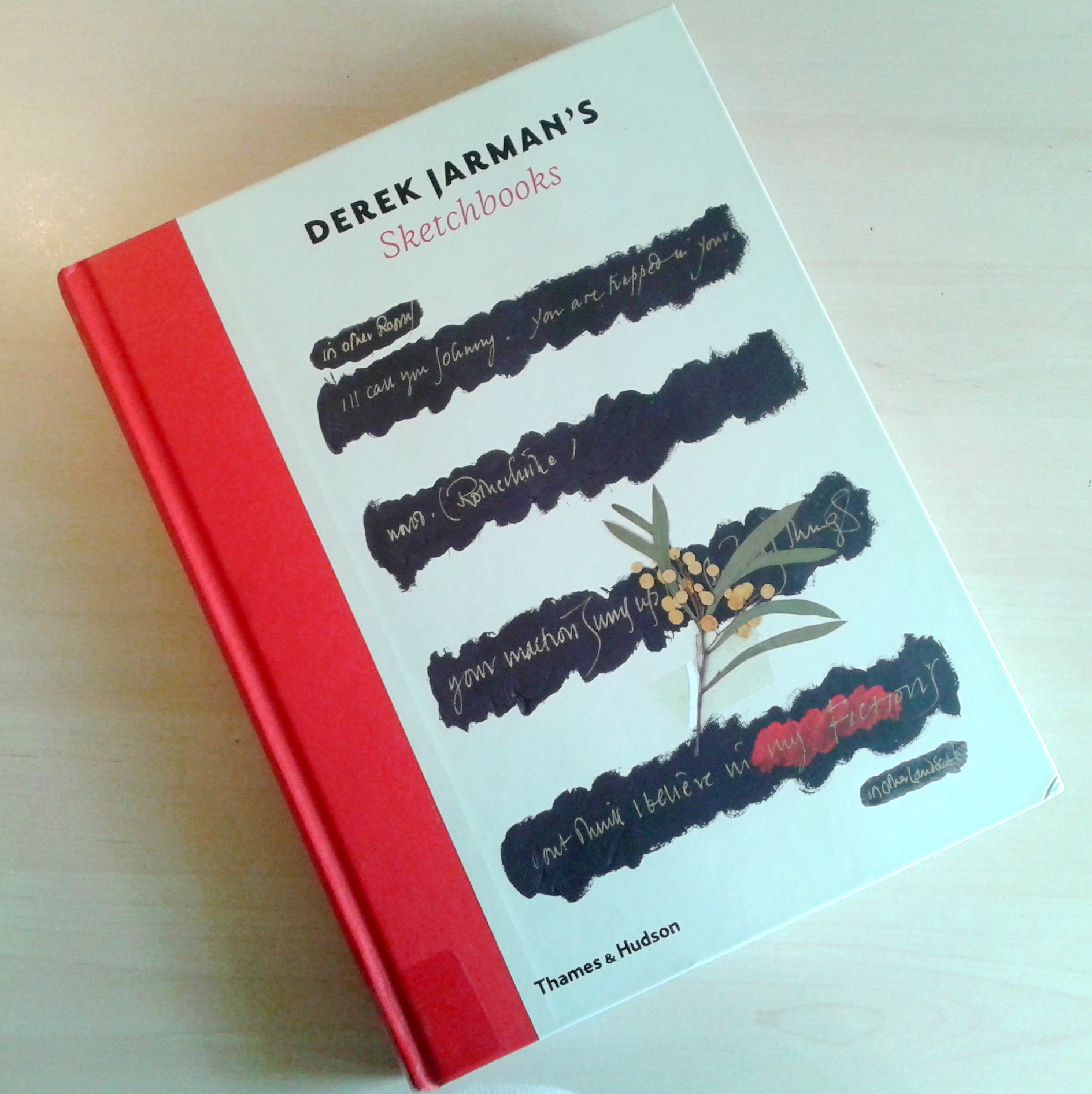
jarman diariesIt’s been a very busy week, and I’ve been diving into all kinds of exciting new and inspirational activities, including the UEA Literary Festival.  I’ve also been submerged in the magical world of Derek Jarman’s Sketchbooks, edited by Stephen Farthing and Ed Webb-Ingall, and I want to share the inspiration I’ve found in them with you.

derek_jarmanIn case you have never heard of Derek Jarman, he was a fabulously talented artist, film-maker, designer, writer, gardener and Gay Rights activist whose career was tragically cut short by AIDS in 1994, aged 52.  He directed music videos for the Pet Shop Boys and designed the sets for Ken Russell’s landmark 1971 film, ‘The Devils’.  At his home in Dungeness, he created one of the most haunting modern gardens in Britain, one that I am deeply in love with.

I first became aware of Jarman when I saw his film, Caravaggio (1986), starring Nigel Terry, Sean Bean, and Tilda Swinton in her first film role.  Later, in 1991, I wept my way through his heart-breaking ‘Edward II’, an adaptation of Marlowe’s play that spoke of Jarman’s outrage at homophobia in Thatcherite Britain.  These are not easy and accessible films.  They are, however, fabulous to look at, and very moving.

When I came across this edition of the sketchbooks in the library the other day, quite by chance, I had no idea that Jarman was a committed visual diarist.  The sketchbooks themselves are large – family photo album sized – and each cover is decorated in black and gold, making a slightly varied but pleasing continuity.  Inside them, Jarman uses ephemera, calligraphy, drawing and painting, poetry, pages of film scripts, actors’ head shots from casting sessions, clippings from newspapers, reviews, photographs of friends and colleagues, bits of feathers and pressed flowers to document his life and each of his projects.  The sketchbooks contain his thoughts on everything from his garden (there is a carefully drawn planting plan), to his illness, to sex, history and death.

Jarman made a series of paintings, the ‘GBH’ series, of black on gold abstracts, inspired by Goya’s Black paintings, and a film called ‘Imagining October’, which arose from finding Sergei Eisenstein’s own copy of ‘Ten Days that Shook the World’, the famous book on the Russian Revolition, and on which Eisenstein had based his ground-breaking film, ‘Battleship Potemkin’.  Jarman had been shocked to discover how much of the book had been redacted with blacked-out text by the Communist authorities.  Both of these concepts are reflected in the sketchbooks, where you can see Jarman working on the idea of black bars with gold writing, seen on the cover of the volume.  Jarman’s anger at the political situation for Gays in the UK shines through these blackened pages.

One of the things that particularly strikes me is the simplicity of the layouts he uses.  Even when he is writing pages of text, making notes or journalling, there is a sense of space.  Nothing is cramped.  He spreads out, not denying himself room to work, enjoying the clarity of white space around his words and images.  This is something I will definitely take away. My diaries always feel cramped.  I always feel that every inch of space must be used, because materials are scarce.  This denial of room to grow is cramping my creativity, something I need to break out of.

I want to draw inspiration from the sheer range of activities Jarman undertook, too.  For him, there is no line in his sketchbooks between diary, writer’s notebook, sketchbook, planner or scrapbook, anymore than there were boundaries between the creative areas he worked in.  Although he was primarily a film-maker, he was so many other things as well.  Jarman teaches me that I don’t just have to stick to writing.  I can follow where ever my Muse leads me.

There are no limits to what we can create, only the ones we impose on ourselves.

Things to try:

  • See if you can get hold of a copy of Jarman’s sketchbooks.  It isn’t cheap – £28 – so maybe you can order it from your library.  You may not like his style of modernist art, but you can appreciate how he puts every aspect of his life into these visual journals to make a record of his thinking.
  • Use your own sketchbook or diary as a kind of studio to record everything you do and think about a particular project.
  • Collect clips, postcards, photos, anything relevant to stick in – Jarman even stuck a ten pound note into his!
  • Luxuriate in space.  Allow each of your drawings, paragraphs, or collaged pieces to bask in a frame of white space, so that they can shine out, and be seen for what they are.  Don’t fall into my scarcity trap – there will always be more paper.
  • Decorate the covers of your sketchbooks or journals in a similar way, as Jarman did, each one slightly different, but using the same colours or materials.  Maybe you could do ‘series’ of notebooks, with matching covers, for different projects.  Don’t be precious about them, however.  Jarman once stuck a heavy bronze seal on the front of one of his books, but it was too heavy to carry and got in the way, so he ended up prizing it off.  The scarred gold cover is even more interesting as a result.

Happy journalling,

EF

Gratuitous Birthday Post

Hi! Its my birthday today, and I promised myself I wouldn’t do any work.  Of course, I meant to prepare a lovely, informative and entertaining post that I could just upload in a trice, but it didn’t happen.  I am really struggling with the concept of preparing posts ahead of time.  It just doesn’t seem to work with my spontaneous side.  But never mind.  For today, I am not going to worry about it.  I’m just going to show you a little glimpse of my present haul – I’m a VERY lucky girl!

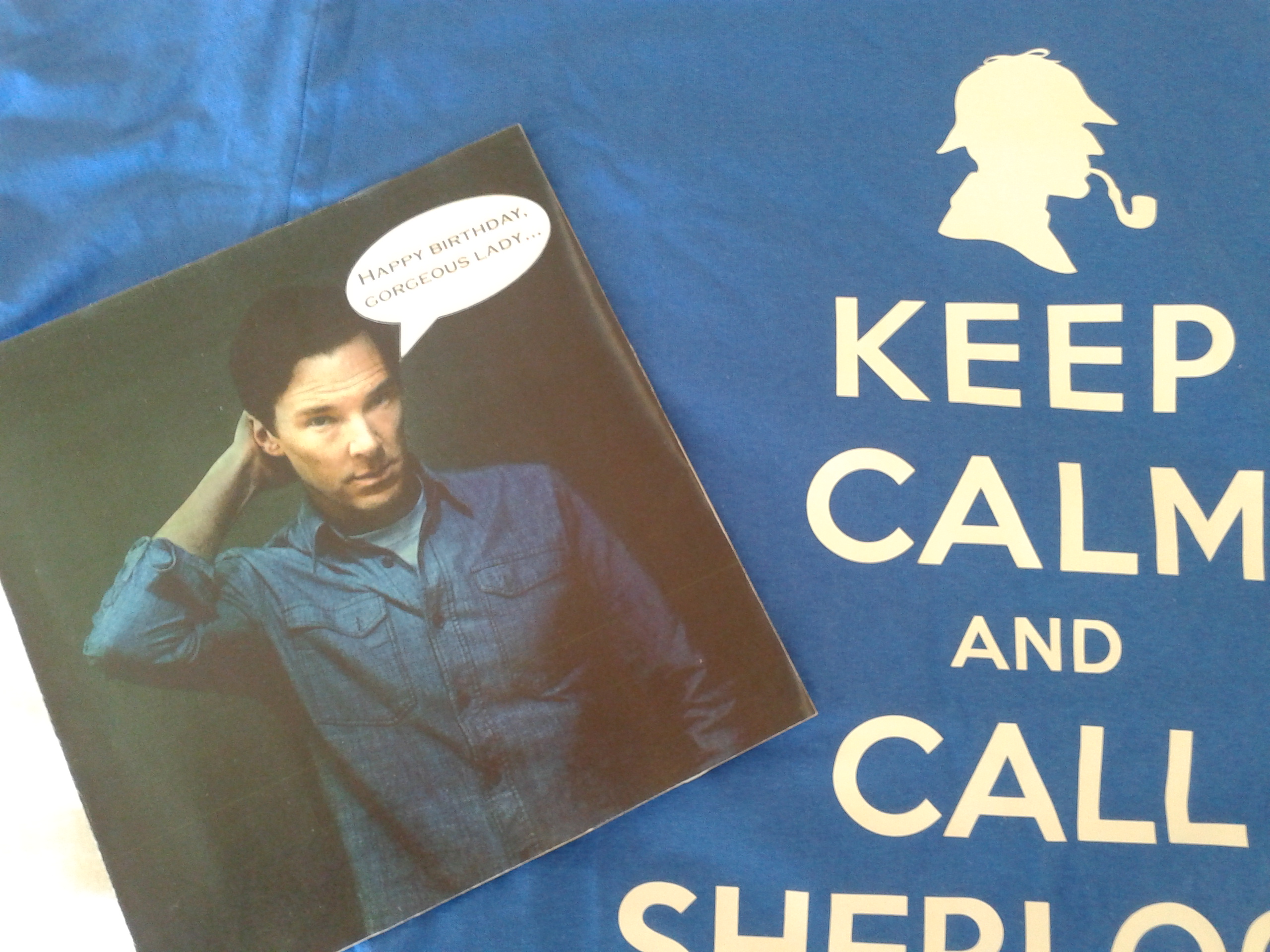
birthday prss 1Can you spot the theme?  I think you’d probably have to be a serious fangrrl like me to get the hedgehog socks connection!  (Oh, and the Benedict Cumberbatch card made by a friend says ‘Happy Birthday, Gorgeous Lady!’  in case you can’t see it in the photo.)

benny card

Anyway, I the spirit of celebrating what I have achieved in the last year, which is a lot, believe me, here is a link to my fanfiction.  If you haven’t read it before, happy reading.

Love, EF

Journal Friday: The Emotional Swingometer

go away bagThe Creative Life is a carnival ride.  Don’t let anyone tell you otherwise.

Right now I am on the rollercoaster.

Thank goodness for my diary.  If it were not for that little Moleskine notebook, I would be a complete basketcase.  Actually, I’m probably still a complete basketcase, but I feel better about it, because I write it all down.

The days when I am completely sure I have squeezed every last drop of juice out of Johnlock.

They days when I can’t stop writing Johnlock.

The days when I have so many ideas for stories that I don’t know what to do with them all.

The days when my imagination is a barren wasteland.

The days when one comment has convinced me that my work is utter crap and I owe it to the world to never write again.

The days when a stroppy comment has filled me with so much anger and resentment and martyrdom that I am going to passive-aggressively hold the entire fandom to ransom by never publishing another Johnlock story again because frankly those bitches are all so ungrateful.  (as if they’d even notice.)

The days when that novel I am writing is the greatest thing ever written.

The days when that novel is so bad I am ashamed to even walk into the same room as my laptop.

The days when reviews flood in, and I am Queen of the World and Goddess of All Writing and my ego is the size of Jupiter.

The days when the reviews flood in, and they just aren’t praising me enough, they’ll never say enough good things about me because I am so bloody wonderful, which of course means that secretly I know without doubt that I am an absolute fraud and completely useless.

The days when the reviews flood in, and I am cowering under my desk in shame that anybody could think that story I wrote is readable.

The days when I am satisfied because I have written something that I think is good.  Good in the way that tapping on solid mahogany with your knuckles is good.  Something that is out of my own real, original voice.  Something that I am satisfied with.

The days when the fandom bores me to tears, or irritates the hell out of me, and so does my writing.

The days when I know my writing is completely stagnant, and I need to progress onto the next stage but I don’t know where to start.

And the days when I just sit down and write.

Before, or after I have written some fiction, I take a little time to reflect.  Sometimes I write in my journal to get my juices flowing, the way Morning Pages are supposed to.  Sometimes I write afterwards, to reflect on where I am going, on my emotional equilibrium (or lack of it).

Usually, when I have published a story, I watch the comments coming in, and try to write through my responses, the paranoid ones and the egotistical ones, the happy, the grateful and the furious.

My journal helps me keep my writing experience in perspective.  There isn’t a lot of perspective about our own creativity, lets face it.  We are all reared to be perfectionists, to rule ourselves out in the basis of not being Picasso, or to believe ourselves to be Dickens without needing to do the hard work.  It is so hard to be objective.

My journal helps me remember that the only life I am saving when I write is my own.  In the great scheme of things, this is not battlefield surgery.  Or, if it is, it is on my emotions alone.  That is why objectivity is important.

I need to remember that my writing is not about what other people think.  It’s about me.  At its very core, it is about healing my own wounds. 

Even if I never publish another word, I will still keep writing, partly because it’s a compulsion, and partly because it mends my soul.

That is why keeping a journal is crucial for every creative person, whether you are amateur or professional.  It reminds you of the WHY.

How do you use your journal in your creative process?

Happy journaling,

EF

Embodied Creativity

In my last post, I talked a little about telling details, those tiny things that communicate so much.  Noticing them requires opening the mind.  But there is another rung on the ladder with this:  Opening to the body.

I call this embodied writing.  By this I mean the kind of writing that includes the visceral details of what it is like to inhabit a physical body.  Physical sensation, not just ideas and emotions.

Our bodies are not just the ‘transport’ we inhabit, as dear Sherlock likes to put it.  They interact with the environment in order to gain information about it for survival purposes.  They do this through the medium of the Senses.

  • Touch
  • Taste
  • Sight
  • Smell
  • Hearing

Our eyes, noses, ears, tongues and skins gather data and feed it back to the brain, which sifts it and uses it to build up a picture of the outside world.  This means that our experience of life is formed as much by our body’s external contact as it is by our thoughts and ideas.  As writers particularly, we spend so much time locked inside our heads, submerged in ideas for stories, that we forget we have bodies.  Our bodies get neglected, or worse – sometimes writers abuse their bodies because they actually get in the way of the work by demanding annoying things like food and sleep.  We forget that our bodies are the foundation of our art.

By using the sensations they give us, we can enrich our work exponentially, making it more immediate, tapping into common experience and tissue memory.

Over the next few weeks, I am going to talk about ‘Writing with the Senses’ in an effort to get you and me out of our heads and into our bodies with our writing.  We will be working our way through each of the senses, being mindful of the feedback they give us, using them to ground us in our corporeal selves, and bringing the gorgeous experiences they give us into our creative lives.  I’m doing this myself, because I really need to be present inside my body right now, instead of having my brain flying about sixteen feet from it, attached only by the barest thread of consciousness.  And I thought you might be interested in joining me!

So, in the meantime, do this:

Take a few minutes today, tomorrow, daily if you can.  Just stop.  Take a deep breath and let it out.  Bring your mind inside your body.  What sensations can you feel?  Do you have a pain in your toe, or an itchy insect bite?  Did you eat spinach for tea that left that annoying coating on your teeth?  Is your belt too tight?  There doesn’t have to be any great revelation.  Just notice.

Taking a moment at regular times during the day in order to be present inside your body is an invaluable exercise in grounding yourself and being mindful.  And it is a great prelude to thinking about the Senses.

Happy Creating,

EF