Tag Archives: Writing

I am incubating a Cunning Plan!

Summer opens up a world of possibilities...

Summer opens up a world of possibilities…

Isn’t summer wonderful?  The Husband is off work at the moment, enjoying a couple of well-earned weeks’ rest.  My mother came to stay for the week last week (very exhausting), and the week ended with a family party, and a 6 hour long round trip to get there.  You will appreciate that I am feeling just a little jaded right now.  However, there is sunshine, and friends dropping by, and this morning we sat in the garden, drinking freshly pressed apple juice for breakfast, and basking, and it doesn’t get much better than that, let me tell you!

Sometimes, its good to take a breather.  I’ve had a week where my thoughts have not been my own, and its made me realise how much I need to write.  It is not so much a desire as a primal drive.  Now I have my time (and my brain) to myself again, all I can think about is what I want to write next.  My body may not be ready to get started yet – a lot of restorative time in bed will be necessary for that – but my Muse is getting her juices into gear.

And let me tell you, that feels so great!

I can feel a plan beginning to form behind my eyes about what I want to achieve in the next three months up to Christmas.  (Yes, I know, I’ve started thinking about presents already, I must be a sick, sick person!)  I can’t quite put my finger on the specifics of it yet, but I can’t wait to just plunge in and indulge my creative urges.

And I mean indulge!  I want to do something delicious and opulent.  I want to manifest an idea made of mental gold thread and velvet and jewels, something as luscious as sinking my teeth into a ripe peach.  Know what I’m saying?

I want to CELEBRATE!

I promise I’ll keep you posted about what I come up with.  In the meantime, enjoy the rest of the summer, and raise a glass of Pimms/mint julep/mojito/insert your favourite tipple here to the joys of August and Time Out!

With love,

EF

Planning the Perfect Home Office – Progress Report

So, as I mentioned before, Husband, in his wisdom, decided that the best idea he had ever had would be for us to swap studies.  He gets the box room at the back of the house, north facing, looking over the boiler house roof and into the woods beyond.  And I get the room at the front of the house, south-facing and a little more than twice the size, with accompanying futon and a big space to lay out my yoga mat, should I be so inclined.  Yes, I will have to share this space when friends come to stay, but frankly that doesn’t happen very often because we live so bloody far from everyone else we know on the planet!  On the other hand, my new desk overlooks the front garden, with a view down the lane and across the fields to the poplar plantation, about half a mile away.  Not only is it a great view, but I can see people coming!

So far so good.

What I was not bargaining for is the sheer accretion of junk that has built up over five years of occupancy.  There are mountains of magazines to sort through, clippings to find a home for, bills to file, and then there are the hundreds of other bits I never knew had.  A bellpull made of six gaudily decorated velour camels, given by a distant-travelling cousin.  A mug from an old work project with a cartoon on it of my own design.  Sufficient packs of playing cards to run a sizeable poker tournament – we never play cards.  Tiny audio tapes from an old Dictaphone machine, now long lost.  A bag of marbles – blamed on Husband.  A slightly used Barbie doll with complete wedding trousseau.  Empty A4 clip files and notebooks galore.  And how many packets of staples does one person really need?

(I’m not even going to mention the host of dead biros, fluff and ancient receipts for distantly deceased electronic equipment.)

It turns out that Number One on the list of activities when planning your home office is:

CONDUCT THE MOTHER OF ALL DECLUTTERINGS!

Having spent long hours toiling over heaps of useless junk, diligently throwing out anything I hadn’t looked at in six months, I then went through the following process.

Start by being proactive:  Being me, I went out and got a book from the Library on how to plan your home study.  It has lots of pretty pictures.  What it does not have is a list of things you will need.  It says you must work it out yourself.

Thanks.

Question 1 in the book:  How much storage will you require?

Answer:  How the fuck do I know?  I’m a writer!  By definition, I generate vast quantities of paper! And I draw too, so double that!

Cunning Strategy:  Make sure the Husband takes on responsibility for household filing so at least I don’t have to think about that.  I hate it anyway.  He can have it in his office so I never have to think about it again.  Plus, its one less filing cabinet to fit in.

Concern:  I have all these writing notebooks that I may need to refer to as a part of my work, so they will need to be handy.  But what do I do with all the Morning Pages notebooks and diaries?  I need to keep them because they record my life, but I doubt I shall need to drag them off the shelf on a regular basis.

Hesitant solution:  Bung them in big plastic crates with mouse-proof lids and store them in the boilerhouse?  Discard on the basis that its too risky because mice are fiendishly devious little bastards.

Sneaking suspicion:  I would rather go out and spend a fortune on funky stationery than plan any of this stuff.

Probable outcome:  I will be cheap and impulsive, go out to The Range and buy a bunch of ugly stuff I don’t like instead of working out how much I need and saving for the really nice stuff I do like, and none of it will do what I want/need it to, and then I shall not want to use my new office as a result, i.e. back to square one.

Sudden flash of determination:  I am not going to ‘cheap out’ again.  I’m going to do it right this time.  Because I deserve a nice place to create.

(Sneaking suspicion and Probable outcome persist in the back of my mind.)

Intermediate action:  Go on fact-finding mission.  In other words, hang out in posh shops looking at all the kit I can’t afford but would dearly love.  Come home feeling resentful, poor and even less determined to plan sensibly than I was before.

Current state of affairs: sulking.

Yes, I would love to be able to say I went out and bought a label maker and some washi tape and now my life is complete, but it hasn’t happened yet.  I have a desk and a chair, and three bookshelves double stacked with books, and a slightly denuded pile of Sherlock clippings, but my magnificent new working space has yet to materialise.

I’ll keep you posted.

(And if you have any tips, let me know.  Please?)

EF

On Perfectionism (and Timing)

Carpet makers in Turkey weave a mistake into every carpet they produce - because, they say, only what God makes is perfect.

Carpet makers in Turkey weave a mistake into every carpet they produce because, they say, only what God makes is perfect.

A friend was trying to finish his novel.

‘So many grammatical errors,’ he moaned.  ‘So many mistakes.’

He worked so hard that he wept.  It would never be perfect.  It would never be good enough.

All this effort, two days before he was due to be married.

There is perfectionism, and there is timing.

Perfectionism is a disease I suffer from myself.  It has blocked me for years.  Nothing can ever be good enough.

I set my standards so high, I never fail to fail.  And then I look at what I have failed to do, and tell myself I am useless, and that I will never finish anything.  Without noticing (conveniently) that I have set myself up for the perfect fall.

I am perfect at this.

So it is with this blog.  It had to be perfect.  It had to be faultless.

Never mind that I have a serious chronic illness that regularly prevents me from leaving the house, which affects my cognitive function to the extent that at times I can neither read nor write, nor understand what is said to me.

The blog still had to be perfect.  And I had to post three times a week.  Regardless.

Regardless of my health, or looking after elderly, sick parents, or my husband’s workload, or my marriage, or the weather, or having to attend friends’ weddings, or making time for much-needed holidays, or anything else that comprises having a life.

Add in the blog and perfectionism and you have a recipe for disaster.  Or at least a very poorly blogger.

This is as insane as my friend trying to perfect his novel two days before one of the most important and stressful days of his life.  (And happiest, lest we forget.)

Sometimes, you have to sit down and recognise that perfectionism is a disease created by Nigel.  Sometimes you have to stop, and realise you haven’t been very realistic about what you can achieve.

And you have to move the bar.

Perfectionism and timing have combined to create the perfect storm in my life right now.  I have been going through a bout of severe illness, and just at the start of August, the busiest month of my year so far.  My mother is coming to stay for a week.  Friends are getting married, and babies are being welcomed into the clan.  The garden needs watering, and I have a craving to write original fiction that I have not felt in many months.  With limited energy, and limited time, I can only do so much.

Conclusion:  this blog cannot be perfect.  It only has to be good enough.

It only has to be here to encourage you, dear reader, on your own journey of writing and creative discovery.  It only has to be witness to my own creative process, as I try to navigate a way through illness and into producing a novel that will make my soul sing, and make you turn the page with delight.  It doesn’t need to be the be-all and end-all of teaching writing – there are plenty of other people who can do that so much better than me.

Here are my good enough dreams:

I want to write that novel.  I want to write an ebook on journaling for you, too.

WARNING: RIDICULOUS DREAM SHARE ALERT

I want to make a collectors’ edition of my novel, illustrated with my own art, for you to buy.  Yes, I know, it’s crazy, but it’s something that is calling me, and somehow I know I have to follow its siren song.  And you are supposed to share your creative dreams, aren’t you, to help make them happen?  So I am sharing my dream with you to give it some karmic weight.  (Yeah, I believe in this stuff.  Bear with me.)

I also want to be well, have a holiday, enjoy some quality time with my mum, have a happy marriage (i.e. see my husband occasionally), water the garden and, well, have a life, really.

And I don’t want either perfectionism or bad timing to get in the way.

So I’ll make a deal with you:

I’m going to blog twice a week, instead of three times.

Sometimes I might only manage once, but if I do, I want you to know that the time I haven’t spent writing a blog post for you has been spent either a) getting well or, b) working on a creative project like my novel.  Because the blog can’t take up all my creative energy.  That just doesn’t make sense.  The blog is not the purpose, it is secondary to the purpose.  The purpose is the writing.

There was a time, this time last year, when I thought I would never have the courage to set up this blog.  Right now, I am scared that I will never have either an ebook or a novel to offer through it.  This time next year, I hope I’ll have proved at least one of those fears wrong.  In the meantime, I am moving the goalposts, lowering the bar, and whatever other clichés you care to insert.

I hope that you will stick with me.  I hope that you will share my journey, and tell me about yours too.  I hope that we can learn this together, that we can kick Nigel into touch and fill our lives with creative joy.

Happy creating,

EF

The Writing Life: Literary festivals

Finding your tribe as a writer, or in any kind of creative endeavour, is an important thing to do.  Being around other writers provides support and inspiration, and I think it’s a crucial thing to do.  Writing can be a very solitary activity, and its no surprise to find that many writers suffer from depression.  You try sitting on your own every day for six months of the year and see how it affects your mental health!  Its important to get out.

Literary Festivals and author signings are a really good way to fill your well and get affirmation for your work.  Maybe you won’t be able to present what you’ve written to other people, but being around those who are interested in the same things as you, undergoing similar challenges, really helps.

As a writer, you also need to gauge the market and be aware of your contemporaries’ work.  Reading is an important thing to do, and if you really love writing, you will love reading just as much!  Literary festivals give you a chance to be exposed to books you might never pick up otherwise, to hear authors speak about their work, and to ask questions about their writing process.   Think about it – a huge reservoir of inspiration and knowledge out there, just waiting for you to tap into it.  Why would you not?

Your local bookshop will probably have readings by authors scheduled, and these are worth attending because they are more intimate, and allow you more personal access.

Check the culture and review sections of newspapers, and the ads in writing magazines, as well as noticeboards in libraries, for details of the bigger events and festivals.  Some music festivals are starting to have literary strands too, so keep your eyes peeled.

My nearest festival in the one at the University of East Anglia, but its slightly different from a three day or week-long event, in that it studs two university terms with readings by authors, playwrights, poets and journalists.  This gives a wide variety of speakers over a six month period, and allows me to attend where I want, and to absorb what I learn over time.  And because it is such a prestigious centre for creative writing, it attracts some seriously big names.

I have attended events with Arthur Miller, Jeanette Winterson, Rose Tremain, Simon Armitage, Seamus Heaney, Iain Banks (need you ask!), Rachel Cusk, Alan Hollingshurst, Isabelle Allende, Richard E Grant and many others.  I went under sufferance with a friend to see Ian McEwan, whose writing I hate, only to be utterly charmed and instantly determined to reread everything he has written.  And I saw Doris Lessing the week after she had been awarded the Nobel Prize for Literature.  She was feisty, fascinating, and marvellous despite obviously being in terrible pain, and she tore the rather pompous interviewer to shreds, which was very satisfying.  At the end she received a spontaneous and heartfelt standing ovation, and I actually found myself crying.  You can’t find better inspiration than that!

Be warned, however.  Sometimes your idols can prove to have clay feet.  I went to see Graham Swift, whose books ‘Waterland’ and ‘Last Orders’ I had adored.  He read so badly, and was so miserably boring, that I felt insulted enough to vow never to read another one of his books.  And I haven’t.

Brett Easton Ellis was a writer whom I had worshipped since reading his work for my degree.  I clamoured to get a ticket to see him.  And now I can’t remember a thing about him, not even what he looked like, and certainly nothing of what he said.

I generally come away from these events feeling inspired and excited about doing new work, full of ideas and hope for the future.  It can be a dangerous game, however.  Be prepared, if you go to an author reading, to feel insignificant, and that you work is poor and will never be published.  It happens sometimes, though less often the more you write, and it will pass.

The important thing, however, is to go.  Attend events with even the least known authors, since they are often the ones who will inspire you the most.  (And one day, you might be up there too, so it adds to your own karma to support other people!)  Ask questions, and read the books.  This will enrich your own work, as well as introducing you to writing you might never have experienced otherwise.

Challenge yourself.  I don’t really do poetry, but went along with a poet friend of mine to see readings by several poets, and was enchanted.  I’ll never be a poet, but this form has opened my mind to the possibilities of language, and I’m so grateful.

Finding your tribe, and being amongst other writers is important.  It helps you feel part of a joint creative endeavour, but it also feeds your Muse.  There is a whole world of wonderful written joy out there, and literary festivals area an easy way into it.

Happy listening!

EF

The Writing Life: Go On Retreat

DSCI2692It’s getting to that time of year.  The sun is out, schools are breaking up, and the beach is calling.  You may have already enjoyed a holiday, or you are preparing to join friends, your significant other and/or family for a week or fortnight chilling out.

I love annual holidays, believe me.  These days, though, my system won’t handle hot weather anymore, and money is thin on the ground, so we don’t do the foreign holidays like we used to.  A week in the Inner Hebrides, surrounded by fantastic scenery (and enough whisky to entertain the husband) is the most we occasionally manage.

Holidays are great, especially if they include sun (we don’t have unreasonable expectations when we go to Scotland, put it that way!).  You can spend a week by the pool reading and relaxing, visit a few local sites, enjoy slow evening meals in a tavern while you watch the sun sunk into the azure sea.  Bliss.

But have you ever thought of taking a holiday with your creative passion?

And no, I am not talking about one of those great holidays where you go painting with a tutor in the South of France, or take tutorials with a famous poet at Arvon, although I have no doubt they are fantastic!.

I’m talking about just you and your muse.  One on one.  Taking time out for what may be the most important romance of your life.  Your relationship with yourself.

Once a year, our writers group gathers at a local conference centre in the South Norfolk countryside.  We arrive on Friday afternoon and leave on Sunday afternoon.  Three hot, delicious meals a day are provided, together with morning coffee and afternoon tea.  We each have an en suite study bedroom with bed and desk, and views across the fields.  The welcome is friendly, and you can practically hear the collective sigh of relief as we all turn inward, away from our busy lives, to concentrate on our writing.

Imagine that.  An entire weekend, just you, and your stories.

No having to food shop, cook meals, prize your angry children from each other’s throats or soothe your spouse’s ego when their team lost at whatever sport they are obsessed with.  A whole weekend where you can sleep, soak in the bath, so some yoga, walk through the countryside, listen to the birds, and pick up your pen when the muse strikes you.  There are familiar friends from the writers group to discuss your work with, to talk about writing and reading and the ideas that fill your head.  But there are no everyday worries to distract you from your work.

It doesn’t have to be expensive.  Our retreat costs around £140, which I think is pretty impressive for full board for two and a half days.  We don’t have luxury, but we don’t need it.  The luxury is being able to spend time with our stories.

Each evening, we gather together after supper.  On the Friday night, we are still settling down, orienting ourselves within the space we have set aside to be with our work.  We bring bottles of wine and soft drinks, and snacks to share.  We also bring pieces of writing by other writers from books and poetry collections that we have recently enjoyed, and take turns to read to one another.  This provides a cross-fertilisation, and a chance to reconnect.  During the weekend, we meet for meals and coffee breaks, but mostly we spend time alone, working or moodling, feeding our souls, communing with our creativity.  On Saturday evenings, we gather again, to read and workshop what we have written through the day.  And we always gather for afternoon tea on Sunday, about 4pm, to finish off and say goodbye.

Sometimes, when someone is going through a difficult time in their lives, this retreat is simply time spent with themselves, refilling the creative well.  It doesn’t have to produce anything in particular apart from a chance to ground in one’s own needs and interests, to find a bit of peace.  At other times, we come with a sense of what we specifically want to achieve, meaning to address some particular aspect of a current work, or a precise task, such as preparing a synopsis for an agent.  Having a plan is good, but its better to go with your creative season.  If you just need to down tools from a busy life and immerse yourself in creativity, that’s the thing to do.  Each of us seems to find her own need for every retreat, and we look forward to each new one from the moment we leave the last!

Even if you can’t find a group to go with, you might have a friend who could join you.  This weekend, I had the pleasure of greeting two of my fanfiction writing friends who came up to Norwich for a weekend, shared a cheap hotel room, and enjoyed a break for writing, creativity and fun.  We got together, had a meal, and shared our interests.  It was so refreshing!  Making time to go somewhere different allows you to depart from your everyday cares, and concentrate on the art form that you love.  This more informal approach might be a good way of managing a retreat for you.

I heartily encourage you to find a way to take time out for a writing or creativity retreat.  It is a practise that I think every creative person should incorporate into their process and their life.  It revives and stimulates.  It also reminds me that I am part of a tribe, however hidden we are.  It stimulates new ideas and new interests, and above all, it gives peace of mind.

So if you are planning a hectic family break right now, why not take the time to dream up a way of escaping on your own, however you do it, just you and your muse, as part of a group, or alone, to feed your soul.

Happy retreating,

EF

Outflow: My Creativity Right Now

Picasso ceramicsWe are having a heatwave here in the UK, and I’m not very good in hot weather.  The result is that my brain has gone on strike, as has much of my body.  Which makes me think about ‘creative seasons’ and the Habit of Art.

My ongoing health problems taught me long ago to have peace with the days when I can’t do anything beyond lie on the sofa and practise my groaning. ( I’m getting quite good at groaning, I have to say.)  Chronic Illness is, however, a bit of an extreme way of forcing oneself to recognise one’s creative cycles, and not one I would recommend.

There are lots of creativity gurus who are adamant that turning up at the page, or the canvas, and making yourself do the work is the only way forward, and for the most part, I would agree.  But what do you do on the days, like today, when it just ain’t gonna happen?

Take note, that’s what.

I find my creativity goes in bursts, as I have mentioned before, and in recent years I have noticed that my writing seagues slowly into art in the summer months.  Writing is a great thing to be doing when the weather is cold and wet, and all you want to do is curl up in the warm.  In the summer, though, the urge to get out there into the landscape and experience the world is almost irresistible, as anyone who has ever worked through the summer in an office will agree.  Right now I am experiencing the difficult-to-ignore urge to paint rather than write.

And I am OK with that.

Yes, I am feeling a bit frustrated that I can’t settle to the writing projects I want to progress, but I can’t force it, or I will get resentful, and probably produce pages of complete drivel that I’ll hate later.  The urge to be creative is still with me, though.  It is just taking a different, more exterior form.  I want to draw, paint, decorate pottery, make cushion covers, garden, and bake cupcakes.  So that’s what I’m going to do – at least as soon as the weather cools down and my brain starts functioning again!

There is a tension between turning up to create and the creative seasons themselves, and the skill of a true creative is to be able to accept the difference between a) the resistance to sitting at the desk and working, which is procrastination and stopping oneself being all one can be, and b) the natural flow of creativity as it morphs from one season to the next.  There is much to be said for making yourself sit down to create every day, but using it as a stick to beat yourself with is not helpful.  We need to be aware of when our creativity transforms, and to trust it enough to go with the flow.  This doesn’t mean I am abandoning my writing for good, simply that I know that right now, that isn’t where my best work will come.

The image in my head to illustrate this is when Picasso discovered the provencale village of Vallauris and threw himself into the art of ceramics.  I have no doubt there were those who worried that his canvas days were over, but that was far from the truth.  Instead, he trusted his creative urges enough to know that ceramics was a road he had to walk at that point in his life.

So I am trying to emulate Picasso, and to be at peace with where my creative road is taking me.  It’s not easy, and Nigel has a lot to say about not having the gumption to get on with the novel, but frankly, STUFF NIGEL!  Lets get out in the sun, eat ice cream, and do creativity the way we need to right now!

Happy sun-bathing and creating,

EF

The Writing Life: Writers Groups

DSCI2689

I belong to a writers group.  And it’s great!

It all began years ago, when I started the Diploma in Creative Writing at the University of East Anglia.  It was the first writing course I ever went on.  I walked into the room and found myself surrounded by people like me.  It was the first time I ever felt like I wasn’t different and strange.  I had found my tribe.

Writing is a solitary occupation, so it is crucial for both your mental health and your work to socialise.  And what better way to do that than with other writers who are going through the same trials and tribulations as you are?

As part of our diploma course, we went on a weekend retreat, involving taught sessions, visiting speakers, workshopping and private writing time.  It was a huge success and we bonded.  Many of us went on to study for the Advanced Diploma in Prose Fiction, which was primarily a workshop-based course, and that further cemented the group.

Since then we have continued to meet, once a month, to share our work, our experiences, problems and interests.  And an awful lot of tea and flap-jacks!  Members have come and gone, buts okay.  There is a core group who have stuck together for over a decade now, sharing life experiences, supporting one another through MA courses and publication.  We go on annual retreats together, about which more in future.  We meet at each other’s houses, planning dates ahead and each offering to the host nights most convenient.  Hot and cold drinks, nibbles and cakes are provided to lubricate the conversation.

Based on the old course model, each member brings a piece of new writing that they have done, and we try to keep it to around 1,000 to 2,000 words in length – any longer and it takes up too much time.  You can read your own piece, or ask someone else to read it.  (It is sometimes really helpful to hear another person read it in order to pick out the parts where the writing is less fluid.)  Then people comment.  Helpful and empathic criticism is offered.  We always make sure we start by pointing out what we like about the piece.  Often, if it is part of a larger work, people will ask questions about plot or backstory.  Because we know one another’s work so well, we can refer back to earlier stories, or earlier parts of the work, and kick around ideas to find out what might be a useful improvement for any problems.  At the end of every participant’s session, they are asked how they feel about what was said, which gives them the chance to say anything that has been missed in the discussion.  We usually manage to workshop about three pieces of prose in a 2.5 hour meeting.

Not everyone may have something they want to read, or will have had time to write that month, and that’s okay too.  They contribute by commenting on and supporting the work of others.  We have prose writers and poets.  We share news of any courses or day schools that may have been attended, and often discuss what books everyone is reading too.

And of course, we do a lot of nattering and gossiping too.

Outside the regular meetings, we have been known to circulate work and meet informally for writing sessions.  We even do writing sessions over the phone.

I encourage you to find your own tribe.  You can do it online or in person.  Libraries and publications such as Mslexia and the Writers Digest often have small ads for writers groups.  Or start one yourself, as we did.  Make sure you are happy with the atmosphere and ethos of the group you join, however.  There is no point in sharing your work and then having it brutally cut to pieces.  Gaining confidence in dealing with confidence is one thing.  Bullying is quite another.  There are pitfalls with joining any group, but the advantages with a good one will outweigh any glitches.

My pals in the group have stuck by me through thick and thin and seven novels, and I am eternally grateful to them for their kind support and criticism.  And for banning me from using the word ‘massive’.  Sometimes you need that kind of pal.

Dear Bridget, Clare, Heidi, Nina, and Sally, I love you.

And now I had better get myself together and go and put some flap-jacks in the oven, because they’ll be round tonight and I haven’t written anything yet!

Happy creating,

EF

Nuts ‘N’ Bolts: Writing Exercises

writing notebook Firstly, an apology.  Observant readers will note that today is Thursday.  Yes, I am a day late in posting.  Sorry.  Life got in the way, in the shape of a migraine, and it’s not funny trying to write with tunnel vision and the pain equivalent of a knitting needle stuck through your eyeball.  I figured I might sound somewhat distracted (as indeed I was), so in the spirit of demonstrating how important self care is, I bugged off and went to bed.  Today’s post is something of a restart.

For a while I have been feeling the itch to get back to writing original fiction.  I’ve been working on fanfiction almost exclusively for a couple of years now, and while it has been hugely instructive in terms of both technique and confidence, I feel like it is time to start making some personal headway again.  Hence the restart.

Getting back to basics is one way to do this if, like me, you are feeling a little at sea when it comes to what to write about.  And one of the best basics to get back to is the marvellous tool that is the writing exercise.

Writing exercises are based on the idea of stream-of-consciousness and free association.  You sit down with your notebook and write for a set amount of time, without judgement or criticism.  You are free to make mistakes, try stuff out, experiment with new words, phrases, images, metaphors.  This is a free-form space where there are no mistakes, only ideas tried on for fit and comfort.

What you need:

  • An allowance of time (10 minutes, 15, half an hour if you have it, or the luxury of more.)
  • A notebook (maybe your writing notebook, or one you keep specially for exercises).
  • A good pen that you can write easily with.
  • A timer.
  • A quiet space to work.
  • A prompt.

What to do:

Maybe you sit down to write at your desk, and your brain goes blank, or worse, is crowded with too many ideas that are too big to fit into 10 minutes or whoever long you have got, and you freeze.

Say hello to your little friend, the prompt.

A prompt is a word, sentence or idea that you use to start you off.  Write it in your notebook.  You may like to start a fresh page, thus allowing yourself a psychological fresh start.  Set your timer to your allotted amount of time, and off you go.

You start writing whatever comes into your head.  You might be writing about yourself, the way you would in your journal, or you might be writing about a character, or from a character’s point of view.  You might describe a scene or an experience.  Keep writing.  Whatever appears on the movie screen of your brain, write it down. And the next thing.  And the next thing.  Keep going until the bell rings and your time is up.

This is a great way of generating material, especially if you are the kind of writer who finds building up words a process of torture.  It is also good for exploring the backstory of your characters, finding out what makes them tick.  And of course, you will occasionally find yourself coming back to reality in the middle of a short story that you didn’t even know you had in you, as I often do.

I like to do two or three 15 minute exercises at one sitting, which allows me to really get into the groove.  You may not have time for that, and that’s okay.  The important thing is that you do the exercises.  And do one daily.  Limber up.  Get into the Habit of Art.

If you find it hard to get yourself into the mood, or to make time, writing exercises are a great tool to use with others.  Arrange to meet up with a writing pal at the local café, and do a few prompts together.  You don’t have to share what you have written if you don’t want to, but if you make an appointment with someone else, you are more likely to show up at the page and do the work.

Where to find prompts:

Ah! I hear you cry.  But where am I supposed to find these fabled prompts?

Well, there are plenty of books around that offer just these kinds of starting grounds.  I am very fond of the following:

‘A Writer’s Book of Days’ by Judy Reeves

‘The Writer’s Block’ by Jason Rekulak

‘The Writer’s Idea Book’ by Jack Heffron.

Search the internet for ‘writers prompts’, or check out http://creativewritingprompts.com/, which is a delight.

In the meantime, here are a few to get you started:

  • What does your character carry in their pockets and why?
  • I woke with a start…
  • Heat
  • My first pet
  • A favourite meal

Happy Writing!

EF

How to Write: Write what you know, or not…

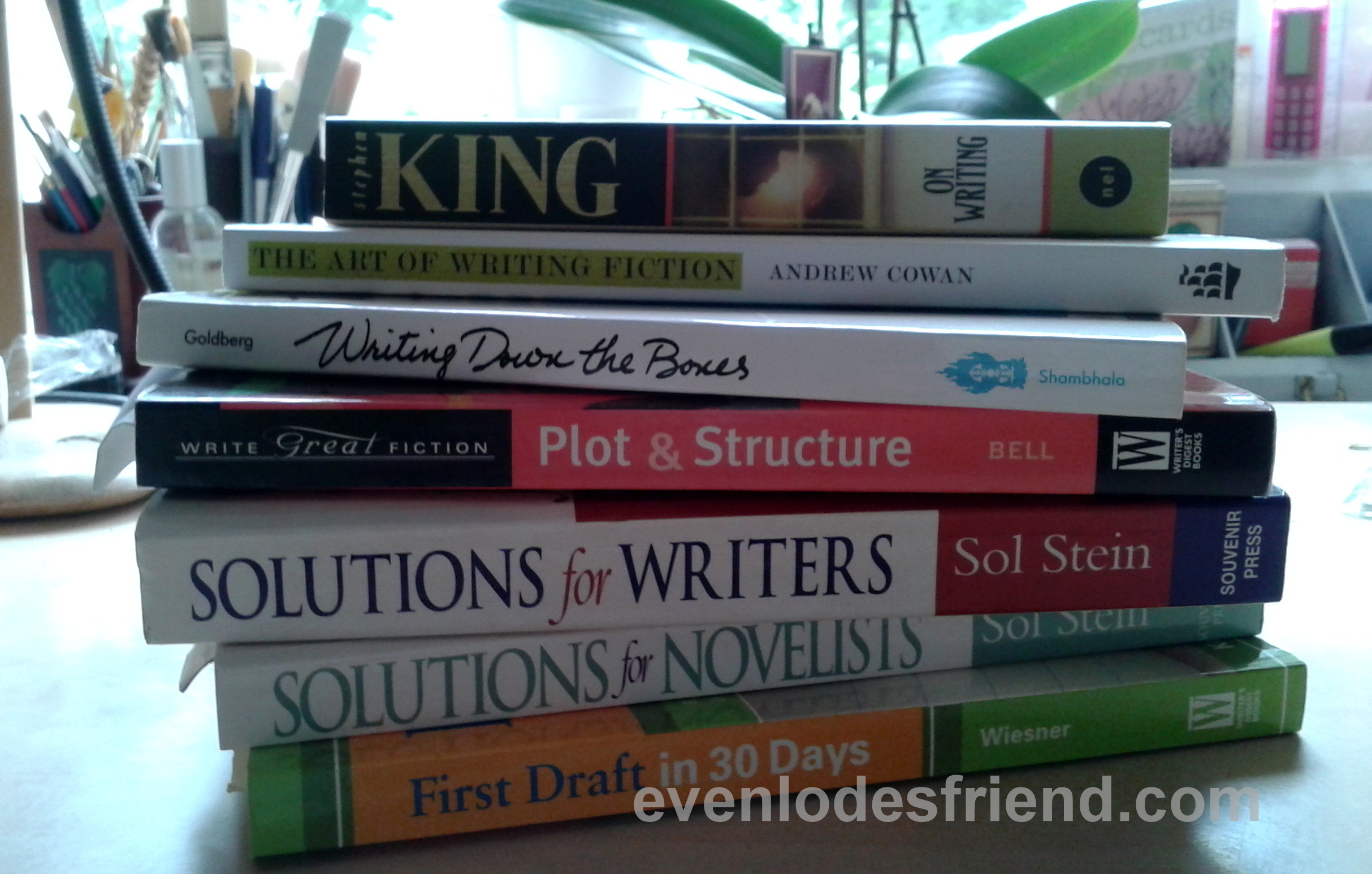
writing books

Most books on how to write will tell you this:  write what you know.

If you have some major area of expertise, they say, you should use that as a background for your novels.  Dick Francis, a famous jockey, wrote crime novels set against the backdrop of the horse-racing world, with spectacular success.  John Grisham was a criminal lawyer and politician before publishing fabulously successful legal thrillers.  Agatha Christie drew on her war work as a hospital dispenser when writing her detective fiction.  All of these authors, and many more, have made huge successes of writing about what they know.

BUT –

(And the word BUT has a bit of fairy dust in it that magically negates everything that comes before it, have you noticed that?)

I once heard novelist Rachel Cusk at a reading on the subject.  She was stridently against the idea of writing about what you know.  She said words to the effect of:

‘You know, we write fiction, and the clue is in the name.  Fiction.  It means we make it up.’

Take a moment to think about this:  the genre of science fiction would never have been invented if we only wrote about what we know.  No one has travelled across the Universe of the star ship USSS Enterprise, after all.  Fancy a world without ‘Harry Potter’ or ‘Game of Thrones’?  That would be the logical conclusion.

And what about crime?  Yes, I agree there are a number of very talented writers producing procedural crime novels who have a background in criminal pathology or forensics, but how many truly great crime writers have actually personally killed someone? (None, we hope.)

‘Write what you know’ does not, therefore, take account of the most wonderful asset we have, the thing that makes human beings extraordinary amongst all the myriad of life on this planet:

Imagination

Imagination enables us to fly beyond the stars at warp speed, fight dragons with broadswords, fall in love with Benedict Cumberbatch and have him love us back.  And all in our lunch break.  Think about it –who really wants to write about their day job when they can write about this stuff?

There is, of course, a caveat.  Sometimes you need to do research.  And research is a double-edged sword on which you fall at your own peril:

I wrote a book set in London.  I have not lived in London.  I gave it to a friend to read, and he was a Londoner, born and bred.  He asked me about the car chase – Where are they?  Where are they going?  What road are they on?  He was frustrated because he knew the city well and he could not orient himself within the action.  I had not done my research and I did not know the setting well enough to wing it.  The novel collapsed for the reader as a result.

The opposite is true.  I wrote this story, set partly in Oxford, a city I know well and visit often.  I was able to undertake the depicted walk myself, just to be sure I had the details and the route right.  The result was a story that was adored by readers who knew the city too.  I had a personal email from one who was delighted that memories of her student days had been rekindled by my work.

So, getting the details right is important.  If you don’t, you can look like an idiot who doesn’t know what he is talking about, and the credibility of your story collapses.

BUT

(Fairy dust again.)

There is such a thing as having too much detail.  The first novel I wrote was set in the Iron Age, around 230BC, on the Newbury Downs.  It is not an area I know well, though I have driven through it.  And I have no background in archaeology or prehistory, so I had to research it all myself.  It took me seven years to finish it, and I gave up doing word counts after 250,000.  I knew too much.  I had too much detail – there are things I know about Iron Age saddles that normal human beings really shouldn’t know.  It’s doubtful that any reader would care.

And yes, you always get the odd accuracy fiend who emails you to say (puts on squeaky voice) ‘Er, the spoon your hero was using in scene 23?  Well, those kinds of spoons were not invented till three hundred years after the date you posit…’ etc etc.  But those are not your average readers.  Unless you write sci-fi, in which case you had damn well know your warp cores from your improbability drives.

“The best way to become acquainted with a subject is to write a book about it.”

-Benjamin Disraeli

The point I am trying to make here is this:  Ignore the advice.

Write what you want to write.

Write what you need to write.

(And if you have to, do the research.)

I promise to talk more about research in a future post, but in the meantime, do this:

Write the novel you want to read.

Happy creating,

EF

How to Give Good Criticism, or ‘Do as you would be done by’

This post follows on from my earlier one, about how to take criticism.

Now, before you get defensive, criticism is a good thing.  It can help you develop as an artist in whatever field you choose to pursue.  It can open your mind, make you a bigger, better human being.

BUT

It has to be CONSTRUCTIVE CRITICISM.

Constructive criticism is given from a place of concern and interest.  It is offered by someone who cares about your work and wants you to be the best you can possibly be.

Most people don’t know how to do this, which means criticism gets a bad rap.  It is seen as something damaging and negative, something that can potentially destroy you as an artist, and believe me, it is, if you do it wrong.

This is a guide on how to do it right.

 THE ONLY RULE IN GIVING CONSTRUCTIVE CRITICISM IS EMPATHY

Everything comes from this.

Put yourself in the place of the person whose work you are reviewing.  Think about what you want to say about it.  How would you feel if someone said something like that to you about your work?  Would you feel hopeful, buoyed up, enthused, or would you be utterly crushed?

Take the time to think before you type or speak.  This is especially important if you are reviewing someone’s fanfiction or online work.  It’s so easy to plonk a few keys and fire off a comment before you have thought about it, before you have considered the impact on the person receiving it.

Don’t say what you would have done instead.  So many readers think that helpful comments should be about ‘well, I would have written it this way.’  No.  Criticism is about pointing out what doesn’t work for you as a reader.  It is down to the writer/creator to decide what to do about that.  (However, helpful suggestions are often very well received.)  Remember that this work comes from someone’s unique perspective, and that they have made many artistic decisions for specific reasons.  Those are reasons that you may not share, understand or even perceive.    Give the writer/creator your respect.

Gauge the level of criticism the writer/creator may be ready to receive.  This can sometimes be quite hard, especially if there is seems a lot wrong with a piece.  Is the writer in need of help at the most basic level, i.e. the nuts and bolts of language and grammar?  This may, of course, be because the language used is not their native language, so they are learning.  If that is so, they may be very grateful for your help.  Perhaps the comments you need to make are at a higher level, in terms of plot, pace, character, structure or dialogue.  Again, this may be a problem with linguistic mastery.  Try to choose one area to comment on at a time.  Don’t deluge someone with criticism of all major aspects of their work, or they will go to pieces.

Knowing the writer’s other work helps.  This way you can refer back to it, and they feel known and appreciated.  If someone is commenting with knowledge of your back-catalogue, they can comment in context.  They know where you are coming from, and how your work has changed over time. It’s not necessary to read everything a writer has written before you comment, but if you have read one or two of their other works, and you think they are relevant, it can be a great boost, a recognition of the progress they have made and what they do right.

Practise constructive criticism in a writers group.  You can join them online or face to face.  Watch notice boards in your local library or bookshop, or scan the pages of literary and writers magazines like Mslexia to find a good group.  Alternatively, form your own, and workshop your work together.  Make the rule that all comments must be caring and constructive.  Always ask the recipient how they feel about what was said at the end of their workshop session, so that they have a chance to talk about any comments they found difficult to handle – trust is crucial.  (I’ll write more soon about writers groups and how useful they can be.)

Always point out and praise what does work, and be positive.  The writer/creator has put a lot of time and effort into producing something for your consumption and enjoyment, and that in itself is a great achievement.

Don’t EVER get personal.  This is about the work, not the person.

If you react in a strongly negative way to a piece, ask yourself whether this is because the content is touching on your own issues and triggers?  If it is, DO NOT comment.  I suggest you spend some time writing your rant out in your journal, rather than firing it off to some innocent writer who doesn’t know about your ‘stuff’.

Some examples of constructive criticism:

(These are all actual examples of constructive criticism I have received on my work, and are offered as illustrationss of general points.)

“I’m not really sure I understand the character’s motivation at this point.  Maybe I need to see them in a scene that shows them being attacked about this issue so I know why they are reacting so defensively later on, or maybe point to some backstory that suggests this?”

“And then he said it.  The thing he wasn’t supposed to say.  The one thing I never expected from him.”  – (section of text from my story)  This feels like overwriting to me.  If it was the one thing he wasn’t supposed to say, surely it is unnecessary to add that it was unexpected from him.  You are repeating the sense here.  Just take the second sentence out, and its perfect as it is.”

“The word xxxxxx stands out as awkward here for me.  Would they really use that kind of language?  It sounds more like modern slang than a Victorian expression, and it kind of bumped me out of the flow of reading.  Could you substitute something similar but gentler?”

“(Example given)  This sentence is really long.  It has so many commas that I got a bit confused as to what you were trying to say.  It would make much more sense for me if you made shorter sentences, so that I don’t have to consciously keep track of where you are going.”

 A final note:

Remember, it takes a lot of guts to put your creative work out into the public arena.  For many creative people it feels like sticking one’s head into the lion’s mouth.  Respect that fear and the bravery that outweighs it.  Always respect and have empathy for the creator of the work on which you comment, and it will be hard to go wrong.  If we support one another’s work lovingly, we can all learn together.

Incidentally, I would love to know if you have more tips on how to receive or make constructive criticism – if you do, please comment/reply!

Happy creating,

EF