Category Archives: Inspiration

On Process: Too Many Ideas, Too Little Time

Usually creative people complain about creative block.  I don’t.  For the most part, I have the opposite problem.  Too many ideas.  Not enough time to execute them.  I have this constant fear that I shall die suddenly without sharing all the pictures in my head.  That would be a great incentive to work if it weren’t for the fact that my poor health is a huge brake on my capacity to work.

And then there is the fact that I have the mind of a butterfly.

The Buddhist masters often refer to the concept of ‘Monkey Mind’.  This is what your mind does when you try to meditate, and your thoughts bounce around like gibbons, and feel impossible to control.

Welcome to my world.

Actually, that is not entirely true.  I can be deeply committed to one idea for a short period of time.  The most I can normally manage is about three months.  Then I bounce off to find another sparkly thing.  Most of the time, I come back.  Occasionally, I manage to actually finish something.  Occasionally it gets shelved for good, or the idea gets incorporated into something new, because its too good to waste.

I’ve been socialising a lot this summer, and people have repeatedly asked me the same questions:

‘How’s the writing going?  What are you working on at the moment?’

Below is the honest answer (i.e. the one I don’t give nice people at parties because its too complicated to explain, especially if they’ve never met me before.)

The things I am currently working on:

  • A series of short stories about John and Sherlock in a stable relationship
  • Finishing a work about Sherlock’s pursuit of public sexual humiliation because of his guilt about his faked suicide.
  • A novella about a Viking Princess
  • My novel about Victorian sexuality, currently titled ‘The Butler Did It’ (Please could somebody suggest a better title, I’m getting desperate!)
  • My journaling ebook

Other ideas I have churning about in my head include:

  •  A possible novella about a young man getting over the death of his male lover in a road accident
  • A short story based on a line from a deliciously naughty Johnlock fanfic I read the other day, The Red Box by Cleo2012
  • The third Evenlode novel (vampire gangsters ahoy!)
  • A Loki fanfic set after the end of Thor 1

(And this is before I have even begun to tell you about the paintings I want to make…)

I was explaining this smorgasbord to a friend, and she said ‘How on earth do you handle all that?’

The answer is, ‘I have no idea.’

I suppose I have a good memory, but the older I get, the more I am going to need to employ my writing notebooks to record all this.  The truth is that ideas are far easier to come by for me than the wherewithal to execute them.  And there just isn’t enough time in my day to get all this done, and execute my duties as wife, friend, aunt, guidemother, part-time carer to elderly, sick in-laws etc etc. and still protect my health.

Triage is necessary.

I just have to grab one sparkly thing and run with it for as long as I can.  I have to choose the most important thing to me at the time.

Most creative people complain about creative block, but the other side of the coin is equally disabling, and I know for a fact I am not the only one who experiences this problem.  Choosing which is the best idea to work on.

If you have any ideas on how best to deal with idea overspill, please let me know in the Replies section.  I’d love to know what you do.

Happy Creating,

EF

On Cabbages and Trombones – Making Language Strange

The expression ‘cabbages and trombones’ was one used by the poet Ian Macmillan at a recording of a poetry radio show which I went to see with a friend a while back, and the phrase stuck with me.  He was talking about how poets seek to make language strange and startling, how they seek to use it to weave a rich tapestry of image and idea.  That, after all, is the purpose of poetry, to enrich our experience of life with pattern and syllable.

The concept chimed with me again when my husband was wrestling with a writing problem of his own.  Besides being an academic, he runs an online whisky company, and occasionally works as a whisky writer.  He had been asked to contribute reviews of a variety of whiskies for this book.  Little bottles duly began to arrive in the post every morning, and off he went at a rate of three or so per evening.  Everything was fine for the first thirty tests or so.  But then he began to run out of descriptors.  Just how many new adjectives can you come up with when you’ve got 60 whiskies to review?  They can’t all taste of TCP or green jelly babies.  Can each review really be different from the last?

And today, as I busy myself with planning my new writing schedule, and working on new stories, it has come back again.

Experts say those with a college education generally have about 12,000-17,000 words in their vocabulary, but as writers we need to have far more and we need to use them in unusual and riveting ways.  I realise that I have dropped into the habit of reading very little but fanfiction, and if you are a fanfiction reader yourself, you will know that there are a lot of linguistic ruts involved.  Favourite words include laving, ravishing, carding (of luxuriant hair), trembling and so on.  No fanfic is complete without somebody emitting ‘ragged breath’.  If you have read enough of these, you begin to spot the clichés.  If you read too many, they scream out of the screen at you.  (I hold my hands up and say I am as guilty as any of falling into this trap!)

The trouble is that if you don’t read more widely than just what other people write on the internet, your vocabulary stays static.  This is what mine has been doing.  Now I am writing again on a daily basis, I have realised how stagnant my linguistic skills have become.  Of course, its not just words, but metaphors and similes.  I need to polish up my style, make it strange and new.  I need to expand my consumption, and open my mind.

 WARNING:  Incoming Master Plan for Expanding Lingustic Skills:

I’m taking a two-pronged attack:

  1. Widen my reading
  2. Use my notebook at all times

I’ve been reading just fanfics and nonfiction all summer, and its been a long time since I actually finished a proper novel.  You can’t be a writer if you don’t read.  Mostly I just read at bed time, a few paragraphs to help me drift off.  But I need to take Stephen King’s sage advice:

“If you want to be a writer, you must do two things above all others: read a lot and write a lot.”

Stephen King, “On Writing”,

Hodder and Stoughton (2000) p164

 Of course, I’ve got a whole pile of books lying around, waiting to be ploughed through.  Top of the pile are ‘The Night Circus’ by Erin Morgenstern, and ‘Atonement’ by Ian McEwan.  I don’t especially like McEwan, but I am determined not to let this bloody book defeat me.  It’s the third time I’ve tried to read it, after all, and I refuse to be beaten!

I have also decided to follow Ian Macmillan’s advice.  Poetry is the way to go.  I’m not a reader of poetry – I’ve barely read any since my degree – but if you want to know about making language strange, go to the experts.  I went to the library yesterday and got out two collections, one of Ted Hughes, and one of Simon Armitage, because I had heard of them.  I’ll let you know if it works.

The second prong (I love that word, don’t you?) is more nebulous.  Out comes my little red Moleskine.  I need to think about how I am going to get the ball rolling on this particular aspect, but just jotting down a few ideas on what the weather feels like, smells like, tastes like, or overheard conversations, or the colours of shadows, might be a good start.  Again, I’ll let you know how I get on.

In the meantime, here’s to cabbages and trombones.  And whisky that tastes of TCP and green jelly babies.  Both of which have taught me a lot about writing.

(Incidentally, you may like to know that I am currently publishing a new fanfic called ‘A Shadow of His Former Self’.  You can find it here at A03, and here at Fanfiction.net.  I hope it takes your fancy.)

Happy creating,

EF

I am incubating a Cunning Plan!

Summer opens up a world of possibilities...

Summer opens up a world of possibilities…

Isn’t summer wonderful?  The Husband is off work at the moment, enjoying a couple of well-earned weeks’ rest.  My mother came to stay for the week last week (very exhausting), and the week ended with a family party, and a 6 hour long round trip to get there.  You will appreciate that I am feeling just a little jaded right now.  However, there is sunshine, and friends dropping by, and this morning we sat in the garden, drinking freshly pressed apple juice for breakfast, and basking, and it doesn’t get much better than that, let me tell you!

Sometimes, its good to take a breather.  I’ve had a week where my thoughts have not been my own, and its made me realise how much I need to write.  It is not so much a desire as a primal drive.  Now I have my time (and my brain) to myself again, all I can think about is what I want to write next.  My body may not be ready to get started yet – a lot of restorative time in bed will be necessary for that – but my Muse is getting her juices into gear.

And let me tell you, that feels so great!

I can feel a plan beginning to form behind my eyes about what I want to achieve in the next three months up to Christmas.  (Yes, I know, I’ve started thinking about presents already, I must be a sick, sick person!)  I can’t quite put my finger on the specifics of it yet, but I can’t wait to just plunge in and indulge my creative urges.

And I mean indulge!  I want to do something delicious and opulent.  I want to manifest an idea made of mental gold thread and velvet and jewels, something as luscious as sinking my teeth into a ripe peach.  Know what I’m saying?

I want to CELEBRATE!

I promise I’ll keep you posted about what I come up with.  In the meantime, enjoy the rest of the summer, and raise a glass of Pimms/mint julep/mojito/insert your favourite tipple here to the joys of August and Time Out!

With love,

EF

The Writing Life: Literary festivals

Finding your tribe as a writer, or in any kind of creative endeavour, is an important thing to do.  Being around other writers provides support and inspiration, and I think it’s a crucial thing to do.  Writing can be a very solitary activity, and its no surprise to find that many writers suffer from depression.  You try sitting on your own every day for six months of the year and see how it affects your mental health!  Its important to get out.

Literary Festivals and author signings are a really good way to fill your well and get affirmation for your work.  Maybe you won’t be able to present what you’ve written to other people, but being around those who are interested in the same things as you, undergoing similar challenges, really helps.

As a writer, you also need to gauge the market and be aware of your contemporaries’ work.  Reading is an important thing to do, and if you really love writing, you will love reading just as much!  Literary festivals give you a chance to be exposed to books you might never pick up otherwise, to hear authors speak about their work, and to ask questions about their writing process.   Think about it – a huge reservoir of inspiration and knowledge out there, just waiting for you to tap into it.  Why would you not?

Your local bookshop will probably have readings by authors scheduled, and these are worth attending because they are more intimate, and allow you more personal access.

Check the culture and review sections of newspapers, and the ads in writing magazines, as well as noticeboards in libraries, for details of the bigger events and festivals.  Some music festivals are starting to have literary strands too, so keep your eyes peeled.

My nearest festival in the one at the University of East Anglia, but its slightly different from a three day or week-long event, in that it studs two university terms with readings by authors, playwrights, poets and journalists.  This gives a wide variety of speakers over a six month period, and allows me to attend where I want, and to absorb what I learn over time.  And because it is such a prestigious centre for creative writing, it attracts some seriously big names.

I have attended events with Arthur Miller, Jeanette Winterson, Rose Tremain, Simon Armitage, Seamus Heaney, Iain Banks (need you ask!), Rachel Cusk, Alan Hollingshurst, Isabelle Allende, Richard E Grant and many others.  I went under sufferance with a friend to see Ian McEwan, whose writing I hate, only to be utterly charmed and instantly determined to reread everything he has written.  And I saw Doris Lessing the week after she had been awarded the Nobel Prize for Literature.  She was feisty, fascinating, and marvellous despite obviously being in terrible pain, and she tore the rather pompous interviewer to shreds, which was very satisfying.  At the end she received a spontaneous and heartfelt standing ovation, and I actually found myself crying.  You can’t find better inspiration than that!

Be warned, however.  Sometimes your idols can prove to have clay feet.  I went to see Graham Swift, whose books ‘Waterland’ and ‘Last Orders’ I had adored.  He read so badly, and was so miserably boring, that I felt insulted enough to vow never to read another one of his books.  And I haven’t.

Brett Easton Ellis was a writer whom I had worshipped since reading his work for my degree.  I clamoured to get a ticket to see him.  And now I can’t remember a thing about him, not even what he looked like, and certainly nothing of what he said.

I generally come away from these events feeling inspired and excited about doing new work, full of ideas and hope for the future.  It can be a dangerous game, however.  Be prepared, if you go to an author reading, to feel insignificant, and that you work is poor and will never be published.  It happens sometimes, though less often the more you write, and it will pass.

The important thing, however, is to go.  Attend events with even the least known authors, since they are often the ones who will inspire you the most.  (And one day, you might be up there too, so it adds to your own karma to support other people!)  Ask questions, and read the books.  This will enrich your own work, as well as introducing you to writing you might never have experienced otherwise.

Challenge yourself.  I don’t really do poetry, but went along with a poet friend of mine to see readings by several poets, and was enchanted.  I’ll never be a poet, but this form has opened my mind to the possibilities of language, and I’m so grateful.

Finding your tribe, and being amongst other writers is important.  It helps you feel part of a joint creative endeavour, but it also feeds your Muse.  There is a whole world of wonderful written joy out there, and literary festivals area an easy way into it.

Happy listening!

EF

Outflow: My Creativity Right Now

Picasso ceramicsWe are having a heatwave here in the UK, and I’m not very good in hot weather.  The result is that my brain has gone on strike, as has much of my body.  Which makes me think about ‘creative seasons’ and the Habit of Art.

My ongoing health problems taught me long ago to have peace with the days when I can’t do anything beyond lie on the sofa and practise my groaning. ( I’m getting quite good at groaning, I have to say.)  Chronic Illness is, however, a bit of an extreme way of forcing oneself to recognise one’s creative cycles, and not one I would recommend.

There are lots of creativity gurus who are adamant that turning up at the page, or the canvas, and making yourself do the work is the only way forward, and for the most part, I would agree.  But what do you do on the days, like today, when it just ain’t gonna happen?

Take note, that’s what.

I find my creativity goes in bursts, as I have mentioned before, and in recent years I have noticed that my writing seagues slowly into art in the summer months.  Writing is a great thing to be doing when the weather is cold and wet, and all you want to do is curl up in the warm.  In the summer, though, the urge to get out there into the landscape and experience the world is almost irresistible, as anyone who has ever worked through the summer in an office will agree.  Right now I am experiencing the difficult-to-ignore urge to paint rather than write.

And I am OK with that.

Yes, I am feeling a bit frustrated that I can’t settle to the writing projects I want to progress, but I can’t force it, or I will get resentful, and probably produce pages of complete drivel that I’ll hate later.  The urge to be creative is still with me, though.  It is just taking a different, more exterior form.  I want to draw, paint, decorate pottery, make cushion covers, garden, and bake cupcakes.  So that’s what I’m going to do – at least as soon as the weather cools down and my brain starts functioning again!

There is a tension between turning up to create and the creative seasons themselves, and the skill of a true creative is to be able to accept the difference between a) the resistance to sitting at the desk and working, which is procrastination and stopping oneself being all one can be, and b) the natural flow of creativity as it morphs from one season to the next.  There is much to be said for making yourself sit down to create every day, but using it as a stick to beat yourself with is not helpful.  We need to be aware of when our creativity transforms, and to trust it enough to go with the flow.  This doesn’t mean I am abandoning my writing for good, simply that I know that right now, that isn’t where my best work will come.

The image in my head to illustrate this is when Picasso discovered the provencale village of Vallauris and threw himself into the art of ceramics.  I have no doubt there were those who worried that his canvas days were over, but that was far from the truth.  Instead, he trusted his creative urges enough to know that ceramics was a road he had to walk at that point in his life.

So I am trying to emulate Picasso, and to be at peace with where my creative road is taking me.  It’s not easy, and Nigel has a lot to say about not having the gumption to get on with the novel, but frankly, STUFF NIGEL!  Lets get out in the sun, eat ice cream, and do creativity the way we need to right now!

Happy sun-bathing and creating,

EF

Nuts ‘N’ Bolts: Writing Exercises

writing notebook Firstly, an apology.  Observant readers will note that today is Thursday.  Yes, I am a day late in posting.  Sorry.  Life got in the way, in the shape of a migraine, and it’s not funny trying to write with tunnel vision and the pain equivalent of a knitting needle stuck through your eyeball.  I figured I might sound somewhat distracted (as indeed I was), so in the spirit of demonstrating how important self care is, I bugged off and went to bed.  Today’s post is something of a restart.

For a while I have been feeling the itch to get back to writing original fiction.  I’ve been working on fanfiction almost exclusively for a couple of years now, and while it has been hugely instructive in terms of both technique and confidence, I feel like it is time to start making some personal headway again.  Hence the restart.

Getting back to basics is one way to do this if, like me, you are feeling a little at sea when it comes to what to write about.  And one of the best basics to get back to is the marvellous tool that is the writing exercise.

Writing exercises are based on the idea of stream-of-consciousness and free association.  You sit down with your notebook and write for a set amount of time, without judgement or criticism.  You are free to make mistakes, try stuff out, experiment with new words, phrases, images, metaphors.  This is a free-form space where there are no mistakes, only ideas tried on for fit and comfort.

What you need:

  • An allowance of time (10 minutes, 15, half an hour if you have it, or the luxury of more.)
  • A notebook (maybe your writing notebook, or one you keep specially for exercises).
  • A good pen that you can write easily with.
  • A timer.
  • A quiet space to work.
  • A prompt.

What to do:

Maybe you sit down to write at your desk, and your brain goes blank, or worse, is crowded with too many ideas that are too big to fit into 10 minutes or whoever long you have got, and you freeze.

Say hello to your little friend, the prompt.

A prompt is a word, sentence or idea that you use to start you off.  Write it in your notebook.  You may like to start a fresh page, thus allowing yourself a psychological fresh start.  Set your timer to your allotted amount of time, and off you go.

You start writing whatever comes into your head.  You might be writing about yourself, the way you would in your journal, or you might be writing about a character, or from a character’s point of view.  You might describe a scene or an experience.  Keep writing.  Whatever appears on the movie screen of your brain, write it down. And the next thing.  And the next thing.  Keep going until the bell rings and your time is up.

This is a great way of generating material, especially if you are the kind of writer who finds building up words a process of torture.  It is also good for exploring the backstory of your characters, finding out what makes them tick.  And of course, you will occasionally find yourself coming back to reality in the middle of a short story that you didn’t even know you had in you, as I often do.

I like to do two or three 15 minute exercises at one sitting, which allows me to really get into the groove.  You may not have time for that, and that’s okay.  The important thing is that you do the exercises.  And do one daily.  Limber up.  Get into the Habit of Art.

If you find it hard to get yourself into the mood, or to make time, writing exercises are a great tool to use with others.  Arrange to meet up with a writing pal at the local café, and do a few prompts together.  You don’t have to share what you have written if you don’t want to, but if you make an appointment with someone else, you are more likely to show up at the page and do the work.

Where to find prompts:

Ah! I hear you cry.  But where am I supposed to find these fabled prompts?

Well, there are plenty of books around that offer just these kinds of starting grounds.  I am very fond of the following:

‘A Writer’s Book of Days’ by Judy Reeves

‘The Writer’s Block’ by Jason Rekulak

‘The Writer’s Idea Book’ by Jack Heffron.

Search the internet for ‘writers prompts’, or check out http://creativewritingprompts.com/, which is a delight.

In the meantime, here are a few to get you started:

  • What does your character carry in their pockets and why?
  • I woke with a start…
  • Heat
  • My first pet
  • A favourite meal

Happy Writing!

EF

How to Write: Write what you know, or not…

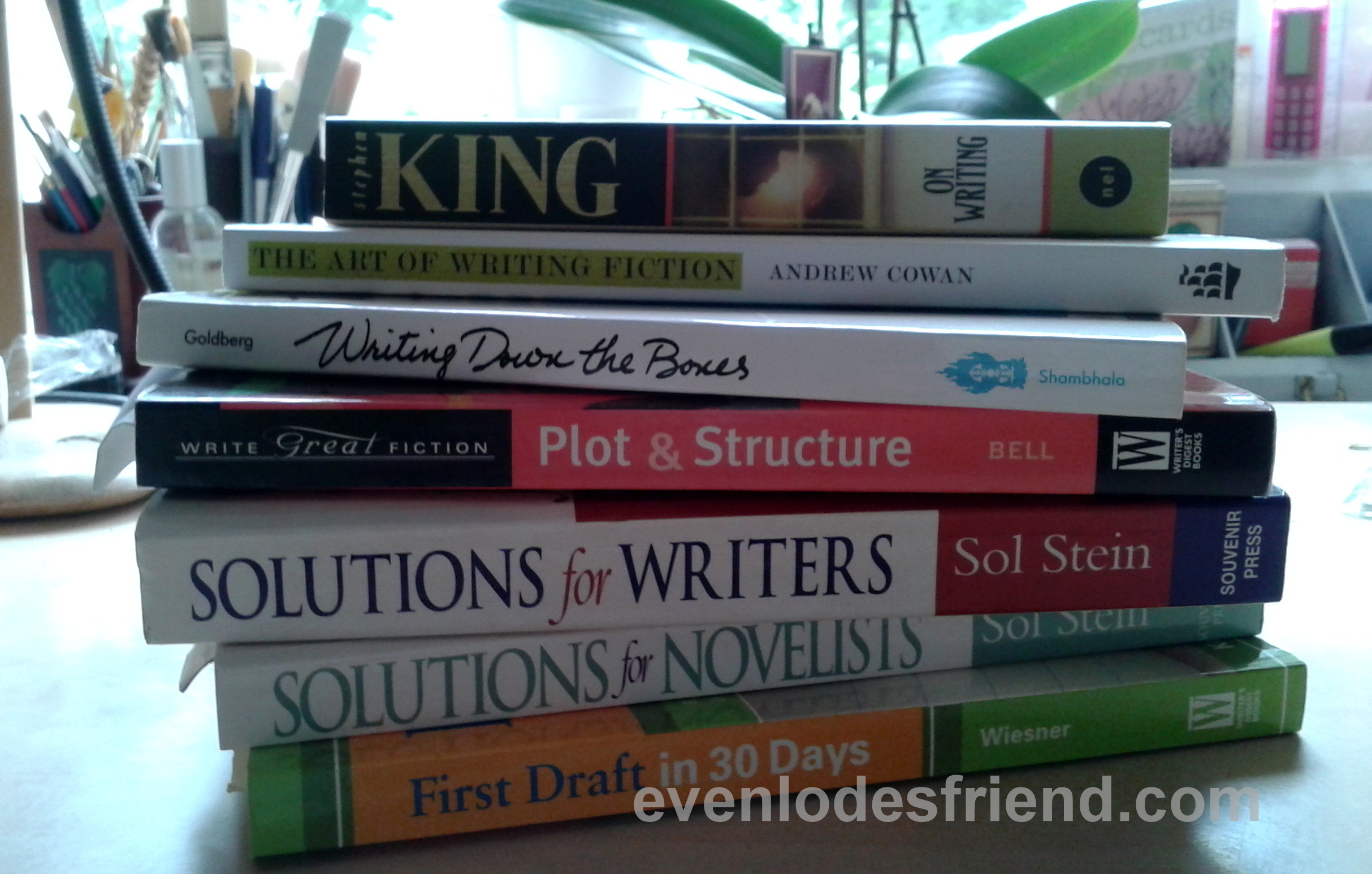
writing books

Most books on how to write will tell you this:  write what you know.

If you have some major area of expertise, they say, you should use that as a background for your novels.  Dick Francis, a famous jockey, wrote crime novels set against the backdrop of the horse-racing world, with spectacular success.  John Grisham was a criminal lawyer and politician before publishing fabulously successful legal thrillers.  Agatha Christie drew on her war work as a hospital dispenser when writing her detective fiction.  All of these authors, and many more, have made huge successes of writing about what they know.

BUT –

(And the word BUT has a bit of fairy dust in it that magically negates everything that comes before it, have you noticed that?)

I once heard novelist Rachel Cusk at a reading on the subject.  She was stridently against the idea of writing about what you know.  She said words to the effect of:

‘You know, we write fiction, and the clue is in the name.  Fiction.  It means we make it up.’

Take a moment to think about this:  the genre of science fiction would never have been invented if we only wrote about what we know.  No one has travelled across the Universe of the star ship USSS Enterprise, after all.  Fancy a world without ‘Harry Potter’ or ‘Game of Thrones’?  That would be the logical conclusion.

And what about crime?  Yes, I agree there are a number of very talented writers producing procedural crime novels who have a background in criminal pathology or forensics, but how many truly great crime writers have actually personally killed someone? (None, we hope.)

‘Write what you know’ does not, therefore, take account of the most wonderful asset we have, the thing that makes human beings extraordinary amongst all the myriad of life on this planet:

Imagination

Imagination enables us to fly beyond the stars at warp speed, fight dragons with broadswords, fall in love with Benedict Cumberbatch and have him love us back.  And all in our lunch break.  Think about it –who really wants to write about their day job when they can write about this stuff?

There is, of course, a caveat.  Sometimes you need to do research.  And research is a double-edged sword on which you fall at your own peril:

I wrote a book set in London.  I have not lived in London.  I gave it to a friend to read, and he was a Londoner, born and bred.  He asked me about the car chase – Where are they?  Where are they going?  What road are they on?  He was frustrated because he knew the city well and he could not orient himself within the action.  I had not done my research and I did not know the setting well enough to wing it.  The novel collapsed for the reader as a result.

The opposite is true.  I wrote this story, set partly in Oxford, a city I know well and visit often.  I was able to undertake the depicted walk myself, just to be sure I had the details and the route right.  The result was a story that was adored by readers who knew the city too.  I had a personal email from one who was delighted that memories of her student days had been rekindled by my work.

So, getting the details right is important.  If you don’t, you can look like an idiot who doesn’t know what he is talking about, and the credibility of your story collapses.

BUT

(Fairy dust again.)

There is such a thing as having too much detail.  The first novel I wrote was set in the Iron Age, around 230BC, on the Newbury Downs.  It is not an area I know well, though I have driven through it.  And I have no background in archaeology or prehistory, so I had to research it all myself.  It took me seven years to finish it, and I gave up doing word counts after 250,000.  I knew too much.  I had too much detail – there are things I know about Iron Age saddles that normal human beings really shouldn’t know.  It’s doubtful that any reader would care.

And yes, you always get the odd accuracy fiend who emails you to say (puts on squeaky voice) ‘Er, the spoon your hero was using in scene 23?  Well, those kinds of spoons were not invented till three hundred years after the date you posit…’ etc etc.  But those are not your average readers.  Unless you write sci-fi, in which case you had damn well know your warp cores from your improbability drives.

“The best way to become acquainted with a subject is to write a book about it.”

-Benjamin Disraeli

The point I am trying to make here is this:  Ignore the advice.

Write what you want to write.

Write what you need to write.

(And if you have to, do the research.)

I promise to talk more about research in a future post, but in the meantime, do this:

Write the novel you want to read.

Happy creating,

EF

Inspiration Monday: Dreams

angrysea

Angry Sea by John Lewis Photography

Everybody dreams.  Maybe you don’t remember all your dreams, but they are there as a window into your own psyche, and to explore as a source of inspiration.  Dreams are a chance for your imagination to go completely wild, places where the impossible really can happen.

I’ve always been very fortunate to dream in vivid technicolour.  Many of my dreams are coherent stories in filmic form.  I am often aware that I am dreaming, and find myself enjoying the stories playing out inside my head.  Maybe you don’t have that capacity, but through the technique of lucid dreaming, you can develop more.  Maybe you only have occasional images, snapshots of your dreamworld.  Even these can be fodder for your art.

One Christmas Eve I had a dream.  I know it was a coherent one, I was aware of it at the time.  When I woke in the morning, I had only one image left in my memory, but it was a compelling one.  Imagine a man, looking very like Richard Armitage, tied to a chair.  A demon stands in front of him and sinks its hand into his chest, and pulls out his still-beating heart.

That was all there was.

No context.  No meaning.  Just this image.

That was where my five book series of Evenlode novels began.  Five novels, which began with one blurrily remembered image from a dream.

Here is the dream I had last night:

Two teenaged boys are living in a run-down, poverty-stricken, former industrial city in the North of England.  They roam a half-derelict, grey landscape pocked with disused steel works and the skeletons of mine engines.

One is tall, dark and skinny, the other short, stocky and blonde.  They are both outsiders, clinging together for support because they have no one else.  They are hunted by a gang of other boys who regularly attack them, and call them names.  They accuse the two friends of being gay.  That is the reason they give for their hatred.

One day, the blonde boy helps his friend through the front door of the dark boy’s parents house.  He has been badly beaten.  His father is at home.  When the father finds out the reason why his son has been beaten, he assumes the accusers are correct.  He starts to beat his son for being gay, for being weak.  His belt will make the boy a proper man, he claims.  The blonde boy stands between father and son.

‘Your son is a proper man.  A real man.  He protects me.  He takes the heat for me, because I am gay, not him.”

The blonde boy has already been rejected by his own family for his sexuality.

Later, broken and despairing, the boys walk, hand in hand, up the hill to where a huge World War Two concrete bunker stands, clinging to the top of a sea cliff above the town.  The sea is rough, the wind strong, the air full of swirling grey drizzle.  The cavernous interior of the bunker has been taken over by the council, and is being used as a reahearsal space for the city’s orchestra.  They are practising a piece as swirling as the tormented weather outside.

Together the boys walk through long dark corridors buried in the hillside, swelling music echoing around them,  until they reach the roof of the bunker, where the Ack-Ack guns were once mounted.  Together, they stand up on the narrow wall around the edge, and kiss.  And then, together to the last, they jump and fall, still holding hands, down the cliff and into the churning seas below.

Yes, it is messy and there are holes and cliches in it.  But that is what I dreamt, in its entirety, as I remember it.  It is atmospheric and tragic, and I don’t even want to think about doing a psychological reading of it.  But wouldn’t it make a great short story?  Or even a short film?

Dreams are a free resource just floating about inside your own head, begging to be used.  Don’t waste a minute.  After all, isn’t that a great excuse to sleep more?

Writing Exercises:

You can find our more about Lucid dreaming here and here.

Keep a notebook by your bed and write down your dreams as soon as you wake.  Don’t wait.  You will forget them.  Write down whatever you can remember, no matter how disjointed it may seem.  Describe what you saw in as much detail as you can.  I get enormous, almost baroque detail in my dreams.  Get as much down as possible, even if it seems too weird, complicated or just completely insane!  You never know what may be useful later.

(I find this technique especially helpful with troubling dreams or nightmares, which I have a lot.  These sorts of dreams can follow me around during the day, filling my waking heart with dread or sadness.  However, I find that once I write them out, their power over me wanes, and I don’t get the ‘after effects’.)

Now, dip into your dream notebook whenever you are looking for an idea or a writing exercise to play with.  Choose a dream, a scene, an image, or a whole story if you get them, and use it as a starting point.  Write stream of consciousness for fifteen or thirty minutes and see what comes out.  Can you use this as the start of a short story?  A screenplay?  Is there an interesting character here for you, as there was with my Christmas Eve dream?

If you are a visual artist, what colour palette comes out of this dream for you?  What striking images, silhouettes, shapes stick in your mind?  For example, in my ‘two boys’ dream, the colour palette was greys and blues, the shapes of derelict buildings were jagged silhouettes against the lowering sky.  Explore the colours you recall in your sketchbook.  What would a painting of your dream look like?

A musician might take from my dream the echoing strings of the orchestra, muffled by the concrete, and backed by the roaring of the waves as they crash against the cliff below, and turn that into some kind of soundtrack.

Where can you take your dreams?  How far can you drive your limitless imagination?

Happy dreaming,

EF

Inspiration Monday: Art

I’ve talked a bit about using images for inspiration before, here.  Today, I want to say a little about the inspiration specific pieces of art can offer.

Girl with a Pearl Earring by Johannes Vermeer

Girl with a Pearl Earring by Johannes Vermeer

I hope you have seen the film ‘The Girl with a Pearl Earring’ with Colin Firth and Scarlett Johannson.  But have you read the incredible book on which it is based, by Tracy Chevalier?  Chevalier’s work is spare and beautiful, as atmospheric as the eerily beautiful painting which inspired it.

The Nightwatch by Rembrandt van Rijn

The Nightwatch by Rembrandt van Rijn

A film I sincerely doubt you have seen unless you are a particularly rabid Martin Freeman fan, or a Peter Greenaway fanatic, is ‘Nightwatching’, which deals with the events behind the making of Rembrandt van Rijn’s most famous work, The Night Watch, above.  While it is a stagey and self-aware production, typical of Greenaway’s work, Freeman’s performance as Rembrandt is devastating, for if ever there was a part he was born to play, it is this one.  Greenaway takes the making of the painting, and interweaves it with conspiracy, murder and an ironic portrait of seventeenth century Dutch life and commerce.  Add to this the tragic downfall of the artist with which the picture is associated, and you can see how a single painting can be the starting point for a many-faceted new artistic endeavour.

Coal Face Drawers by Oliver Kilbourn

Coal Face Drawers by Oliver Kilbourn

‘The Pitmen Painters’ by Lee Hall, is not specifically inspired by an individual work, but by the collective experience of a group of miners  from Ashington, near Newcastle upon Tyne, who set up a long-lived and much praised art group.  It is as inspiring a piece of theatre as I have seen, and  brings proper credit to the work of the pioneering men who took up painting against society’s expectations in the 1930s.  The fascinating painting above is Coal Face Drawers, by Oliver Kilbourn, a scene from a miner’s own life.

Rothko Seagram Murals

When I was seventeen, I visited the Tate Gallery for the first time.  The Tate Modern had not yet been created, and the fabulous Seagram Murals by Mark Rothko were at the old Tate Gallery, what is now Tate Britain.  The Murals now have an area designed to Rothko’s original specifications in the Tate Modern, but then, they were in a much smaller, but still impressive room.  I sat there amidst these vast panels of claret and black for nearly two hours, completely mesmerised.  Rothko’s huge blocks of colour have been much derided by those who dislike abstract art, but his work is about the effects of colour on the emotions, and I can definitely tell you that those paintings had an intense effect on my teenage brain that day that I will never forget.  I have never felt so calm, so peaceful, so at one with myself and the world, and I have spent my life since chasing after that feeling, hoping somehow to replicate it.

As a result I became interested not only in Rothko’s work, but in other abstract artists and their theories.  I read Kandinsky’s ‘Concerning the Spiritual in Art’, and was intrigued by the idea of the painter imbuing a work with some kind of spiritual presence.  Eventually I used this idea for a novel, in which a much-coveted and rare painting is imbued with occult properties that devastate the lives of its owners.

It is important to state that I am not encouraging you to steal other people’s art.

Proper credit MUST be given.  We must always acknowledge where we come from, and the ideas that have influenced us along the way.  That is part of being an artist, in whatever medium.

What I am suggesting here is that the great works of those who have gone before us can inspire original and unique responses of our own.  It would not be so far from the truth to say that this is what fanfiction is – and if you are sceptical about fanfiction, I refer you to the literary responses to great art that are much lauded:  Jean Rhys’s novel, ‘Wide Sargasso Sea’, which is a retelling of Charlotte Bronte’s Jane Eyre, or perhaps ‘Death Comes to Pemberley’, PD James’s sequel to Jane Austen’s ‘Pride and Prejudice’.  Milton’s ‘Paradise Lost’ is inspired by the Bible, so don’t be sniffy about your inspiration!

Creative Exercises:

Visit an art gallery.  You would be amazed what fabulous works of art are available to view in your local county town or art sellers.  Treat yourself to a big trip, and visit a major city where you can enjoy a large museum.  Take time to wander about and figure out what you like and why.  Buy postcards of your favourite pieces.  Do a bit of research about the artist and their ideas.  Salt this inspiration away for future reference in your writing notebook and your image box, or let it fizz away in your brain like a vortex, spitting out new ideas as debris as it spins.

Alternatively, you could check out the suggestions above, watch the DVD of ‘Girl with a Pearl Earring’ or ‘Nightwatching’, or read Chevalier’s wonderful novel, and see where they take you.

Happy Creating,

EF

Inspiration Monday: Colour

colorful-paints-WallpaperThe fact that human beings can perceive colour has been a huge influence on our development and our cultures. Colour has helped to protect us from danger, and find good things to eat.  It has helped us to define who we are in relation to others, as well as what we believe.  These days, it is as widely used in marketing and medicine as it always has been in art and fashion.  Colour blindness can prove a significant disability.

Thinking about how we respond to colour can be a rich seam to plunder for creative purposes.  The artists of the Fauvist movement, such as Matisse, and later Abstract Expressionists such like Mark Rothko, used intense shades of colour to convey and provoke emotion.  Both Matisse and Picasso made blue nudes, but look at the images they produced:

blue-nude picasso

Picasso Blue Nude 1902

blue nude Matisse 1952

Matisse Blue Nude 1952

Matisse’s vibrant cutout provokes a very different response to Picasso’s sombre meditation on grief.

Blue is the perfect colour to think about as an example.  It is culturally significant in many ways.  For example, the pigment lapis lazuli, a vibrant blue, was the most expensive pigment available to Medieval and  Renaissance artists, so was reserved for only the most important figures. Thus, the Virgin Mary is always pictured wearing a blue robe.  In Medieval England, blue was worn as an amulet to ward off ill-health, probably because of its Marian associations.  (This is why brides still wear ‘something blue’.)  In contrast, in some cultures, blue is shunned as the token of death, ghosts and bad luck.

We identify blue with calm and peace, and blue light has been used in urban areas with some success to reduce violence.  Blue can also be associated with depression – we talk of ‘having the blues’.

Conversely, red is seen as a vivid, energetic colour, associated with lust and sex.  We speak of the ‘scarlet woman’ for example.  It can also be interpreted as a warning of danger, as in ‘Stop’ signs and traffic lights.  Rooms painted red look smaller to our perception, but also warmer and cosier.  A blue room looks airy and spacious, but can seem rather cold.

Our emotional response to colour is also of interest.  We speak of ‘warm’ and ‘cool’ colours, and choose the clothes we wear by colour according to our mood.  I wear bright red all the time, but my mother accuses me of looking ‘too bright’ when I do!  My sister has such a visceral response to the colour lilac that it actually makes her nauseous.

I never really appreciated the importance of colour in the landscape around me until I moved to East Anglia.  I grew up on the south coast of England, by the sea.  There, the beaches are formed of toffee-coloured flints and broken, bleached shells.  The sea is often edged with emerald green seaweed, and is invariably the colour of cold coffee.  The crumbling sandy cliffs are the colour of ginger, and are held together by clumps of dark green gorse which turns acid yellow in spring.

The colours of the Norfolk coast are much more muted.  The beaches are pale sand, bound with dunes of khaki marram grass.  The sea is often indigo or petrol blue, and the skies are milky even in the most brilliant of summer weather.  Here, the prevailing colours are buff, dun, woad, grey.  They make the south coast seem gaudy by comparison.

As an artist or writer, you can use all this to your advantage.  The psychology and culture of colour can set the scenes for your images and stories.  Imagine a woman walking into a grey room in a scarlet dress?  (Artist Jack Vettriano uses this kind of contrast to huge effect!)  Imagine what people would be whispering behind her back.  Imagine what the response of the man she is meeting for dinner might be.

Creative Exercises:

Spend some time thinking about your own responses to colour.  What colours do you have in your home, and why?  Do they remind you of happy memories, or are they just there?

What are the colours you predominently wear?  How do you feel in them?  Go to the shops and try on garments in colours you would never normally wear.  How do they feel?  Why would you normally shy away from them?  What do you think the colours would say about you if you appeared in public in them?

Spend some time sitting on a bench in the high street, watching passers-by.  Note what colours they are wearing.  Are you drawn to them because of their colour choices, or repelled?  What do you think their colour choices say about them?  And what do you think they are trying to say with colour?

Keep your eyes peeled for colour around you.  What colour is your front door, the doctors’ waiting room, the toilet in your favourite restaurant, the plaster of the building across the road?  What shades are the trees, the earth, the sky?  What do these colours mean to you personally?  How do they make you feel?

You might like to spend some time with your writing notebook.  Choose a colour and write a word association exercise, scribbling all the words that come into your mind in connection with that colour, no matter how outlandish they might seem.  Now go back and examine what you have written.  Does your list suggest an atmosphere, a story, an image?  Play with whatever comes up as a response and see where it takes you.

There are a host of books you might like to read in connection with this subject.  Here are a few:

The Virgin Blue by Tracy Chevalier

The Colour by Rose Tremain

Colour: Travels through the Paintbox by Victoria Finlay

Happy Colouring,

EF