Category Archives: Learning the Craft

On Process: Your Creative Clock

Ickworth Garden Temple - take a moment to reflect

Ickworth Garden Temple – take a moment to reflect

I don’t think I have ever read a book about how to write (and I’ve read a lot of books about how to write) that didn’t stipulate that writing first thing in the morning, as soon as you get up, is the best thing to do.

Excuse my “French”, but bollocks to that.

I am not a morning person.  Not in any way, shape or form.  I never have been, and I never will be.  In addition to this apparently genetic disadvantage (my mother is terrible in the mornings too), I suffer from a chronic illness which means I need about four hours to get going for the day.  My brain doesn’t normally come online in any meaningful way until about 11am.  And if I try to get going any earlier, I am totalled for days afterwards.

Writing first thing in the morning is never going to happen for me.  Its a biological impossibility.

Ask me about 9.30pm, though.  Yep, by then I am motoring!  I have suffered from insomnia since childhood, when I lay in bed making up stories in the dark to amuse myself while everyone else slept.  I think this is when I became a writer.  I am at my most creative in the hours of darkness, when my mind flies along, pumping out ideas and exciting images like Spielberg on speed.  I even dream in glorious technicolour.

And yes, I write during the day too, but mostly not before about 4pm.  I often have a big pulse of creativity between 4pm and 6pm that is great for finishing stories, and for writing blog posts, which is exactly what I am doing now – its 5.45pm and my brain is firing on all cylinders.

Ask me to invent something at 10am, though, and you are wasting both our times.  Ask me after 10pm and you probably couldn’t stop me with a sledge hammer!

We all have an internal body clock.  Some of us are naturally larks, and some owls.  If you are honest with yourself, you know which you are, when you function best.  You might be brilliant at doing advanced maths in the morning, or you might be better checking your email or dusting the objet d’art.

This doesn’t just apply to the hours of the day, but to your annual clock too.  I find I have a bit of a manic period in March, when the sap starts to rise and I can’t sleep at all because my brain is whirring so frantically with new ideas.  I actually get breathless!  By the time April comes in, I am mentally drained, and can barely come up with an idea for something for tea until July.  July is often my time for last bursts of activity on a project that needs finishing, the final sprint.  But during the summer months, I can safely say there are better things to do than sit inside with a laptop.

Once September comes in, I start to go into my creative cave, a kind of incubation period where I sit with ideas, mull them over, do my planning.  Then during the depths of winter I engage in my deepest writing, my most productive spells, when I can turn out 2-3000 words a day at times.  I find I draw best in the first half of the year, which to me is an exterior time, a period of surging energy.  The second half of the year is for going inside, for living with the images and tales in my head.

I’ve discovered this pattern over the years, observing myself and my creativity and making notes about how I am working in my writing notebooks.  Self reflection is something that helps your creative process and there should always be space in your writing notebooks, sketchbooks and journals for considering how you work best, and what you do when.  These things are important to know, because that way you can optimise your output.   I know, for instance, that there is no need for me to beat myself up in June when I realise I’m not writing.  That’s ok.  Its not the time to do it.  June is when I am out in the world, filling my well.  I know the time will come, and that the downtime in the summer is an important resting and refuelling stop.  Knowing when not to beat yourself up for not being creative is incredibly important for your self confidence and longevity as an artist, and for your mental health.

Writing Exercise:

Take out your notebook, journal or sketchbook – whatever is your creative workbench – and spend some time reflecting on when you have produced your best work, both in terms of the time of day, and of the year.  Do particular seasons have creative resonances for you?  Are the liminal times of dawn or twilight the moments when you come up with your best ideas?  Do you write or paint great stuff in the summer months, or when you are on holiday?  Are you stupified by the cold grey winter skies, or do they encourage you to look within for brighter pictures?

Make sure you take time periodically to reflect on this subject, as it will help you build up a clearer picture of your creative clock.  I like to do it at the beginning of each month, like a review, or quarterly, at the changing of the seasons.  The more you know yourself as a creative person in this way, the more easily you will be able to use your energy for your best work, and to avoid frustration and blocks.

Happy creating!

EF
On Process: A Room of One’s Own

In this new series of posts, On Process, we will talk a little about discovering your own creativity cycles, and how best to optimise them.  We’ll start with the most basic requirement: space.

Virginia Woolf coined the term ‘A Room of One’s Own’ in her book of the same name, in which she explored creativity and feminism.  Her thesis is that in order to be a serious artist, you have to have dedicated private space in which to work.  While I don’t think this is entirely true – many great books have been written at kitchen tables, for instance – I think it is an important consideration, and it really does help.

These days I am lucky enough to have a room of my own.

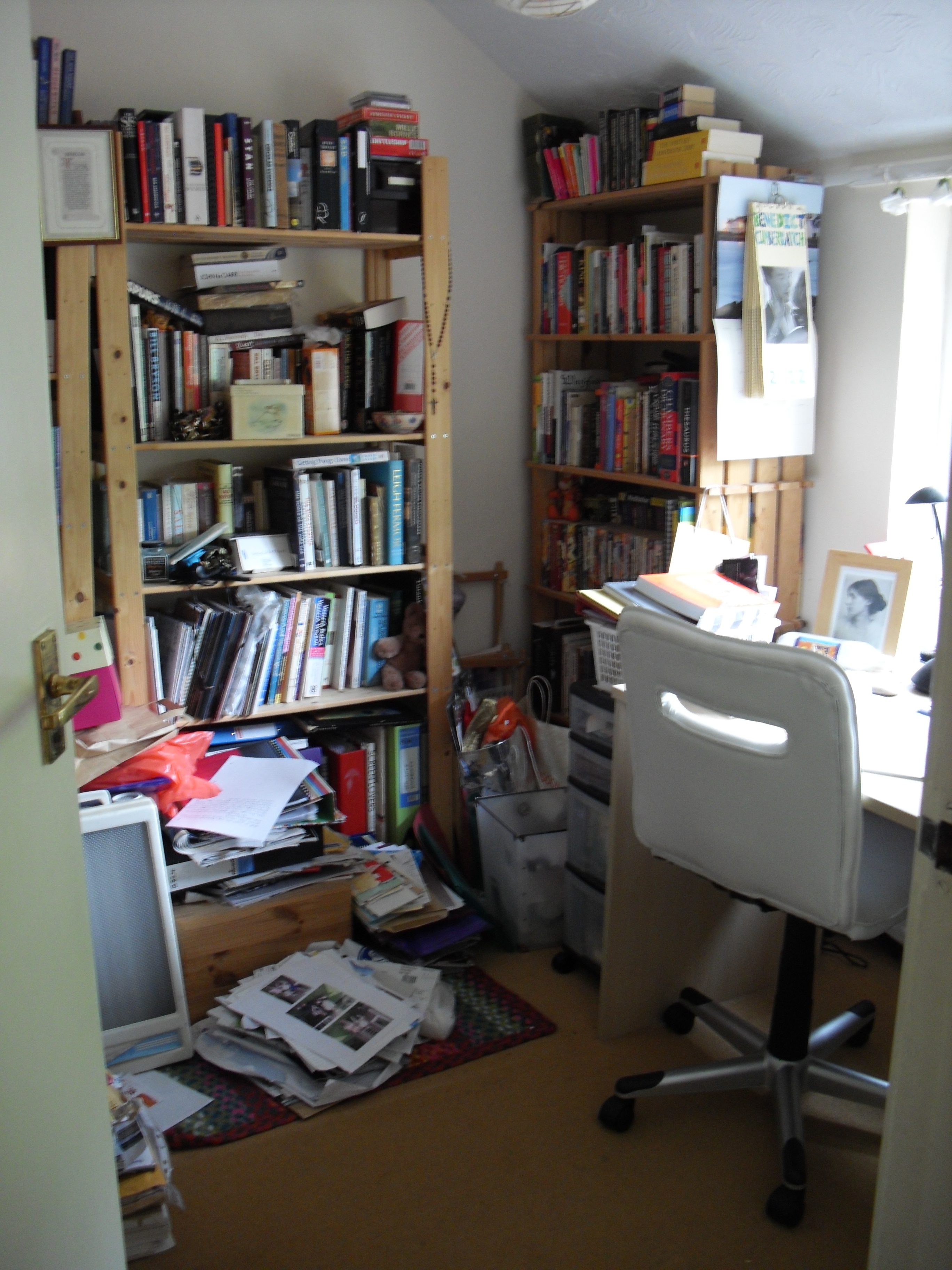
My study 1As you can see, its a mess.  Currently, it has a very nasty case of piles. (Piles of paper and junk, that is.)  The fact that it has become such a dumping ground, to the extent that I am now doing most of my writing sitting downstairs on the sofa, and I’m not doing any painting at all, is an important barometer for how much value I am attaching to my own art and writing practise.  In other words, not much.

One of my goals is to revamp my study.  This is because I need a Room of My Own.  Psychologically, I need to recognise my right to my own creative independence, and that is what my study signifies to me.  I need to make a gift to my creative self of a loving and beautiful space in which to make my dreams happen.  Its hard to claim that right, but I’m working on it.

You may not have the luxury of your own space, in which case, I sympathise because I spent many years in the same position, sharing a desk in the corner of our dining room with my husband.  (Even though he had his own office at work – not that I’m bitter, you understand!)  Still, there are ways to mark out some territory that you can call your own, a space where you feel totally free to create as you want.  That may be a corner of a shared room, the luxury of an actual studio, garden shed or study, or if you are not so territorial as I am, maybe a favourite table at a local cafe where you go to write, think or journal.

Where ever you choose, consider this space as not only a private area, safe from others, but also as sacred to your art – whatever form that takes.  When you go there, it should signal to your Artist Brain  that it is time to create.

Light candles, perhaps, and if you are so inclined, make a little altar to attract creative energy.  Surround yourself with pretty, evocative things.  Get some nice stationary and writing instruments.  A few pebbles can be delicious to handle and look at.  Make some inspiring signs to stick up, to remind yourself that you are entitled to this, that your voice is unique and deserves to be heard.  A painting that you like, objects that have emotional value for you, some nice furniture if you can afford it (I would love a comfy armchair to read in for my study), a noticeboard with inspiring images on it, wll all help to make even a small corner your own.

My Study 2In this picture of my study, you can see some of the things I cherish as part of my creative process.  (Sorry for the small lettering, I haven’t quite got the hang of Paint yet!)

I got the lovely chair for my birthday last year.  I’d never had a special, proper chair for my home office before. It still feels like an outrageous luxury!  There are fairy lights in the shape of roses around the window, which are nice when I am writing at night, as I usually prefer to.  There is my collection of books about writing, and books for reference, my Image Box for inspiration, and of course, my much cherished Benedict Cumberbatch calendar, which my adored niece made by hand for me last year.  On my desk, I keep a framed photograph of Virginia Woolf herself, because she is such an inspiration to me, both as a writer and as a person.

Try to carve out some personal space within your home environment to dedicate to your creativity.  Even if you are only able to keep your journals in a favourite tote bag down the side of the sofa to use when you can, it still counts.  It will help to enhance your creative process, and enable you to battle those critical voices that tell you your work isn’t good enough.

I’ll keep you updated on my efforts to reclaim my study from the mess and make it a place to snuggle down in to create.

Flow, or How To get Out Of Your Readers’ Way

flow at Ardnave

Ardnave Beach, Islay – I didn’t have an illuminating photo of a stream, so rocks will have to do!

You’ve probably heard of Flow.  It is that psychological state of perfect concentration that we fall into when our attention is completely absorbed in something, whether it is running, painting, reading, crafting or anything else that involves us completely.

As a writer, Flow is what you are after in your reader.  You have probably felt it yourself.  Remember those books that were so engrossing that you could lose hours at a time between the pages, and not notice?

The trouble is that when you are reading, the tiniest thing can jolt you out of it – from the cat meowing for its tea, to your baby crying to be picked up, or even something as small as the rain tapping against the window.  As a writer you are up against this too-human tendency, and your job is to make sure that you do not add to the distractions.

This is why getting the nuts and bolts right is so important.

For example, have you ever come across a typographical error in a printed novel?  It seems to be happening more and more these days, and I find I notice at least one in every novel I read.  It is irksome.  It makes you suddenly aware that you are in the act of reading a book, rather being so caught up in the action that you are in it with the characters, a part of the crowd.

I have judged a number of short story competitions in my time, and I never fail to be amazed at how writers fail to take account of this. Being aware of your readers’ flow can improve your writing immeasurably, and can make the difference between a prize and publication, or languishing at the bottom of the reject pile.

Its not just about presentation – lets face it, in this digital age, your work could be presented in any number of ways, so even if you make sure you conform to the industry standard of 12 point, double spaced text, (which I would always advise) your reader may not ultimately be consuming it that way.  You can make the difference, and keep your reader in the moment, by observing a few simple rules:

1. Pay attention to punctuation.  It’s a small thing, but it makes a big difference.  Read your work aloud, and notice where you take a breath, or pause.  That’s where a comma should go.  Read a good book about it.  You can’t do better than this one.

2.  Don’t trust the spell checker.  It can’t tell the difference between ‘passed’ and ‘past’, and that little difference could be enough to annoy your reader out of their flow, and maybe give up completely.

3. Get to grips with language.  Knowing the meaning of words is really important, so don’t just take it for granted – Fanfiction writers, I am looking at you!  Just because someone else uses the word ‘ravage’ instead of ‘ravish’, doesn’t mean you have to make the same mistake! (And ‘leisurely’ is not an adverb. Grrr!)  When in doubt, look it up!

4.  Don’t use overlong sentences.  You aren’t Henry James.  Thank God.  Keep it to one or two clauses at most.  Don’t ramble.  Short sentences may increase the pace of your scene, but you can slow things down in other ways if thats what you want, through description and reflection.

5.  Don’t repeat yourself.  This is a private bugbear of mine, I have to confess.  You don’t need to use the same word three times in a three line paragraph.  You’ve got vocabulary – use it!  If you want to understand how the breadth of language can be used to write a whole book about just one thing, avoiding  repetition, read Patrick Süskind’s dazzling novel,  ‘Perfume’.  It proves you really don’t have to repeat yourself.

6. Proof read.  And then do it again.  And then get someone else to proof read for you.  Seriously.  There are so many typos and spelling mistakes (commonly referred to as ‘smelling mistakes’ in our house) that you often can’t see without help.  (And now I am having a mini-nervous breakdown that there will be typos in this article that I haven’t seen – you see, we all do it, so beware!)

These are just a few simple things you can do to give your reader a smooth ride.  If you do that, not only will they keep reading to the end, but they are far more likely to come back for more.  And thats what you want!

Happy writing!

Inspiration Monday: Images

DSCI3431

My Image Box

Writing exercises are a great way to get yourself going with new writing ideas.  Sometimes it is hard to think up something to write about, and this is where images can be really useful.  If you don’t have time to go out into the world and absorb the landscape, or you don’t feel like listening to music or doing something else that feeds your imagination, images of all kinds can be evocative prompts to get you going.

I keep an ‘Image Box’.  I buy odd postcards when I am visiting shops, art galleries, National Trust properties.  (I even drop leaflets into my image box, knowing the colours used in them can get my juices flowing, and I scour magazines and newspapers for pictures that catch my eye.)

Postcards don’t have to be of anything particular, the places and objects depicted don’t have to be of things you have seen or visited.  They just have to get you started.

When I am stuck, and need to write something fresh, something that comes clean out of the blue, I pull a random image out of my box.  Then I set the timer, and write for fifteen minutes on what the image suggests to me.

Here are a few pictures out of my box:

postcards

Postcards from my Image Box

(clockwise from top left) Sylvia Plath 1959, photographed by Rollie McKenna;   The Forest of Bowland from ‘Our forbidden land’ by Fay Godwin 1989;   ‘Silver Moonlight‘ by John Aitkinson Grimshaw (Harrogate Museums and Arts);    ‘A Norfolk Village’ by Edward Seago (Norwich Castle Museum and Art Gallery);    Sound II sculpture by Anthony Gormley, Permanent Installation in the Crypt at Winchester Cathedral, photograph by Roger Twigg.

These are all striking images, but what stories do they tell?  What do they suggest to you?

Writing Exercises:

1) Start collecting images for an Image Box of your own.  You might like to do it the old fashioned way, as I do, with postcards and pictures cut from newspapers, magazines and Sunday supplements.  Or you might like to use a digital version like Pinterest.  Whichever suits you.

(These days I also keep a private folder of images that I download from Tumblr on my laptop, which also feeds my imagination – I don’t use them for anything other than my own private use, so I hope I’m not infringing any copyright by doing so.)

Keep an eye out for anything really striking – a black and white, chiaroscuro portrait perhaps, or an arresting street image.  Whatever catches your eye.

2) When you have time for a writing exercise, get out your timer and your writing notebook.   Fish out a random image that appeals to you, set the timer for fifteen minutes, and write!

It doesn’t have to be a complete story, remember.  It can just be a sliver of description, a bit of character study, a list of traits or adjectives, or a bit of backstory.  What is going on in the image?  What is the place like? Are there people?  What are they doing, and why?  Is it a portrait like the one of Sylvia Plath above – forget who she is for a moment, and look at the image.  Why might this girl be wistful, a bit sad or worried?  Who could the person in your portrait be?  Why do they look the way they do? Or who is the person doing the looking, taking the picture?  What is their story?

Use your Image Box whenever you are stuck for something to write about.  I have got whole stories out of a single image, like this one, which I wrote from a fanart masterpiece by Marielikestodraw, the doyenne of gorgeous fanart.  You never know what might be sparked off.

Happy notebooking!

There’s No Time to Write! (Part 2 – in which the author comes clean about what being a writer is really like)

So today, according to my editorial calendar, you were supposed to be reading a detailed and amusing essay on why writing exercises are a great way to get yourself writing, even when there is little time.

And then life got in the way.

It does that, doesn’t it?

I am a big devotee of those home interiors and lifestyle blogs that tell you all about how to organise your cleaning equipment, how to update that hideous credenza with a quick lick of paint (here’s one I did earlier), and offer funky downloadable printouts of chore lists and records for when you last took the dog for his shots.  You know the ones?  The ones that are supposed to make you feel like your life is amazing and completely within your control, but actually make you feel like one of those weird hoarding people who live on indoor garbage heaps in documentaries.

Reading this blog, you might feel just that way too.  You may think I’ve got it all together.  That I write oodles of books and I’m so productive.  Well, I’ll let you into a dirty little secret – I’m not.

Just like the lovely ladies who write those amazing lifestyle and organising blogs, I have mess, and piles of dirty laundry, and weeds in the garden.  I get up in the morning and really don’t feel like writing.  Or there is just no time.  Like today.  I seriously did not feel like doing my Morning Pages today.  I felt ill and all I wanted to do was sleep.  I wanted to scream at anybody who came near me, and then get under the duvet and have the world just GO AWAY AND LEAVE ME ALONE THANK YOU VERY MUCH!!!!

(I’m sure you are familiar with those kinds of days.)

Sometimes it happens.  It probably even happened to Dickens.  What the hell.

I didn’t beat myself up about it.  Instead, I wrote my Morning Pages.  I scribbled three pages of growls and groans about how I have no time to do the things I want to do because I’m faffing about doing a bunch of other stuff that is urgent but not important.  In the course of those three pages, I realised that the reason why I am so crabby today is that I haven’t written a story in weeks.

I’m crabby because I am not writing.

Duh.

At this point, it becomes profoundly obvious that even a fifteen minute writing exercise has to be fitted in to today.  Otherwise I will be up before the beak for homicide!

This is why you have to make time to write:  because if you are a writer, you need to write in the same way as you need to eat your greens and take exercise.  Writing makes you sane.

The distance between sanity and insanity is the width of a pen nib.

(I wrote that years ago, it’s good isn’t it?!)

And you’d better believe it.

So join me in stopping the grumps.  Get out your writers notebook and try the following exercise.  I guarantee it will make you feel better.

Writing Exercise:

Get a timer and set it for fifteen minutes – ten, if you are really pushed.  Write down the following phrase and then finish it as a sentence.

I haven’t written anything lately because….

Let your mind tumble onto the page.  It doesn’t matter if it is a list of reasons, like that your husband ought to put the kids to bed a bit more often so that you can have some time to yourself, or that you’ve got the finish that damned presentation to give at work first thing tomorrow.  Maybe it’s that you have a character rumbling about in your head but you are having trouble with some aspect of him or her, in which case, write that down too, and expand on the problem.  If you keep on writing until the pinger goes, you may just have found the edge of a solution.

Write whatever comes to mind.  Complain, moan, plan, get excited, drone, create, wonder what subjects you are interested in.  Whatever you need to get down.   At the end of fifteen minutes, I guarantee you will have either worked out what is stopping you (and if you are anything like me, it may turn out to be that YOU are what is stopping you), or you may have come up with a plan of how to carve out some time to write, or you may even have come up with a new story idea or scene.

Whatever.  The important thing is that you just spent fifteen minutes writing.  Hooray!  Now do it again.  Maybe today.  Maybe tomorrow.  But do it.

Inspiration Monday: Landscapes

Lighthouse at Dusk

From the Yorkshire Moors in ‘Wuthering Heights‘ to the foggy twilight of Sherlock Holmes’ Edwardian London, landscapes conjure up all kinds of stories for us.  In fiction, they can be so much more than just backdrop.  Tolkein used them to illustrate the journey to the centre of Hell, contrasting the lush green of the Shire with the volcanic wastes of Mordor in The Lord of the Rings.  The closer the hobbits get to the heart of evil, the more the landscape breaks down.  Landscapes can even act as a separate character altogether.

At school, my English teacher taught us to describe landscapes in terms of what they looked like, but it is just as important to your readers to describe what they feel like too.

Paps of Jura

Mountains to me feel full of angry, untamed energy.

Adur Valley 1The South Downs, however, are softer, gentler hills, rolling and swelling banks of green pasture.  They conjure an altogether different energy.

DSCI2825

A rustic country lane in summer has a very different feeling to a city street in winter, and the stories that take place there are bound to be different.

Contrast can make your stories all the more interesting – think of that rustic country lane as  an invading tank rumbles by.  Think of the moment the Black Riders from Mordor cross the borders of the Shire, bringing war and evil with them.

The landscape in which you set your stories can enhance your theme, either with a sympathetic atmosphere, or by offering a shocking opposition to the action.

Writing Exercise:

Today is a Bank Holiday in the UK, which means many people are off enjoying the fine weather and the beautiful countryside.  If you have been out and about today, get out your writers notebook and describe the place you have visited.  Seaside or countryside, what shape was it, what colours?  What did it taste like, smell like?  What weather was happening? What plants grew there, what trees, what animals inhabited it?  Were there crowds of people, or just a lonely figure in the distance, perhaps walking a dog?  Did you see a falcon wheeling in the sky, or a rat scrabbling about in the dustbins behind a convenience store?  And what did this place make you feel?  Was it pleasant, foreboding, exciting, relaxing or scary?

Salt this description, however rudimentary it may be, away, and think on it.  What kinds of stories could happen in this environment?  Who might live here?  What problems might they face?

Next time you travel, even if it is only to the end of your road, consider the landscape you are in, and if you can get the chance, write about it.  Let the stories the land around you brings bubble up.  See where they take you.

There’s No Time to Write!

(or paint or draw or sew or dance or make movies or {insert chosen art or craft here}).

Every book or blog about writing (or any art) will tell you that you have to do it.  Practise.  You can’t be a writer unless you write.  You can’t call yourself a dancer unless you dance, or a musician unless you play.  But in our busy modern world, in the midst of a double-dip recession, who the hell can find time to pursue their arts?

My husband says this to me a lot.

“I need at least three hours,” he’ll say.  “I can’t just write in fifteen minutes a day.”

Toni Morrison wrote her novel, ‘Beloved’, by getting up early in the morning and writing for half and hour or so  at the kitchen table while her family were still asleep.  She made time to write.  JK Rowling wrote in an Edinburgh cafe while her baby was napping in the pushchair.

My husband doesn’t make time to write.  He is a talented screenplay writer.  He is also an enthusiastic potter and actor.  He doesn’t do these things.  He works instead (for which I am very grateful, incidentally.) He works pretty much all the hours God sends, so far as I can see.  I am sorry that the world is missing out on his talent.

You may be the same.  There may be no time spare to carve out in your life.  But let me offer you this story to illustrate my point, which is:

Just because you aren’t writing, it doesn’t mean you aren’t writing.

Two years ago, I went down to Hampshire to visit my mother.  My stepfather was very ill and in hospital, so ostensibly I went down for the weekend to help my mother with the stress, and the nearly two hour round trip to the hospital and back every day.

Whilst I was there, my stepfather died.

My siblings were not able to stop work to support her at this time, so I stayed with her for three weeks, helping her with the paperwork, assisting with organising the funeral, comforting her where I could.

As you can imagine, it was a very busy, stressful and distressing time, but I was extremely glad I was there to share it with her, and to be of help.

A family death is an all-consuming experience.  Grief seeps into your very bones.  You think of nothing else.  But even thought I loved my stepfather very deeply, and mourned him intensely,  I realised that I needed some respite from the pain and the busy-ness.  So in the tiny moments I had alone, in the loo or the shower, at night before sleep, I bathed in the world of my stories.  I wrote.  Maybe I didn’t actiually scribble notes down, but I told the stories I needed to tell myself to keep myself calm and sane.   During those three weeks, I organised, plotted, and even wrote parts of a major story in my mind, a story which became ‘A Case of Resurrection’, which deals with grief (unsurprisingly).  It is a work of which I am still proud, written at one of the most difficult, and probably busiest times in my life.

The purpose of this story is not to pluck your heart-strings, but to say that not only can you write when you are busy, but that when you are, writing can become a life raft, an antidote to stress, a way of expressing your feelings when there may be no other way available.  You might remark that I wasn’t actually writing, but I ask you, in response, to expand your definition.  Writing takes a great deal of planning and long hours of thought, as well as lots of typing.  You write it out on the keyboard eventually,  but first you have to think it.

By all means, put writing time into your busy schedule.  Mark it in your filofax or diary.  Make daily time for it.  No one would advocate that more than I. But consider it in a wider scope.  You can write under any circumstances if you really want and need to.

A Little Melodic Inspiration

Where do your ideas come from?

That is the question most writers dread.  Or rave about.  Iain Banks rants about it at great length in his glorious book, ‘Raw Spirit‘:

“Leaving aside the obvious, ‘Class A drugs, actually’ or, ‘A wee man in Auchtermuchty’, I’ve sometimes wondered what sort of answer people really expect to this.”

(‘Raw Spirit’ by Iain Banks, Century Books London, 2003 p255)

And so he goes on. I asked him at a signing once about how he dealt with getting stuck in the middle of a novel, and he obviously interpreted it as me asking The Question, and didn’t take it well!

But in my mind its a reasonable question for one thought alone, and it is this:

Maybe we don’t know where the ideas come from, but how do we get our minds into the right place for them to arrive? 

Its about putting lots of mulch in the ground to make it a rich, fertile place for new things to grow.

I have an assortment of answers to this problem, but today I thought I would share one of them with you.

Music.

I make a playlist for every novel I write.  When I am sitting down to work on a scene, or with the characters, I play the playlist on my headphones, and this gets me in the mood, gets me in touch with the characters, the environment, the colours and sounds through which they move.  Often, particular characters end up being associated with specific tracks.

And sometimes, it is just one piece of music that I hear that sparks a story, or gets me in the mood to write.

Here are some to try:

Richard Hawley – Standing at the Sky’s Edge

(This is the core soundtrack for a novel I am working on at the moment)

Suede – Asbestos

(This is the ‘title theme’ for a novel about my favourite character, Evenlode.)

Fantasia on a Theme by Thomas Tallis by Ralph Vaughn Williams

(This last one I listened to for six months pretty much continually while I was writing the climactic scenes for my first novel, which was set on the South Downs in Pre-Roman Britain.)

Writing Exercise:

Get out your CD collection, or your iPod, or fire up youtube, however you listen to music.  Listen to a few tracks and see what mental images are conjured up.  What landscape can you see?  What kind of people inhabit this world? Can you see their faces?  What challenges are they facing?  Who do they love?  Who do they hate?

Get out your writing notebook and begin to set down what you can of these images.  You may need to make lists of ideas or words, or you might like to write passages of description.  You might even draw!  Note everything that comes to you, and listen again, as many times as you need to in order to get out as much as you can.

Don’t forget to write down the piece of music and the artist whose work generated the images you have found.

This exercise may prompt a whole new story, or you could use your descriptions to feed into something you are already working on, or something you have yet to write.  Nothing you write is ever wasted – it can all be recycled into new work.

Happy listening – and writing!

The Habit of Art, or How Benedict Cumberbatch Taught Me to Write

Martin Freeman and Benedict Cumberbatch in BBC TV's 'Sherlock'

Martin Freeman and Benedict Cumberbatch in BBC TV’s ‘Sherlock’


Once upon a time, I did a Diploma in Creative Writing at the University of East Anglia.  It was the first proper writing course I had ever taken.  One of the first things we were told as students was that in order to get better, we must write every day.

Writing for me has always been a very instinctive thing.  It comes in bursts. (I’ll talk about your creative rhythm in a future post.)  So I didn’t think much of this ‘show up at the page every day’ theory.  I believed that inspiration dropped from the sky and you did it, whatever it was, to manifest the story or the picture or the dance, or whatever your particular art form was.

Years later, in the midst of a story drought, the BBC TV series ‘Sherlock’ happened to me.  (I say ‘it happened to me’ because it was almost against my will that I eventually watched the reruns, having heard all the fuss people were making about how good it was the first time around.)  And what intrigued me about this version of the stories with which I was so familiar was not the modern setting, but the relationship between the two men, Sherlock Holmes and John Watson.

What would happen if two such men were devoted to one another?  What would happen if they fell in love?

The idea had not occurred to me before with any characters I had created, or anyone else’s for that matter.  And possible scenarios started to blossom inside my skull.  In the end, there were so many of them that I had to write them down, just to make room for things like ‘remember to buy light bulbs’, and other such modern survival thoughts.

Before I knew it, I was writing something new every day.  Paragraphs became pages became short stories became novellas became books.  Every day.  Thousands of words.

This is a practise.  It is similar to an opera singer or concert pianist doing scales, an artist doing studio sketches, a ballerina doing barre work.  They say it takes 10,000 hours of practise to truly master a skill.

I have worked daily.

Yes, I have written fanfiction, which some literary writers sneer at.  But I have done my 10,000 hours and more.  Fanfiction has caused me to write daily.  Through it, I have learnt more about crafting stories than I could ever have done with my hit-and-miss, inspiration method.  I have learnt the lesson that my tutors on the Diploma sought to impress upon me, and failed.

To get good, you have to practise. Daily.

You have to try things out, stretch yourself, sometimes do the same exercises over and over again from different points of view and in different styles.  But you have to practise.

In my experience, yes, discipline has a lot to do with it.  You have to show up at the page, as they say.  You have to sit at your desk.  But it is important to have some motivation too, some enthusiasm that drives you.  I’m useless at self-discipline, believe me, and I wouldn’t have done it if I hadn’t had Benedict Cumberbatch and Martin Freeman circling each other like dogs on heat inside my skull.

So my advice to you is this:  yes, show up at the page.  Every day.  Practise, practise, practise.  Write the same scenes over and over again from different angles, different perspectives, different times of day, or life.  But practise.  Enthuse, rave, drool, froth at the mouth over gorgous characters or actors if you have to, but practise.

Get the Habit of Art.  Get creative every day.

Writing Exercise:

Get out your writers notebook. (You haven’t got one yet?  See my post about why you should.)  Think of a scene from a favourite movie that really grabs you, preferably with more than one character involved.  It might be a talky scene, something emotional, or some action.  Now put pen to paper and describe it from the point of view of one of the characters in the scene who is not the hero or heroine.  Someone periferal.  Or a secondary character.

For example, Star Trek’s Captain Kirk and Mr Spock are facing off about whether to transport to a dangerous planet when the transporter machine is on the blink and they might not be able to get out quickly, but you could write it from inside the head of the security man standing on the door, watching.  How does it feel to him to have the two men in charge of his future well-being fighting over something he maybe doesn’t understand?

You might choose to write Mary Bennett’s experience of her sister Elizabeth’s first meeting with Mr Darcy, from ‘Pride and Prejudice’, or housekeeper Mrs Fairfax’s dim view of Jane Eyre’s carrying on with Mr Rochester in ‘Jane Eyre’ (Jean Rhys wrote the entire novel ‘Wide Sargasso Sea’ in this way, from the point of view of Rochester’s wife, Bertha.)  Or you could write from the mind of one of James Bond’s jilted girlfriends!

Choose a story you are attracted to and try a few scenes from an alternative angle.  See where it takes you.  And if you find yourself with something that intrigues you, stuck with it, and see where it takes you.  Every day.

(More on writing every day, and writing exercises soon.)

The Writer’s Notebook

Writers nbk planning 22-04-2013 14-59-52 3648x2736

My spiral bound writers notebook – these pages show planning for a historical novel I am working on.

Every craftsman needs a workbench.  The notebook is to a writer what a workbench is to a carpenter.  Every book about how to write will tell you that.  The trouble is that there are as many ways to keep a writing notebook as there are carpenters’ workbenches.  So I thought I would say a little bit about this most basic of skills.

Your notebook travels with you continually, wherever you are.  It is the hopper into which you throw all the useful scraps you collect on your journey through life.  It is like a memory that you carry with you – one that won’t malfunction, unless you drop it in a pond or set fire to it, of course!  This is where you scribble all your ideas, the clever sentences and metaphors you dream up, the quotes that inspire you, the snippets of conversation you overhear on the bus.  In the old days, this was called a Commonplace Book, something like a scrapbook, but one in which you record more than events.  It is a little like your journal, but more functional.  I always like to think of mine as a record of the development of my mind.

Most teachers suggest you start out with one notebook.  The important thing to know is that this is a skill that evolves, ebbs and flows.  You will find a comfortable way to do it after a while, a way that fits into your lifestyle and way of working. In anycase, to start out, choose yourself a notebook that will stand heavy use, and one that you like (otherwise you won’t be drawn to write in it.)

I use an A4 hardbacked spiral bound lined notebook by Pukka Pad, which I love.  I can fold it over, stick things into it, draw diagrams, and because the cover is plain, I can decorate it however I like.

However, A4 is a BIG size, and its not something I can just stick in my pocket and carry everywhere.  As a result, I’ve evolved a second notebook.  It is a tiny Moleskine, which I carry in my handbag. It is hardback too, so it withstands a great deal of getting knocked about, and chocolate stains.  This is my scribble place, where I note things down on the move.

DSCI3393

My baby moleskine lives in my handbag. Snippets get stuck into these, as well as overheard conversations and quotes.

DSCI3394

Just to prove notebooks don’t have to be neat, or be devoted solely to your writing life – this one also has details of some tights my mum wanted me to buy her!

This is a method of recording that I have developed over time.  It may not work for you.  You may need to keep everything in one place, in a single book, or you may need several different notebooks for different purposes.  It depends on how you work, so it will be different for everyone.  There is no one right way.  But I suggest you start with a single notebook to make life easier.

Here are some things you can do with it:

  • Reflect on where you are with your writing, and what you would like to achieve
  • Scribble down a paragraph that comes to mind
  • Record useful or inspiring quotes
  • Plan your stories
  • Write your characters’ back stories
  • Draw pictures of your characters, or collect photos of actors and actresses who put you in mind of them
  • List books you might like to read
  • Do writing exercises
  • Stick in interesting newspaper stories for future inspiration
  • Stick in inspiring pictures or postcards
  • Review books you have read, movies or TV shows you have seen, art exhibitions you have visited, music gigs you have enjoyed
  • Take notes at meetings of writers groups you attend
  • Note ideas for new stories or characters
  • Mindmap plots
  • Draw diagrams
  • Describe the weather (you wouldn’t believe how useful this can be when you are trying to write action set on a sunny August day but living through a wintry November afternoon!)
  • Doodle
  • List music that inspires you. (A playlist for every novel really helps set the mood for writing)
  • Potential character names – I came across someone called Theodicy Godbolt one day when  I was researching 16th Century British History – you couldn’t make that one up!
  • Whatever else takes your fancy – it’s your notebook!

There is one absolute that every writer’s notebook should have at the back.  A list of words and their meanings that you come across.  Every writer should be expanding their vocabulary all the time.  Come across a new word?  Write it down somewhere you can refer to it, and then you will remember it!

writers nbk sticking things in 22-04-2013 15-00-41 3648x2736

Sticking in pictures of actors who inspire you can be useful!

These are just a few ideas to get you started.  I’m going to talk a lot more about notebooking in future posts, not least because I am a notebooking fanatic, but you might like to grab yourself a pad and pen and start scribbling right now.  And if this doesn’t inspire you, maybe you might like to read this, or this, which is one of the best books on writing I have ever read.