Category Archives: Writing Every Day

On Process: Too Many Ideas, Too Little Time

Usually creative people complain about creative block.  I don’t.  For the most part, I have the opposite problem.  Too many ideas.  Not enough time to execute them.  I have this constant fear that I shall die suddenly without sharing all the pictures in my head.  That would be a great incentive to work if it weren’t for the fact that my poor health is a huge brake on my capacity to work.

And then there is the fact that I have the mind of a butterfly.

The Buddhist masters often refer to the concept of ‘Monkey Mind’.  This is what your mind does when you try to meditate, and your thoughts bounce around like gibbons, and feel impossible to control.

Welcome to my world.

Actually, that is not entirely true.  I can be deeply committed to one idea for a short period of time.  The most I can normally manage is about three months.  Then I bounce off to find another sparkly thing.  Most of the time, I come back.  Occasionally, I manage to actually finish something.  Occasionally it gets shelved for good, or the idea gets incorporated into something new, because its too good to waste.

I’ve been socialising a lot this summer, and people have repeatedly asked me the same questions:

‘How’s the writing going?  What are you working on at the moment?’

Below is the honest answer (i.e. the one I don’t give nice people at parties because its too complicated to explain, especially if they’ve never met me before.)

The things I am currently working on:

  • A series of short stories about John and Sherlock in a stable relationship
  • Finishing a work about Sherlock’s pursuit of public sexual humiliation because of his guilt about his faked suicide.
  • A novella about a Viking Princess
  • My novel about Victorian sexuality, currently titled ‘The Butler Did It’ (Please could somebody suggest a better title, I’m getting desperate!)
  • My journaling ebook

Other ideas I have churning about in my head include:

  •  A possible novella about a young man getting over the death of his male lover in a road accident
  • A short story based on a line from a deliciously naughty Johnlock fanfic I read the other day, The Red Box by Cleo2012
  • The third Evenlode novel (vampire gangsters ahoy!)
  • A Loki fanfic set after the end of Thor 1

(And this is before I have even begun to tell you about the paintings I want to make…)

I was explaining this smorgasbord to a friend, and she said ‘How on earth do you handle all that?’

The answer is, ‘I have no idea.’

I suppose I have a good memory, but the older I get, the more I am going to need to employ my writing notebooks to record all this.  The truth is that ideas are far easier to come by for me than the wherewithal to execute them.  And there just isn’t enough time in my day to get all this done, and execute my duties as wife, friend, aunt, guidemother, part-time carer to elderly, sick in-laws etc etc. and still protect my health.

Triage is necessary.

I just have to grab one sparkly thing and run with it for as long as I can.  I have to choose the most important thing to me at the time.

Most creative people complain about creative block, but the other side of the coin is equally disabling, and I know for a fact I am not the only one who experiences this problem.  Choosing which is the best idea to work on.

If you have any ideas on how best to deal with idea overspill, please let me know in the Replies section.  I’d love to know what you do.

Happy Creating,

EF
On Cabbages and Trombones – Making Language Strange

The expression ‘cabbages and trombones’ was one used by the poet Ian Macmillan at a recording of a poetry radio show which I went to see with a friend a while back, and the phrase stuck with me.  He was talking about how poets seek to make language strange and startling, how they seek to use it to weave a rich tapestry of image and idea.  That, after all, is the purpose of poetry, to enrich our experience of life with pattern and syllable.

The concept chimed with me again when my husband was wrestling with a writing problem of his own.  Besides being an academic, he runs an online whisky company, and occasionally works as a whisky writer.  He had been asked to contribute reviews of a variety of whiskies for this book.  Little bottles duly began to arrive in the post every morning, and off he went at a rate of three or so per evening.  Everything was fine for the first thirty tests or so.  But then he began to run out of descriptors.  Just how many new adjectives can you come up with when you’ve got 60 whiskies to review?  They can’t all taste of TCP or green jelly babies.  Can each review really be different from the last?

And today, as I busy myself with planning my new writing schedule, and working on new stories, it has come back again.

Experts say those with a college education generally have about 12,000-17,000 words in their vocabulary, but as writers we need to have far more and we need to use them in unusual and riveting ways.  I realise that I have dropped into the habit of reading very little but fanfiction, and if you are a fanfiction reader yourself, you will know that there are a lot of linguistic ruts involved.  Favourite words include laving, ravishing, carding (of luxuriant hair), trembling and so on.  No fanfic is complete without somebody emitting ‘ragged breath’.  If you have read enough of these, you begin to spot the clichés.  If you read too many, they scream out of the screen at you.  (I hold my hands up and say I am as guilty as any of falling into this trap!)

The trouble is that if you don’t read more widely than just what other people write on the internet, your vocabulary stays static.  This is what mine has been doing.  Now I am writing again on a daily basis, I have realised how stagnant my linguistic skills have become.  Of course, its not just words, but metaphors and similes.  I need to polish up my style, make it strange and new.  I need to expand my consumption, and open my mind.

 WARNING:  Incoming Master Plan for Expanding Lingustic Skills:

I’m taking a two-pronged attack:

  1. Widen my reading
  2. Use my notebook at all times

I’ve been reading just fanfics and nonfiction all summer, and its been a long time since I actually finished a proper novel.  You can’t be a writer if you don’t read.  Mostly I just read at bed time, a few paragraphs to help me drift off.  But I need to take Stephen King’s sage advice:

“If you want to be a writer, you must do two things above all others: read a lot and write a lot.”

Stephen King, “On Writing”,

Hodder and Stoughton (2000) p164

 Of course, I’ve got a whole pile of books lying around, waiting to be ploughed through.  Top of the pile are ‘The Night Circus’ by Erin Morgenstern, and ‘Atonement’ by Ian McEwan.  I don’t especially like McEwan, but I am determined not to let this bloody book defeat me.  It’s the third time I’ve tried to read it, after all, and I refuse to be beaten!

I have also decided to follow Ian Macmillan’s advice.  Poetry is the way to go.  I’m not a reader of poetry – I’ve barely read any since my degree – but if you want to know about making language strange, go to the experts.  I went to the library yesterday and got out two collections, one of Ted Hughes, and one of Simon Armitage, because I had heard of them.  I’ll let you know if it works.

The second prong (I love that word, don’t you?) is more nebulous.  Out comes my little red Moleskine.  I need to think about how I am going to get the ball rolling on this particular aspect, but just jotting down a few ideas on what the weather feels like, smells like, tastes like, or overheard conversations, or the colours of shadows, might be a good start.  Again, I’ll let you know how I get on.

In the meantime, here’s to cabbages and trombones.  And whisky that tastes of TCP and green jelly babies.  Both of which have taught me a lot about writing.

(Incidentally, you may like to know that I am currently publishing a new fanfic called ‘A Shadow of His Former Self’.  You can find it here at A03, and here at Fanfiction.net.  I hope it takes your fancy.)

Happy creating,

EF

The Need for Habit

calendarI’m crabby.  It’s been two days, and I’m not fit to know.  This should not be happening.  I’ve had a lovely holiday, nearly two weeks with the Husband at home, sunshine, dear friends and family visiting, trips to the beach and great food.  Yesterday, even the Husband noticed I was out of sorts, which is saying something!

This morning I was fed up to the back teeth with myself.  I really hate feeling like this.  Stale.  I sat down with my journal and worked it out.  What is it that is making me so grumpy?

Turns out, it’s the very thing that should be making me happy.  My holiday.

The critical mass of creativity has now built up to such an extent that I need to get back to work.  Holidays are great, and important times for reflection and rest.  Don’t get me wrong.  But I’m ready to get back to it now.

What I’ve been saying all along is true.  You need the Habit of Art.

Well, I need it, in any case.

I need to get back into my routine.  I need the Husband to go back to work so I can have the house to myself.  I need my thinking time, my moodling time, and I can’t have that with someone else in the house, no matter how much I love them (and I do), because my first reflex is always to consider them first, and put myself and my art second.  Even inside my head.  I find myself resenting the people I love, and my family and friendship commitments, if I don’t have this mental and creative space.  My well has been filled, my Muse is ready to let rip, and I am bubbling with ideas.  What I need is the time and space to get to it.

I need my routine back.

I can’t do this yet.  I’ve a bunch of things to get through first.  Lots of socialising with dear friends.  There will be more trips to the beach, and strawberries to eat in the garden in the sun.  My Muse can get as grumpy as she likes, but I can’t let her out just yet.

It’s not long now, though.

And it’s great to know, thanks to my journal, that it’s not the fact that I have run out of ideas that is making me a bad-tempered cow.  My creative juices haven’t run stale.  It’s just that there is no space right now to get the words or paint on the page.  I must be patient.  The time will come.  I have had my rest, refilled the well, and now I am revving at the start of this new race!

And then, come the green light, and Hooray for the Habit of Art!

Happy creating and holidaying, whichever you are doing,

EF

Nuts ‘N’ Bolts: Writing Exercises

writing notebook Firstly, an apology.  Observant readers will note that today is Thursday.  Yes, I am a day late in posting.  Sorry.  Life got in the way, in the shape of a migraine, and it’s not funny trying to write with tunnel vision and the pain equivalent of a knitting needle stuck through your eyeball.  I figured I might sound somewhat distracted (as indeed I was), so in the spirit of demonstrating how important self care is, I bugged off and went to bed.  Today’s post is something of a restart.

For a while I have been feeling the itch to get back to writing original fiction.  I’ve been working on fanfiction almost exclusively for a couple of years now, and while it has been hugely instructive in terms of both technique and confidence, I feel like it is time to start making some personal headway again.  Hence the restart.

Getting back to basics is one way to do this if, like me, you are feeling a little at sea when it comes to what to write about.  And one of the best basics to get back to is the marvellous tool that is the writing exercise.

Writing exercises are based on the idea of stream-of-consciousness and free association.  You sit down with your notebook and write for a set amount of time, without judgement or criticism.  You are free to make mistakes, try stuff out, experiment with new words, phrases, images, metaphors.  This is a free-form space where there are no mistakes, only ideas tried on for fit and comfort.

What you need:

  • An allowance of time (10 minutes, 15, half an hour if you have it, or the luxury of more.)
  • A notebook (maybe your writing notebook, or one you keep specially for exercises).
  • A good pen that you can write easily with.
  • A timer.
  • A quiet space to work.
  • A prompt.

What to do:

Maybe you sit down to write at your desk, and your brain goes blank, or worse, is crowded with too many ideas that are too big to fit into 10 minutes or whoever long you have got, and you freeze.

Say hello to your little friend, the prompt.

A prompt is a word, sentence or idea that you use to start you off.  Write it in your notebook.  You may like to start a fresh page, thus allowing yourself a psychological fresh start.  Set your timer to your allotted amount of time, and off you go.

You start writing whatever comes into your head.  You might be writing about yourself, the way you would in your journal, or you might be writing about a character, or from a character’s point of view.  You might describe a scene or an experience.  Keep writing.  Whatever appears on the movie screen of your brain, write it down. And the next thing.  And the next thing.  Keep going until the bell rings and your time is up.

This is a great way of generating material, especially if you are the kind of writer who finds building up words a process of torture.  It is also good for exploring the backstory of your characters, finding out what makes them tick.  And of course, you will occasionally find yourself coming back to reality in the middle of a short story that you didn’t even know you had in you, as I often do.

I like to do two or three 15 minute exercises at one sitting, which allows me to really get into the groove.  You may not have time for that, and that’s okay.  The important thing is that you do the exercises.  And do one daily.  Limber up.  Get into the Habit of Art.

If you find it hard to get yourself into the mood, or to make time, writing exercises are a great tool to use with others.  Arrange to meet up with a writing pal at the local café, and do a few prompts together.  You don’t have to share what you have written if you don’t want to, but if you make an appointment with someone else, you are more likely to show up at the page and do the work.

Where to find prompts:

Ah! I hear you cry.  But where am I supposed to find these fabled prompts?

Well, there are plenty of books around that offer just these kinds of starting grounds.  I am very fond of the following:

‘A Writer’s Book of Days’ by Judy Reeves

‘The Writer’s Block’ by Jason Rekulak

‘The Writer’s Idea Book’ by Jack Heffron.

Search the internet for ‘writers prompts’, or check out http://creativewritingprompts.com/, which is a delight.

In the meantime, here are a few to get you started:

  • What does your character carry in their pockets and why?
  • I woke with a start…
  • Heat
  • My first pet
  • A favourite meal

Happy Writing!

EF

On Process: The Myth of the Suffering Artist

Chatterton 1856 by Henry Wallis 1830-1916(Henry Wallis’s painting of  Thomas Chatterton (20 November 1752 – 24 August 1770), who was an English poet and forger of pseudo-medieval poetry. He died of arsenic poisoning, either from a suicide attempt or self-medication for a venereal disease.)

I was going to start this post with a list of all the Creatives who have damaged themselves for the sake of their art.  I lay in bed the other night, trying to compile a list of them.  There were a lot, and those were just the ones I could come up with at 3am!

And why bother?  We know who they were.  We know the names of Rothko, Hemingway, Woolf, Pollock, Kerouac, Kinski, Dylan Thomas, and so very many others.

We conveniently don’t notice the ones like Grayson Perry, and Tracey Emin, who credit their art with saving them. (I’ve made links to autobiographies here, and I encourage you to read them, as they are enormously inspiring.)

We certainly don’t remember the millions of artists who, over the course of the last two millennia, have lived happy, healthy and fulfilling lives as well as making art of all kinds.

You don’t have to suffer in a garrett to be an artist.  You don’t have to drink yourself to death, take drugs, cut yourself, starve yourself, tolerate life in abusive relationships, live in squallor or destroy your health.  That is not what an artist is.

An artist is someone who makes art.

(Whatever kind of art that is, from writing to painting to dance.)

Just that.  Nothing else.  Just that.

Creativity is the greatest healing force in the Universe.  I know this because I have seen it and felt it for myself.  When you begin to create, you end suffering.  You will feel better.  I promise.

And yes, it will be frustrating at times, and maybe you will cry your way through every chapter, every linocut, every sculpture, every pas de deux, as you work through all the difficult feelings that come up.  Because lets not kid ourselves, people who create great art of all kinds are often driven to do so because of their own difficult pasts.

So maybe writing 500 words a day is like getting blood out of a stone for you?  There are ways to deal with that, but remember that struggle often comes from deep hurts from long ago, from entrenched behaviours that stop you being your most luminous self.  And if you write those words, every day, you will get through those barriers, and you will feel wonderful.

I promise.

I know because it happened to me.  And continues to happen.  Every day.

If you think that you cannot communicate accurately to your readers the misery and suffering of your characters without having lived it yourself, I will tell you the secret of how you can do without nailing yourself to a cross.

Three little words:

Imagination, empathy and research.  And the most important of these is IMAGINATION.

Imagine yourself in their place.  How would you feel?  What would distress you the most about their position.  Read up.  Find out how other people felt who went through similar traumas.

DO NOT TRAUMATISE YOURSELF.

Eat well.  Get enough sleep.  Value yourself.  Work at having loving and fulfilling relationships with others. Exercise.  Meditate.   See the doctor and the dentist if you need to.  Use your art to heal whatever wounds you have.  Care for yourself, and your art will be the better for it.  As will you.

Happy Creating,

EF

Inspiration Monday: Architecture

Travel Pictures Ltd

Shark House, Oxford

The Inspiration Monday series is designed to give you a selection of places to look for inspiration for whatever art you create, from writing to quilting, from dance to pottery.  There are places and things to inspire you everywhere, no matter how blocked you feel!

Alright, I confess.  I’m a bit of an architecture nut.  I’m lucky.  I live in a country that is just bursting with fabulous buildings, from the modest to the outrageous.  So much has survived from our long past, and so much is being produced now that is thrilling and new.

Architecture provides a great inspiration, even if you are not into history, as I am.  It is especially useful as a starting point for the visual arts (how about making a quilt based on architectural motifs from your local area, especially if you live in a place that has an interesting and original vernacular architecture of its own.)

For a writer, architecture can be more than just set dressing.  Think of the magnificence of the stately home, Brideshead, in Evelyn Waugh’s novel, ‘Brideshead Revisited’, a building whose ornate Catholic imagery permeates the relationships of all the characters.  Or perhaps the dark secrets represented by the rambling corridors of Manderley in Daphne du Maurier’s ‘Rebecca’, where the gothic corners hide secrets that threaten the happiness of the unnamed heroine.

Architecture is not just about the grand mansions of the rich and privileged.  The sqallid, shabby, utilitarian flats of Orwell’s ‘1984’ are just as terrifying as the monumental Ministry of Truth.  Or perhaps the rickety walkways and rookeries of Oliver Twist’s Victorian slum dwellers, or the eponymous ‘L-Shaped Room’ described by Lynne Reid Banks.

Peter Mothersole's House

Peter Mothersole’s House, Norwich

I’ve had a fascination with the building pictured above for some years now.  It’s eccentric and rather alarming pitch to one side only makes me love it more.  I’ve made it the home of one of the characters in my new novel.  In fact, it would not be so far fetched to say that this house has inspired the entire novel.

Compare the pictures below, and consider the kinds of stories that might happen in each, architecturally different, setting:

Speedies

Speedy’s, well known to all ‘Sherlock’ fans.

Greek villa

Greek Holiday Villa, Lesvos

terrace houses

Terraced Houses, Northern UK

awesome-modern-house-mediterranean-coast-1

Modernist Mediterranean house

Architecture can be the starting point for your art and writing.  It can be set dressing, atmosphere, even a character in its own right.  Using architecture as a starting point can ground your work in it’s local context, add weight to the story, place it in a particular time, economic class, religious mode or social millieu.  You can say a great deal about your characters through the kinds of houses they live in, the buildings where they work and worship, and why they choose these and not others.

Writing Exercise:  Look Up

Porch heraldry, Blickling Hall, Norfolk (NT)Porch heraldry, Blickling Hall, Norfolk (NT)

Next time you are walking around town, look up above the shop fronts.  You usually spend your time looking into the plate glass windows at all those gorgeous things you can’t afford.  You may not notice the kinds of buildings they are housed in.

In Britain and across Europe, you may see fascinating architectural details that you never noticed before, even in a street you have walked up all your life.  In other countries, you may see less history, and more the story of the way the architecture is used by it’s inhabitants, the way they have added to it, moulded it to their own needs over time.  What kind of lives are lived out behind these walls?  What stories have these beams and doorframes witnessed?

You might like to learn to read a building, to spend some time researching architecture in your area, the little quirks that are local.  In most countries you will find builders have used the materials that come to hand: wooden logs, local stone, thatch, reeds, brick of different colours, pantiles. What is local to your area?  What is the local style? What shapes do the buildings make – are they low, huddling to the ground against the weather, or do they tower above the streets, dwarfing the inhabitants, statements of power and wealth?  Can you incorporate this into your art?  What does it say about the kinds of lives people live, and have lived, around you?

Happy Creating!

EF

Inspiration Monday: On Walking

Footprints Ardnave 1Many great writers have also been great walkers.  Imagine Jane Austen striding across the Hampshire countryside around Chawton, her home village, the hem of her white muslin gown getting stained with mud, or Virginia Woolf stomping over the Sussex Downs, hands buried deep in her pockets, muttering sentences and paragraphs for her current work under her hat brim.  The Romantic poets were famous for striding around the Lake District, soaking up the epic scenery and composing all the while.

There is something meditative about walking, a rhythm that comes with stomping feet, the steady repetition of step after step over the ground.  The act of walking induces a kind of trance, a change in consciousness that opens up our minds.  When I am able to walk, I can exorcize even the foulest of moods, and I always come home with an idea, an image, a sentence at the very least.

Walking gets us close to our environment in a way that travelling by other means can’t.  You cannot see details from a car the way you can on foot.  A cat lazing on a sunny windowsill.  The colour of a starling’s wing.  A family gathered around the kitchen table, enjoying a late sunday lunch together as you pass.  On foot, you can surreptitiously peer in through windows, or linger to observe a view, a cloud or a flower.  We can even listen in to conversations we might miss otherwise:

‘Andrew, did you put the blood and bone tub back in the shed last week, because I can’t find it?’

Walking allows us to observe the world whilst being part of it.  It brings us into Flow, a place where our thoughts smoothe into a creative stream.  We can walk ourselves out of being stuck on a project, and we can walk ourselves into a new one.  Plus, it burns calories and keeps you fit and, well, and who doesn’t love that?

Creative Exercise:

Put a notebook or sketchbook and a pencil in the pocket of your jacket.  You could even take a camera.  Put on a sturdy pair of shoes and go for a walk around your neighbourhood.  Take twenty minutes, more if you have it.  Try to walk with a steady motion, a regular rhythm.  Drum out a beat with your soles. Open your mind to whatever thoughts come up.

Look around you.  What little details, or big stories to you witness?  You can scribble things down on your way, or you can stop, if you have the time, to take notes, draw a sketch or two, snap a few photographs.  You don’t have to photograph people, remember –  a wonky chimney stack or a graffitied sign might spark your interest, perhaps even an interesting pattern made by litter in the gutter.  Take the time to witness and observe.  Combine this with the meditative beat of footsteps.  A treasure trove is outside your door.  Even if you only walk and see, do that much.  When you get home, note down what you have seen for use later, and enjoy feeling refreshed.

Walk twice a week for preference, daily if you can.  Get to know your locale.  Push yourself by walking in new places.  Extend and vary your routes.  Walk whether you feel like it or not.  Especially when not.  Putting one foot in front of another gets your mind to a new place that is always worth exploring.

On Process: A Room of One’s Own

In this new series of posts, On Process, we will talk a little about discovering your own creativity cycles, and how best to optimise them.  We’ll start with the most basic requirement: space.

Virginia Woolf coined the term ‘A Room of One’s Own’ in her book of the same name, in which she explored creativity and feminism.  Her thesis is that in order to be a serious artist, you have to have dedicated private space in which to work.  While I don’t think this is entirely true – many great books have been written at kitchen tables, for instance – I think it is an important consideration, and it really does help.

These days I am lucky enough to have a room of my own.

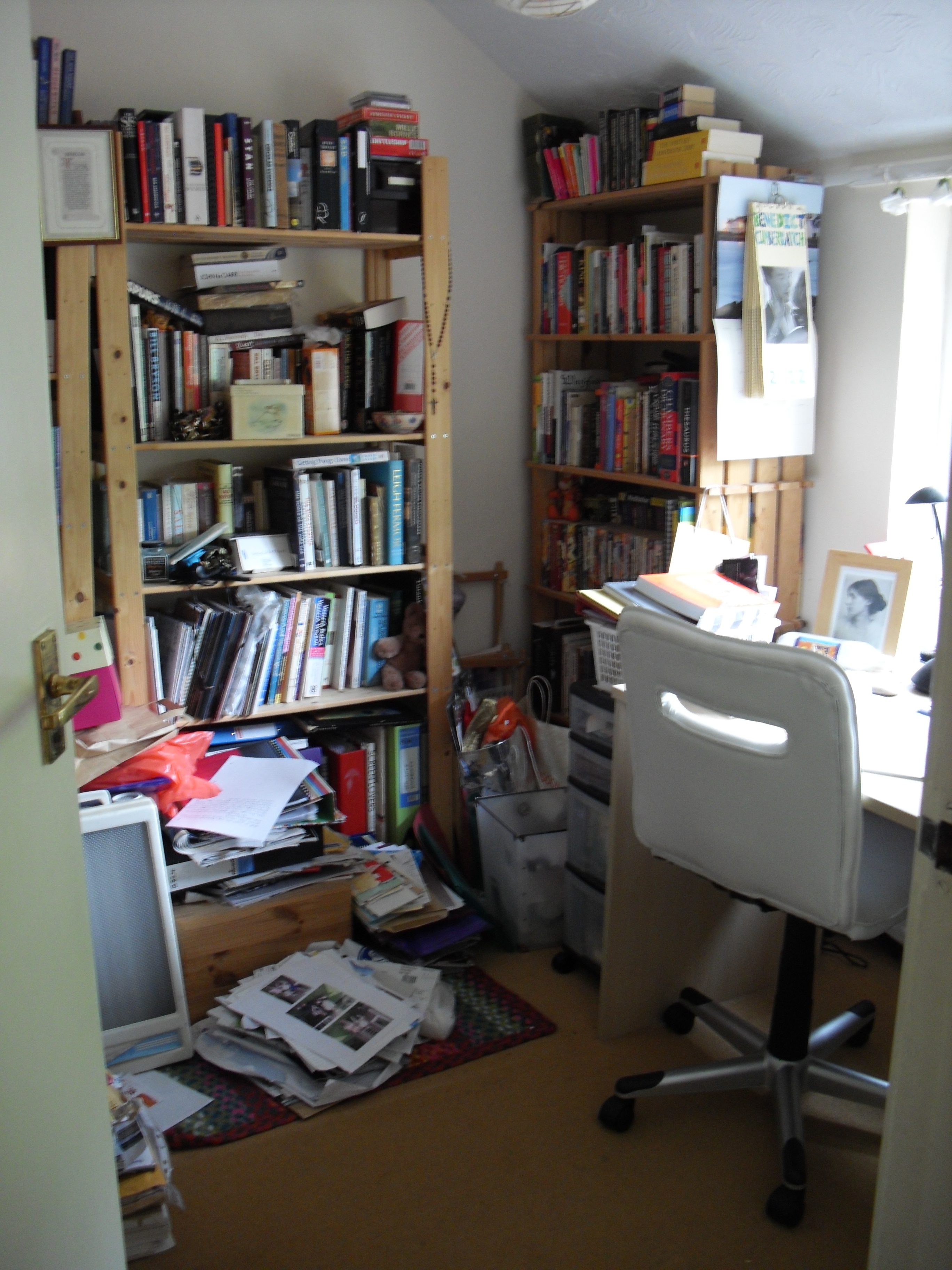
My study 1As you can see, its a mess.  Currently, it has a very nasty case of piles. (Piles of paper and junk, that is.)  The fact that it has become such a dumping ground, to the extent that I am now doing most of my writing sitting downstairs on the sofa, and I’m not doing any painting at all, is an important barometer for how much value I am attaching to my own art and writing practise.  In other words, not much.

One of my goals is to revamp my study.  This is because I need a Room of My Own.  Psychologically, I need to recognise my right to my own creative independence, and that is what my study signifies to me.  I need to make a gift to my creative self of a loving and beautiful space in which to make my dreams happen.  Its hard to claim that right, but I’m working on it.

You may not have the luxury of your own space, in which case, I sympathise because I spent many years in the same position, sharing a desk in the corner of our dining room with my husband.  (Even though he had his own office at work – not that I’m bitter, you understand!)  Still, there are ways to mark out some territory that you can call your own, a space where you feel totally free to create as you want.  That may be a corner of a shared room, the luxury of an actual studio, garden shed or study, or if you are not so territorial as I am, maybe a favourite table at a local cafe where you go to write, think or journal.

Where ever you choose, consider this space as not only a private area, safe from others, but also as sacred to your art – whatever form that takes.  When you go there, it should signal to your Artist Brain  that it is time to create.

Light candles, perhaps, and if you are so inclined, make a little altar to attract creative energy.  Surround yourself with pretty, evocative things.  Get some nice stationary and writing instruments.  A few pebbles can be delicious to handle and look at.  Make some inspiring signs to stick up, to remind yourself that you are entitled to this, that your voice is unique and deserves to be heard.  A painting that you like, objects that have emotional value for you, some nice furniture if you can afford it (I would love a comfy armchair to read in for my study), a noticeboard with inspiring images on it, wll all help to make even a small corner your own.

My Study 2In this picture of my study, you can see some of the things I cherish as part of my creative process.  (Sorry for the small lettering, I haven’t quite got the hang of Paint yet!)

I got the lovely chair for my birthday last year.  I’d never had a special, proper chair for my home office before. It still feels like an outrageous luxury!  There are fairy lights in the shape of roses around the window, which are nice when I am writing at night, as I usually prefer to.  There is my collection of books about writing, and books for reference, my Image Box for inspiration, and of course, my much cherished Benedict Cumberbatch calendar, which my adored niece made by hand for me last year.  On my desk, I keep a framed photograph of Virginia Woolf herself, because she is such an inspiration to me, both as a writer and as a person.

Try to carve out some personal space within your home environment to dedicate to your creativity.  Even if you are only able to keep your journals in a favourite tote bag down the side of the sofa to use when you can, it still counts.  It will help to enhance your creative process, and enable you to battle those critical voices that tell you your work isn’t good enough.

I’ll keep you updated on my efforts to reclaim my study from the mess and make it a place to snuggle down in to create.

Journal Friday: Motivations

Grandmas 80th

Family memories: Who are you leaving a legacy for? (That isn’t me, incidentally, its my own Grandma, and my nephew and two nieces, all grown up now.)

I became a Great Auntie for the third time yesterday.  Actually, saying that makes me sound old, and I’m not, really I’m not.  I became an aunt for the first time when I was 14, and since then my siblings have surrounded me with a reasonably sized and very rewarding family.  A big family event like this, or even just a friend having a baby, always raises a question for me, since I don’t have children of my own.

When I am gone, who will remember I was here?

I think that is one of the reasons I have stuck so dilligently to the diary-keeping habit.  The need to leave a mark,  To leave something of myself for posterity.  My diary is a record of my brain as much as anything, its change and development;  the ideas and interests I have had; the things I believe in; the problems i have struggled with and the solutions I have found.  And yes, it records my loves and losses too.

Every time I write, there is a part of me, something in the back of my mind, that is aware that one day, some beloved relative will find these notebooks and start to read them.  I don’t censor myself because of that.  Far from it, because I want them to know, fifty years down the line, who I really was, and what my daily struggles and joys actually were.

Some women keep a diary throughout their pregnancies, talking to their unborn child through the pages.  Others record their terminal illnesses so as to leave a message for their children to remember them by in later years.

Writing a diary can also be a more direct conversation with another person.  Anne Frank wrote her famous diary to her imaginary friend Kitty, perhaps so that she would not feel so alone in her wretched circumstances.  I doubt she ever thought she was leaving a legacy that would inspire people all over the world for decades to come.  For Frank, Kitty was a friend and confidante, a person to whom she could confide things she would never be able to say to anyone else.

For the most part, people write diaries and journals for and to themselves.  They may have little thought of recording ‘interesting times’, unless they are self-seeking politicians such as Alan Clark.  They write because they need to, because it helps them work things out, or simply because they enjoy it.

None of these reasons is wrong.  There are no wrong reasons.  You might think it self-important to want to leave a mark on the world, but it doesn’t make it a reprehensible motivation.   We all have our motivations for doing what may seem an apparently narcissistic activity, at least on the surface.

What are yours?

Journal Exercise:

Take out your journal and spend a few pages musing on why you write it, and whether you write to or for someone.  Journals are not meant to be read by anyone except their writer, at least not without permission, but sometimes we write with someone specific in mind.  Do you write for someone else, to someone else, or just to yourself?  Do you mean to use your writing as a prompt for other forms of creativity, painting for instance?  Or do you want to record a difficult stage in your life so that you can learn from it?  Do you want to write things down so you will remember them in years to come, or do you want to leave a record for posterity and your great-grandchildren?

If you have something to say to a specific person that you cannot say to their face, write them a letter in your diary, letting it all out.  You never have to send it, but it can help to say those things in some private, safe way.  That is what your diary is for.

If you are interested in historical diaries, you might look at The Great Diary Project for inspiration.  Other people’s published diaries can be an endless source of inspiration, and I will be writing about notable ones in future posts.  In the meantime, why not pop out to your local library or bookshop and see what you can pick up.

Happy journalling!

Journal Friday: Check In and Kick Start

So how are you doing?  Have you been writing your Morning Pages?  Did you buy yourself a journal and scribble your thoughts?

I started my Artist’s Way ‘Redux’ on Monday, and so far I have only missed one day on the Morning Pages (MPs).  I’m feeling pretty proud of myself.  I keep my MP notebook by my bed, along with my fountain pen, and write when I wake up.  It seems to be clearing the sleepy fluff out of my head, and helping me to work out what I want to do for the day.  What’s important.  (Need to be careful not to get ink on my nice white sheets, though!)

How about you?

Did you have a go with the journal exercise last week, as Puggle did?  Did you find out more about your life, and where you are?  Maybe even where you want to be?

Why not share with us how you are doing by leaving a message in the replies/comments?

Sometimes, its hard to think of what to write, or how to start.  I have to admit, there are times when I sit down with my journal or MPs and stare into space and think ‘what now?’  My MPs especially are punctuated by the sentence:  ‘I don’t know what to write next, my mind has gone blank.’

If you are suffering from this, and need a little kick start to get you going, here are some ideas that might just prime your pump.

Kick-Start Exercise # 1:  What Happened today?

Yes, I know that sounds boring and traditional, but maybe its not if you go about it the right way.  What was the most important thing that happened to you today, the event or feeling that sticks out in your mind above all others as important?

It might be the moment the doctor told you that your child didn’t have meningitis.  (Or did, in which case I am sorry.)   It might be that your boss complimented you on your work for the first time ever.  It might just be a moment when you were sitting at the traffic lights and looked up, and the clouds making were breathtakingly beautiful shapes, and it felt good to be alive.   Maybe nothing happened, and that in itself is a relief, an achievement or a significant red flag for you.

We go through our lives in a state of dazed distraction most of the time.  We barely notice the things that are important, let alone the things that are not, no matter how beautiful or poignant they may be.  Take a moment to stop and record what was most important today, the lasting memory of the waking hours you have just experienced that you want to take forward with you into the future.

Kick Start Exercise #2:  Have a Rant

If you are still stuck, how about writing about somethiing that makes you angry.  Everybody has something.  If you don’t, maybe you want to consider that in and of itself – are you repressing feelings, and if so, why?  Maybe your rant has to do with the neighbour allowing their dog to bark at all hours of the night, or potholes in the road that the council doesn’t fix.   What would you say to them if you could?  Maybe you want to yell at the government for some policy you don’t like, or you hate that your washing machine seems to eat socks and you can never find a complete pair.  Perhaps there are things you need to shout at your parents, partner or children, but don’t feel able to.  Your diary or journal is a safe place for all this.  Let it out.

Good luck with your journalling and MPs this week, and please share how you are getting on with us here.