Category Archives: The Creative Process

The Clunky Stage

writing notebookThe clunky stage.

If you write, you’ll know what I mean.

If you write on a daily basis, its those first ten minutes during which your brain feels like no one has oiled the cogs for ten years, and your pen feels like the nib is dragging through molasses.

If you haven’t written for a while, it feels like performing an appendectomy on yourself.

Hemingway was not kidding when he said:

There is nothing to writing. All you do is sit down at a typewriter and bleed.

Yesterday I sat down to write a new story.

I haven’t written in a while.  I don’t really get on with doing writing exercises much, although I know I SHOULD.  And at the moment I am experimenting with a new journalling practice called Deep Soul Writing, (of which more later) which is proving to be an interesting, but demanding, experience.  So my creative writing has been rather rare.

Nevertheless, I still have stories rattling around in my brain.  I always do.  So last night I thought I would start writing one down.  Free up some brain space.  Like you do.

Cue: wading through concrete.

How did this get so hard?

I’ve written seven novels, and dozens of fanfics.  How did I get this rusty this quick?

Nothing brings home the importance of daily practice, whether you are a pianist doing your scales, an artist doing your warm up sketches, or a writer doing – dare I say it – writing exercises, like coming back to your artform after a break and finding:

OH MY GODS THIS IS SO HARD!!!

My husband complains of feeling stiff and awkward if he misses even one of his twice-weekly body pump gym classes.  And now I know how he feels, because man! am I stiff!

But, as the old adage says, the only way out is through.

So I will suspend judgement on what I am scrawling because I know that while it may be as fluid as a fence post, at least I am on my way.  Sooner or later, things will loosen up, get more limber.  The adjectives will start replacing the cliches.  The dialogue will start to sound like it is coming out of real people’s mouths instead of cardboard cut-outs.  The metaphors will start to gang up on me.  The language will take on the richness of one of Queen Elizabeth I’s gowns.

Then, and only then, will I really get down to business.

But I have to write my way through the shit first.

So, like every marathon runner, I will set out in hope.  I will do my stretches, and thud through the first few miles until the muscles have warmed up and the movement starts to flow again.

Because even when its like bleeding into the keyboard, my soul is dancing, and I know, really know, that this is what I was meant for.

Happy Creating,

EF

Creative Recuperation

Statue by Anthony Gormley on the top of Blackwells Art and Poster shop, Broad Street, Oxford.

Statue by Anthony Gormley on the top of Blackwells Art and Poster shop, Broad Street, Oxford.

We just got back from a demanding time in Oxford, and after the difficult fortnight we have had, I find myself feeling emotionally as well as physically exhausted.  So when I found this post from Jamie Ridler this morning, I realised I had to make a concerted effort to have some healing time.

One of the hardest things to accept about our creativity is that it often comes and goes.  There are times of bounty, when the Muse is flowing and there are so many ideas coming into your head and out of your pen that you feel like you could get hysterical just trying to keep pace.

And there are the droughts.  The times when nothing new has come for months, and you feel like you may never paint or write or dance again.

One of the things that my ME/CFS has taught me, and continues to teach me, is to go with that flow.  There are times of the year when our bodies need downtime, and times when our tails are up and we are full of energy.  Any woman knows this from her menstrual cycle.

The trouble is that we live in a 24/7 culture that requires us to be ‘on’ seven days a week, twelve months a year, and our biology just hasn’t evolved sufficiently to keep up with that. (We’ve only had the lightbulb for a hundred years or so, remember?)  We simply can’t be  in action continually.  We aren’t machines.  We have to stop and rest.

Resisting that PUSHPUSHPUSH productivity mindset is a constant practise, but if you are intent on living a truly creative life, you need to take account of not only your own biorhythms, but also your creative rhythms.

It is time to be gentle with ourselves.

Because if we don’t make time to be gentle with ourselves, our bodies will remind us that we must in no uncertain terms – often with the red traffic light of major illness.

So this week, I am resolved not to make any particular demands on myself. I will be journalling, and watching some old films, eating nurturing food, and taking lots of naps.  Maybe I’ll even paint my toenails, which always cheers me up!  I am going to take it one day at a time and listen to what my body needs.  By doing that, I know my mojo will come back eventually.   I just need to give it some space.

Happy creating – or resting, whichever you need to do right now,

EF


Reflections on a Weekend

The harbour and yacht marina at Warsash, on the Hamble River, Hampshire, near where I grew up.

The harbour and yacht marina at Warsash, on the Hamble River, Hampshire, near where I grew up.

I’m in a time of endings.

I spent the weekend with my mother.  She’s 84 years old, and not very well.   She’s always been so robust, ploughing through life like an entire panzer division, armoured and indestructable.  And now she’s frail and shaky on her feet.  Still going, don’t get me wrong, but undoubtedly fading.  The little child inside of me is frightened and confused, terrified at the prospect that the day is now not far off when Mummy won’t be there anymore.

The weekend was characterised by extreme weather, wild winds and a huge storm blowing in from the Atlantic on Friday night.  I lay in bed, listening to the gale roaring in the pines and the waves crashing on the beach up the road.  A tarpaulin was flapping mournfully on the house next door, which is being renovated.  Out in the Solent, a few miles away and easily seen from the shore, the massive Hoegh Osaka container ship was heeled over precariously on her side while tugs battled to keep her afloat overnight.

My writing life feels just as precariously balanced and embattled as that metal leviathon marooned in the major shipping lane.  The squalls that pulsed through during the weekend in close succession, and even my mother’s ill health, all feel symbolic of my life right now.  My writer’s group seems to be petering out after more than a decade, and the retreat we will go on together at the end of this month seems likely to be the last.

It is a time of endings.

Yet, in the terracotta tubs outside my mother’s front door, green shoots are appearing, the tops of bulbs – hyacinths, daffodils, crocuses, even tulips.  Dotted through almost every garden in the street, spectacular orange-pink camelias are in full bloom.  The maritime climate suits them.  They show bright faces of gorgeous colour even in the depths of winter.  Fresh shoots of hope.

Without endings, we cannot have new beginnings.

Just as the dying off of exhausted foliage in autumn and the long winter months of dormancy and recuperation make way for the voluptuous gush of spring, so the phases of our lives must pass away, so that new joys, opprtunities and inspirations can take their place.

Today, I don’t know what I’m doing with my writing.  But I continue to write.  I feel hopeful.  And while I wait for the right story to pop its first green shoots through the earth, I will put what I have into this blog, into my diary, into notebooking, in preparation.  I will hope.  But I will also be ready when that green shoot comes.

Today I will honour the endings I know are coming.  Change is a part of life, and I will sit with the feelings of sadness that sometimes come with it.

But I will also plant up the amaryillis and paperwhite bulbs I bought the other day, and set them on the windowsill to remind me that out of compost, out of the remains of what is no longer living, comes indescribable beauty.

Happy Creating,

EF


Learning the Lessons

Footprints Ardnave 1I have to admit to being a bit nervous about posting again.  Which is silly, really.  But last week’s battering has really knocked my confidence, and the events of the intervening days have been a rough ride.

But just when you think you can’t cope anymore, the Universe hands you a rose.  This time in the shape of Pola’s loving and kind comment on my last post:

“The reason I’m writing is to let you know that I really appreciate your talent in writing. I appreciate your devotion to your craft and your desire to help others in developing their own style and creativity. So whatever you decide, I just wanted you to know that I think you’re an important voice in the world of writing and that I hope you never give up in your endeavor to have your voice heard. This world would be less without it.”

Thank you so much, dear, dear Pola.  I cannot tell you how much this meant to me.

With your words ringing in my ears, I got back on the horse last night, and wrote a new story, 2207 words of trying something new with ‘Lewis’.  It was somehow important to start again with ‘Lewis’ given that it was a ‘Lewis’ story that caused all the trouble in the first place.  I don’t know where the story came from, it just popped into my head.  I don’t know if I’m ready to publish anything yet either, but it feels so good to be back in the saddle.

I was made to write.  I don’t know how not to.

Somehow, I’m going to have to learn to deal with criticism better, from the sort that is justified to the sort that is completely out of order.  Its very hard to do that when you are already in a tough place.

I realised that I posted the story because I wanted a confidence boost.  I wanted some good reviews to cheer me up.  And when I didn’t get them, got the reverse in fact, it knocked me over completely.

Important Lesson #1:  Do not post your fanfics just to get applause.

I posted ‘Not So Innocent’ on a whim.  I don’t have a beta, so it hadn’t had a second reader look at it.  There was no one to tell me that it had dodgey elements in it.  I had doubts about it, I have to admit, but I couldn’t quite put my finger on what they were.  If I’d had backup, maybe I would have seen its faults.

Important Lesson #2: Get a beta reader.

Preferably someone who knows the fandoms I write in, has excellent capacity for spotting my hidden prejudices, and my inability to cope with apostrophes.  I read last night’s creation to Husband (a stickler for apostrophes), which was a very useful exercise (reading your work aloud is always enlightening), but he doesn’t have the time to be a proper beta, and he’s got enough stress on his plate as it is.

I’ve always fought shy of having a beta because I don’t like the idea of the delay it involves.  I’m probably too protective of my work anyway, so having an editor would be good practise in stepping back, and would probably help me handle criticism better.  Plus I’ve had bad experiences with supposedly ‘helpful’ readers in the past.  And I know what a lousy beta I am in terms of getting around to reading other people’s work I’ve offered to read.

If anyone is interested in being a beta for me, and can offer a fast turn-around time, dedication to grammar and a fine eye for possible offending material, please let me know.

Its hard not to feel over-sensitive at this point.  I confess I am still very wobbly.  Things in RL are on shaky ground.  I’m trying to support Husband and his family members as best I can, while dealing with my own illness, and the onset of the most difficult time of the year for me in terms of mental health.  Taking it slow and looking after myself, so that I can look after him, is the best I can do.

Important Lesson #3:  Look after yourself.

And of course:

Important Lesson #4:  DON’T GIVE UP.

So thank you for your continued support.  One way or another, we’ll all get there.

Happy Creating,

EF

Be Open. Don’t Try So Hard.

On Ardnave Beach, Islay, which I am yearning for dreadfully at the moment.

On Ardnave Beach, Islay, which I am yearning for dreadfully at the moment.

Lately, I keep coming back to the same thought:

Be present.  Turn Up.  Be still and open.  Don’t try so hard.

I was watching Jamie Ridler’s morning vlog, in which she talked about how people strive so hard to find their Life Purpose.  We make such a BIG DEAL out of it.

What if we just let it happen?

I’m not saying you can just expect your art to pop up out of nowhere.  You have to be present, make yourself ready.

You do your core practises.  Your morning pages.  Your writing exercises. Your artist dates.  Your scales or your practise sketches.  Your barre exercises.  You make sure that you are ready when the inspiration comes.

When I used to read about writers who sat down at their desks in the morning and stayed there for an alotted number of hours, regardless of whether the work came or not, I used to think they were mad.  It seems like working too hard. It seems like self-punishment.

Maybe you don’t just have to sit at your desk.

Maybe you can cultivate a mindset of being open.  Where ever you are, and whatever you are doing.

Maybe we are all trying too hard.

Forcing it just doesn’t work.  Every writer who has ever been blocked knows that.  But if you keep up the practises, the ideas come.  They come because your mind is constantly in a place where it is curious and open, and like a lamp in the darkness, it attracts the fluttering moths of inspiration.

So keep her steady as she goes.  Turn up for your daily creative habits.  Relax into them, and don’t panic.

The work will come.

Happy Creating,

EF

Help will come

Life Org kit I was working on my Life Organiser last night for the first time in a couple weeks (it’s been a hell of a couple of weeks), and the quote at the top of the page for Week 43 in Jennifer Louden’s book just jumped right out at me:

A thunderbolt illuminates your heart: it isn’t your job alone to fulfil your dreams and give birth to your yearnings. You can relax and ask for help, and help will come.

It was that last sentence that jumped off the page at me.

Help will come.

Help will come.

All you have to do is ask.

Lately, I haven’t been asking. Actually, let’s be honest here, I have the greatest difficulty in asking for anything, ever. It’s one of the hardest lessons I have had to face with chronic illness. Sometimes, you just can’t be perfect and do it all. Or maybe, do any of it. You have to ask for help.

Whether I need to ask for help cleaning the house because I’m too exhausted to push the vacuum cleaner, or I need help from my Muse because frankly, ain’t nothin’ goin’ on in my storyworld, it is really, really hard to admit I need help.

Usually, I do the passive-aggressive woman thing of wearing myself out, reducing myself to a stressy heap of tears and vitriol, and then Husband put his hands on his hips and says in a despairing tone: ‘well, you only had to ask.’

I’ve been feeling really stressed for the last few days, and not very well at all, and if I was one of those organised bloggers who writes their posts weeks in advance, I would have had a bunch of spare posts backed up to cover me for the times where my brain goes blank. But I‘m not. I’m a ‘fly by the seat of my pants’ kinda gal, and I really like being able to write what I need to write when I need to write it. I need my posts to feel current for me, otherwise they come out creaky and preachy. Or at least, I think so.

So I didn’t write on Monday. I just couldn’t.

Instead, I had a bit of a meltdown.

On Tuesday, I decided to trust to the Muse. You could say that I asked for help. I trusted that some inspiration would come along. I listened. And while I was listening, I got down to a few other things, including my Life Organiser.

Bingo!

The action became the lesson. Trust. Ask. (Keep busy while you are waiting.) Help will come.

And it did.

If you are struggling with your creativity right now, ask for help.

Maybe you just need Grandma to come and look after your baby for an hour so you can write or read a book by yourself. Maybe you need someone to hoover the carpet, which will give you enough time to do something for yourself, something creative.

Or maybe you need to ask the Universe for help, to look up to the sky and say ‘Please could you send me some inspiration, because right now, I’m a bit blank.’

Then listen.

(The listening part is the important bit.)

As I mentioned in a recent post, silence helps.

If you can’t find silence, do something that will allow your Muse to speak. Morning pages; perhaps, a walk around your neighbourhood with your camera; a few writing exercises. Do your Life organiser, or read a book. Allow yourself to be open. Make peace with your temporary stuckness, but act in a way that will allow whatever message your Muse has for you to come through.

Help will come.

Your job is to be gently open to it.

Happy Creating,

EF

Inspiration Monday: Silence

pat oxburgh b&w

Husband sitting in the partially ruined church at Oxburgh, Norfolk

I was reading the chapter on silence in Christina Baldwin’s book ‘Life’s Companion: Journal Writing as Spiritual Practise’, and it immediately rang bells for me. I have a particular reason for this. Let me explain:

One of the symptoms of the chronic illness with which I live, ME/CFS, is sensitivity to noise. Some days are better than others, but there are everyday sounds in modern life that can create physical agony for me. And no, I’m not kidding.  I mean, I get actual pain. A cold electric current feeling up and down my spine and a nauseating icy pain in the back of my skull. Unpleasant to say the least.

For the first three years of my illness, I couldn’t listen to any music with a beat at all. Every thud of bass was like a knitting needle jabbed into my neck. No pop radio, no rock, no hand jiving in the car to the Stone Roses or the Pet Shop Boys. No Elvis.  No Beatles.  Nothing.

I couldn’t listen to anything much. Mozart and Bach worked, a little Handel mixed in. Beethoven proved too noisy, as did anything after him, although I did find I could handle some Vaughan Williams. Opera was right out, so goodbye to my favourite tenor, Placido Domingo. I just couldn’t bear to listen to him anymore.

Most of the time, though, any kind of noise was painful.

So for three years I avoided places where the music was piped, and had to ask friends who listened to music perpetually to turn down their stereos, which was mortifying because they just didn’t understand.

I adjusted to a world without music.

I learnt a different way of listening.

I listened to the birds, the ones that make pretty sounds, and the ones that don’t. I learnt I could set my watch by the rooks in the tree opposite the house. (They all get together and start shouting at one another at 3.30pm, no matter what time of year it is.) They’re funny, like one of those noisy markets where everyone is shouting about their wares.  I’m rather fond of rooks now.

I learnt to hear the vegetation around me too, the creaking trees and rustling shrubs, the fresh new spring leaves and the rattle of the dried autumn ones.

And the animals. The scuttle of mice in the undergrowth, the mewling squeaks the rabbits make, the scrabble of the squirrels on the roof tiles. The buzz of the mason bees under the window in the summer, the drone and thump of the hornets throwing themselves against the window, attracted by the light, in autumn.

I came to realise how much noise pollution we endure, day after day, the constant onslaught of a life lived with continual racket, the radio, the TV, the iPod, the piped music, the slot machines, even the roar of conversation echoing in the cavernous, sound-reflecting spaces of shopping malls. And how much we use recorded sound to blot out our minds, to stop us thinking too much.

The Christian mystics said that prayer is talking to God, but it isn’t much use if you don’t listen for when He speaks back. To hear the Divine, we have to be in silence. This is just as important when the voice that speaks inside us is the big, blousy, shriek as when it is the almost inaudible whisper. The practise of creativity demands that we listen. Sometimes, we have to listen hard, and without distractions.

When did you last spend time in silence? Do you make space for a little quiet time daily? Do you relish that moment when the kids are in bed, and you can sit down at the kitchen table with a glass of wine, take a deep breath, and just listen to the noises the house makes around you as it settles for the night? Or do you fill every waking hour with a constant cacophony to drown out the voices inside your head that are telling you the life you are living is not fulfilling you?

Out of the quiet comes not only spiritual fulfilment, spoken of in all religions, but human creativity. Out of silence come the stories we tell, the fantasies and day dreams that grow into novels, plays, paintings, films, concertos and ballets.

When we cultivate stillness, when we listen, we give our brains space to breathe. And yes, sometimes we then have to face up to the uncomfortable truths of our lives. But often, we have the opportunity to tap into wells of creative inspiration previously unknown to us. Our Muse’s voice can be heard.

You don’t have to take a vow of silence to benefit from stillness, and I’m not saying you should give up the joy of music. (I’m back on it now, and believe me, its one of my greatest inspirations.)

Listen to yourself.

What I am suggesting is that you take time daily to be in stillness. To listen to the sounds of the world around you instead of filling the void with canned synthetic noise. To listen to yourself. It may only be ten minutes, or the time you spend in the bathroom every morning, or half an hour before bed without the telly on. You don’t have to meditate, although that is good too. No, this is a different idea, a way of being quiet with ourselves, a way of listening for the inspiration to come. I know you lead a busy life, no doubt, and that quiet in a city is hard to find. But I assure you, it is there. You can find it. And when you do, immerse yourself in its balm, as often as you can, and allow it to feed your creative life.

Happy Creating,

EF

Inspiration: Sucking up History

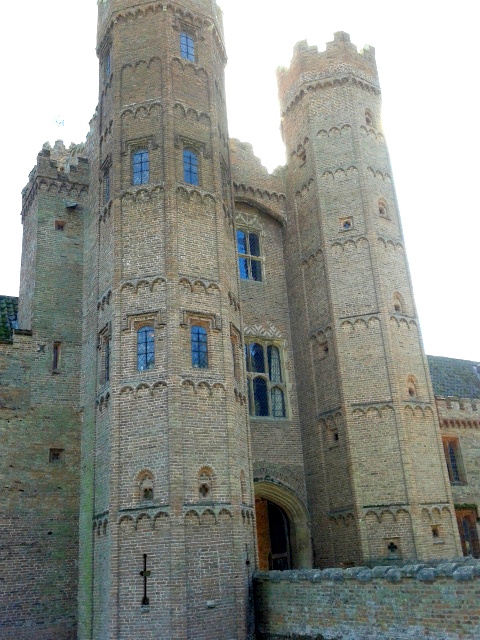
20140927_135032As a special treat last weekend, Husband took me to visit a local National Trust property, Oxburgh Hall.

Built about 1482, Oxburgh was the home of a well-connected family who hung onto their Catholic faith throughout a period in English history when it was dangerous to dissent from the religious line the Crown laid down.  Oxburgh’s inhabitants  suffered as a result, passed over for lucrative posts at Court, closely watched for sedition and treason, and restricted from certain occupations as well as from celebrating their religion openly.

The result of this (relative) penury is that the building escaped the zealous passion for updating property that characterised the aristocracy, and many of its original features remain intact, including the King’s Room and the Queen’s Room, authentic Tudor bedchambers in the tower house that spent many years used only as storage spaces!

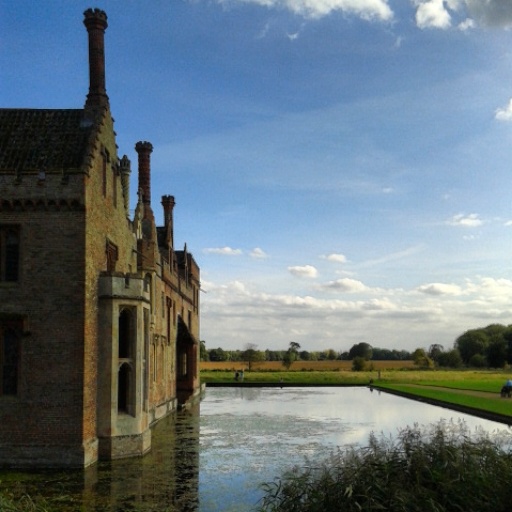
Oxburgh Hall:  The Moat

Oxburgh Hall: The Moat

Oxburgh appears to float on its moat, which cannot be drained as the 500-year-old elm wood posts which support the foundations would crumble were they to dry out.  It still has the barleysugar chimneys and characteristic towered gatehouse that recalls the Wars of the Roses.  Inside the sombre portraits of nuns, the needlework sewn by Mary, Queen of Scots in her years of captivity, and the Priest Hole, where illegal Catholic priests had to hide from government troops, speak of a dark history of dissent and risk, of members of the family living in fear for their lives, simply because of their religious beliefs.  Oxburgh was a particular target during both the Reformation and the Civil War.  And yet, despite this, the little rowing boat that floats beside the steps on the moat is  named ‘Le Boat sur le Moat’, so the family still kept their sense of humour!

I started wondering what it would be like to live through that?  Never to be able to trust your neighbours, your servants, even your family?  To live constantly in the shadow of the block?  To live in fear of the next knock on the door?  To question your beliefs every day because they challenge your personal safety and that of those you love?  To always be regarded as ‘Other’?

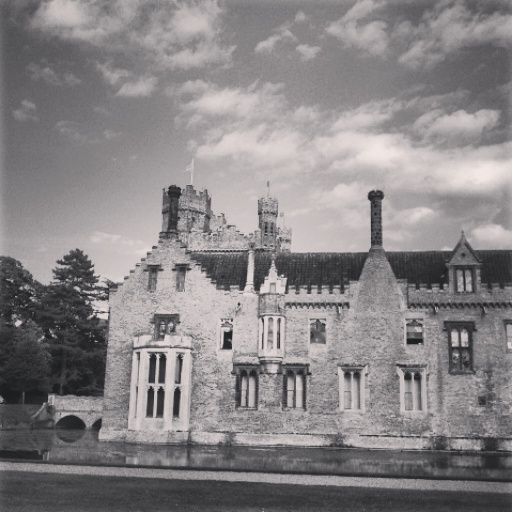
Oxburgh Hall

Oxburgh Hall

The history around us gives us an opportunity to look at our own lives through a different lens.  What happened in England in the 15- and 1600s is not really much different to what is happening in parts of the world now.  Being inside a building where these things happened, seeing and touching the belongings of people who lives through such terrifying times, brings the realities home in a much more deeply felt way.  If we do not live under such stresses ourselves, we can never truly understand what they mean, but we can imagine.

I live in a house that was built in the 1880s.  Its just a little country cottage, the middle one of a row, the kind that are common in the UK.  It was originally built as two houses, one up-one down dwellings with an outside wash house, coal hole and privy each.  The men who lived here worked for the local Lord as farm workers or gamekeepers, and got the house as part of the deal.  Their women kept the house, cooked the meals, raised the children, and spread their washing out on the pasture behind the houses to dry on wash day every week.  The children would have walked across the fields to school each weekday, and worked alongside their parents when they got home.  They would have worshipped at the medieval parish church whose tower can be seen from our livingroom.  How different the lives of those souls would have been from mine.

Inspiration:

Think about historic buildings and places near where you live.  try to visit one or two if you can.  They don’t have to be as old as Oxburgh to count.  What about a coffee shop built in the 1930s, during the Depression, or a 1950s diner?

Take some time to soak up the place.  Think about the people who have lived and worked there.  How would the community have reacted or been affected when the building was put up?  They might have had to sacrifice their own land or homes, for instance, or they might have objected on moral or economic grounds.  How would it have felt to visit this place in those days?  What kind of day to day issues would have been on the minds of those who lived here?  What stories are concealed in their lives?

Take some time to write a few pages, answering these questions.  It doesn’t have to be historically accurate, but it helps.  Use the building or place as an entrance into someone else’s life and see where it takes you.

Happy Creating,

EF


The Benefits of Giving Up

The Cumberbatch

Gratuitous Cumberbatch photo. Just because I felt like it!

Dear Reader,

I want to tell you about why its sometimes a really good idea to give up.

You weren’t expecting that, were you?

In my last post, I wrote about the folly of trying.  Of pushing ourselves beyond endurance, and as a result, being unable to achieve the things we want.

That post was an example of me writing my own permission slip.  That day, I took my own advice.  I gave up trying.  I spent a lot of time just lying around.  I felt terrible, so why do anything else? I simply surrendered to what my body was trying to tell me.  Which was, in essence, ‘STOP’.

So far, so good.

The next day, I woke up at 8.30am, earlier than I am normally able to do, and in addition, woke with a clear head.

I grabbed my laptop and opened it up.

And I wrote.

I wrote all day.

In between spells of writing, I stripped the bed, put clean sheets on, did three loads of washing, tidied the kitchen, ironed some fresh pillowcases, made some long overdue phonecalls, and cooked a lovely supper for Husband and myself. I got so much done!

By close of play, i.e.11pm, I had written (get this) 6470 words.  Thats 27 pages.

The most I have ever written in one day.

(Round of applause, please.)

And all because I had given myself some much-needed space.

This is why you must learn to stop.  Yes, it is important to write every day.  Little and often is imperative.  Regular practise for any art form is necessary.

And there will be days when you sit down at your desk or in your studio and think:  ‘I really don’t want to do this today.’  And when you start, the brush strokes will be ugly or the words will come out like lumps of lead.  And then you will get going and things will flow and it will be alright.  (In fact it will be better than alright.  Because all the pain and depression you may have been struggling with will fly away, and creating will heal you.)  That is the point of any practise.

I am not saying you should only write when you feel like it.

What I am saying is that you must recognise that there are some days when your body is leeched to a husk, when your brain is too full or too empty to do anything but be.  Those are the days when you need to be gentle with yourself.  To put away the expectations.  And you will know those days.  The days of crisis.  The days when Life just steps in and pulls the carpet from under you.

If, like me, you live with chronic illness, working out which those days are becomes a little harder.  After 17 years, I am getting better at it, but I’m still not great.

The important thing to remember is that when you release the pressure on yourself, the result is often magic.

Its very Zen to say: let go of perfectionism, let go of expectations, but its easier said than done.  We all carry expectations from society, our upbringing, our peers and ourselves.  Letting them go is a daily practise in itself.  I am reminded however of an old saying I once heard:

“Let go, and Let God.”

Once we stop trying, once we stop tensing up and forcing things, the creativity flows through us freely onto the page or the canvas or the keyboard.  When we are free to make crap art, we learn.  And invariably, in my experience at least, when we give ourselves permission to make crap, what comes out is pure gold.

So here I am, in the aftermath of this great day of writing, assessing what I have learnt, what I can take with me from this experience.  I don’t know if what I wrote yesterday was gold or dross.  Chances are it will be about 50/50.  I don’t really care.  To be frank, it was fun.  It was an enormous relief just to spread my wings and fly without judging myself at all.

And I’m looking forward to doing it again just as soon as I can.

Happy creating,

EF


The Folly of Trying

My counsellor told me a story:

A man was asked at a conference to come up onto the stage, where the speaker had set a single chair in the centre.

‘Try to pick up the chair ,’ the speaker said.

The man picked up the chair.

‘No, you’re not getting it,’ the speaker said.  ‘Try to pick up the chair.’

The man picked up the chair again.

‘No, you’re still not getting it.  TRY to pick up the chair.’

The man put his hands on the chair and then, in a flash of inspiration, he understood.

Because TRYING to pick up the chair is not the same as picking up the chair.

If you TRY, you never actually achieve the action.  You just TRY.

Or, as the venerable Yoda said, in ‘The Empire Strikes Back’:

Try not.  Do.  Do or do not.  There is no try.

(I had that on my door at college.  I don’t think I understood it then.  Now I do, I really, really do.)

This wisdom has really been banging on my door today, as I struggle with a cold, coming on the back of a bad spell of IBS and ME/CFS.  I am busy TRYING.  Trying to get better.  Trying to feel well. Trying to cope with the housework. Trying to write.

Sometimes you have to recognise the wisdom of ‘Do or Do Not.’

Lately, I worry that this blog has become more about illness and less about creativity.  More about my TRYING experience.  But I think it really is an important lesson to learn for creative people.  We push ourselves and push ourselves, driven by expectations and perfectionism and Gods-know what demons we have inside us, deftly planted there, no doubt, by our loving parents. We dance the dance of the OUGHT-hogs.  The SHOULDS.  We are so busy forcing meaning into our lives as creatives, as Eric Maisel ill-advised (IMHO), that we pulverise our souls and our bodies into gibbering wrecks, terrorised by all the goals we fail to achieve and the standards we are incapable to meeting.  Books about how to write invariably advise the student that they have to write every day, no matter what.  I don’t think thats healthy or, frankly, practical.  Of course, it helps if you can.  A lot.  But seriously, who can write when their child has been up all night vomiting, or they have just received a redundancy notice?

Sometimes you have to treat yourself with loving kindness.  Sometimes you have to lower your expectations, and maybe even give in to the avalanche that Life has dumped on your head.  I have been talking to several friends who are all struggling with ill health this week, recovering from cancer treatment or at the end of a difficult pregnancy, or even in bereavement, and I truly believe that this is something all of us needed to hear.

Sometimes you are allowed to stop trying.

Sometimes its good to stop trying.

And then, when you have given yourself a break, a rest, a time of wound-licking, you can get up and go and do what it is you need to do.

MInd you, I have probably just proved myself wrong by writing this blog post, because I’ve spent the last six hours lying in bed groaning, absolutely convinced that I couldn’t write anything today.  So there you go.  Take from that what you will.  Just promise me something?

BE KIND TO YOURSELF

Happy Creating,

EF