Category Archives: Writing

Inspiration Monday: Mad Thoughts!

Do you ever have one of those moments when you wonder WTF is going on inside your head?

I try to keep mindful of the thoughts that go through my head, partly as a defense mechanism against depression and overdoing things, but also to a degree out of sheer amusement because some of the stuff I think can be deeply bizarre.  For instance, here is yesterday’s offering:

“I don’t want her to think we’re the kind of people who don’t clean our bathroom mirrors.”

?????????????????

This raises so many questions about my sanity that I daren’t even go there.

BUT

What about using this as a creative writing prompt?

Who is the ‘her’ the speaker is so paranoid about?  A demanding mother-in-law, for example, the boss who might have a promotion available, or a rich friend, perhaps.  What sort of people don’t clean their bathroom mirrors anyway?  What kind of people are the ‘we’ mentioned?  Detach this sentence from me and my interiors paranoia for a minute, and think of all the possible short stories you could write using this moment of madness as a starting point.

There are so many little moments in life that could be writing prompts.  That is why you keep your writing notebook with you, so that you can write down the moment your mother-in-law steps over your threshold and into your new home for the first time, and the first thing she does is look at the floor and say ‘I see you haven’t hoovered today’ (you moved in two days ago.)  Just imagine all the thoughts that would come into your head then!  Or when the hostess of a dinner party you attend dispells a painfully embarassing moment by announcing, without any preamble:  ‘I like cheese.’  (What was going in inside her head?)  Or when you catch yourself wondering what it would be like to eat daffodils (answer: don’t – they are poisonous.  I looked it up.)  Or even wondering what alpacas think about.  What do alpacas think about anyway?

Your mind is a garden of unbridled surreality and whimsy.  Don’t ever think you are short of prompts.  Its all inside your head.  All you have to do is watch what is going on.

Happy Creating,

EF

Clear the Decks

If you listen to the elderly, you always find wisdom.  One of the things I learnt this weekend was from my husband’s aunt, who was in her day a deeply respected midwife.  (She delivered Roald Dahl’s children, as well as tennis player Tim Henman.)  She is a very tidy person, and when I asked her about this, she told me that part of her nursing training emphasised the importance of starting with a clear surface at all times, whatever you were doing.  So she tidies up after herself obsessively, even now, when she is so disabled that she can barely move.

I took this idea away with me.  It occurred to me that one of the things I love most about going on a writers’ retreat is arriving in a room with an empty desk, uncluttered, a space to work.  It inspires me hugely.  Obviously, Auntie’s edict on clearing the decks is an excellent one.  It’s not rocket science, either, to make space for your creativity.

But.

And this is a big but.

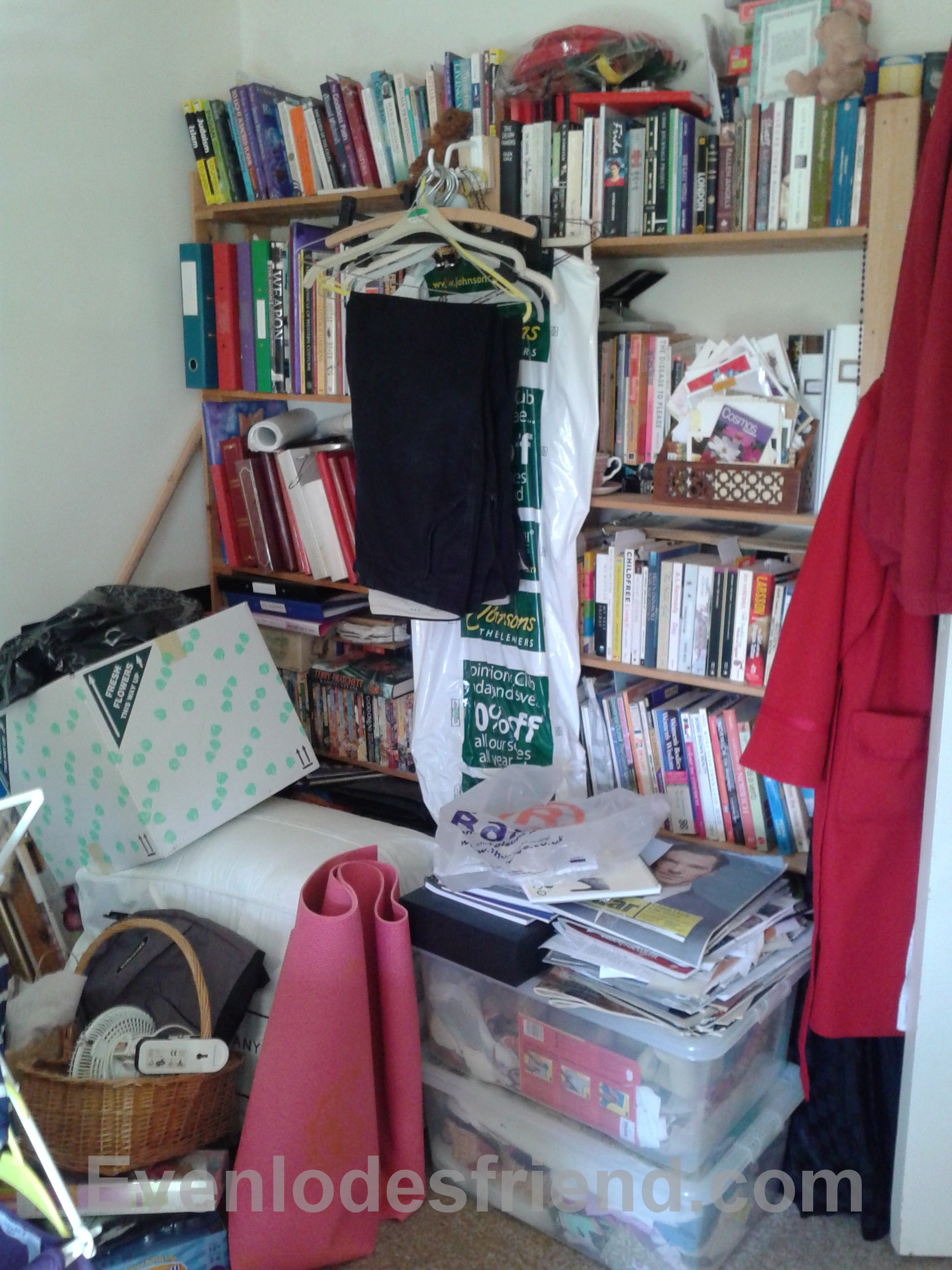
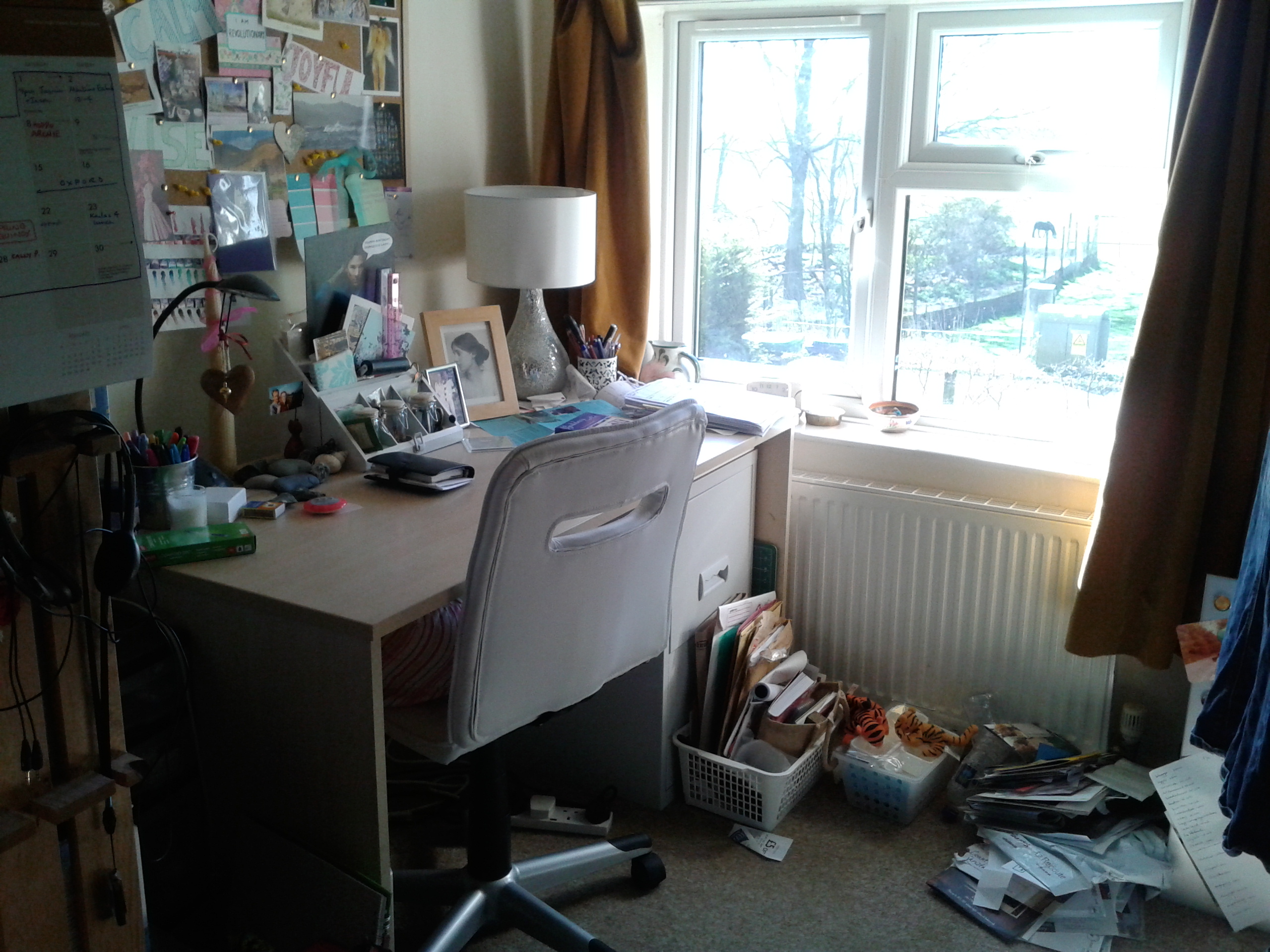
I went into my study this morning and this is what I saw.

The shelves as you come into the room.  Total dump.

The shelves as you come into the room. Total dump.

My study is the only place we can dry laundry in the winter months.

My study is the only place we can dry laundry in the winter months.

The current state of my desk, complete with pile of unopened post.

The current state of my desk, complete with pile of unopened post.

A bit not good, as Sherlock and John would say.

What does this space say about how I prioritise myself and my creativity?  I think it shows how little I value myself and what I do.  How can I do my best work in this mess?

I long for a clear space in which to work, but this is what I’ve got.  No one but me is responsible for this chaos.  Okay, yes, Husband tends to keep his study clear by dumping stuff in mine, but I let him do that.  I allow these heaps of junk to build up, blocking the energy, my energy.  And after all, who would want to work in this mess?

So I think it is time for another push on making my study work.  I’ve done this before, as you know.  But really, how much have I invested in that process?  I always find an excuse.  I’m always too tired to make it a priority, or too busy.  I can always work downstairs on the sofa, and I usually do.  But then I have to go running up and down to get what I need.  Meanwhile, Husband has a lovely study that is a dedicated space for his business, which is tidy and organised, and which he loves.

If he can have it, so can I.

Its time to clear the decks.

Happy Creating,

EF

Journal Friday: Handwriting

Handwriting in my writers notebook

Handwriting in my writers notebook

I’ve probably banged on about this before, but nevertheless, I’m going to do it again.

Write your diary by hand.

I’m serious about this.  No, really.  There are many reasons.

Yes, you hate writing.  Besides, you’ve got your computer and you can write so much more easily and quickly using a keyboard.  And hell, a laptop or an iPad are so much more portable and….

Wait.  What’s more portable than a little notebook and a pen?

There are reasons why using your hand to make marks on a page in the age-old way are important.

Firstly, writing with your hand will benefit you directly in a psychological way.  You may not agree with my position on Gestalt, but I truly believe that the unconscious or subconscious is locked up in the tissues of your body and needs to speak.  Allow it to, and it will say all the things you can’t bring yourself to acknowledge.  I have personal experience of the incredible efficacy of this, so you’ll just have to trust me.

Using your hand may seem slower, but it will unlock parts of your mind that you have no conscious access to, and allow you to release emotions in a healthy way.  Using your hand to write will heal you in ways you can’t imagine yet.

Using your hand slows things down enough to allow for reflection.  Not everything that is fast is better.  Sometimes you need to stop and think between sentences.  Allowing your eyes to follow the flow of your nib on the page allows your mind the breathing space it needs to move on to the next emotion, memory, image.

Going slower is good.

Another reason to hand write your diary is for beauty’s sake.  Yuck, you may think – Have you seen my handwriting????

Your handwriting may look like crap, but that’s because you don’t use it.

Practise is the key to making anything beautiful, and if you practise your writing, carefully and consciously, you will not only find yourself writing faster, but also more legibly and beautifully.

Again, this is something I know about.  I’ve been keeping a diary since I was seven years old, and looking back through the volumes gives me the chance to see how my own handwriting has evolved.  I have to say that I went through many phases of adopting the styles of others.  Yes, I copied the handwriting of my best friends in order to be more like them.  I’m sure many girls do.  And as a teenager, I adopted some of those silly squiggles and loops that are so common – like drawing a circle instead of a dot on the top of a small case ‘i’, and so on.  Yuck.  Thankfully, I grew out of that one too.  I even learnt to hold my pen in different ways in order to affect particular styles.

Now my handwriting has settled into a more mature, consistent style, although it does vary from day to day depending on my mood.  I have worked on it, crafted it, to make it more attractive, more pleasing to the eye.

I also have two styles for practical purposes, my usual style, and the one I use for writing very quickly, which enables me to take verbatim notes in meetings and such like without having to know shorthand.  Using either, I find that practise makes them more attractive and easier to read.  The more I write, the better I get.  Literally.

Writing is an art form in itself.

The other thing about handwriting is that, like map reading, it is becoming a lost art, and one we will sorely miss when it is gone.  I am a rabid advocate of reading maps, and I object strongly to anyone assuming that I have a satnav I can just plug into.  Satnavs are a disaster because they aren’t intelligent enough to handle the complexities of actual landscapes, and the number of times I’ve got stuck on a country road behind a vast articulated lorry whose driver has blindly followed his satnav’s instructions and then found he can’t escape are countless.

Similarly, handwriting takes account of the subtle nuances of the emotional landscape.  Because my handwriting changes with my mood, it actually speaks as much as the words I record about how I am feeling, in a way that static typefaces never can.

But more than that, if we lose the capacity to write by hand, what would happen if we were suddenly without electricity or technology?  How could we communicate?  If you were stuck in a desert, how could you write on a rock to leave a message for someone trying to find you?  If there were a natural disaster, Gods forbid, how could you leave a last message for your loved ones before you died?  Or more simply, how could you make a quick note of your shopping needs if you lost your phone?

It may seem laborious and a bore, but please use your handwriting, at the very least in your journal.  Not only will you be making a work of art to pass on to posterity, but you will find the simple act of allowing your brain to communicate directly through your arm will unleash creativity and healing undreamt of.

Right now, as I type this, I am actually yearning to pick up a pen and write.  I don’t know what I’ll write.  Anything, probably.  Just a bit of rubbish.  But the act of moving my hand across the page is seductive and addictive in a way that nothing else is, and I long for it.

You can feel this bliss too.  It isn’t hard.  You learnt how to do it at school.

Simply take up your pen and write.

Happy Journalling,

EF

Journal Friday: Every Moment

cropped rosesEvery moment is a new opportunity.

Don’t think about all the books you haven’t written yet.  All canvases you haven’t filled, the dances you haven’t danced, yet.

With every new breath, you have an opportunity to DO DIFFERENT.

Didn’t write your diary yesterday?  Do it now.

Didn’t do your writing exercise or sketch.  Do it now.

There will always be an excuse.  Why listen to it?

Every moment is an opportunity to change what you do.  Its a choice.  Every waking moment.  You can choose to keep on keeping on, doing the same old same old, thinking the same old thoughts, being a victim, blaming other people because you never made the time to learn the piano or whatever.

Or you can choose to live the life you want to live RIGHT NOW.

If the life you want to live involves living in a villa on a Greek island painting huge abstract canvases, (confession: this is my dream retirement) and maybe you can’t run away to the sun just now, well, just get some paper out of the photocopier and some coloured pencils or pens and make some colours on the page.  Be the change you want to see.

You can be the person you always wanted to be RIGHT NOW.

You have a choice RIGHT NOW.

Be your own hero.

Choose now. 

Make your choice and be it.

Happy Creating,

EF

Back to Basics: The Writing Exercise

I’ve pretty much lost two months of creativity this year so far, and I’m keen to get back on the horse, so to speak.  Part of that involves getting back to basics.  And one of the best ways to do that if you are a writer is through the Writing Exercise.

You will need:

A timer

A notebook

A pen

A space where you will not be interrupted.

Fifteen minutes every day.

Yes, I know that the last one can be difficult, but you can manage it.

Look at the list again.  See how cheap those items are?  And yet it’s such a huge payoff for a very tiny investment.  If you don’t have a timer on your phone, you probably have one in the kitchen. The notebook and the pen can be as rudimentary as you like, just so long as you can write quickly and easily without thinking too much about how the tools feel in your hand.  You don’t want writer’s cramp, after all.  Your tools should be transparent.  You don’t want to be thinking about them.  You need to focus all your mind on the story that is finding its way out of your head and onto the page.

There is one more thing you need.

A prompt.

There are loads of them about.  You can make up your own.  You can get a friend to send you a prompt, like a writing dare, every day by email or text message.  You can use a book – I’m using Judy Reeves’ wonderful book, ‘The Writers Book of Days’ at the moment.  Or you can find lots of websites online that will give you prompts.

Don’t think too much about it, whatever your prompt is.  Just take it as a starting point, write it at the top of your page, then set your timer for fifteen minutes and let your brain make hay!

I’ve decided to give myself an extra rule, though.  I was considering the weaknesses in my work and I realised that I have a real problem writing three-dimensional female characters.  All my stories are full of fascinating, psychologically complex men and paper-doll women.  This is a bit worrying as a female writer.

So I have decided for the whole of March that I am going to do a writing exercise every day, and I am only going to write about female characters.

Merciless practise.

Let me tell you, it’s already working, three days in.  I have already created a female character that I absolutely love and want to come back to.  But I am determined to go on.  Like a ballet dancer working at the barre, or a concert pianist doing scales, I am going to practise and practise until I feel I am really making some progress.  And then I’m going to practise some more.

It’s the Habit of Art.  And it feels great.

I am doing writing exercises every day for the whole of March.  Fifteen minutes a day.  No neat handwriting, no fancy notebooks, just a cheap pen, an exercise book and my timer.

Why not join me?

(You can read more about writing exercises here.)

Happy creating,

EF

Friday Quickfic – Lewis OmegaVerse

Kevin Whately and Laurence Fox in the TV series 'Lewis'

Kevin Whately and Laurence Fox in the TV series ‘Lewis’

May the Gods forgive me, but I have written a Lewis omegaverse fic.  I have never written anything like this before, and it scares the hell out of me, not least because its the thing I knocked out in two hours last week (while possibly not breathing).  I’ve probably got all the details wrong, but in the spirit of putting stuff out there, I figure, what the hell!

Not for the faint-hearted – do not read if you are not into violent sex or M/M couplings.

But if you like this stuff, you can find it here.

Read at your own risk!

Happy creating,

EF

The Frustration Monster

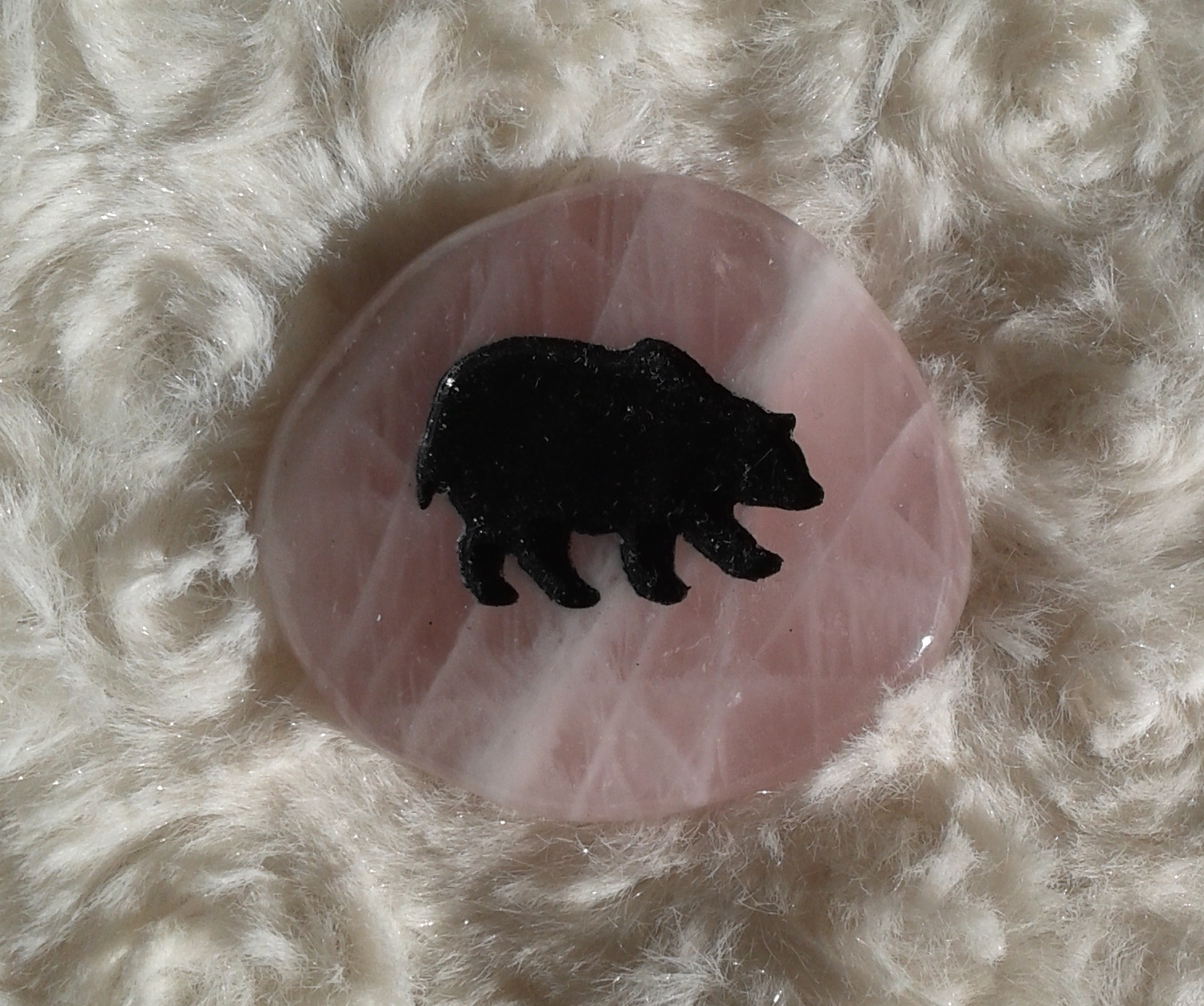
Rose Quartz for healing and a bear for intuition.  I keep this stone by my bed to remind me what energy I need in my life rigth now.

Rose Quartz for healing and a bear for intuition. I keep this stone by my bed to remind me what energy I need in my life right now.

Aaaaaaaargh!

Do you ever feel like that?

I’ve got a whole belly-full of OUGHTS right now, and the Frustration Monster is biting at my tail, dammit!

I’m still in the midst of bear energy, but I don’t feel calm at all.  I’ve been trying to think of a sensible post to write, but my brain is like porridge and I am not feeling very at peace with all this hibernation/intuition stuff now that its finally getting sunny and mild outside.

Yes, I’ve got a bad case of the OUGHTS.

I OUGHT to be writing something.

I OUGHT to be writing something serious.

I OUGHT to be keeping a writing notebook.

I OUGHT to be keeping a better, serious, consistent writing notebook.

I OUGHT to be making more of this website.

I OUGHT to be writing my journalling ebook.

I OUGHT to be earning money.

I OUGHT to be doing the garden/cleaning the house/washing up/ making new curtains/planting bulbs/scrubbing the bath/calling that friend I haven’t seen for ages/ doing yoga/ meditating/ making green smoothies/ feeling better by now etc. etc. etc.

Instead, I can just about manage writing in my diary some days.  I can make the supper.  I can stuff laundry in the machine and press the button.  I can do what is absolutely necessary, but not much more.

I have written this week, despite this.  I have had two days of absolute brain dump.  Verbal runs.  On Monday I wrote so hard, so fast, I actually ended up dizzy (NOTE TO SELF: remember to breath whilst typing).

Yes, I made a story of 2195 words in two hours, but I didn’t feel good about it, and not just because of the whole ‘not breathing’ thing.  It was a fanfic.  And not even a ‘Sherlock’ fanfic, but a ‘Lewis’ one. (How the hell did I develop a hierarchy of OUGHTS about fanfics, for Gods’ sakes?)  Somehow, right now, that doesn’t feel good enough.  I just couldn’t be glad that I had actually managed to write something, anything, for the first time in two months.

Hello Nigel, Hello Perfectionism.

Nothing is good enough.  Nothing is enough.  Everything is SHOULD and OUGHT.  And all those words lead to is: me beating myself up.  Which is not what bear energy is about.

Tomorrow, I intend to feel better.  Tomorrow I am going to have peace, and relax, and not care about the fact that I can’t think straight.  But today I’m going to have a pity party and throw things and be a general grump, because sometimes, you just have to get it out of your system.

I hope you aren’t being dogged by the Frustration Monster, or scrambling over mountains of SHOULDS  and OUGHTS, but if you are, please know that you aren’t alone.  And we’ll get through it.

Oh, and tell Nigel to piss off from me, will you?

Happy creating,

EF

Journal Friday: Taking Stock

I’ve been sitting in the garden today, enjoying the surreally mild February weather, and writing in my diary.  Taking stock.

This is the 8th week of 2014 and I have written virtually nothing apart from blog posts – and they have been rare enough.  I have been very ill, and getting over it has been a long struggle.  We are in the middle of a major life transformation as we care for elders who are coming to the ends of their lives, which requires a lot of travelling and worry.  This year has not been so much about ‘Dare’ so far, as about ‘Coping’.  And as usual, when things are difficult, creativity gets a back seat.

Now I’m feeling much better.  My brain is starting to work again.  I am still in ‘Bear Time’, though, contemplating how to navigate the coming choppy waters, and how this time of resting has helped me.  I want to take that lesson forward.  ‘Daring to rest’ seems appropriate.

I was working in my writer’s notebook yesterday.  Just jotting a few notes.  My poor notebook is getting battered.  Its been carried about in my handbag since September, when I was first trying to get back into keeping a proper writers notebook.  Its been sadly neglected lately, and as I scan the pages, I can see the entries are distinctly intermittent.  It turns out that keeping a notebook has been a really difficult habit to cultivate for me.  I think this is because:

  • I tend to keep ideas in my head (not a very effective way of recording them as they tend to drift into obscurity and get forgotten.
  • I tend to get caught up in the ‘thinking’ mode of trying to organise my ideas by keeping different notebooks for different projects, which means I never have the right notebook on me when I have an idea for that particular project.
  • I worry about the idea of having one notebook for everything, which is the obvious solution.  How will I find anything?  How can I combine my planner pages, my blog ideas and my writing ideas when tabbed sections just put me off?

My old notebook is pretty much full, now. That, at least, feels like an achievement.  Now, as I settle back into my writing groove, I need to get a new one and start using it.  A single notebook for all my ideas and projects.  I wrote long and hard about this in my journal, exploring every possibility, and the only way of dealing with it that I can see is precisely this:  to keep one notebook and to write everything in it, from writing exercises to jotting down quotes and sticking in cuttings.  To keep it by chronological not subject order.  It will be a record of my thoughts as they come to me.n  I’ll try to organise it as much as I can by using different colour pens for different areas of my life, but thats about it.

Now all I have to do it find the perfect notebook.  And that, as we stationery addicts know, is a lifetime’s search!

How do you organise your journals, your writers notebooks or sketchbooks?  Do you go by project or by time?  What format do you use?  Are you a Moleskine addict or a cheap exercise book fan?  Please share your ideas and tips with me in the comments section, I would love to hear from you.

Happy Journalling,

EF

Choosing the Right Words to Convey an Action

Kevin Whately and Laurence Fox in the TV series 'Lewis'

(l to r) Laurence Fox as DS Hathaway and Kevin Whately as DI Lewis in the TV series ‘Lewis’

The reason I started thinking about being mindful when choosing words is this:  the other night about 4am I was lying in bed wrestling with a paragraph for a story.  Yes, I do this.  A lot.

In one of the Universe’s most amusing ironies, disturbed sleep and insomnia are symptoms of my ME/CFS, so I can sleep for Britain during daylight hours, but can’t go for more than about 3 hours at a stretch at night.  Then I lie awake, waiting for the next bout of sleep to come, and its helpful to have something to entertain my brain in the meantime.  This is when I write.  Not at my desk, but lying down in bed.  In case you are wondering how I remember things, I tell myself the same scenes over and over again, perfecting them, until I know them pretty much by heart.  I write them down during the day, once I’m happy I’ve got them right.  Yes, its weird, but its my process, and it seems to work.

So anyway, there I am, lying in the dark, wrestling with a scene in which Detective Sergeant Hathaway has phoned Detective Inspector Lewis from his hospital bed for a reassuring chat.  The two have just admitted their feelings for one another, but none of the talking and working things out has been done.  Things are still delicate, tender and vulnerable between them.  Having had a quiet, romantic chat, Hathaway ends the call, and Lewis, from whose point of view the scene is told, lies in his own bed, staring at the ceiling and contemplating how he feels for his colleague.

So how to convey that moment of transition from phone call to meditation in a single sentence?  Here are the possibilities I came up with:

“He hung up.”

I don’t know, it just sounds too abrupt, as if Hathaway has rung off in a rage.  I reject this option.

“The line went dead.”

Even worse.  This suggests not only anger, but perhaps even peril – maybe an assailant has disconnected the phone or snatched it from beloved Hathaway’s hand, or there was an accident or an explosion that terminated the call prematurely.  I reject this option too.

“He terminated the call.”

People don’t actually think like this.  Its as bad as saying:

“He exited the building.”

Nobody uses this tone inside their own head.  Verbs like terminated and exited are too distant and clinical.  They contribute to what is known in the business as the ‘Authorial Voice’.  In other words, the reader is aware that an omniscient storyteller-author is telling them what is happening, and what to think, rather than opening a door through which they can view the experiences of the characters themselves.  If you want to read authorial voice done well, read Dickens or Thackeray, who are always commenting on their characters in this way.  Its old-fashioned, and uncomfortable for most modern readers.  Don’t do it.  It just looks like you don’t know what you are doing.  Always tell your stories from inside your character’s heads, regardless of what tense you are using.

And incidentally, words like terminated and exited are too formal.  They should be kept for technical manuals and academic papers.  If you are in doubt about whether a word is too formal, think about how you use language inside your own head.  Would you think ‘I terminated that call’?  No, I didn’t think so.

“He rang off.”

A little gentler than “He hung up”, but still a bit too brusque, as if there has been a tiff.  I reject this one too.

I try to think of another verb for concluding a call, concluding again being too formal, but can’t think of one, so I decide to go for my next option, which is to skip the obvious:

“After Hathaway rang off, Lewis lay on his back and stared at the ceiling.”

You see what I’ve done here?  I don’t really need to tell the reader that the conversation ends, because all readers know that telephone conversations end eventually, so I nod to the fact, and then concentrate on Lewis’s reaction.

If an act isn’t noteworthy in terms of action or emotion, if it doesn’t move the story along, then you can safely leave it out and allow the reader to make their own assumptions about the obvious. 

After all, I don’t need to tell my readers everything Lewis did when he woke up that morning to get to the phone call, from the first yawn, through using the loo and scratching his bum, to noticing that the instant coffee in the jar has gone lumpy and that he’s almost out of bread for toast.  What is important is not which toothpaste he uses, but the phone call from his future lover, and its aftermath.  That is what moves the story forwards, and that is what the reader is interested in.

“Lewis dropped the phone handset onto the covers and lay back, Hathaway’s richly textured voice still echoing in his head.”

This tells us a bit more about Lewis’s reaction to Hathaway, and the effect of their conversation, but dropping the phone sounds a bit too abrupt as well.  He would be too dreamy and relaxed by this point to drop anything!

“Afterwards, he lay back, allowing the memory of Hathaway’s richly textured voice to flow through him.”

This doesn’t mention ending the phonecall at all.  It entirely concentrates on Lewis’s response, emphasising the sensual effect it has on him.

By iteration, I have completely removed the need for solving the original problem, which was finding a way to communicate the end of the call, and I have added to the emotional impact of the moment as well.  So this is the version I will go with, at least for now.  After all, first drafts always get changed.

I hope that by walking you through the process of wording the paragraph, I have been able to show you how much choosing your words mindfully can enhance your writing, and how you communicate emotion and action to your reader.  It might take a bit of time, but thinking through the effect you want to achieve will make a huge difference for your reader.

If you want to read the previous post on this subject, click here.

To read the next post in this series, click here.

And if you haven’t come across the delicious TV series Lewis (called Inspector Lewis in the US, I believe), I highly recommend it.  You can read a fanfic I wrote for it here.

Happy writing!

EF

Choosing the Right Words – An Introduction

I want to talk a little bit this week about the idea of choosing the right words when you write.  About thinking carefully about the words you use to express a particular mood, character or action.

This probably seems a ridiculously obvious concept, but to neglect it means abandoning a whole myriad of ways in which you can make your stories deeper, enriching them for your reader.

Think about a man walking.  You could say:

  • He ambled
  • He limped
  • He sashayed
  • He scampered
  • He strode
  • He marched
  • He hobbled
  • He stomped
  • He inched
  • He shuffled
  • He scurried
  • He strolled
  • He paced
  • He sauntered

And these are only a few of the synonyms you could use for the verb ‘to walk’.  Yet, they each tell us something different about the man doing the walking, and raise questions in the reader’s mind about why he is moving in that particular way.

For instance, the man who is limping – Was he born with the limp, or has he acquired it, and if he has, was it recently or a long time ago?  Does he have some physical disability that limits his movement, or has he just this minute been in an accident?

He might, for example be limping because he is very old.

Perhaps he limps as a result of an old war wound – like our friend Dr John Watson.  This introduces a level of poignancy, of heroism wrapped in tragedy, and invokes our sympathy for him.

A man who strides has self confidence.  He holds his head high, intent on getting where he is going.  He may be a man on a mission – and we want to know what that mission is!

A man who sashays might be a bit camp, might be a dancer, might be charming a companion, moving in this way to make her laugh and draw her in.  Is this the start of a big romance?

A man who ambles is in no particular hurry.  He is relaxed.  He has time.  We might think him lazy, perhaps, or more likely, a man on holiday from the usual stresses of his life, sure in the knowledge that everything can happen at his own pace.

Usually we think of ‘Show, Not Tell’, the old writers’ maxim, as something overt.  Don’t tell us how John Watson got his war wound, for example.  Better to show us.  Show us his recurring nightmare of the moment it happened (which also demonstrates to us how he is barely coping with the trauma, as well as showing us the actual trauma itself –two for the price of one!).

By using the right words, evocative and interesting ones, we can communicate to the reader so much  more, and in such a subtle way that they barely even notice being told – which is true writing skill!

Writing Exercise:

Think more about the verbs I have used in the list above, and what they communicate about the man doing the movement.  Choose one and use it as a prompt for a writing exercise.  Take fifteen minutes to free-write in your writers notebook about the man who marches, the man who scampers, or any of the others.  (Come up with some of your own, if you like.)

Make a character sketch.  Who is this man?  What does he look like?  What age is he?  What does he do – and how does the way he dresses and moves communicate that?  Why does he move the way he does?  Where is he going in this particular fashion, and why?  Is anybody with him, and are they affecting his way of moving?

When you have finished, look over what you have written.  Can you see any clichés?  Remember, while clichés are usually clichés because they are true, they don’t have to come across as clichés!  Always be on the lookout for clichés in your writing, so that you can remould them into strange, eye-catching virtues.

You could use this character sketch as the core of a larger piece.  Or you could take the character you have created and write about him moving in another of the ways listed, repeating the exercise to learn more about him.  Why would he change his mode of movement?  Is he responding to the requirements of others, or affecting a certain walk to give a particular impression?  If so, why?

Spend time playing with these verbs, and let them take your imagination where it will.  Most of all, have fun!

(If you want to read the next post in this series, click here.)

Happy Writing,

EF