Category Archives: Self Reflection

Exhausted and Overwrought – and Deleting ‘Not So Innocent’

Following mature and thoughtful discussion in the comments section of my last post, I’ve decided to take ‘Not So Innocent’ off AO3.  The whole thing has upset me too much, especially since we are now facing a new personal crisis in RL.  Its just not worth it.

Right now, I don’t want to publish a fanfic ever again.  I just can’t face it.  I’ll get over that, I suppose.  I always do.  I certainly don’t want to spend today writing, as I had planned.

I want to say something erudite about the way women are treated by society, but I just don’t think I can.  I’ll just say this:

Jimmy Saville’s victims number in the hundreds.  More come out every day.

Accusations are now filtering out about not just sexual and physical abuse, but children being killed as part of sex parties by a ring centred in Westminster in the 70s and 80s.

Bill Cosby’s career is in freefall after accusations of rape.

Rotherham.

Birmingham.

Rochdale

Oxford

Telford

Syria and Iraq

Boko Haram

Women being executed for bringing ‘shame on their families’ by being the victim of rape.

Just about every photoshopped photograph in every glossy magazine published anywhere in the world.

Every diet company that preys on women’s poor self image.

Gala Darling’s recent revelations

Every girl who’s afraid to walk down her own street at night, but thinks the only way to be acceptible to her peers is to go out scantily dressed on a Friday night and get so drunk she can’t even stand, let alone take care of herself and keep herself safe.

Every boy who thinks that when a girl says no, she means ‘yes’ because she’s ‘playing hard to get’.

Every person who judges me because I don’t have children, or because I let my hair grow grey, because I’m not behaving like a ‘proper’ woman.

My husband’s 86 year old aunt, who weighs no more than 6 stone, telling me her thighs are fat.

And the fact that the acceptance of abuse is so ingrained in both my mind and yours that often we don’t even notice it.  Because I certainly didn’t.

EF


An Essay on Prammage*, or How Not to Take Your Own Advice About Adverse Criticism

*Prammage: noun, colloquial.  The act of throwing one’s toys out of the pram;  going off in a flounce or a sulk; a passive-aggressive act of self-harm or self-sabotage in response to not getting one’s own way; see also ‘cutting off your nose to spite your face’.

I was going to write you a lovely blog post about playing with language today, but events have taken an interesting turn, and I wanted to share them with you.

On Monday 17th November I posted a Lewis fanfic called ‘Not So Innocent’ that I’d had hanging around on my hard disk for a while.  It was written as a quickfic, and I found it again, and thought it was funny, so I decided to post it as a quickie and didn’t think much about it.  Being a Lewis fic, it didn’t get masses of attention, because the fandom is relatively small, but the person I posted it for as a gift liked it, and that seemed all that mattered.

This morning, Wednesday 19th November, I woke up to vicious criticism on both FF.net and AO3 for the story.  The reviewer basically accused me of condoning and inciting sexual harrassment and rape.

Hmm.

This didn’t go down too well with me, since I have been victim of both sexual harrassment and abuse.

I am also not in a good place at the moment, and my response to this unexpected attack was to delete the story on both AO3 and FF.net.  I have never written a dub-con or non-con story and I wouldn’t.  It disgusts me.  I have written quite aggressively dark stories that include child abuse and public humiliation sex, but which explore the psychological wounds that underly and result from them.  For anyone to accuse me of condoning sexually abusive behaviour was just too much.

I can’t be arsed.  I’ve got too much other shit going on in my life to bother with making myself a target for such oversensitive extreme-feminist bull.

As far as I was concerned, the reader had simply not identified the subtext which runs through the story, which is that all participants know exactly what is going on, and are party to it, an irony from which the humour is supposed to arise.

Obviously I didn’t make that subtext clear enough, I realised, as I stomped off to the bathroom to shower.  (I do most of my thinking and story planning in the shower.)  And then I really got to thinking:

Was my own experience of sexual harrassment at work being a ‘normal’ part of a woman’s career colouring my work?

FULL DISCLOSURE:  I have been on the receiving end of some serious acts of sexual harrassment in my younger days (before I lost my looks, haha!).  It was regarded with a shrug as something that went on.  Indeed, at some level, ‘Not So Innocent’ must draw on the experiences I had as a young academic at a number of conferences.

At one, I allowed myself to be seduced by an older man who was also the leader of a rival project.  He was charming and intelligent, and I was lonely and desperate for comfort.  It later transpired that he was only interested in me because he thought he could extract from me details of what our project was doing.

And this is where the question of consent comes in.  We had fully consensual sex that night, but it turned out that we were consenting to two different things.  I thought I was consenting to beginning an intimate relationship with long term prospects.  He thought I was consenting to being exploited for information.  The question of consent between two people having sex turns out to be a lot more complicated than just ‘do you want to, or not’.

My own experience of conference ‘pursuits’ is not something I have examined much before, except to realise that its pretty exploitative, but I can see that in writing ‘No So Innocent’, I’ve displayed some attitudes that I had internalised without thinking.  Instead of thinking: ‘this is what happens’, maybe I should have realised: ‘this isn’t something that should happen.’

I began to reflect on ‘Not So Innocent’ in a different way, by considering what both James and Lewis are consenting to, and what Innocent is implying.  Would she really go through with her threat?  I think not. I think she’d sit James down on the end of her bed and give him a good talking-to about how much he loves Lewis, and how much Lewis clearly loves him.  I think I knew that when I was writing it.  I think James knows it too.

And even if they did have sex because he chickened out with Lewis, I think it would be lovely, passionate, and above all, uncoerced.

There was intended to be a sexual frisson between James and Jean.  I wanted him to be torn to a certain extent, attracted by the prospect of Innocent’s considerable charms.  I happen to think she’s a very sexy woman, and I think James sees that, just as she finds him attractive.  I realised I underwrote the irony because while I was writing, I wasn’t sure how the thing was going to end – and I secretly wanted James and Innocent to end up in bed together.  That is the danger of publishing an unpolished quickfic.

As for the scene where James gets into bed with Robbie, I honestly don’t think there is a consent issue there.  Robbie is clearly consenting, and if he wasn’t, he’s quite capable, both in terms of physical strength, and authority, of ejecting James.  In my opinion, it is clear that they are also both consenting to the same thing, and they both know it:  the start of a loving relationship, and the end of their unrequited yearning for each other.

And yes, it would be different if it were a man getting into a woman’s bed uninvited, or a man threatening a woman with seduction, but that isn’t what is happening.  These are two people who are in love, finally being pushed through their inhibitions by a fond friend.  The fact that they happen to be co-workers, with the ensuing power-politics, becomes irrelevant in the face of love.

I wish I hadn’t deleted the story, because I have deleted the comments of the readers as a result.  I wish I had left it so that people can make up their own minds.  Because, if nothing else, this story might make people rethink attitudes at work that they have previously taken for granted as normal, as I have.

I also think its a work I have clearly under-written in terms of subtext, and all the participants’ complicity, but I’m not going to rewrite it, or change it in any way.  I want it to stand as a testament to the fact that I will no longer throw my toys out of the pram because someone doesn’t like my work.

I have never censored myself because of a review, and I won’t start now.

So I’ve decided to republish ‘Not So Innocent’ on AO3, so that you can make up your own mind.  I’d love to have a discussion with you on the subjects raised, either in the comments here, or on AO3.

I’ll look forward to hearing from you,

love EF

Deep Breath

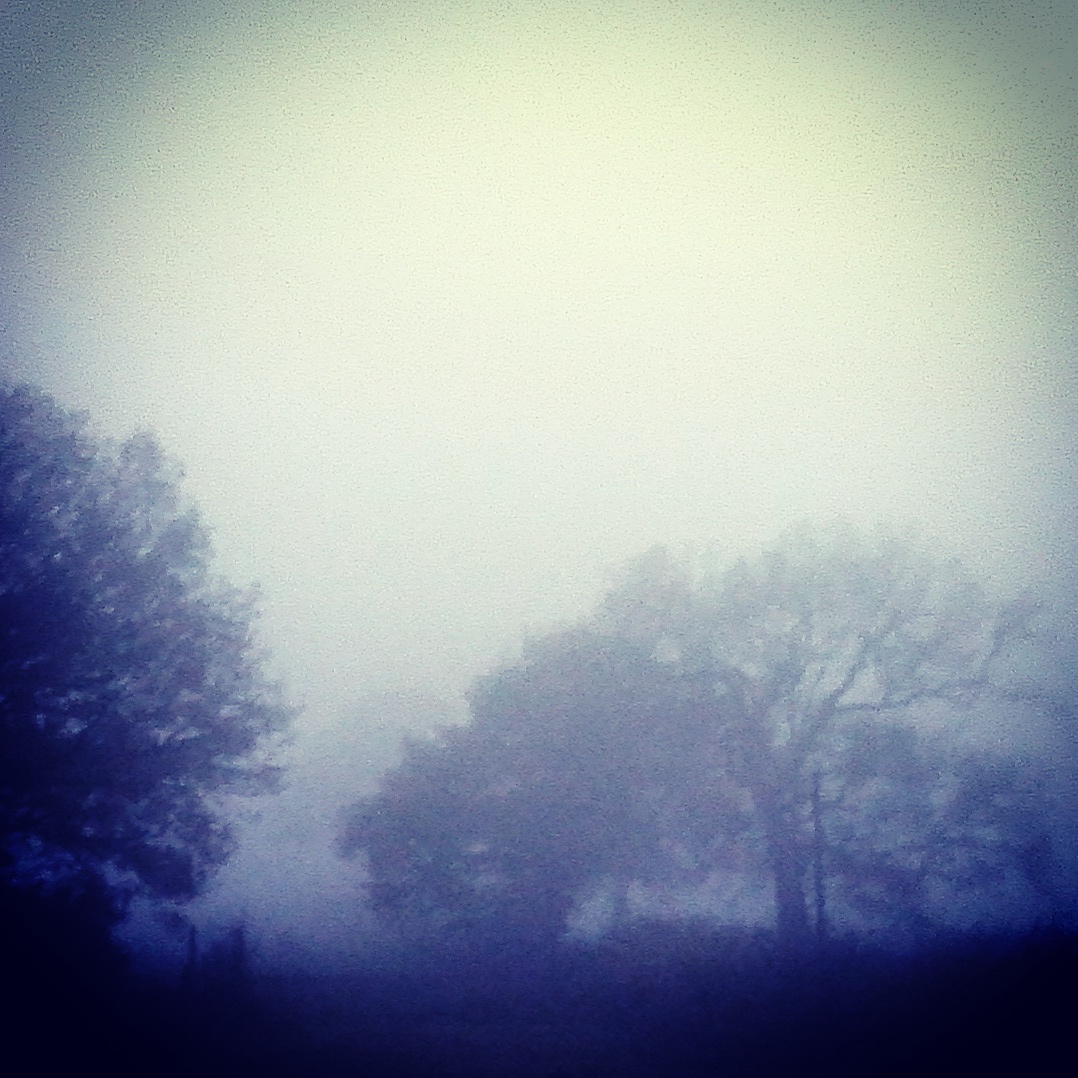
The view from my bedroom window.

The view from my bedroom window.

Samhain is past, and we are well into the Mourning Moon, a time of releasing the old, and accepting our own power. Here in rural South Norfolk, we’ve had soggy and unseasonably mild weather, which has lately meant long days of grey skies and continual downpours. The last of the trees to shed their leaves, the oaks, have begun their brown weeping. The landscape is smudged khaki and brown and yellow, the edges blurred by autumn mists.
A fortnight has passed since my last post, a space during which I have been trying to recover a little of my strength, and some of my thinking capacity. The first week was one of complete surrender. After it, I felt more rested than I had in a whole year, I think.
The second was more tense, punctuated by a day-long dash to Oxford and back, to take the elders to the doctors for important assessment and treatment. Seven hours in a car, split in half by four hours of pushing a wheelchair and repeating myself every ten minutes, was enough to exhaust almost all the good will my body and I had built up between us. Since then I have been lost in a hormonal, anxiety-ridden mist, feeling OUGHTS and SHOULDS mounting up like an impending avalanche over my head. Add to that the impending doom of the Christmas season, and life-changing news from several friends, and I’m not sure I’ve come out of this much recharged.
Let’s just say, this has been a time of reassessment and reflection.
While I have come a long way in my year of ‘DARE’, I’m not sure that I can face another action word year. After ‘REVOLUTIONARY’ (2013) and ‘DARE’ (2014), I’ve attracted way too much change into my life for comfort, and I think I need a rest, thank you, Mrs Universe. I’ve decided that next year, I need a gentler world to ease my way. ‘BALANCE’ or ‘NURTURE’, perhaps. Or even just ‘EASE’. A reminder to be kinder with myself, something that, like most women, I find difficult to allow myself to do.
Tectonic shifts are happening in my creative life too. The relief I felt at giving myself a rest from blogging caused a delicious upsurge in other creative outlets. I immediately went off and made the back door curtain I’d been meaning to sew for the last six years. I’ve been hand-quilting a Christmas stocking for my guide-daughter too, which is enormously satisfying. I hope I manage to get it finished in time. Being able to sew again feels fantastic, although I had a few scary moments trying to remember how to thread my sewing machine!
I’ve decided I need to be using my journaling practise in a much more systematic way, too. I want to try a lot more guided journaling, by which I mean journaling from prompts rather than the simple stream-of-consciousness method I have always used. I’m feeling the need for more deep self-exploration, and I want to use my creativity as an integral part of the work I do with my Gestalt counsellor on a weekly basis to effect this.
I haven’t stopped writing, in the meantime, even though I haven’t been blogging. I’ve got two big fanfics on the go at the moment, great sprawling things that seem to be growing every time I look at them. My head is full of scenes stored up to be written out. That’s not a brilliant way of writing, especially when my head is so blurry. The other day, I sat down to write a scene, only to realise that of the two emotional points I wanted the characters to thrash out, I could only remember one.
A bit not good.
The result was some serious re-evaluation of my notebooking habits, which I still haven’t resolved, but hope to share with you soon.
As well as putting some conscious intention into my reading habits, I’ve been contemplating a new original writing project too. In the wake of the In/Famous Engagement, and the storm that followed it, I came to the conclusion that I needed to get away from fanfiction. And yes, I know I’ve been saying this for ages, but sometimes it takes a big event to push us to make real changes. So much is shifting in my life right now, and I want to move on to something fresh. I don’t think I’m going to be able to give up writing fanfics, nor do I honestly want to, but there is an idea knocking at my door, scratching at the wood like the ghost of Cathy in ‘Wuthering Heights’, and it won’t go away. As I used to say to my school friends:

‘I think I’ve got a story coming on’.

And finally, I’ve got some ideas for non-fiction that I want to have a go at. I think the phrase is ‘watch this space’.
Thank you, dear readers, for sticking with me through this break, and throughout this bumpy year. While I know it is only going to get bumpier for a while, I’m grateful that you are with me, listening to my ramblings. It is good to know I’m not shouting into the unresponsive darkness.
Happy creating,
EF

Inspiration Monday: Silence

pat oxburgh b&w

Husband sitting in the partially ruined church at Oxburgh, Norfolk

I was reading the chapter on silence in Christina Baldwin’s book ‘Life’s Companion: Journal Writing as Spiritual Practise’, and it immediately rang bells for me. I have a particular reason for this. Let me explain:

One of the symptoms of the chronic illness with which I live, ME/CFS, is sensitivity to noise. Some days are better than others, but there are everyday sounds in modern life that can create physical agony for me. And no, I’m not kidding.  I mean, I get actual pain. A cold electric current feeling up and down my spine and a nauseating icy pain in the back of my skull. Unpleasant to say the least.

For the first three years of my illness, I couldn’t listen to any music with a beat at all. Every thud of bass was like a knitting needle jabbed into my neck. No pop radio, no rock, no hand jiving in the car to the Stone Roses or the Pet Shop Boys. No Elvis.  No Beatles.  Nothing.

I couldn’t listen to anything much. Mozart and Bach worked, a little Handel mixed in. Beethoven proved too noisy, as did anything after him, although I did find I could handle some Vaughan Williams. Opera was right out, so goodbye to my favourite tenor, Placido Domingo. I just couldn’t bear to listen to him anymore.

Most of the time, though, any kind of noise was painful.

So for three years I avoided places where the music was piped, and had to ask friends who listened to music perpetually to turn down their stereos, which was mortifying because they just didn’t understand.

I adjusted to a world without music.

I learnt a different way of listening.

I listened to the birds, the ones that make pretty sounds, and the ones that don’t. I learnt I could set my watch by the rooks in the tree opposite the house. (They all get together and start shouting at one another at 3.30pm, no matter what time of year it is.) They’re funny, like one of those noisy markets where everyone is shouting about their wares.  I’m rather fond of rooks now.

I learnt to hear the vegetation around me too, the creaking trees and rustling shrubs, the fresh new spring leaves and the rattle of the dried autumn ones.

And the animals. The scuttle of mice in the undergrowth, the mewling squeaks the rabbits make, the scrabble of the squirrels on the roof tiles. The buzz of the mason bees under the window in the summer, the drone and thump of the hornets throwing themselves against the window, attracted by the light, in autumn.

I came to realise how much noise pollution we endure, day after day, the constant onslaught of a life lived with continual racket, the radio, the TV, the iPod, the piped music, the slot machines, even the roar of conversation echoing in the cavernous, sound-reflecting spaces of shopping malls. And how much we use recorded sound to blot out our minds, to stop us thinking too much.

The Christian mystics said that prayer is talking to God, but it isn’t much use if you don’t listen for when He speaks back. To hear the Divine, we have to be in silence. This is just as important when the voice that speaks inside us is the big, blousy, shriek as when it is the almost inaudible whisper. The practise of creativity demands that we listen. Sometimes, we have to listen hard, and without distractions.

When did you last spend time in silence? Do you make space for a little quiet time daily? Do you relish that moment when the kids are in bed, and you can sit down at the kitchen table with a glass of wine, take a deep breath, and just listen to the noises the house makes around you as it settles for the night? Or do you fill every waking hour with a constant cacophony to drown out the voices inside your head that are telling you the life you are living is not fulfilling you?

Out of the quiet comes not only spiritual fulfilment, spoken of in all religions, but human creativity. Out of silence come the stories we tell, the fantasies and day dreams that grow into novels, plays, paintings, films, concertos and ballets.

When we cultivate stillness, when we listen, we give our brains space to breathe. And yes, sometimes we then have to face up to the uncomfortable truths of our lives. But often, we have the opportunity to tap into wells of creative inspiration previously unknown to us. Our Muse’s voice can be heard.

You don’t have to take a vow of silence to benefit from stillness, and I’m not saying you should give up the joy of music. (I’m back on it now, and believe me, its one of my greatest inspirations.)

Listen to yourself.

What I am suggesting is that you take time daily to be in stillness. To listen to the sounds of the world around you instead of filling the void with canned synthetic noise. To listen to yourself. It may only be ten minutes, or the time you spend in the bathroom every morning, or half an hour before bed without the telly on. You don’t have to meditate, although that is good too. No, this is a different idea, a way of being quiet with ourselves, a way of listening for the inspiration to come. I know you lead a busy life, no doubt, and that quiet in a city is hard to find. But I assure you, it is there. You can find it. And when you do, immerse yourself in its balm, as often as you can, and allow it to feed your creative life.

Happy Creating,

EF

Journal Friday: Returning to the Journal

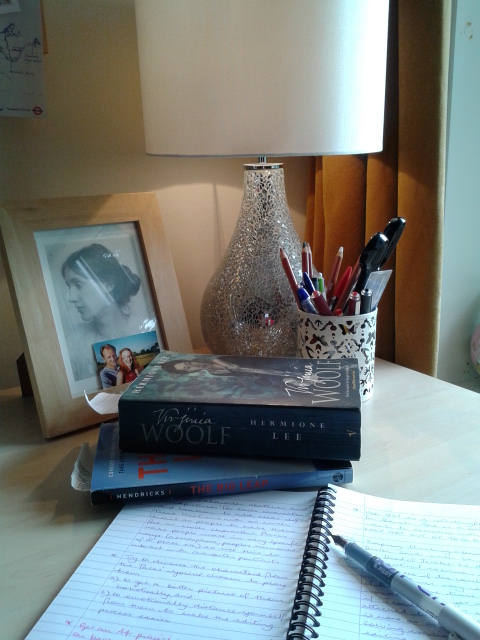
VW desktop

This time of year (autumn) is always a time of new starts for me. Husband is a University lecturer, which establishes a certain kind of seasonality in our house – we live according to the academic year, just as we have since we were kids. And on top of the usual stationery-buying frenzy I get at this time of year, I find myself stopping to reassess where I am too.

In truth, its always good to stop off on the seasonal journey to think about where you are in your life, and where you want to go. Life coaches encourage us to do this on a quarterly basis, and to be quite frank, I think it’s a good wheeze. It is hard enough to find time in a busy life to stop and think, but like the prayer bell in the monastery that reminds the inmates to focus on God at regular intervals, the seasons are an automatic prompt to stop and take stock.

This year has been a time of huge shifts for me, changes in my role as wife, care-taker, aunt, friend and woman. I have felt new currents in my creative life starting up, the drive to take my photography more seriously, the sense of a new mission, a new message in my work. It is a time of change, of departures.

Pagan theology tells us that autumn is the time to reap the harvest of what we have sown during the productive seasons of the year – not only of Spring and Summer, the active months, but also of the deep, dark percolation of the Winter that preceded them, before we go down into the dark once more, into that time of thinking, rest and meditation. We need to think about what we have achieved, assess the fruits of our labours, celebrate them, and prepare to settle into a time of productive hibernation during which we can incubate our hopes and dreams for the future.

Well, hooray for the journal, then!

I have been taking time to settle back into my journal-keeping, and to use it in a more constructed way. I have never really used the technique of guided journaling before, by which I mean writing from prompts designed to explore the psyche.   I’ve always been more of a ‘stream of consciousness problem solver’ kind of diarist. In the midst of upheaval, especially during the summer months, I find it hard, therefore, to keep up such a regular journal commitment, because it often takes time to write and write until you’ve found the answer.

Recently, though, I have decided to be more conscious about what I am doing with my diary. I have set out to explore myself and different aspects of my life in a structured way, in the hope that it will guide me to new paths, and help anchor me through the current storms. I’m using visual means too. Nothing fancy. (I’m still pretty blocked about my drawing.) I’ve been collaging instead. Gala Darling’s ‘Radical Self-Love Bible’ Programme has been invaluable with this, a plethora of prompts and eye-candy to help you explore yourself on paper, through collage and writing. I’m not much good at discipline, of course, and though I am half way through the programme now, my ‘bible’ is pretty lightweight. I tend to fall back on my familiar old notebook on a day to day basis, but Gala’s approach is challenging me just enough to make me think about where I am going with my diary, and that’s enough right now.

Journal Exercise:

This weekend, I am planning to retreat to my journaling practise and do some conscious assessment. I’m going to take time to recognise the enormous changes I have gone through, and the achievements I have made so far this year. I am going to consider my intentions for the coming dark months, and work on an emotional strategy for handling Christmas, which is always a difficult time for me. I mean to use my journal to ground myself in who I am, and who I want to be. And to think about where I am going.

If it proves a productive, positive exercise, I ‘m going to repeat it on a seasonal basis.

Would you like to join me?

Why not take this weekend, or some time during it, to sit down in a quiet place with your journal, and think about where you are in your life, and where you want to go.

  • What have you achieved in the last nine months?
  • What ‘babies’ have you birthed, literal, creative, emotional or otherwise?
  • What are you most proud of?
  • How are you feeling right now, physically and emotionally?
  • How would you like to feel?
  • What small, achievable steps can you take to move towards these intentions?
  • What flashpoints can you identify in the coming three or four months? Can you explore why they affect you? What could you do to ease your path through them?
  • How can you celebrate yourself at this point in your life?
  • What creative voices are calling you right now?

If you find the idea of a more conscious journaling practise interesting, you might like to explore Tristine Rainer’s seminal book, The New Diary.

If you want more guidance about deciding where you want to go in life, take a look at Danielle LaPorte’s The Firestarter Sessions, and The Desire Map.

Kate Courageous’s wonderful website is full of rich wisdom and worth exploring.

Happy Journaling,

EF


Are You Enjoying The Journey?

Are you enjoying the journey?

Are you enjoying the journey?

My niece has just got into drama school. After a long spell when she was not acting, she turned up at the audition feeling rusty and nervous. Afterwards she told me that doing the audition reminded her of just how much she enjoys acting.

She always laughs about how she will buy me a car ‘when she is rich and famous’, and its true, she does want to be famous, but only because it will allow her to get better roles. Her heroines are not the Hollywood starlets who are famous for being pretty (not that she isn’t pretty), but actresses who are famous for excellence – Emma Thompson, Harriet Walter, Fiona Shaw.

This made me think about the chapter in Ann Lammott’s seminal book about writing, ‘Bird by Bird’, in which she talks about those students in her writing classes who are only interested in learning how to get published. Getting published is only a minute fraction of a writer’s life. If you are only interested in that, why go through the long, hard slog of writing a novel in the first place?

You have to like writing. You have to like the process.

There is no point in setting out to be a great painter if you hate getting your hands mucky with paint.

There is no point in applying to drama school because you want to get famous, not because you want to act.

If you do either, you are surely going to spend a great deal of time being very miserable indeed.

When you decide to dedicate yourself to an art form, – or any activity, for that matter – be sure why you are doing it. There are a damn site easier and more reliable ways of getting rich and famous than writing a novel. You’d be much better off buying a lottery ticket or robbing a bank (not that I would condone the latter of course!).

Be creative through a medium that you love, because you love doing it.

Fame and riches may or may not follow, but one thing you can be sure of is that you won’t be miserable while you are waiting for it. You’ll be having a nice life. And lots of fun. Which is really the whole point, isn’t it?

Happy Creating,

EF

Journal Friday: Solitude

Shadow Selfie

Shadow Selfie

I’ve been making huge leaps this week, but one of the results has been a deep gloom opening up inside me.  The exact opposite of the feeling of exhilaration I SHOULD been feeling when I make massive learning gains with my creativity.

(Did you notice the Bingo! word there – give yourself a pat on the back if you picked out the poisonous SHOULD in that sentence!)

Instead of bouncing around like Tigger on a coke spree, I feel like a sodden blanket.

Why?

Because writing is a solitary art.  And human beings are social animals.

Now don’t get me wrong, I’m the first to admit that I need to be on my own a lot.  I like my own company.  But there are also limits.  If I get left on my own for long periods, I get mournful, bad-tempered, sick of myself, sick of everybody else.  I start feeling like I want to stab myself in the forearms with a compass point.  This is obviously not a good place to be.

Husband has been out pretty much every night this week, playing sports and meeting up with business colleagues.  He has commitments that sometimes pan out like this, and I’m fine with that.  But occasionally it means I get a week like this one.   I’ve been on my own from eight in the morning till eleven at night for four days on the trot.  Thats enough time on my own for me to go slightly round the twist, to over-react to everything, and end up in a grumpy hole.  From whence no writing, or anything positive, emerges.

I’ve spent a lot of time struggling to get out of my grumpy hole.  “I ought to be able to get over this, I SHOULD have worked out strategies by now to combat this,”  I told myself.  (There are two Bingo! words in that sentence, can you spot them?.

But then I thought maybe the thing to do was to allow myself to feel the feeling of misery, and then perhaps it would leave.  In other words, not to fight against it, but to be with it, and see where it took me.  Because lets face it, after 44 years of living with depression, I can safely say that a) the odd blue day is a doddle compared with the major depressions I’ve experienced, and b)  I know I get this when I’ve been on my own too much, so maybe I can work out what its trying to tell me.

It turns out that its trying to tell me that I need to get out more.

I get exhausted.  That is part of my ongoing health problems, and I need to take account of that, but I also need to accept that one of the basic needs I have is for a change of scene, and seeing people.  It doesn’t necessarily have to be conscious socialising.  It can be just getting out into town, seeing other human beings in the street in their infinite variety.  Maybe two days a week would be good maintenance treatment for me.  To get out, to see the world, interract with it.  And rest at home the remainer of the time.

(I should probably point out that I live in the middle of nowhere, literally, and I can go days without seeing anybody, which can be very isolating.  We are two miles from the nearest village, not a distance I can walk, so it is not like I can just pop out to the corner shop for a natter and some social contact.  Given that we can only afford one car, and that Husband’s access to work has to take priority, getting about has to be carefully planned.)

I need to take this awareness of my own needs forward.  I’m enjoying my writing so much, but I need to take care of myself too.  And that means going in to work maybe a day or two a week with Husband, settling down at the library or the cafe, and writing there instead of at home.  So that I see people.  So that I have the stimualtion I need.

Journal Exercise:

You may not have the same ‘shut-in’ issues that I have, but I invite you today to examine the ordinary activities and lifestyle factors that help you to be creative in a regular way.  Do you need to drink more water, take regular walks, get a new chair because the one you have gives you back ache, and makes you reticient to sit in it to draw or write?  Does eating dairy give you sinus headaches so that you feel all fuzzy, and you can’t think straight?  Do you need a holiday, a long bath, a place to work where next door’s dog isn’t barking?  Maybe your partner could look after the baby an hour a week so you can have time on your own, or perhaps you need to get up an hour earlier so you can be peaceful with yourself before the rest of the family rises.

Spend some time exploring in your journal the basic things you need to operate at your best: good food, 8 glasses of water a day, cuddles, exercise, Whatever your core requirements are.

Now write about the little things that you could do for yourself that would help you to function above just the basic level of proficiency that you explored above.  Think about the times when you have been really crackling creatively.  What made those times special?  Are there factors you could replicate, to recapture that sense of being in the flow?  What really makes your motor run?  It could be listening to rock music while you work, hanging out at the cafe, carrot cake, more cuddles, or anything else.

A note of caution:  The whole myth about artists having to be self-destructive is exactly that –  a myth.  Try copying F Scott Fitzgerald or Jack Kerouac, and drinking to promote creativity, and I can guarantee what you will end up with is not increased creativity.  You will just end up being dead.

All the actions you take should be self-caring and self-nurturing.

I hope that you can uncover some new ways to nurture your creative flow, or maybe just work out how you sabotage yourself with having too much of one thing, and not enough of another, as I do.  Writing is a solitary act, but you don’t have to be on your own to do it, as I have been reminded this week.

Take care of yourselves, and happy creating,

EF

The White Princess Problem

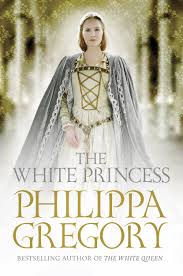
the white princessI’m undergoing quite a lot of shifts in my creative work these days, and as a result, I’ve been reflecting on my reading habits.

Bit not good, as Sherlock would say.

I read woefully little fiction. My bad.

If you want to be writer, you need to read. And read lots. And I do read lots. Its just that most of what I read could be loosely classed as ‘self help’ and history. Let me explain:

A little while back, everyone was raving about Philippa Gregory’s Cousins War novels, which tells the stories of the women involved in the Wars of the Roses, during the late Medieval period. I’d read Gregory’s ‘The Other Boleyn Girl’ when it first came out, because I’d read something similar by Jean Plaidy as a girl, and liked it well enough. I tried the first book in the series, The White Queen, but couldn’t get on with it. So, on the basis (again) that I had read something similar by Jean Plaidy, I decided when The White Princess came out, with its plot about Elizabeth of York, mother of Henry VIII and wife of Henry VII, that it was for me. I bought the book and settled down for a good read.

What a miserable book.

I have clawed my way wretchedly through it. I’ve only got a few chapters left, but every time I pick it up, I am seized with a bout of miserable gloom and depression that can go on for days. I just can’t stand it. I’m determined to finish the beastly thing, just on the basis that I refuse to let it beat me, but dammit if it isn’t the most spirit-crushing book I have ever read. And I’ve read ‘Middlemarch’! Now everyone is telling me that I must read Hilary Mantel’s ‘Wolf Hall’, and I just know that’s going to have the same effect on me.

Is it any wonder that I return repeatedly to Terry Pratchett’s Discworld books?

I want a book to entertain me, and leave me panting for more. I want to be riveted by every turn of the page. Its not that I don’t want conflict. I love conflict. Conflict is what makes a plot irresistible. Without it, fiction is just a mushy mess.

But why does every book that gains acclaim have to be so bloody depressing?

Is it so much to ask for something to be a bit witty? Is it so hard to make a book hopeful in some way?

Maybe it is that I read mostly first thing in the morning, to help me wake up and while I wait for the day’s medication to kick in, and last thing at night before I sleep. What you read first thing can set the tone for your day, which is why I try to choose something uplifting. And late at night, you want to read something that will help you sleep, not leave you lying awake worrying about death and betrayal and being hung, drawn and quartered.

I have a heap of novels that friends have lent me. They seem to be mostly about the Second World War and the Holocaust, which doesn’t bode well. I tried reading Kate Mosse’s ‘Labyrinth’, but it felt too cheesy, and worryingly like Dan Brown’s ‘Da Vinci Code’, which is the only book I’ve ever actually physically thrown at the wall in disgust because it was so badly written. (How that man has the gall to teach creative writing beats me!) I love historical fiction, but I want to read good work that is recently published. And I’m fine reading contemporary set books. Why is it so hard to find something that isn’t going to make me want to slash my wrists?

Maybe I’ll just see if I can get the latest Alice Hoffman from the library. I used to read her. She was good. But if you have any recommendations that fit the ‘positive’ bill, please leave a comment below. I’d love to hear about your favourites.

In desperation,

EF

UPDATE: went to the library and found Andrew Miller’s ‘Pure’. First few chapters are beautifully written, even if it’s a dark story. I’ll let you know if I’m inclined to slash my wrists at any point.

Finding the Right Place to Write

Roald Dahl in his writing hut.  From the CBBC website.

Roald Dahl in his writing hut. From the CBBC website.

As regular readers will know, me and my study have a kinda love-hate relationship. In recent months, I’ve been trying to do it up a bit, make it a nice place for me to work, somewhere that reflects who I am and what I want. Somewhere I want to inhabit. Because I really do think that it is important to have ‘A Room of One’s Own’.

The problem is that it doesn’t seem to work for me in practise.

I do most of my writing sitting in my comfy armchair in the living room, with my laptop in my lap (strangely enough!), or writing in notebooks resting on a brilliant drawingboard that I bought from The Art Trading Company. And seriously peeps, this drawingboard is brilliant, and I’m going to get another one for my bedroom so I can be comfortable when I write in bed, because I also write there a lot, especially in my journal.

Now, it has lately occurred to me that this habit was set in stone when I was just a little kid. When I was small, I had a tiny bedroom only just big enough for a not-quite-full-size single bed, and certainly not large enough to include something as luxurious as a table. As I got older, and siblings moved out, I moved into their (larger) bedrooms, but there was never really enough room for a table or desk.

Aha! But I had my trusty piece of board!

Yes, I said ‘board’. It was a thin bit of old chip board, about A3 size, and I used it for hours, sitting on my bed, for drawing and writing, as a working surface for sewing and painting and plasticine and homework, as a play area, and for all kinds of other activities. That board was a miracle. I could have it on my lap when I was snuggled up amidst the sheets, and it kept the ink from getting on the cotton as well as giving me a firm surface to work on. I loved it, and I was never without it until I left home. After that, I think my mother threw it away. But who knows, it might still be in her house, under the spare bed, along with my ‘A’ level art portfolio!

The other day, I was thinking about my lovely old piece of board as I sat in my armchair with my lovely new drawingboard on my lap, and I remembered seeing photographs of Roald Dahl’s writing hut, where he sat in an old armchair with a board on his lap, and wrote the great classic of my childhood, Charlie and the Chocolate Factory. (My husband actually knew the Dahl family and played in that hut at one time, the lucky hound!)

Nicole Kidson as Virginia Woolf inthe film 'The Hours'.

Nicole Kidson as Virginia Woolf inthe film ‘The Hours’.

Then I remembered a scene from the film, ‘The Hours’, in which my heroine, Virginia Woolf, played by Nicole Kidman, sits in an armchair by the window at Hogarth House, with a baize-covered board on her lap, and scratches out the first few lines of ‘Mrs Dalloway’ with her new pen nib. Woolf was actually more inclined to write at a high table, standing up, but the image is potent for me.

It is very nice to have a desk and a study, and sometimes, that is exactly what I need. But I am also fortunate in that I spend a great deal of time having the run of the house to myself, which means that I can write pretty much anywhere I have a suitable work surface, enough light, and where I can get comfortable. I’m not ungrateful to finally have the luxury of my own study, believe me, but having it as made me realise that really, it wasn’t necessary. I was always saying I couldn’t be a proper writer until I had a study of my own, but that just wasn’t true. I have written far more words in my armchair or my bed.

The lesson I have come upon, and the one I wish to communicate to you, Dear Reader, is that actually, once you find the place that suits you, you can write anywhere. You don’t need a study. And if you have one, as I am lucky enough to, you may not end up using it. Don’t beat yourself up about not doing so. Take Woolf’s exhortation to find ‘A Room of One’s Own’ as a wider license to find space of your own. The local Costa Coffee may be your perfect place to write. Or, as for my husband, the comfy chair by the roaring fire of your favourite pub may be just the place. Or you may indeed have your own study and revel in it. The important thing is to get comfortable and have a firm surface to write or type on, so that you are not distracted. It doesn’t matter if its in a caravan or a lorry cab, so long as your imagination can take flight. Because once it flies away to your story world, it doesn’t matter where you are.

Happy Creating,

EF

Books about Writing


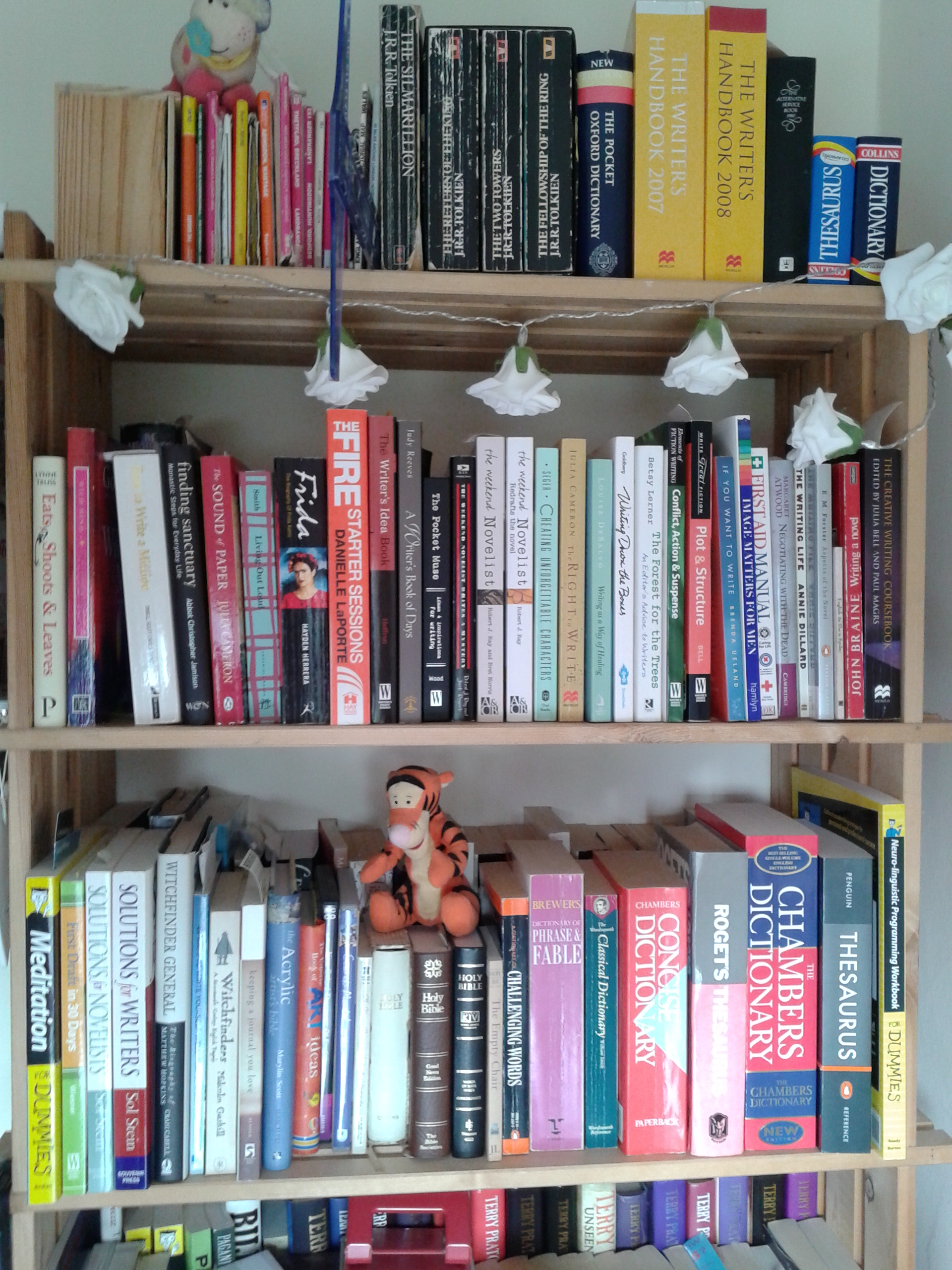
Bookshelf

My shelves of books about writing.

I’ve made a big decision.

No, not that one.

I’ve decided not to buy any more books about how to write for two months.

Now you may not think that’s such a hard task, but I am the sort of person who likes to buy a book about a subject in lieu of actually doing it. I’m a big one for research. If I’m going to take up some activity, say, crochet for instance, then I am the one who will chug down to the library and take out all known books on crochet, in order to find out everything I need to know about the subject. For two days I read avidly and become an armchair expert, without even touching a ball of wool. And then I lose interest and the books gather dust on the coffee table until they have to be taken back to the library before I get fined, no crochet having ever been done.

I’m the same with books about writing.

Once every three or four months, or so, I resolve ‘to take my work more seriously’. This usually involves going in to work with my husband, who is a University lecturer, and settling down in the campus library to tap away on laptop undisturbed. (Never mind the fact that I really struggle to visualise and write in that library, but there you are!)

To get to the library, I have to walk past a bookshop.

(If you love books, you just know where this is going to end, don’t you?)

Add to this the fact that this University runs one of the first, and still best, courses in Creative Writing in the world, whose alumni include the likes of Dame Hilary Mantel, Kazuo Ishiguro and Ian McEwan. You can imagine how good the bookshop’s section of writing is.

Let me tell you, it is hell to walk past.

This is the reason why the bookshelf beside my desk is so crammed with ‘How to Write’ books. I buy a book every time I decide to ‘get serious’, because of course, buying a book is a prerequisite of ‘getting serious’. I’ll read a few chapters. And then I get bored/move on/get ill/realise its shortcomings/decide I want to take up crochet instead etc. So now I have a bookshelf full of books about writing and how to write, many of which are very, very good, dozens of which come highly recommended by friends and in other books about writing, and almost none of which I have ever read cover to cover.

Just call me a butterfly.

Today is another of those ‘I’m going to get serious’ days. Today I am not going to buy a book.

This is partly because I am completely broke, and saving up for a new pair of spectacles because the ones I have got are close to useless and I’m fed up of having to take my glasses off in order to read.

But mostly because its because I need not to read about writing and how to write, but to actually DO it.

You can’t be a writer unless you actually write. And when you write, you learn far more about writing than you ever could from a book.

Books about writing are great. Don’t get me wrong. I’ve got a lot out of them. But there comes a time when you have to leave them alone and learn by doing.

I’ll let you know whether I stick to my guns or not, though I have to say I don’t think my groaning bookcase can survive even one more purchase!

Happy Creating,

EF